Chiang Mai sits in a tropical-savanna climate with three distinct seasons: cool and dry from November to February, hot and increasingly hazy from March to May, and a wet southwest monsoon from June to October. The Mar–Apr burning season brings the worst air pollution of any major Thai city, with AQI often above 200. Knowing the calendar shapes every visit decision, from packing to trail choice.
Updated
Chiang Mai sits at 18.8° north and 310 m above sea level, in a flat basin ringed by forested mountains. That basin geography is the single most important fact about the local weather: it traps cool air on winter mornings, holds heat in April and concentrates smoke during the burning season. Anything you read about the city’s climate ultimately comes back to that bowl in the hills.
The official Köppen classification is Aw, tropical savanna, with a pronounced dry season from November to April and a wet season driven by the southwest monsoon from May to October. Average annual rainfall is around 1,170 mm, more than two-thirds of which falls between June and September. Sunshine is generous outside the monsoon, though the dry months from late February onwards bring their own problem: agricultural smoke.
The three seasons
Locals and tourism guides both divide the year into three. The cool season runs from early November to late February, with crisp mornings, low humidity, daytime highs in the high twenties and the year’s clearest skies. This is high season, and rightly so. The hot season runs from March to May, with daytime highs climbing through the thirties and night-time temperatures that no longer give the city a chance to cool off. The rainy season runs from June to October, dominated by the southwest monsoon and characterised by short afternoon thunderstorms rather than persistent grey drizzle.
Overlaid on the hot season is what Chiang Mai residents simply call the burning season, an annual air-quality crisis from late February through April. It is not a separate climatic season in any meteorological sense, but for anyone planning a visit it functions as one. The burning is so disruptive that many long-term expatriates leave the city entirely for two months each year.
Month-by-month
The data below uses long-run norms from the Thai Meteorological Department’s Chiang Mai station. Real years vary, but the shape of the calendar is consistent.
| Month | High °C | Low °C | Rain mm | Notes |
|---|---|---|---|---|
| January | 29 | 14 | 7 | Coolest, clearest, lowest AQI |
| February | 32 | 15 | 5 | Warming fast, haze begins late |
| March | 35 | 19 | 14 | Hot, smoky, avoid if sensitive |
| April | 36 | 22 | 50 | Hottest, worst air, Songkran |
| May | 34 | 23 | 158 | Pre-monsoon storms, air clears |
| June | 32 | 23 | 130 | Monsoon established |
| July | 31 | 23 | 160 | Reliable afternoon storms |
| August | 31 | 23 | 220 | Wettest, lush landscapes |
| September | 31 | 23 | 230 | Wettest, river levels peak |
| October | 31 | 22 | 120 | Monsoon withdraws late month |
| November | 30 | 19 | 50 | Cool season starts, Yi Peng |
| December | 28 | 15 | 14 | Clear, cool, festival season |
January
The most pleasant month. Highs of around 29°C, nights down to 14°C, almost no rain, brilliant blue skies and the lowest AQI of the year. Bougainvillea and frangipani are out across the city. Festivals include the Chiang Mai Flower Festival in the first weekend of February but preparations begin in late January. Recommended without reservation.
February
Still excellent in the first half, with cool nights and warm dry days. The second half is where seasoned residents start to watch the AQI charts: agricultural burning in Myanmar and Laos begins, and the first hazy mornings appear. Highs reach 32°C. Recommended for early February, cautious for the back end of the month.
March
The first really difficult month. Daytime highs of 35°C combine with intensifying smoke, and by mid-March the AQI is routinely above 150. The mountains around the city disappear into white haze. Recommended only for travellers with no respiratory sensitivity, and only with masks and a hotel that offers air purifiers.
April
The hottest and dirtiest month. Highs of 36°C, lows that do not drop below 22°C, and AQI readings that can hit 300 and beyond. Songkran, the Thai New Year water festival (13–15 April), is the saving grace and a genuine cultural high point, but the surrounding weeks are gruelling. Not recommended unless you are travelling for Songkran specifically.
May
A transitional month and an underrated one. The first pre-monsoon storms arrive, washing the smoke out of the basin and dropping temperatures by several degrees inside a week. By the third week, skies are blue again and the surrounding hills turn green almost overnight. Highs of 34°C still feel hot, but the relief from the haze is dramatic. Recommended for late May.
June
Monsoon properly established. Rainfall averages 130 mm spread across the month, but almost all of it falls in two- to three-hour afternoon storms. Mornings are typically sunny. Highs of 32°C, lows of 23°C. Tourist numbers drop sharply, prices fall and the countryside is at its photogenic best. Recommended for travellers who do not mind a damp afternoon.
July
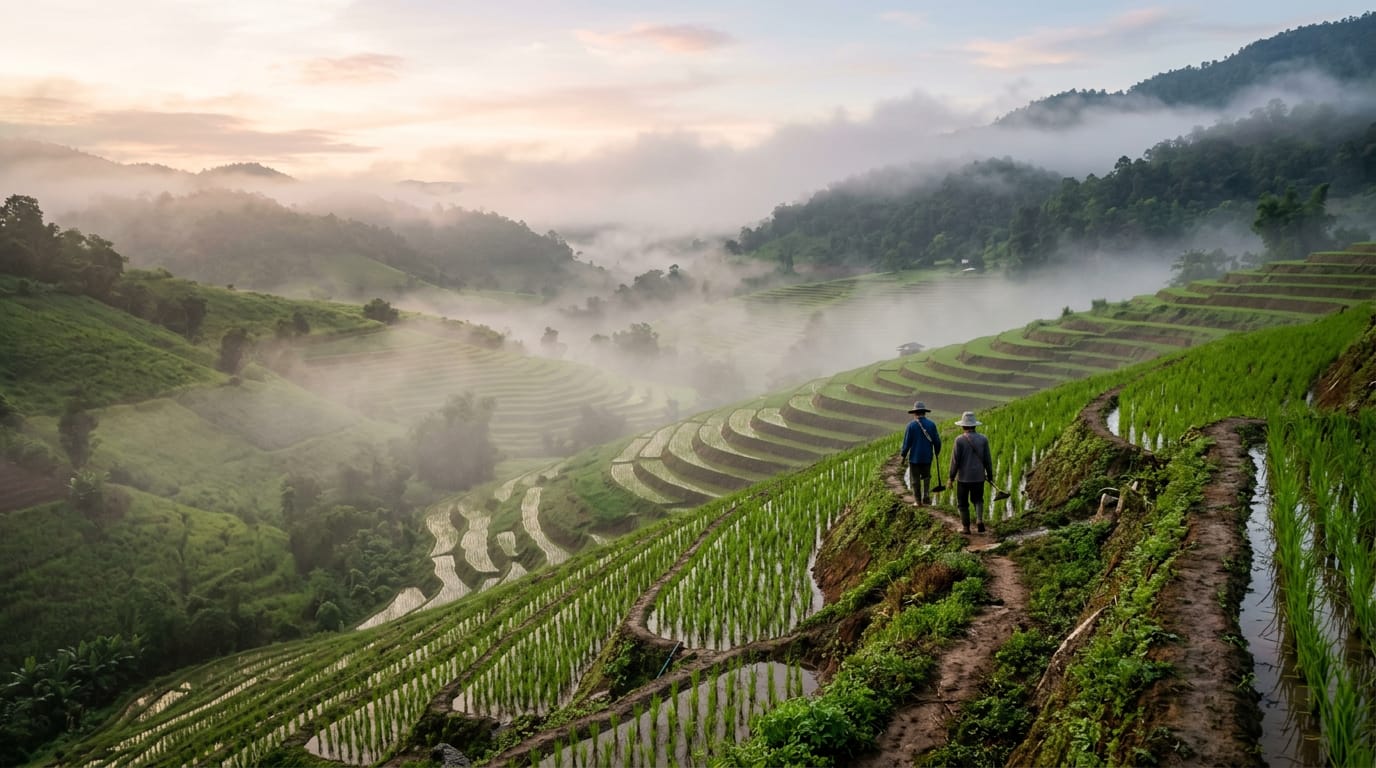
Similar to June, slightly wetter. Storms are more predictable and tend to build between three and five in the afternoon. Rice planting fills the valleys with fluorescent green. Recommended for hikers willing to start early and accept a soaking now and then.
August
The first of the two wettest months, with rainfall above 220 mm. Doi Suthep and the surrounding hills are often capped with cloud all day. River levels rise. Bua Tong sticky-falls and the waterfalls of Mae Sa Valley are at full flow. Recommended for waterfall and forest photography, less so for distance hiking.
September
Statistically the wettest month, with 230 mm of rain on average, and the highest risk of multi-day storms tied to passing tropical depressions. The Ping river occasionally floods sections of the old town. Recommended only for travellers with flexible plans.
October
The monsoon begins to withdraw, usually in the third or fourth week. The first half can still be very wet, but by late October mornings are clearer, evenings begin to cool and the worst of the rains is over. Recommended for the last week, with the caveat that the timing of the monsoon withdrawal varies by a fortnight in either direction.
November
The start of the cool season and one of the strongest months. Lows of 19°C, highs of 30°C, low humidity and reliably clear skies. Yi Peng, the northern lantern festival, and Loy Krathong, the night of floated offerings, fall in November (timing depends on the lunar calendar). Highly recommended.
December
The other peak month, alongside January. Cooler than November, with lows of 15°C in the city and well below freezing on the summit of Doi Inthanon. Highs of 28°C, almost no rain, exceptional visibility. Highly recommended, but book early because every Chiang Mai resident in Bangkok comes home for the New Year holidays.
The burning season
Every year between mid-February and late April, smoke fills the Chiang Mai basin. The fires are agricultural: farmers across northern Thailand, Myanmar’s Shan State and northern Laos burn crop residues, mainly rice and maize stubble, and the hill forests are also burnt to clear undergrowth for mushroom and bamboo-shoot harvesting. The Chiang Mai basin’s shape concentrates the smoke. Cool nights produce temperature inversions that trap pollutants close to the ground, and there is rarely enough wind in March to clear the air.
The result is consistently the worst air quality of any major Thai city. PM2.5 24-hour averages routinely exceed 100 µg/m³ during the peak weeks, four times the World Health Organization’s interim target. AQI readings of 150 to 250 are the daily norm in late March and early April, and individual hours can spike above 400. The smell of smoke is constant, the mountains vanish, and on the worst days the sun is the colour of weak tea by midday.
This is dangerous for several groups: anyone with asthma, COPD or other respiratory disease; pregnant women; children under five; adults over sixty; and anyone with cardiovascular disease. For those people, late February through April is genuinely not a safe time to visit. If you must travel during this window, bring properly fitted N95 or KN95 masks, choose a hotel that uses HEPA air purifiers in rooms, plan indoor activities, and check the IQAir or AirVisual app daily before going outside. Avoid hiking, cycling and outdoor sport entirely.
The government issues episodic burning bans, schools occasionally close, and the Department of National Parks restricts access to Doi Suthep and Doi Inthanon on the worst days, but enforcement is patchy and the underlying agricultural economics have not changed. Improvement, if it comes, will be measured in decades.
Rainfall and the monsoon
The southwest monsoon arrives in Chiang Mai later than in southern Thailand because the city sits in the rain shadow of the Bilauktaung and Daen Lao ranges. The wet season typically opens with thunderstorms in mid-May and is fully established by the middle of June. From then until early October the city averages between five and eight rainy days per week, but rain is not constant. The classic monsoon day in Chiang Mai begins with a clear bright morning, builds with cumulus through the early afternoon, breaks into a heavy thunderstorm between three and six in the evening and clears by sundown. Streets flood briefly, drains overwhelm, traffic snarls, and an hour later the air is cool and rinsed.
The wettest months are August and September, when passing tropical depressions can produce multi-day rain events and the Ping river runs high. October is a transition: the first half is still wet, the second half begins to dry, and by the end of the month the cool season is on the doorstep.
Best time for specific activities
| Activity | Best months | Avoid |
|---|---|---|
| Long-distance hiking | Nov–Feb | Mar–Apr (smoke), Aug–Sep (mud) |
| Temple photography | Nov–Feb | Mar–Apr (haze) |
| Yi Peng lantern festival | Nov (varies) | — |
| Songkran water festival | 13–15 Apr | — |
| Cycling | Nov–Jan | Apr (heat), Aug–Sep (storms) |
| Waterfall photography | Aug–Oct | Mar–Apr (low flow) |
| Birdwatching for migrants | Nov–Feb | Mar–May |
| Doi Inthanon summit | Dec–Jan | Jun–Sep (cloud) |
| Rice-paddy photography | Jul–Sep | — |
Hikers should target the cool season for the high-elevation routes on Doi Inthanon and Doi Suthep, when air is clean, trails are dry and the views actually exist. Temple photography is at its best in the same window, with low humidity producing the sharpest mid-distance light of the year. Cyclists and runners should avoid April entirely. Waterfall enthusiasts will get more out of August and September than any other months.
What to pack by season
Cool season (Nov–Feb). A light fleece or merino layer for evenings, particularly if you plan a Doi Inthanon dawn or an overnight in the hills. T-shirts and shorts during the day. A thin rain shell for the very occasional pre-monsoon shower. Sun cream and a brimmed hat for daytime.
Hot season (Mar–May). Light cotton or linen clothing, a wide-brimmed hat and aggressive sun protection. N95 or KN95 masks if travelling in March or April. Reusable water bottle and electrolyte sachets for outdoor activity. Avoid synthetic fabrics that trap heat.
Rainy season (Jun–Oct). A genuine waterproof shell rather than a flimsy poncho. Quick-drying trousers and shorts. Sandals you do not mind getting wet. A waterproof phone pouch. Insect repellent containing DEET or picaridin, particularly for evenings in the hills. A compact umbrella for short walks between buildings during storms.
Frequently asked questions
What is the best month to visit Chiang Mai?
December and January are the strongest months overall. Daytime highs sit near 28–29°C, humidity is low, air quality is at its annual best, and the cultural calendar is busy with flower festivals and night-market season. Late November is a close second if Yi Peng falls in your window.
Is the burning season really that bad?
Yes, and it is the single biggest reason to avoid Chiang Mai between mid-February and late April. Daily AQI readings routinely exceed 200 and can spike above 400, putting the city among the most polluted places on earth during those weeks. Visibility drops, mountains disappear into haze and outdoor activity becomes a health hazard for sensitive groups.
When does the rainy season start in Chiang Mai?
The first proper monsoon downpours usually arrive in the second or third week of May, with the season fully established by mid-June. Rain continues through October, peaking in August and September. Mornings are often dry and bright, with storms building in mid-afternoon.
How hot does Chiang Mai get?
April is the hottest month, with daily highs of 35–38°C and night-time lows that rarely fall below 22°C. A heatwave can push temperatures past 40°C. Combined with smoke haze, April is the most physically punishing month of the year.
Does it ever get cold in Chiang Mai?
In the city, December and January nights drop to 13–16°C, which feels genuinely cold in homes built for the tropics. On Doi Inthanon and Doi Pui above 2,000 m, ground frost is common in early January, and the summit has recorded temperatures near 0°C.
Is December a good time for Chiang Mai?
December is excellent. Skies are clear, humidity is low, the air is the cleanest it gets all year and the city is full of seasonal events. Bring a light jacket for evenings and an extra layer if you head up Doi Inthanon, where dawn temperatures can be near freezing.
When is the AQI worst in Chiang Mai?
Mid-March to mid-April is the peak burning window. AQI in the city centre regularly sits between 150 and 300 during these weeks, and 24-hour PM2.5 averages above 100 µg/m³ are normal. The worst days line up with windless mornings in the Ping valley basin.
When do trails close due to air quality?
Doi Suthep–Pui and Doi Inthanon national parks issue temporary access restrictions when burning intensifies, typically in March. Closures are not announced in advance and may last anywhere from a single day to several weeks. Check the Department of National Parks site before you travel.
Can I see Doi Inthanon's summit in the rainy season?
You can reach the summit year-round, but from June to September the road is often cloud-bound, the view points are white-out and the nature trail is slippery. Skies are clearest from mid-November to early February, which is also the best window for the kingdom-record cold mornings.
Will the rains ruin a July or August trip?
Not usually. The southwest monsoon brings short, intense afternoon storms rather than all-day rain, and the landscape is at its greenest. Waterfalls are at full flow, the rice paddies are emerald, prices are lower and crowds thinner. Plan outdoor activity for mornings.