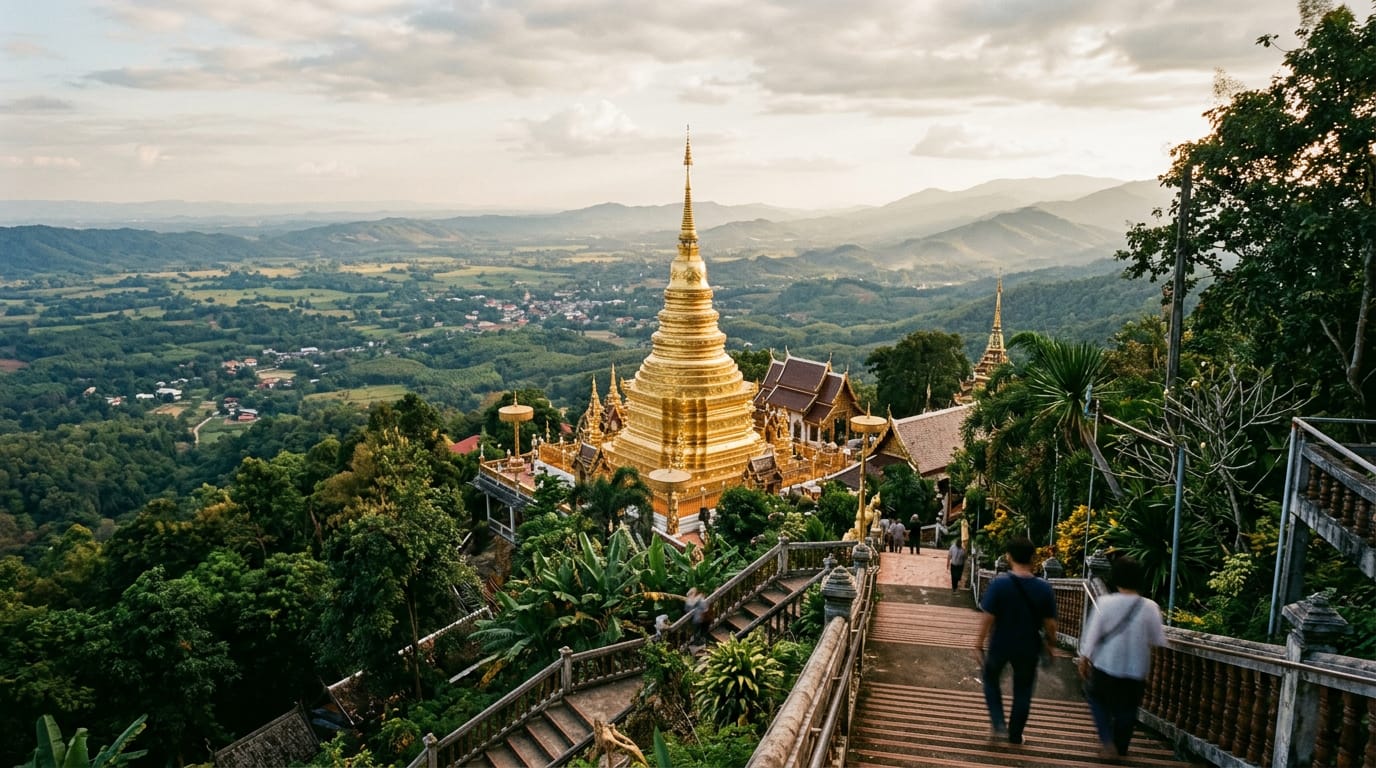
Wat Doi Saket is a hilltop wat in the town of the same name, 17 km north-east of Chiang Mai. Founded in the 14th century, it sits at the top of a long naga staircase and looks out over the Doi Saket valley and its lake. Off the tourist coach trail and frequently empty, it is also the staging site for the largest commercial mass lantern release of Yi Peng each November.
Updated
Wat Doi Saket is the hilltop wat of the small town of the same name, 17 km north-east of Chiang Mai on the road that runs east to Chiang Rai. Founded in the fourteenth century and expanded continuously since, it sits at the top of a long naga staircase and looks out over a valley with a lake at its centre. For most of the year the compound is almost empty: a few local worshippers, a couple of motorbike-borne photographers, no coach groups. For two or three evenings during the November Yi Peng festival, the same compound stages one of the largest commercial mass sky-lantern releases in the world. The two faces of the temple, quiet hilltop wat and Instagram-driven festival venue, belong to the same place.
History and significance
The temple chronicle gives the foundation date as the mid-fourteenth century, during the early Mangrai-period expansion of Lanna religious foundations across the countryside surrounding the new royal capital at Chiang Mai. The exact year is uncertain (local tradition gives 1351) but the compound was certainly active by the late 14th century and is recorded in 15th-century palm-leaf inscriptions held at Chiang Mai University as a regional centre for forest-monk training. The hilltop site was probably chosen for the standard combination of reasons: defensible, visually commanding, geomantically auspicious, and far enough from the river plain to keep monks away from the temptations of settled life.
The temple takes its name from the town, which takes its name from the hill (doi = mountain, saket = small fragment or scattering; the phrase means roughly ‘mountain of the small fragment’). The ‘small fragment’ refers to a Buddha relic said to have been brought here by a wandering monk in the 14th century and enshrined in the first chedi on the summit. The relic and the original chedi were lost or buried during the long Burmese occupations of the 16th to 18th centuries, when the surrounding countryside was repeatedly raided and the temple was effectively abandoned. The current principal chedi was rebuilt in the late 18th century, on the old foundations, by a senior monk from Chiang Mai sent out to re-establish the compound under King Kawila’s general restoration programme.
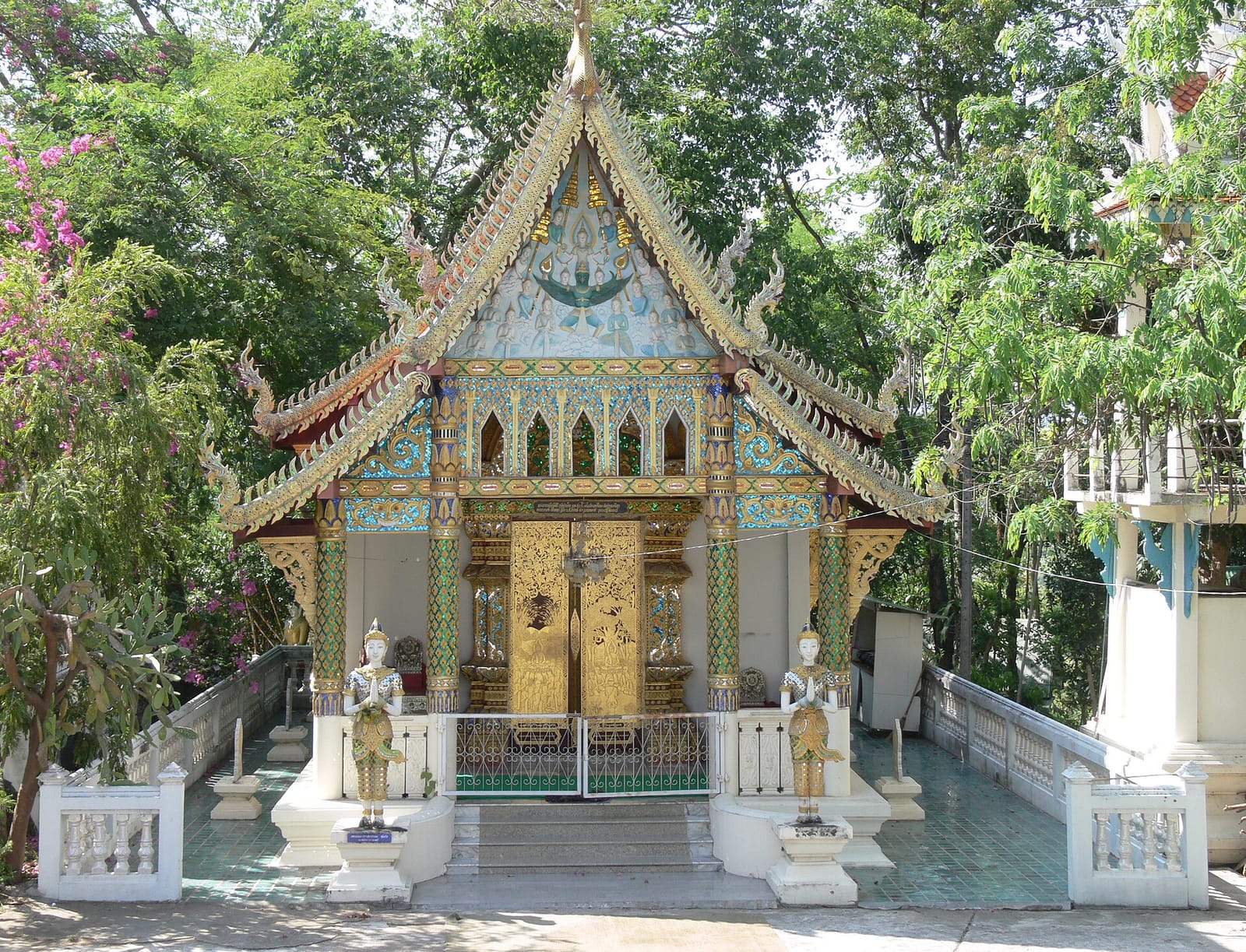
The temple’s modern form took shape during a major reconstruction in the 1960s. The long naga staircase that runs up the hill, 309 steps with continuous naga balustrades, was built then. The main viharn at the top, with its three-tiered Lanna roof, was rebuilt at the same time. The smaller subsidiary shrines and the bell tower along the climb are also 1960s work. The compound has been continuously expanded since: a new ordination hall in 1989, a Buddhist meditation centre on the lower slope in 2002, paved access roads in 2008. The temple is therefore an unusually clean example of a hilltop wat that has evolved continuously across seven centuries without being either preserved as a heritage site or abandoned.
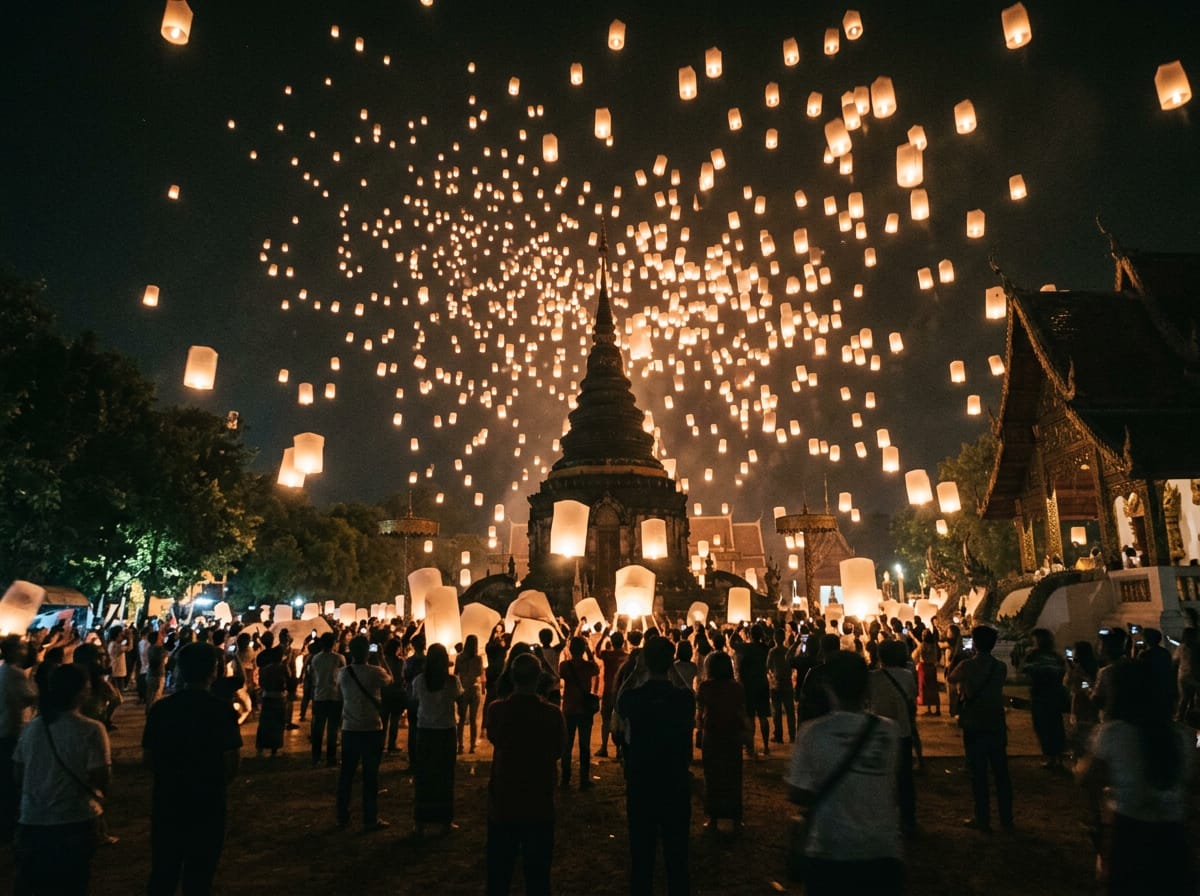
The Yi Peng connection is recent. Yi Peng itself (the Lanna festival of lights on the full moon of the second lunar month, usually November) is centuries old, and small khom loi paper sky-lantern releases have been part of it across the region throughout that time. The mass commercial release at Wat Doi Saket is a 21st-century development organised by Chiang Mai Air Design (CAD), which began staging the event at the temple grounds in 2014 with a few hundred participants and now hosts several thousand paying attendees per evening across two or three festival nights. Tickets range from 4,000 to 15,000 baht per person. It is the source of nearly all the famous photographs of mass sky-lantern releases that define Yi Peng for foreign visitors. The relationship with the temple’s religious practice is locally debated, but the compound remains a fully functioning monastery the rest of the year.
What to see
A full visit covers four areas. The route is dictated by the staircase: climb first, walk the terrace second, enter the halls third, take in the valley view fourth.
The naga staircase
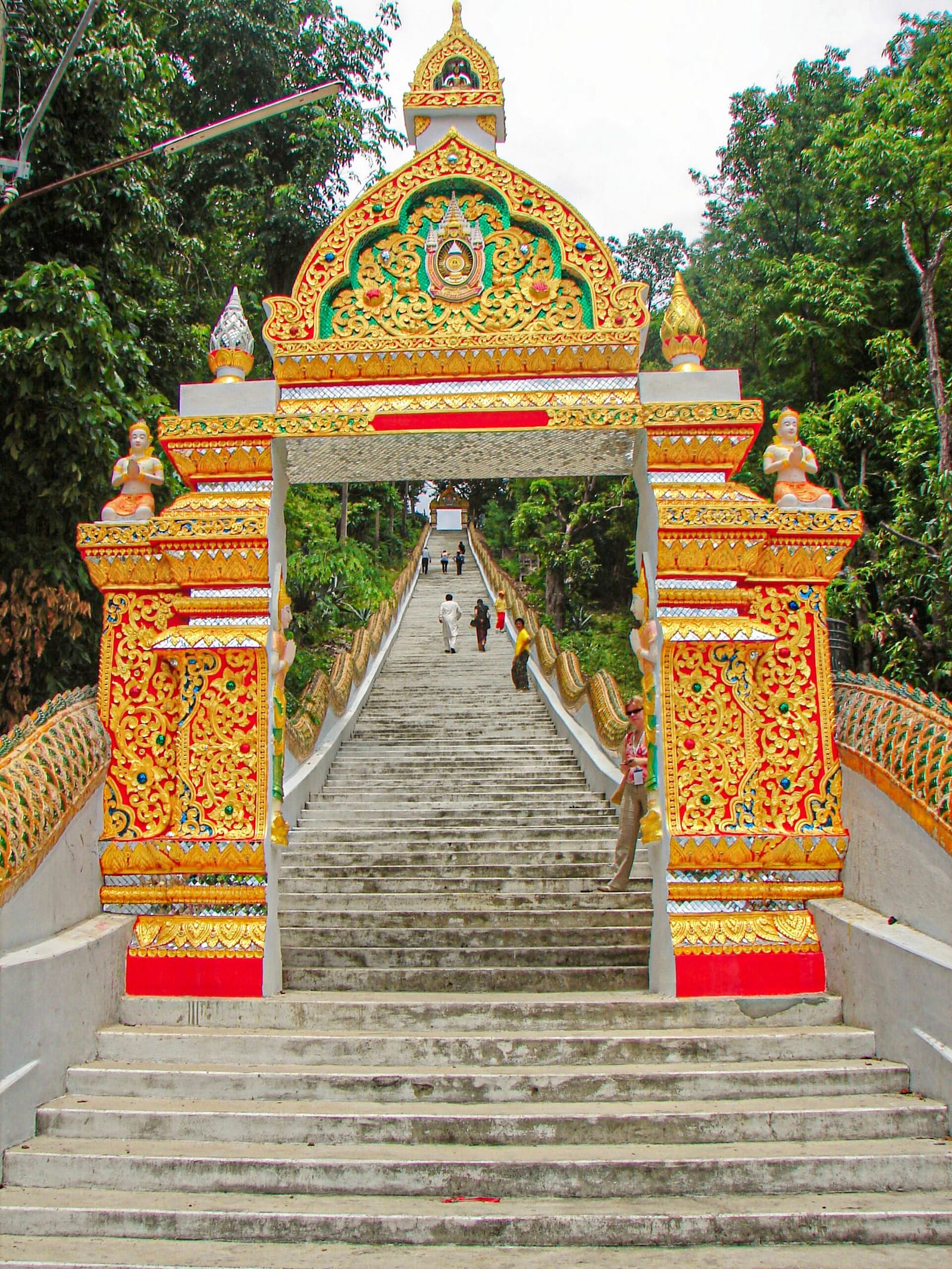
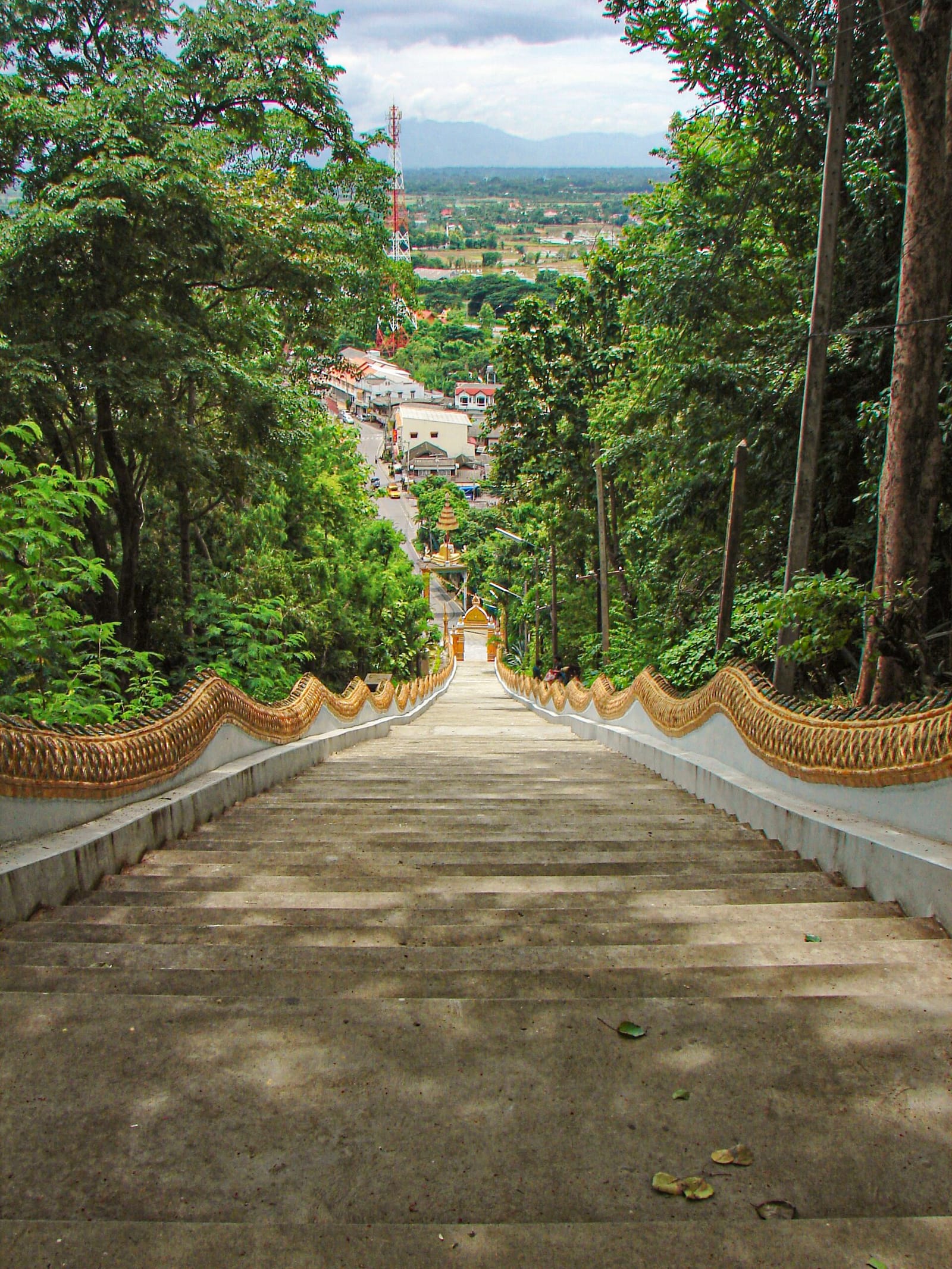
The 309-step staircase that climbs the south face of the hill is one of the longest temple staircases in northern Thailand. Continuous naga balustrades (five-headed serpents whose bodies form the handrails the entire length of the climb) run from the bottom landing to the top gate. The naga are painted in green and gold, with mirror-glass scales catching the light, and their open mouths at the bottom landing form a ceremonial entrance.
The climb takes 8 to 12 minutes at a steady pace. Several small landings with stone benches break the climb. Subsidiary shrines along the way (a small bell tower at the third landing, a bodhi tree on the fifth) give reasons to pause. The staircase faces south-west, so afternoon light from about 15:30 onwards catches the naga scales at their best. A paved zigzag road runs up the back of the hill for visitors who prefer not to climb; most local Thai drive up, most foreign visitors take the steps.
For photographs of the staircase itself, shoot from the bottom landing with a longer lens to compress the climb, or from the first landing looking back down through the naga mouths to the plain beyond. The mirror-glass scales burn out under direct flash; natural side light keeps the colour.
The principal chedi
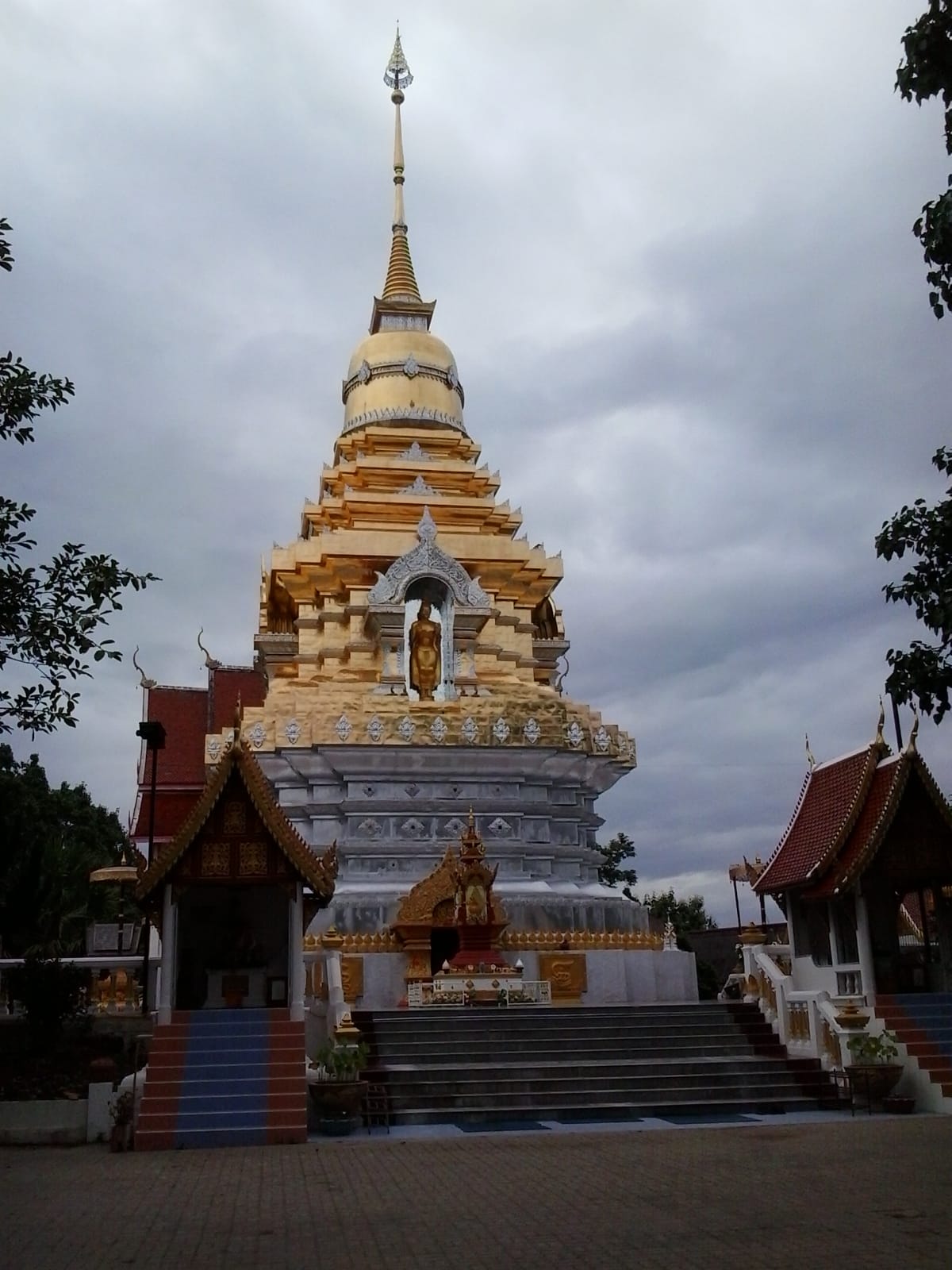
The chedi at the centre of the upper terrace is a tall bell-shaped Lanna stupa, finished in gilded copper plates re-applied in the 2014 restoration that preceded the first CAD lantern event. The form is conventional (bell on octagonal base, four small subsidiary chedis at the cardinal directions, a long pointed spire) but the visual effect at the top of the hill, with the gold catching the sun against the blue sky and the green valley behind, is striking. Walk a slow clockwise circuit around the base. The view changes substantially as you move around it.
The main viharn
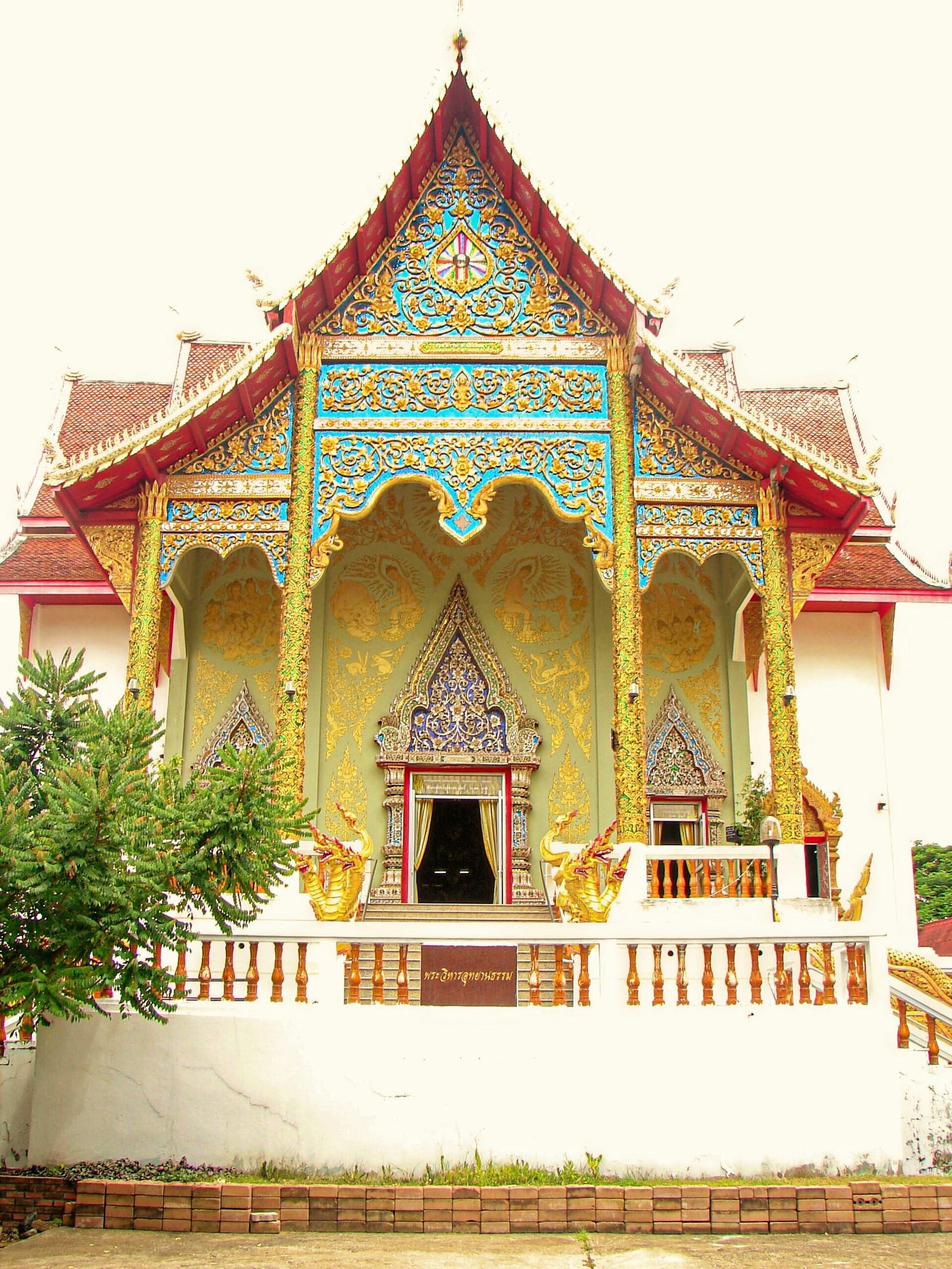
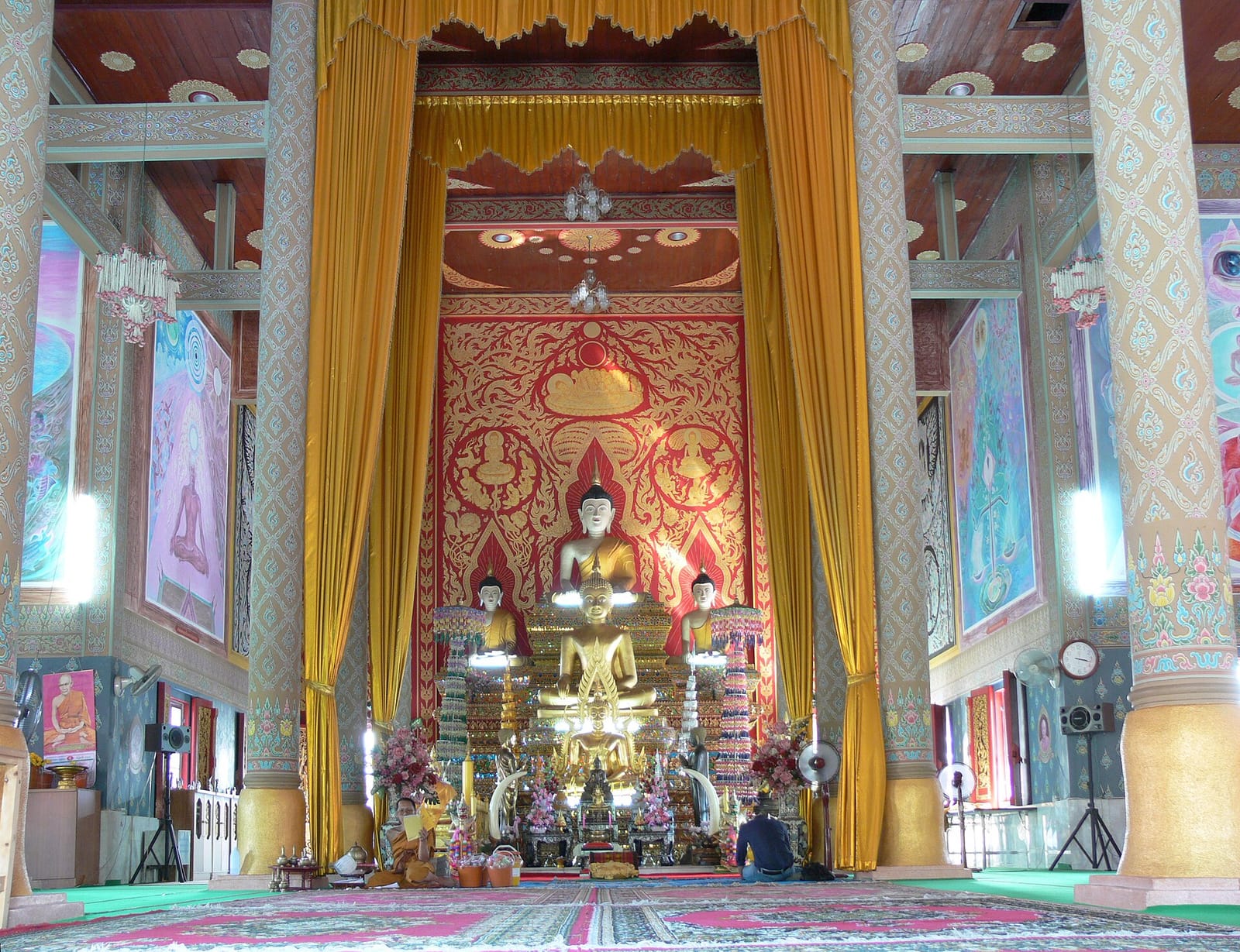
The main viharn sits to the east of the chedi, on the upper terrace. It is a 1960s Lanna-style hall with a three-tiered roof, carved gilded gables and a wide raised teak floor inside. The principal Buddha image is a seated bronze in the maravijaya posture, on a tall altar at the western end. The interior is plain (no historic murals) but the building is open and airy and the floor is cool to sit on. Evening chanting at 17:00 fills the hall cleanly, and the acoustics carry the Pali liturgy without amplification.
The western terrace and the valley view
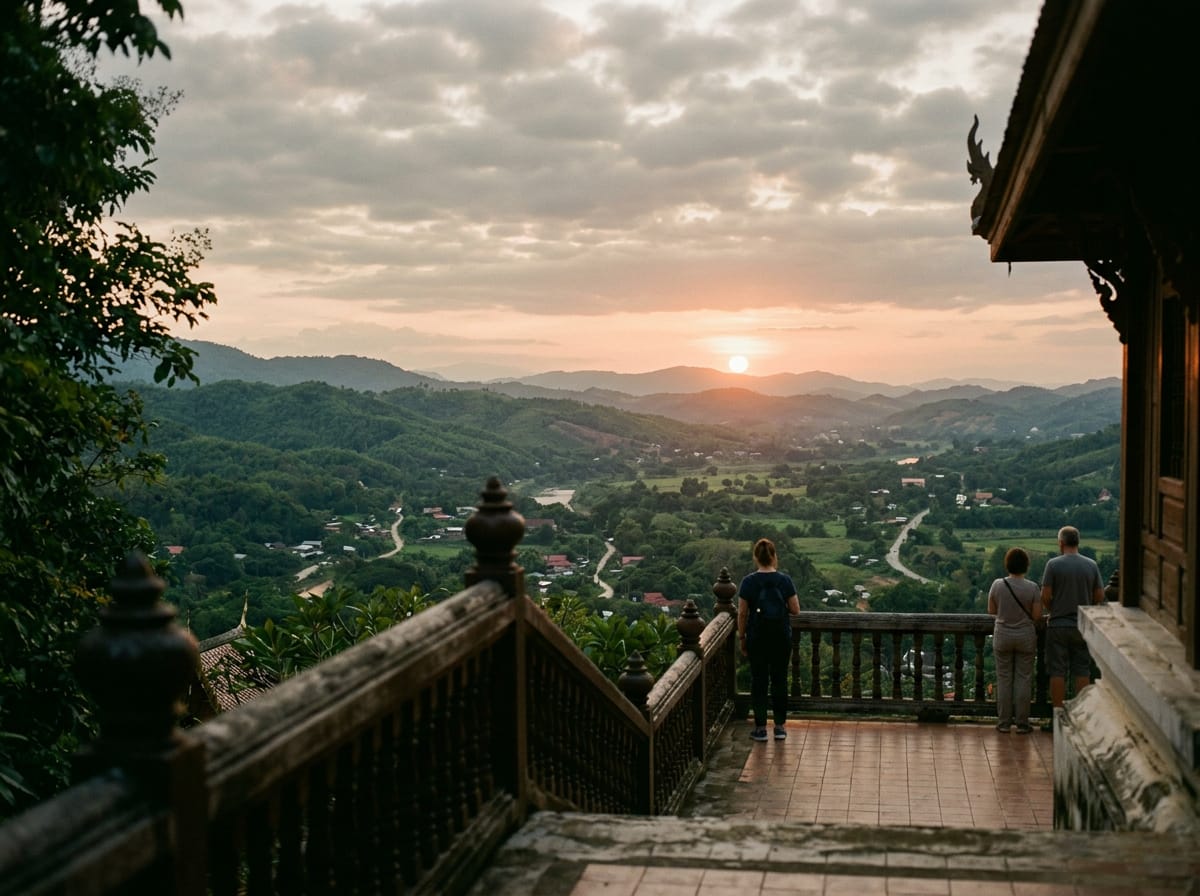
The platform on the western side of the chedi terrace is the second reason most visitors come. It looks out over the entire Doi Saket valley: the town below, paddy fields and orchards stretching east towards the foothills, and the small reservoir of Huay Hong Khrai visible to the south-west. On clear days the long ridge of Doi Suthep is faintly visible 30 km to the west, with Chiang Mai itself hidden in the haze at its foot.
In the cool season the valley works at the other end of the day too. Come up for 07:00 and the paddies below are often under a sheet of thin mist that burns off by 08:30, with the chedi terrace in clear sun above it. You will share the experience with the temple dogs and nobody else.
Sunset over the valley from this platform, between October and February when the air is at its clearest, is one of the best free viewpoints in the Chiang Mai region. The light through November is particularly good; the cool season brings high atmospheric clarity, and the contrast between the gilded chedi behind you and the orange western sky in front is extraordinary. Stay for the 17:00 evening chanting, then walk to the western terrace afterwards for the last 20 minutes of light. The staircase back down is lit by small lanterns at dusk.
The Yi Peng evenings in practice
If you are coming for the mass release, treat it as an event with a temple attached rather than a temple visit. Gates for ticket holders open in the late afternoon; the programme runs through dusk with food, music and a religious preamble, and the lanterns go up together on a countdown after full dark. The collective release is the photograph everyone wants, and it lasts only a few minutes. Decide in advance whether you are photographing or participating; trying to do both badly is the standard mistake. A phone on a chest strap, recording video while you handle your own lantern, is the workable compromise.
Practicalities: book months ahead, check exactly what your ticket covers (transport from the city varies by tier), bring a jacket because the hilltop is cold by 21:00 in November, and expect the descent and the car park exit to take a long while with several thousand people moving at once. Evening flights in and out of Chiang Mai are also rescheduled around the festival nights for airspace safety, so do not plan to fly the same evening.
If the ticket prices grate, the smaller releases on non-event evenings during the festival window cost nothing and feel closer to what Yi Peng is for. Fewer lanterns, no staging, and monks chanting rather than a compère.
How to visit
Wat Doi Saket sits 17 km north-east of Chiang Mai’s Old City on Highway 118, the main route to Chiang Rai. The temple is in the small town of Doi Saket, on the south side of the road.
The easiest option for a first-time visitor is a Grab from the Old City, at 250 to 350 baht and 30 minutes outside rush hour. Have the driver wait, or arrange a return Grab from the town for after sunset.
For independent visitors, a rented motorbike or car is the natural choice. The drive along Highway 118 is straightforward and well signposted; parking at the top of the temple hill is free. A 110cc scooter is sufficient. Allow 35 minutes one-way from the Old City.
A shared songthaew runs from Warorot market for 50 baht per person, but services are infrequent (every 60 to 90 minutes) and the last return runs around 16:00.
The town of Doi Saket itself is small and pleasant, with a Saturday market in the central square, a handful of riverside cafes along the Mae Kuang river that runs through the town, and the lake of Huay Hong Khrai 5 km south. A morning visit to the temple followed by lunch in the town and a walk to the lake makes a coherent half-day outside the city.
Huay Hong Khrai deserves the detour if you have transport. The lake sits inside a royal development study centre established in 1982 to trial watershed restoration techniques, and the grounds, open to the public without charge, include reservoir-side walking paths and a great deal of birdlife. It is the quietest picnic spot within easy reach of the city.
Etiquette and dress code
The standard temple rules apply. Cover shoulders and knees; vests, short shorts, sheer tops and miniskirts are not permitted inside the main viharn. Sarongs are lent free of charge at a small stand at the top of the staircase. Shoes come off before entering the viharn and the ubosot; the chedi terrace, the staircase and the gardens can be walked in normal footwear. Hats and sunglasses should be removed inside any of the halls. Sit with your legs tucked to the side rather than crossed before any Buddha image. Do not point your feet at an image, or at a monk. Women should not hand objects directly to monks; place items on the cloth provided. Photography is welcome throughout the compound. Drones are permitted with prior notice to the temple office, except during festival events; the open hilltop is otherwise one of the few unrestricted aerial photography sites in the Chiang Mai region.
Best time to visit
The temple has two distinct best seasons. For a quiet visit, come on any weekday between November and February in the late afternoon. Climb the staircase around 15:30, walk the chedi terrace until 16:30, sit for evening chanting at 17:00, watch sunset from the western terrace at 17:30, and descend at dusk. The whole sequence takes about two and a half hours.
For the Yi Peng mass lantern release, dates are set by the lunar calendar: the festival falls on the full moon of the second Thai lunar month, usually mid-November. Check the CAD Khom Loi event website and book months in advance. The temple is also open on non-CAD evenings during Yi Peng for smaller, more locally focused free lantern releases, which are quieter, more genuinely religious, and not photographed in numbers.
Avoid March to May, when the climb in the middle of the day is punishing and haze reduces the valley view to a milky white blur. The rainy season from June to October brings green countryside and atmospheric mists but also afternoon downpours.
Nearby and related
Wat Doi Saket sits outside the standard temple-crawl circuit but pairs naturally with the wider Yi Peng festival programme and the other hilltop and mountain wats of the region.
- Yi Peng and Loy Krathong — the November Lanna festival of lights, of which the CAD Khom Loi mass lantern release at Wat Doi Saket is the most prominent organised commercial component. The festival also runs at other temples across the city and along the Ping River.
- Wat Phra Thad Doi Suthep — the famous mountain temple 35 km west, the natural pair for a day that takes in both of the principal hilltop wats of the Chiang Mai region. Combine them across a single day with the city in between.
- The town of Doi Saket itself, with its small riverside cafes, weekly Saturday market and the lake of Huay Hong Khrai 5 km south, makes a pleasant continuation of the temple visit and is the easiest way to spend a relaxed half-day outside Chiang Mai without travelling far.
Photos
Frequently asked questions
What time does Wat Doi Saket open?
Wat Doi Saket opens daily at 06:00 and closes at 18:00. The staircase and the chedi terrace at the top are accessible during all opening hours; the main viharn is open from 07:00 to 18:00. Morning chanting takes place at 06:30 and evening chanting at 17:00. The temple stays open later for the Yi Peng festival and for major Buddhist holy days, when candlelight processions are held around the chedi at dusk.
Is there an entry fee at Wat Doi Saket?
No. Entry is free for everyone. A donation box stands at the top of the staircase and inside the main viharn — 20 baht is customary. The CAD Khom Loi mass lantern release organised at the temple during the Yi Peng festival each November is a separate commercial event with tickets ranging from 4,000 to 15,000 THB per person and is booked separately through Chiang Mai Air Design (CAD).
Where is Wat Doi Saket?
Wat Doi Saket sits at the top of a hill in the town of Doi Saket, about 17 km north-east of Chiang Mai on Highway 118 (the route to Chiang Rai). The street address is simply Doi Saket town centre, Doi Saket District. From the Old City the drive is 30 minutes outside rush hour. The temple is visible from the main road into town — the long naga balustrade running up the hill is unmissable.
How many steps are there to the temple?
The main staircase has 309 steps, give or take a few depending on whether you count the small landings. The climb takes 8 to 12 minutes at a steady pace; longer if you stop to look at the naga balustrade or the small subsidiary shrines on the way up. A wider zigzag road also leads up the hill for those who prefer not to walk — most local Thai visitors drive up, while foreign visitors generally take the steps. There is a small car park at the top for those who drive.
What is the dress code for Wat Doi Saket?
Shoulders and knees must be covered for both men and women. Sarongs are lent at a small stand at the top of the staircase, free of charge. Shoes come off before entering the main viharn and the ubosot. The chedi terrace and the staircase can be walked in normal footwear. Hats and sunglasses should be removed inside the halls. The dress code is enforced at the viharn doorway.
How do I get to Wat Doi Saket from Chiang Mai?
A Grab from the Old City costs 250 to 350 baht and takes 30 minutes outside rush hour. A shared songthaew from Warorot market costs 50 baht per person, but the service is infrequent — typically only every hour or two — and only runs during daylight. A rented motorbike or car is the easiest option for an independent visitor. The drive along Highway 118 is straightforward and well signposted.
Is Wat Doi Saket busy with tourists?
No. The temple sits well off the standard tourist coach circuit and most foreign visitors to Chiang Mai never come here. Even at weekends the compound is usually quiet — a handful of local worshippers, a few photographers, no coach groups. The exception is the Yi Peng festival in November, when the CAD Khom Loi mass lantern release brings thousands of paying participants and the temple grounds become an organised commercial venue for one or two evenings.
What is the Yi Peng mass lantern release?
Yi Peng is the Lanna festival of lights, celebrated on the full moon of the second lunar month (usually November). At Wat Doi Saket, the largest organised commercial mass sky-lantern release in northern Thailand is staged each year by Chiang Mai Air Design (CAD). Several thousand paying participants release khom loi paper sky lanterns simultaneously after sunset, producing the photographed images that have made the festival internationally famous. Tickets cost 4,000 to 15,000 baht per person depending on package, dinner inclusion and seating tier. The event sells out months in advance. The temple compound itself is also a quieter free venue during Yi Peng for smaller local lantern releases on other nights of the festival.
How long does the visit take?
Allow 60 to 90 minutes for the full visit, including the climb up and down the staircase, a slow walk around the chedi terrace, time inside the main viharn, and a pause to look out over the valley. Photographers should add another 30 minutes for the chedi from different angles and the western view at sunset. The temple is large enough to absorb time but not so dense that it requires a half-day.
Can I see the valley from the top?
Yes — the view is the second reason most visitors come (after the temple itself). The platform on the western side of the chedi terrace looks out over the entire Doi Saket valley, with the town below and a lake (Huay Hong Khrai) visible to the south-west. On clear days the ridge of Doi Suthep is faintly visible 30 km to the west. Sunset over the valley from the western terrace, between October and February, is one of the best free viewpoints anywhere in the Chiang Mai region.
When was Wat Doi Saket founded?
The temple chronicle gives the foundation date as the mid-14th century, contemporaneous with the early Mangrai-period expansion of Lanna religious foundations across the surrounding countryside. The exact year is uncertain but the compound was certainly active by the late 14th century. The current principal chedi was rebuilt in the 18th century after the long Burmese-occupation decline. The naga staircase and the present main viharn date from a major restoration in the 1960s. The temple has therefore evolved continuously over seven centuries on the same hilltop site.
Can I attend the evening chanting at Wat Doi Saket?
Yes. Evening chanting begins at 17:00 in the main viharn and lasts about 40 minutes. Climb the staircase by 16:45 to be settled in time. Sit at the back with your feet tucked to the side and do not photograph during the service. The acoustics inside the viharn are excellent — the building is small enough that the chanting fills the space cleanly. After the service finishes, the climb back down at dusk with the staircase lit by small lanterns is one of the more atmospheric experiences offered by any temple in the region.
Related guides
Festival
Yi Peng and Loy Krathong
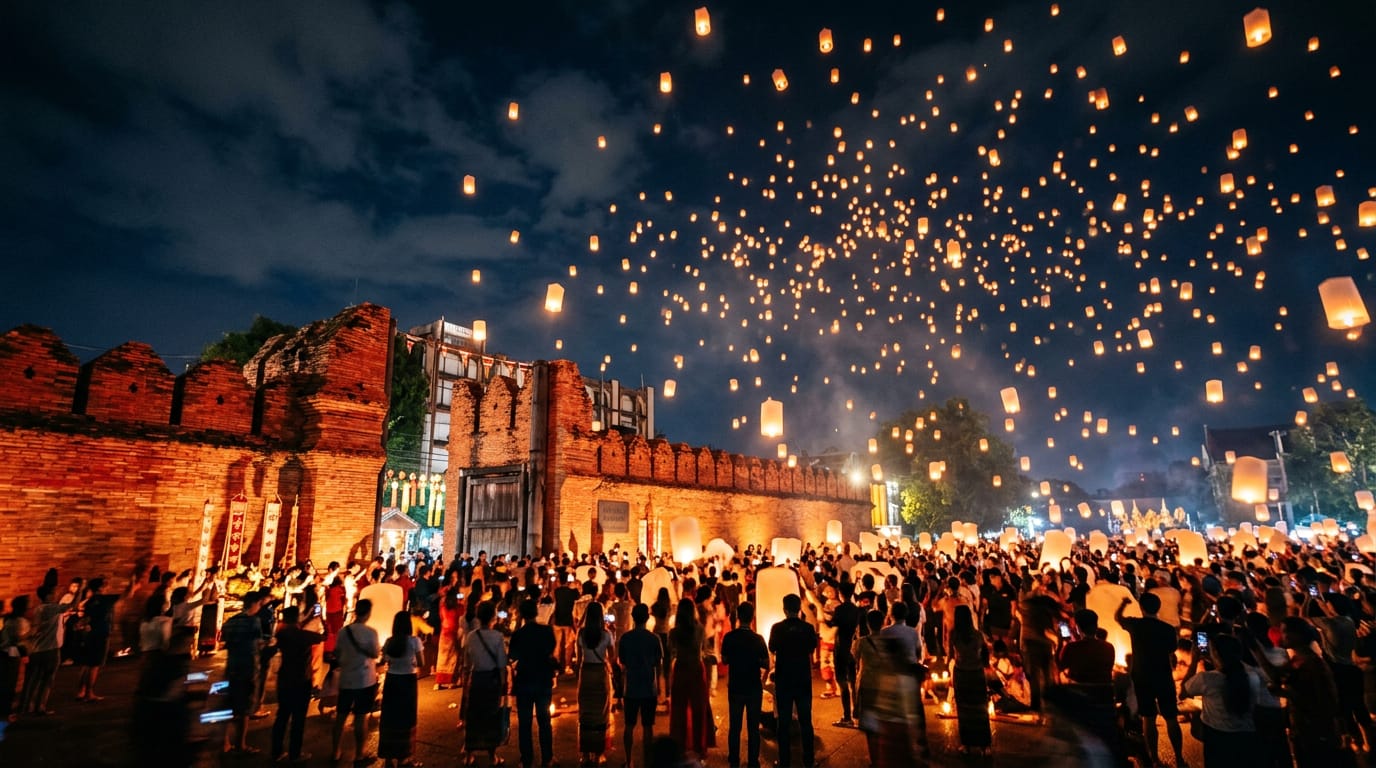
Yi Peng and Loy Krathong are Chiang Mai's twin festivals of light, held together over three nights on the full moon of the twelfth lunar month. Yi Peng is the Lanna sky-lantern release; Loy Krathong is the all-Thai floating of candle-rafts on rivers and ponds. In 2026 the festival runs 23–25 November, with free public lantern releases at Tha Phae Gate, krathong floating along the Ping River and Wat Phra Singh, and large ticketed mass releases at Doi Saket and Mae Jo.
Temple
Wat Phra That Doi Suthep
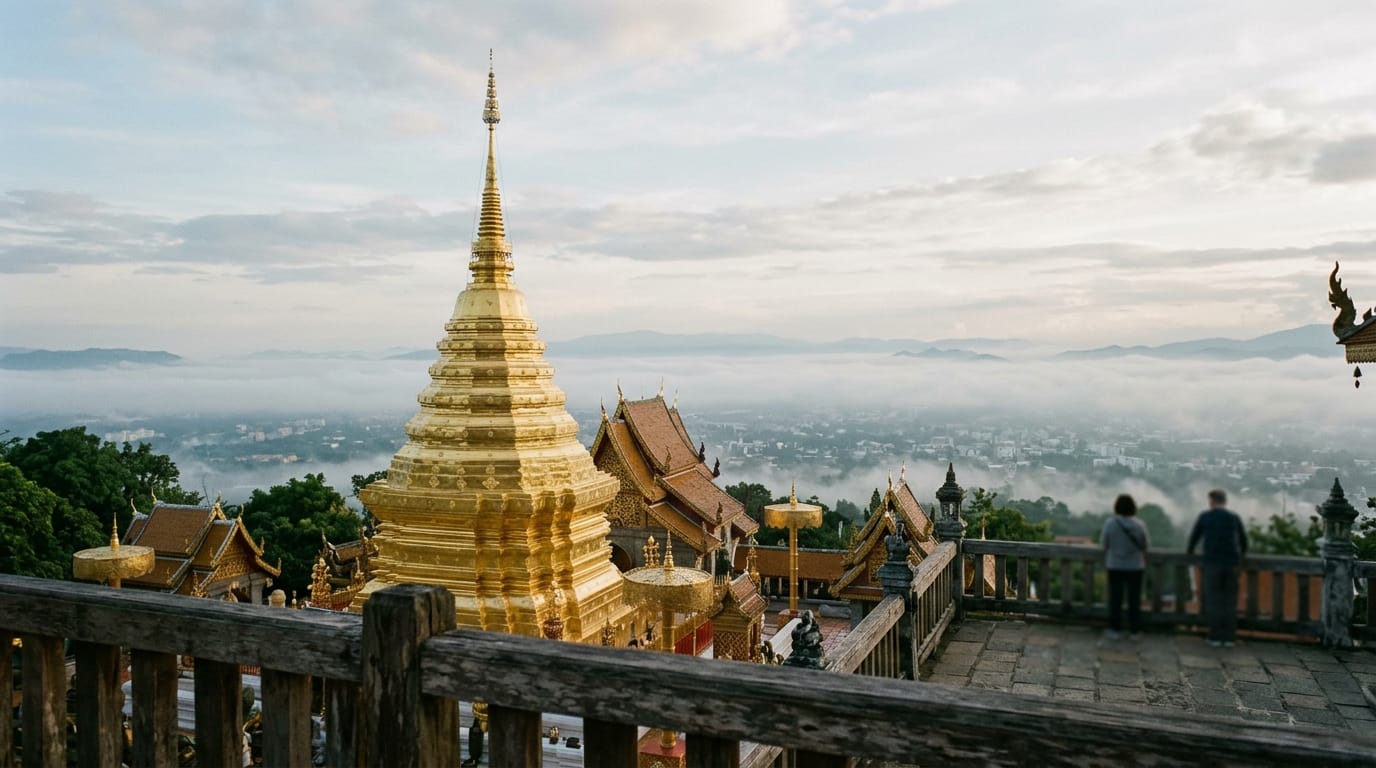
Wat Phra That Doi Suthep is the mountain temple that watches over Chiang Mai from a forested ridge 1,073 metres above the city. Founded in 1383 by King Kuena to enshrine a Buddha relic carried up the mountain on the back of a white elephant, its gilded chedi has been the spiritual centre of northern Thailand for six centuries. A 306-step naga-flanked staircase or a small cable car carries visitors to a courtyard with one of the great views of the Ping Valley.