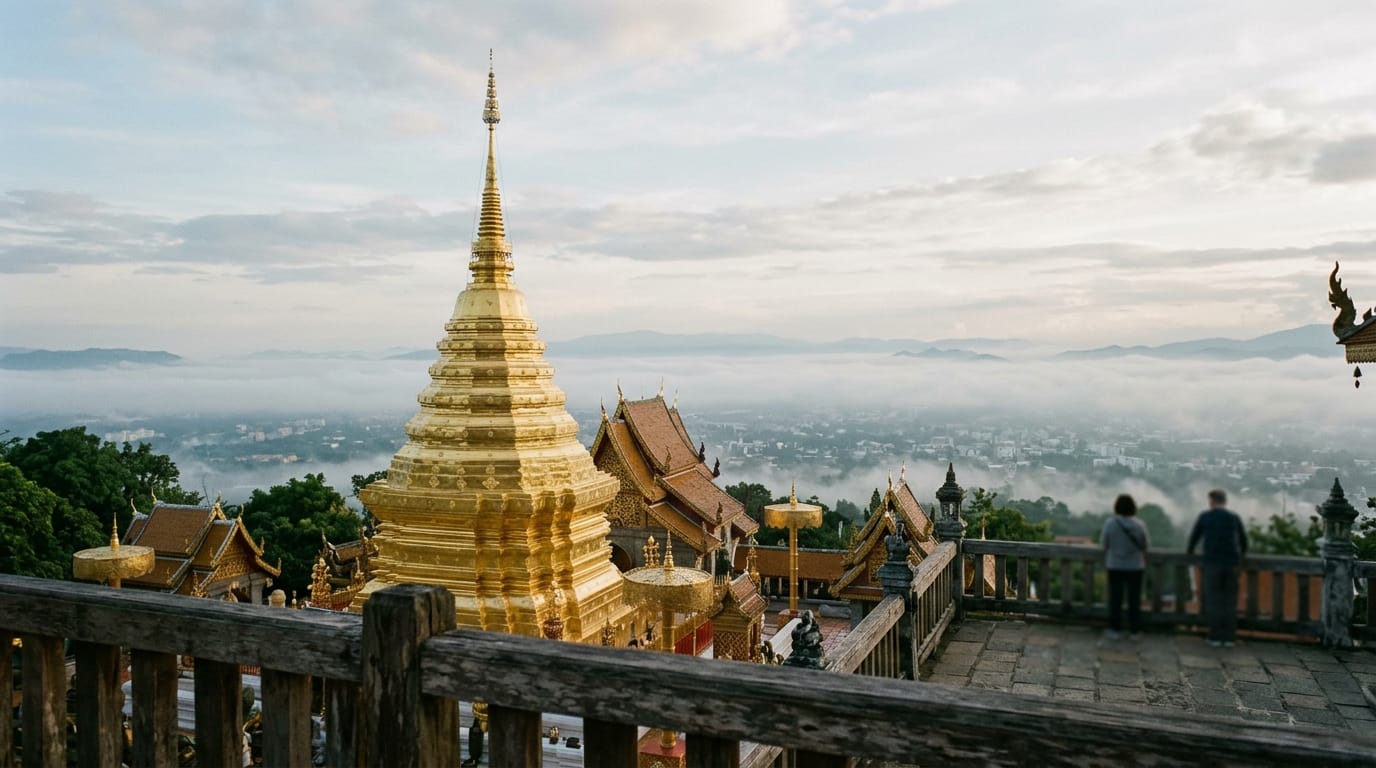
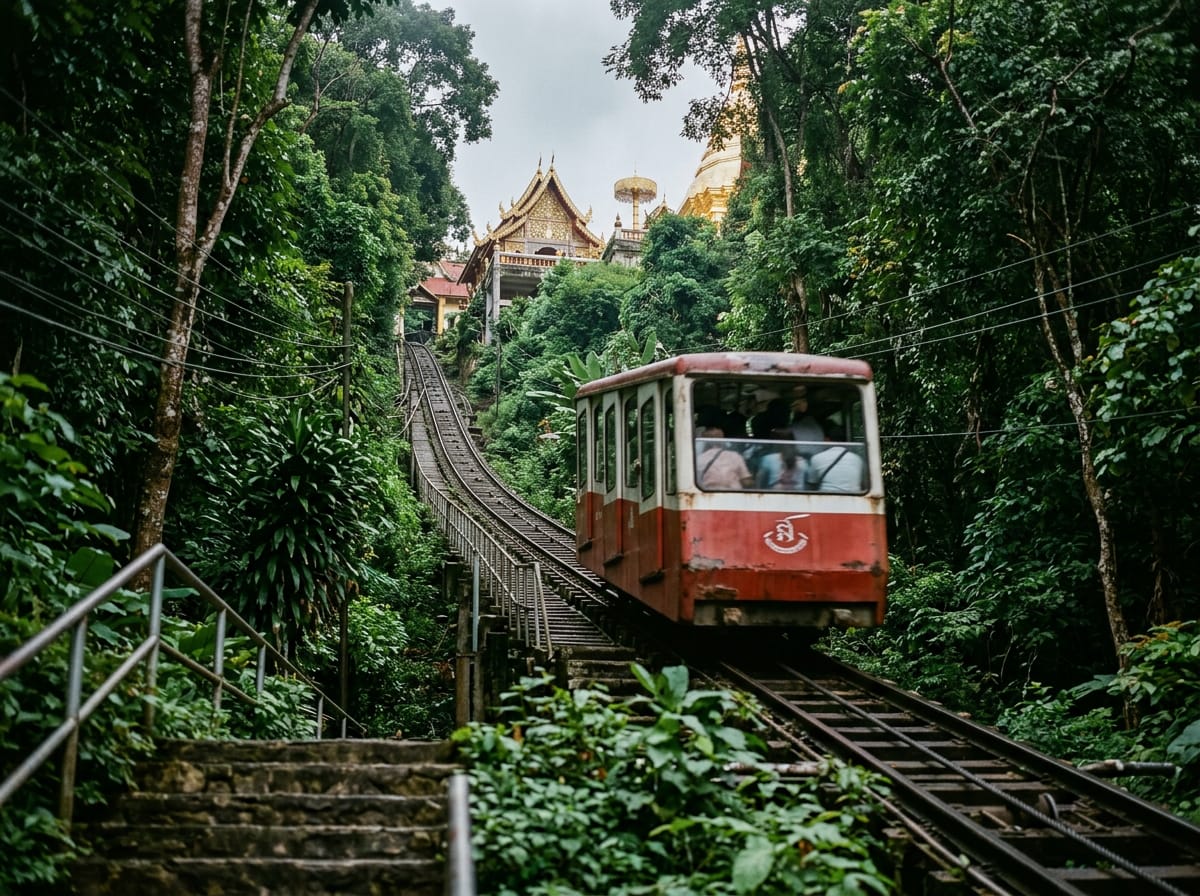
Wat Phra That Doi Suthep is the mountain temple that watches over Chiang Mai from a forested ridge 1,073 metres above the city. Founded in 1383 by King Kuena to enshrine a Buddha relic carried up the mountain on the back of a white elephant, its gilded chedi has been the spiritual centre of northern Thailand for six centuries. A 306-step naga-flanked staircase or a small cable car carries visitors to a courtyard with one of the great views of the Ping Valley.
Updated
Wat Phra That Doi Suthep is the temple that defines Chiang Mai. Its gilded chedi sits on a forested ridge 1,073 metres above the city and has been visible from the Old City moat for more than six centuries. For visitors it is the single essential pilgrimage in the north; for residents it is the place you go on the first day of the New Year, on the morning of your wedding, before a long journey and on any day that calls for a long view.
History and significance
The temple was founded in 1383 by King Kuena, the sixth ruler of the Mangrai dynasty. The founding story is one of the best-known legends of northern Thailand. A monk named Sumana, arriving from Sukhothai with a Buddha relic, found that the relic divided in two on his journey: a sign, the king’s astrologers ruled, that two shrines were needed. The smaller fragment was enshrined at Wat Suan Dok on the western edge of the city. The larger fragment was placed in a reliquary, fastened to the back of a white elephant — white elephants being royal property — and the elephant was released onto the forested mountain to choose the site for itself. It climbed Doi Suthep to a ridge at 1,073 metres, trumpeted three times, knelt and died. King Kuena ordered the chedi built where the elephant fell.
The original chedi was a modest brick structure perhaps 8 metres tall. It was enlarged in 1525 by King Muang Kaew, who added the copper gilding and the surrounding cloister. The road up the mountain did not exist until 1935, when a charismatic monk named Khruba Sriwichai organised the construction of an 11-kilometre track in five months and twenty-two days, using volunteer labour from every district of northern Thailand. Until then, every pilgrim climbed on foot from the base of the mountain — a five-hour ascent through dense forest. Khruba Sriwichai’s role in opening the temple to mass pilgrimage is commemorated by a statue at the foot of the mountain that almost every Thai driver stops to salute on the way past.
The temple was raised to royal status in 1935 and is now one of only six royal first-class temples in northern Thailand. It functions as an active monastery with around eighty resident monks and novices, a popular meditation centre that admits foreign students for retreats of three to ten days, and a school of Buddhist studies. The relic itself has never been publicly displayed and remains, by tradition, sealed in the masonry core of the chedi.
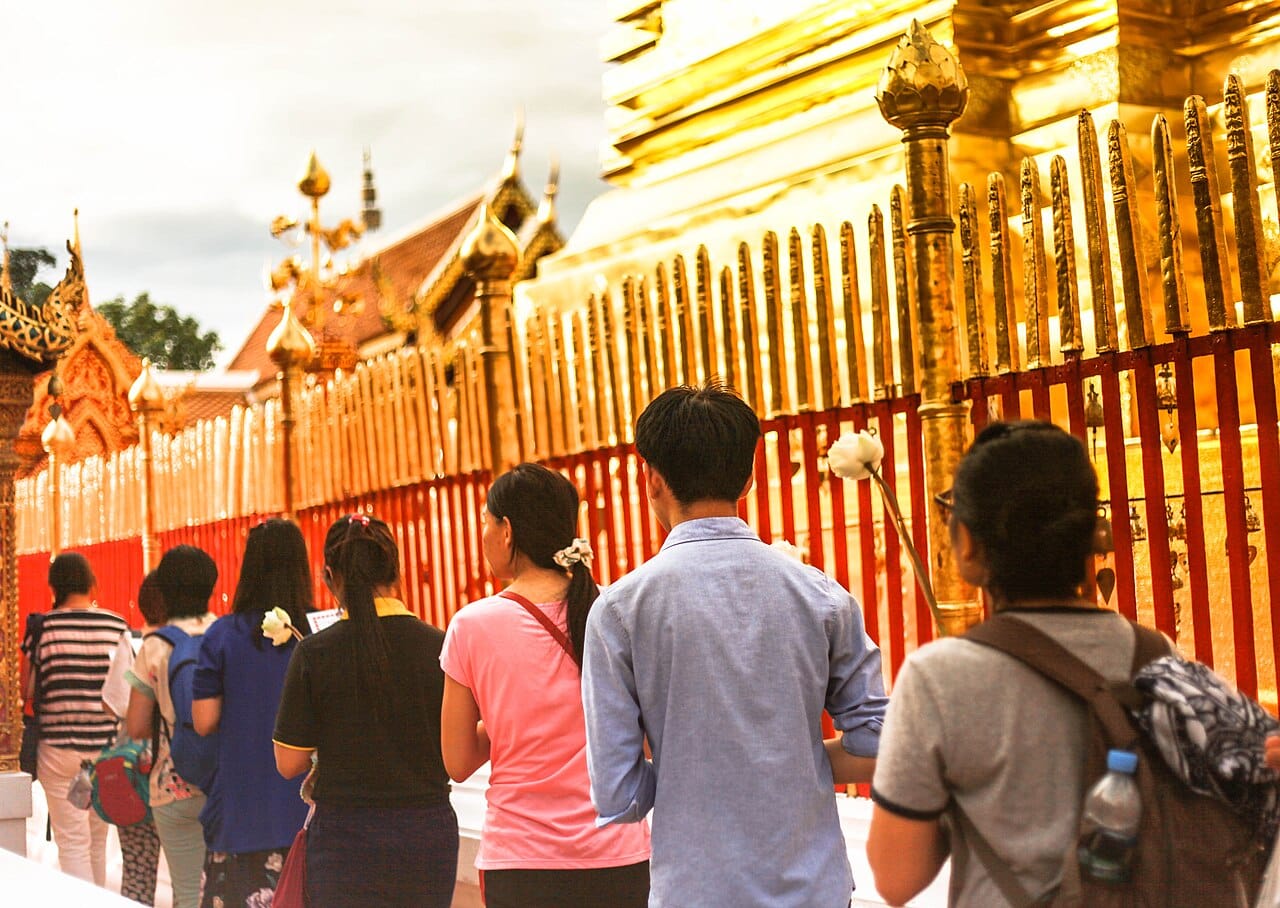
For most Thais the temple’s significance is personal as much as religious: it is the place to come at a moment of decision, to circumambulate the chedi three times clockwise carrying a lotus flower, three sticks of incense and a candle. The gesture is called wian thian. Visitors are welcome to join.
What to see
The upper terrace is a single walled compound of about 4,000 square metres. Everything of significance sits within five minutes’ walk of the gate.
The naga staircase
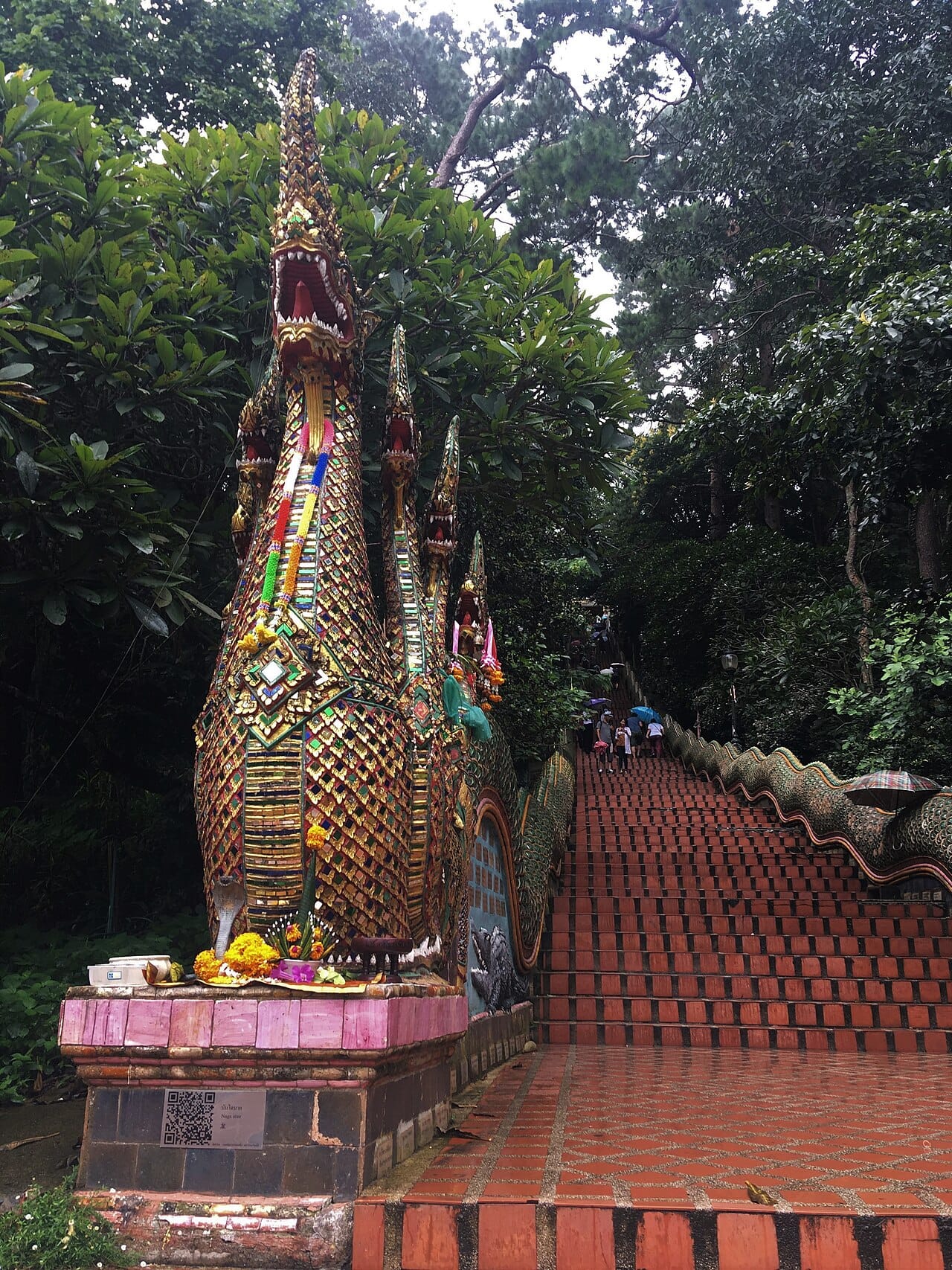
The approach is the temple’s defining experience. Three hundred and six stone steps rise through forest from the lower car park to the upper gate, flanked on both sides by a naga balustrade — a seven-headed serpent with each head as tall as a person. The serpents are descended from older Khmer prototypes but the painted detailing in cobalt blue and gold is purely Lanna. The climb is moderate, not steep, and takes 8 to 12 minutes at a steady pace. Vendors at the base sell bottled water, candles and small flower offerings; ignore the touts who try to lead you up the wrong way.
The chedi
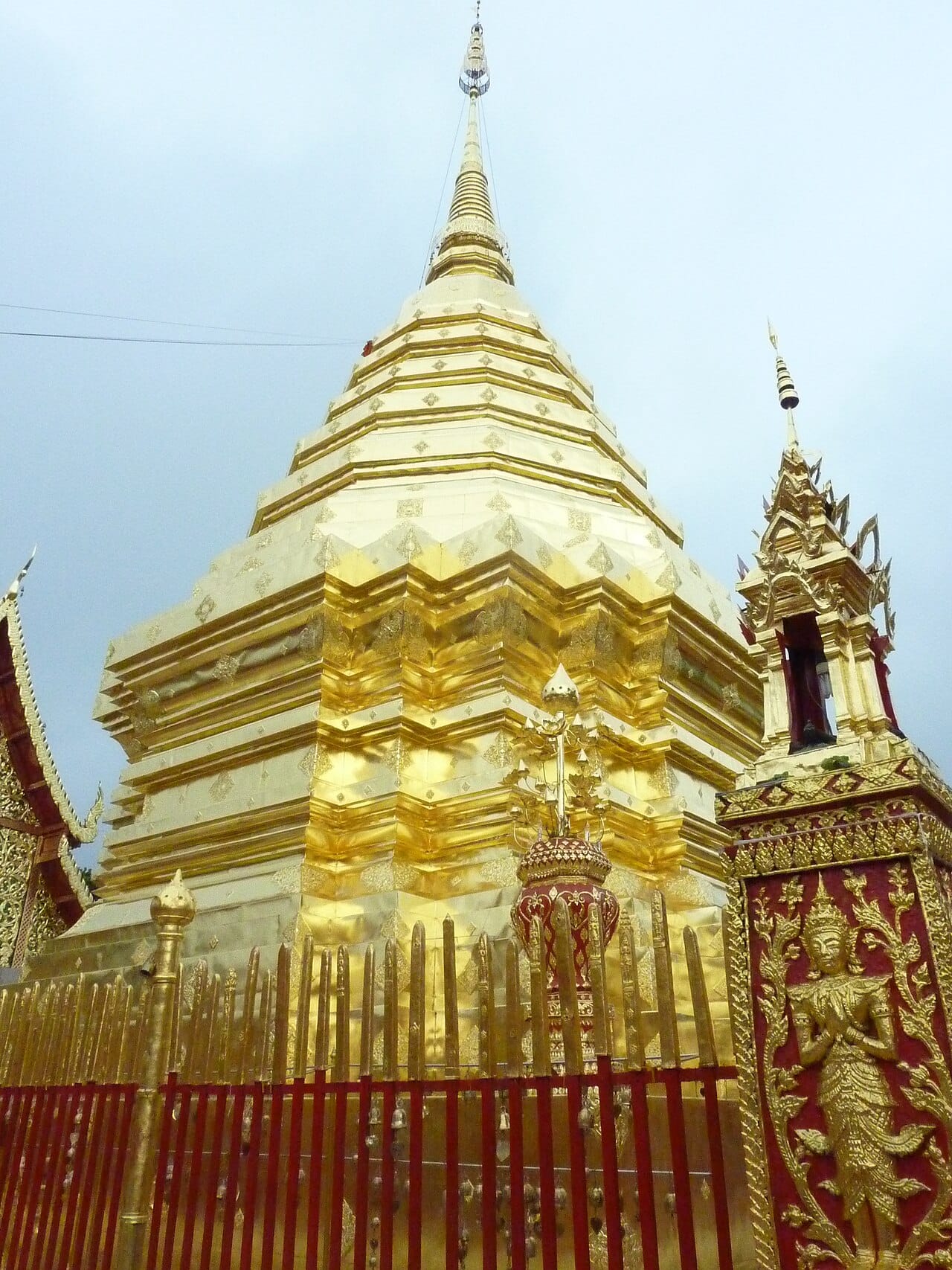
The 24-metre gilded chedi at the centre of the upper terrace is the heart of the temple. It sits on a square base with four small ceremonial umbrellas at the corners, each held aloft by a stone deity. The body of the structure is in the Lanna bell-shape with subtle Burmese influence visible in the elongated spire — the result of refurbishments carried out during periods when Chiang Mai was a Burmese vassal in the sixteenth and eighteenth centuries. The gilding is replaced every fifty years; the current finish, completed in 2019, used 56 kg of gold leaf and is expected to last to roughly 2070. Pilgrims circle the chedi three times clockwise carrying a lotus, three sticks of incense and a lit candle. Visitors are welcome to do the same.
The principal viharn
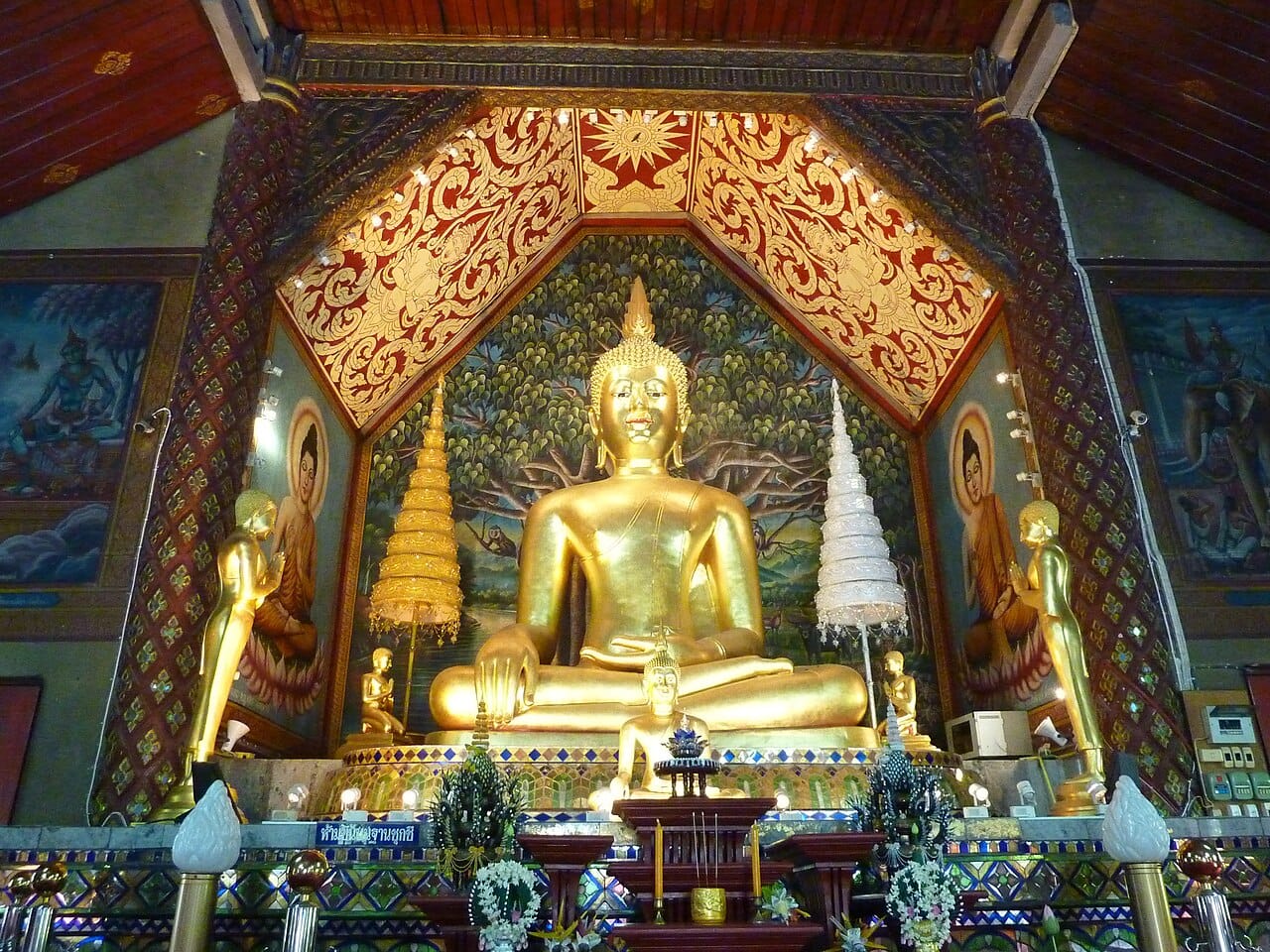
The main viharn sits on the south side of the cloister and opens onto the chedi. It is a relatively modest building, rebuilt in 1925 in the Lanna revival style, with red columns and a five-tiered teak roof. The principal Buddha image is a copper-alloy figure in the maravijaya posture, seated under a seven-tiered umbrella. The lacquered ceiling is painted with stars and lotus medallions in gold leaf on a red ground. Morning chanting is held here around 06:30, evening at 17:00.
The ubosot
The ordination hall, the ubosot, sits in its own small walled enclosure at the north-eastern corner of the terrace. It is open only during ordinations and major ceremonies and is closed to visitors at most times, but the exterior is worth walking around for the carved nak sadung serpent finials on the gable ends.
The scripture library
A small ho trai, or scripture library, stands raised on a stone plinth at the western side of the compound. It is a working library, not a museum: the palm-leaf manuscripts inside are still consulted by the resident monks. The exterior teak walls carry shallow stucco reliefs of kinnari figures and lotus medallions. The plinth is unusually high — over two metres — protecting the manuscripts from damp and termites.
The cloister and bells
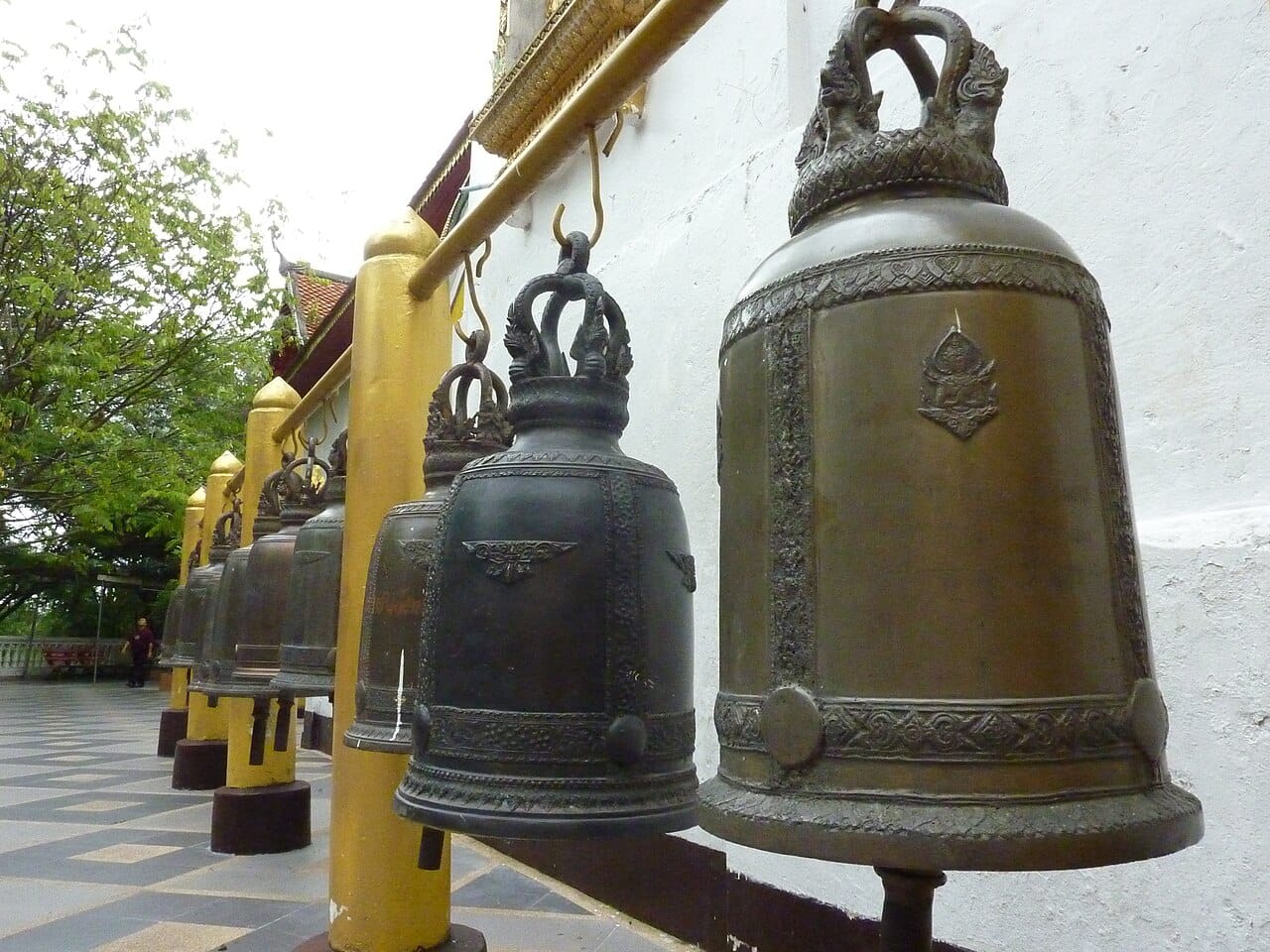
The chedi is enclosed on all four sides by a roofed cloister housing a series of Buddha images donated by patrons over five centuries. A long row of bronze prayer bells lines the outer wall; striking them once with the wooden mallet provided is said to settle the mind before circumambulation. The bells are not decorative — they are used in the temple’s morning service — so strike each one only once.
The viewpoint
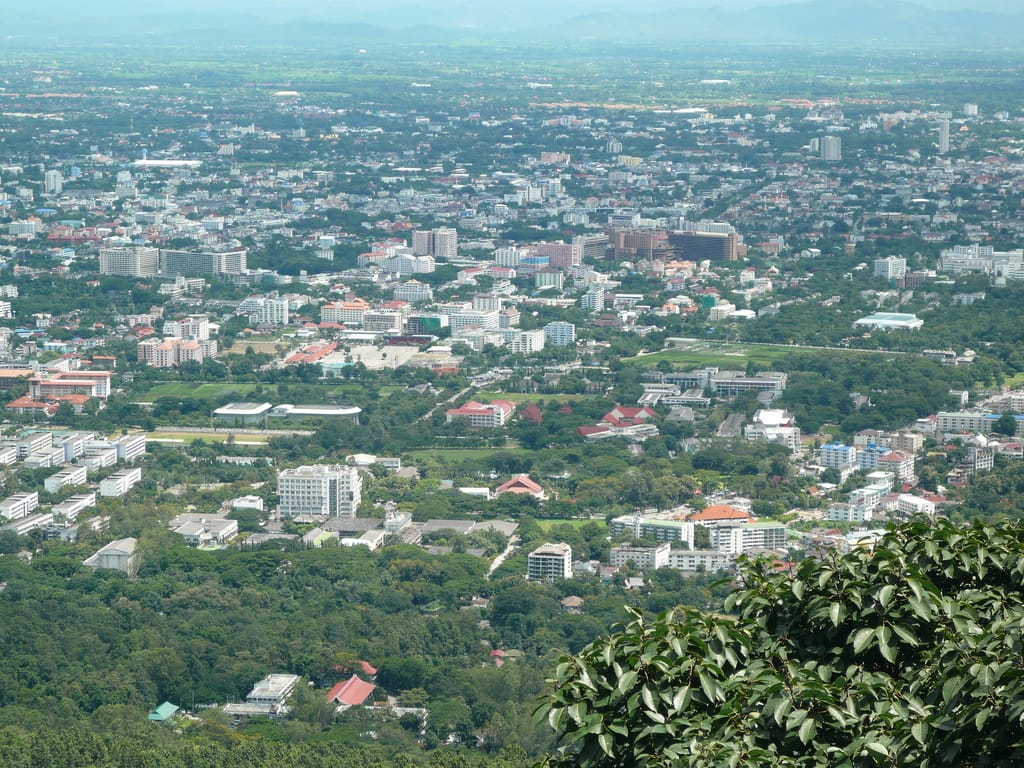
The south-eastern edge of the upper terrace opens onto a balustraded viewpoint over the Ping Valley. On a clear morning you can see directly down to the Old City moat, the airport runway and the eastern hills beyond. The best light is from 05:30 to 07:30; the worst is during the burning season from late February to mid-April, when haze can reduce visibility to less than a kilometre.
The white elephant shrine
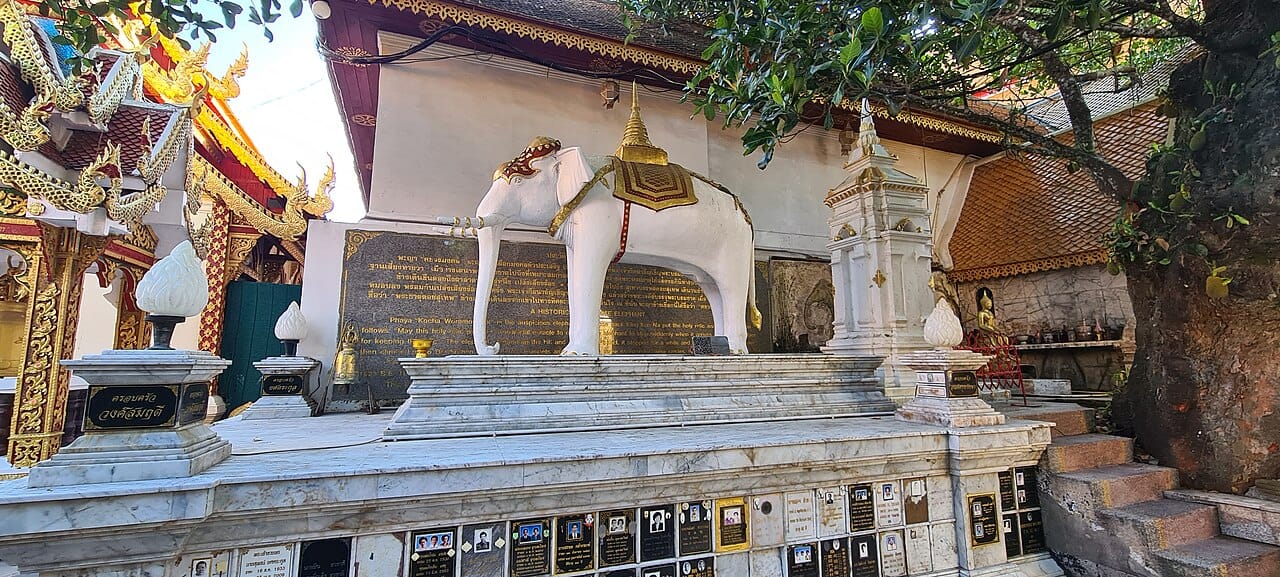
At the base of the staircase, just inside the car park, a small shrine commemorates the white elephant whose death marked the temple’s founding site. The shrine is a recent addition — the original was destroyed in a 1980s rebuild of the lower terrace — but it is the customary place for pilgrims to pay respects before starting the climb. A bronze elephant the size of a small dog sits in the centre under a multi-tiered umbrella.
How to visit
The temple sits 15 km west of the Old City via Huai Kaeo Road past Chiang Mai University, the zoo and the foot of the mountain. The 11-kilometre road from the Khruba Sriwichai statue at the base climbs steeply through hairpin bends to the temple car park.
Red songthaew (shared pickup trucks) gather at Chang Phueak Gate, at the foot of Doi Suthep beside the Sriwichai statue, and outside Wat Phra Singh. The fare is 50 baht per person shared, leaving when full (usually within 20 minutes), or 350 to 450 baht to charter the entire vehicle return including 90 minutes of waiting at the temple. Allow 25 to 35 minutes for the drive depending on traffic.
From Chiang Mai International Airport, taxis or Grab cars cost 350 to 450 baht one-way. Most drivers will not wait at the top, so call a second car for the return. Hotel-arranged minivans typically charge 800 to 1,200 baht for a three-hour return trip.
Renting a motorbike is the most flexible option if you are a confident rider. The road is fully paved and signposted, but the hairpin turns are demanding and the descent requires careful engine braking. Inexperienced riders should not attempt the climb: every wet season several tourists are injured here. Cars must drive cautiously: red songthaews take the corners wide and there are no barriers on most of the road.
Parking at the temple costs 20 baht for cars and is free for motorbikes. The car park fills by 09:00 in high season; arrive early or after 15:00 to find a space without circling.
The temple is the lower of two major destinations on the mountain — Bhubing Palace, the royal winter residence, sits 4 km further up the road with its gardens open daily 08:30–16:30. The Hmong village of Doi Pui is another 3 km beyond that. Combining all three makes a full day. A worthwhile alternative is to drive to the temple and then walk down via the Doi Pui to Doi Suthep hike, which takes four hours through closed-canopy forest and ends back at the base of the mountain.
Etiquette and dress code
The temple is an active pilgrimage site and the rules are strictly enforced.
- Shoulders and knees must be covered for both men and women in the upper terrace.
- Sarongs are lent free at the cable-car station and at the top of the staircase, with a 100 baht refundable deposit.
- Shoes come off before entering the inner cloister around the chedi and before entering any viharn.
- Hats and sunglasses should be removed inside any building.
- Walk around the chedi clockwise — never anticlockwise.
- Sit with feet tucked to one side rather than crossed, and never with feet pointing at the chedi or a Buddha image.
- Do not climb on the chedi, the platforms or the naga balustrades.
- Photography is permitted everywhere outside the inner sanctum, but flash is discouraged near monks during ceremonies. Do not photograph monks without asking.
- Drones are not permitted anywhere on the mountain.
- Voices should be kept low in the cloister.
Best time to visit
Sunrise is the single best time. The cable car does not run before 06:00 but the staircase is open and lit, and the upper terrace is largely empty until the first coaches arrive at around 09:30. The east-facing viewpoint catches the light over the Ping Valley from 05:50 onwards in the cool season. Bring a light fleece — the temperature at 1,073 metres is 8 to 10 degrees cooler than the city and can be genuinely cold from late November to early February.
Late afternoon from 15:30 to 17:30 is the second-best window, with side-light catching the gilded chedi and the day’s coaches long gone. The chanting at 17:00 is open to anyone seated quietly in the rear of the viharn.
Avoid 10:00 to 14:00, when the coach window is at its densest and the cloister can be uncomfortably crowded. Avoid the burning season — late February to mid-April — when the valley view is obliterated by haze.
Full-moon Buddhist holy days, particularly Wisakha Bucha in May and Makha Bucha in February, see thousands of pilgrims climbing the mountain on foot. The night-time procession during Songkran — when an all-night column of lantern-bearing pilgrims walks from Wat Suan Dok to Doi Suthep, arriving at sunrise — is one of the great religious events of the year.
Nearby attractions
The mountain itself is part of Doi Suthep–Pui National Park and rewards a full day of exploration.
- Doi Suthep mountain — the 1,676-metre summit sits 7 km above the temple by trail; the lower forest is excellent for birdwatching.
- Doi Pui to Doi Suthep hike — a four-hour descent through closed-canopy forest, ending at the mountain base.
- Bhubing Palace — the royal winter residence, 4 km further up the road, with rose gardens open 08:30–16:30 when the royal family is not in residence.
- Doi Pui Hmong village — a working ethnic minority village 7 km above the temple, with a small museum and coffee-growing cooperative.
- Wat Pha Lat — a small forest temple half-way down the old pilgrim trail, accessible by foot from the road at the second hairpin.
A short note on Lanna style
The Doi Suthep chedi blends three architectural traditions. The bell-shaped body is pure Lanna, derived from the Sukhothai school and shared with the chedis of Wat Phra Singh and Wat Chedi Luang. The elongated upper spire and the ring of small subsidiary spirelets show Burmese influence absorbed during the sixteenth-century occupations. The four guardian umbrellas at the corners are a regional flourish unique to royal temples in the north.
The cloister, the viharns and the ho trai follow standard Lanna conventions: low-pitched multi-tiered teak roofs, gables carved with the kanok flame motif and finished in gilded lacquer, naga finials extending the bargeboards into upward-pointing serpent fingers. Once you have read these features at Wat Phra Singh in the Old City, you will recognise the same vocabulary up here on the mountain — modified by altitude, weather and the need to withstand monsoon storms that strip the gold leaf from the chedi every two decades.
For the longer visit
If you have 90 minutes, take the cable car up, circle the chedi three times, walk through the viharn and out to the viewpoint, then come down the staircase. That covers the essentials.
If you have two and a half hours, climb the staircase, allow time for the morning chanting if you are there at 06:30, sit on the worn stone of the cloister for a while and walk the perimeter slowly. The bronze prayer bells along the outer wall reward a slow look.
If you have a full half-day, combine the temple with Bhubing Palace and the Doi Pui Hmong village further up the road, or walk down via the Doi Pui to Doi Suthep trail. Stop at Wat Pha Lat on the descent — a small forest temple buried in moss and ficus roots, with no entry fee and almost no visitors. It is the way pilgrims came to Doi Suthep before the road was built in 1935 and it is still, by some distance, the most atmospheric way to leave the mountain.
Photos
Frequently asked questions
What time does Wat Phra That Doi Suthep open?
The temple opens daily from 06:00 to 18:00, but the outer terrace and the viewpoint are accessible from around 05:30 for sunrise visits. The cable car runs from 06:00 to 18:00 with the last ascent at 17:30. Monks begin their morning chanting around 06:30 and the day's first formal ceremonies start at 07:00. Visitors are welcome to observe quietly from the rear of the viharn. The temple stays open later on important Buddhist holy days and during Songkran, when an all-night ascent of the mountain is undertaken on foot by thousands of pilgrims.
How much is the entry fee for Doi Suthep?
Foreign visitors pay 30 baht to enter the upper temple terrace; Thai nationals enter free. The cable car costs 50 baht each way, which adds a 100 baht return trip if you use it both directions. Climbing the 306-step naga staircase is free and takes 8 to 12 minutes at a steady pace. The road approach by red songthaew costs 50 baht per person shared from Chang Phueak Gate, or 350 to 450 baht to charter a vehicle return including waiting time. Parking at the base is 20 baht for cars and free for motorbikes.
Where is Wat Phra That Doi Suthep?
The temple sits on a forested ridge of Doi Suthep, the 1,676-metre mountain that rises directly to the west of Chiang Mai. The upper terrace is at 1,073 metres elevation. By road it is 15 km west of the Old City moat, all on tarmac via the Huai Kaeo Road past Chiang Mai University and the zoo. The temple address is 9 Mu 9, Suthep subdistrict, Mueang Chiang Mai. The mountain is part of Doi Suthep–Pui National Park, though the temple itself sits in a separate inholding and does not require a park ticket.
How long should I spend at Doi Suthep?
Allow two hours including the climb up the staircase, time at the chedi, the viewpoint and a slow look around the cloister. If you take the cable car both ways, 90 minutes is enough. Add another hour if you want to walk down to the white elephant shrine at the base or sit through a chanting service. Most coach tours allocate only 45 minutes, which is too short. Build the visit into a half-day with the [Doi Pui to Doi Suthep hike](/hiking/doi-pui-to-doi-suthep/) or a stop at Bhubing Palace gardens further up the road.
What is the dress code for Doi Suthep?
Shoulders and knees must be covered for both men and women throughout the upper terrace. Vests, short shorts, miniskirts and sheer tops are turned away at the inner gate. Sarongs are lent free of charge at the cable-car station and at a small booth at the top of the staircase, with a 100 baht refundable deposit. Shoes come off before entering the inner cloister where the chedi stands. Hats and sunglasses should be removed inside the cloister and inside the viharn.
Can women enter the inner shrine at Doi Suthep?
Yes. Women may enter the entire upper terrace, the cloister around the chedi and both of the viharns. Lanna temples observe the general Thai convention that women should not touch a monk or hand objects to him directly — place items on a cloth or tray instead. Menstruating women are not formally barred from the cloister; the older custom of staying outside is no longer observed at this temple. When seated in front of the chedi, sit with your legs tucked to one side and keep your feet pointing away from the structure.
Should I take the cable car or climb the stairs?
Most fit visitors should climb. The 306-step naga staircase is the temple's defining approach: the multi-headed serpent balustrades, the rising smell of frangipani and forest, the slow build to the gate at the top — it is part of the religious experience and not a chore. The climb takes 8 to 12 minutes at a steady pace and is not steep. Take the cable car if you have knee or heart problems, if you are visiting with young children or older relatives, or if it is pouring with rain. The 50-baht fare is a small contribution to the temple's maintenance fund either way.
What is inside the chedi?
The gilded 24-metre chedi at the centre of the upper terrace enshrines a Buddha relic — by tradition a shoulder bone, by some accounts a hair — that was carried up the mountain on the back of a white elephant in 1383. The relic itself has never been publicly displayed and is held in a reliquary deep inside the masonry core. The chedi exterior is finished in gilded copper plates that are replaced or re-gilded every 50 years; the most recent re-gilding was completed in 2019. Pilgrims walk three times around it clockwise carrying a lotus flower, three sticks of incense and a candle.
How do I get to Doi Suthep from the Old City?
Red songthaew (shared pickup trucks) gather at Chang Phueak Gate and at the entrance to Wat Phra Singh. The fare is 50 baht per person shared, leaving when full, or 350 to 450 baht to charter the whole vehicle return including 90 minutes of waiting at the temple. The drive takes 25 to 35 minutes depending on traffic. Grab and Bolt rides are available but most drivers will not wait at the top, so you would need to call another car for the descent. Renting a motorbike is the most flexible option if you are confident on the road's hairpin turns.
Is the drive to Doi Suthep difficult?
The road is fully paved, well maintained and only 11 km from the Huai Kaeo Road turn-off to the temple car park. It climbs steeply with sharp hairpin bends, particularly in the upper half. Inexperienced motorbike riders should not attempt it: every wet season several tourists are injured here. If you drive yourself, use engine braking on the descent, watch for the red songthaews that take the corners wide, and avoid the drive on rainy mornings when the road can be slippery with mud washed off the verges.
When was Wat Phra That Doi Suthep built?
The temple was founded in 1383 by King Kuena, the sixth Mangrai ruler, after a Buddha relic brought from Sukhothai by a monk named Sumana split in two. The smaller piece was enshrined at Wat Suan Dok in the city; the larger was loaded onto a white elephant which was released onto the mountain. The elephant climbed Doi Suthep, trumpeted three times at the spot where the chedi now stands and died. Kuena built the original chedi to mark the spot. The current structure has been enlarged and re-gilded several times, most significantly in 1525 and again in 2019.
Is Doi Suthep worth visiting?
For most visitors to Chiang Mai it is the single essential temple. The combination of the climb, the chedi, the viewpoint over the city and the sense of being in an active pilgrimage site rather than a tourist attraction is unmatched anywhere else in the north. Even visitors who have seen many temples elsewhere in Thailand find Doi Suthep memorable. Visit at sunrise for the view and the cool air, or in late afternoon when the light catches the gilded chedi side-on. Avoid the 10:00 to 13:00 coach window if you possibly can.
What is the story of the white elephant?
In 1383 a monk named Sumana arrived in Chiang Mai with a Buddha relic from Sukhothai. The relic divided into two pieces of unequal size on its journey, which was understood as a sign that two shrines were needed. The smaller piece was housed at Wat Suan Dok. The larger was placed in a reliquary, loaded onto the back of a white elephant — white elephants being royal property and sacred in their own right — and the elephant was released into the forested mountain to choose the site. It climbed to a ridge at 1,073 metres, trumpeted three times, knelt and died. King Kuena ordered the chedi built where the elephant fell. A small shrine to the elephant stands at the base of the staircase.
Can I see the sunrise from Doi Suthep?
Yes, and it is one of the best experiences the city offers. The viewpoint at the temple's south-eastern edge looks straight across the Ping Valley with the Old City directly below and the eastern hills on the horizon. Arrive by 05:30 to be in place, either by chartered songthaew (book the night before, 400 baht return) or motorbike. The cable car does not run before 06:00 but the staircase is open and lit. Pack a light fleece — the upper terrace is 8 to 10 degrees cooler than the city and can be cold in December and January.
What happens at Doi Suthep during Songkran?
During the Thai New Year in mid-April, thousands of pilgrims walk up the mountain at night, leaving Wat Suan Dok at around 19:00 and arriving at Doi Suthep by sunrise. The all-night procession is one of the great Lanna religious events. The route follows the road in places and a parallel forest path in others; lanterns and water-stations are set up along the way. Cars are restricted on the road during the procession. Even if you do not walk yourself, watching the lantern-lit column climb the mountain from the city viewpoints is unforgettable. Day visitors during Songkran should expect long queues at the staircase.
Related guides
Temple
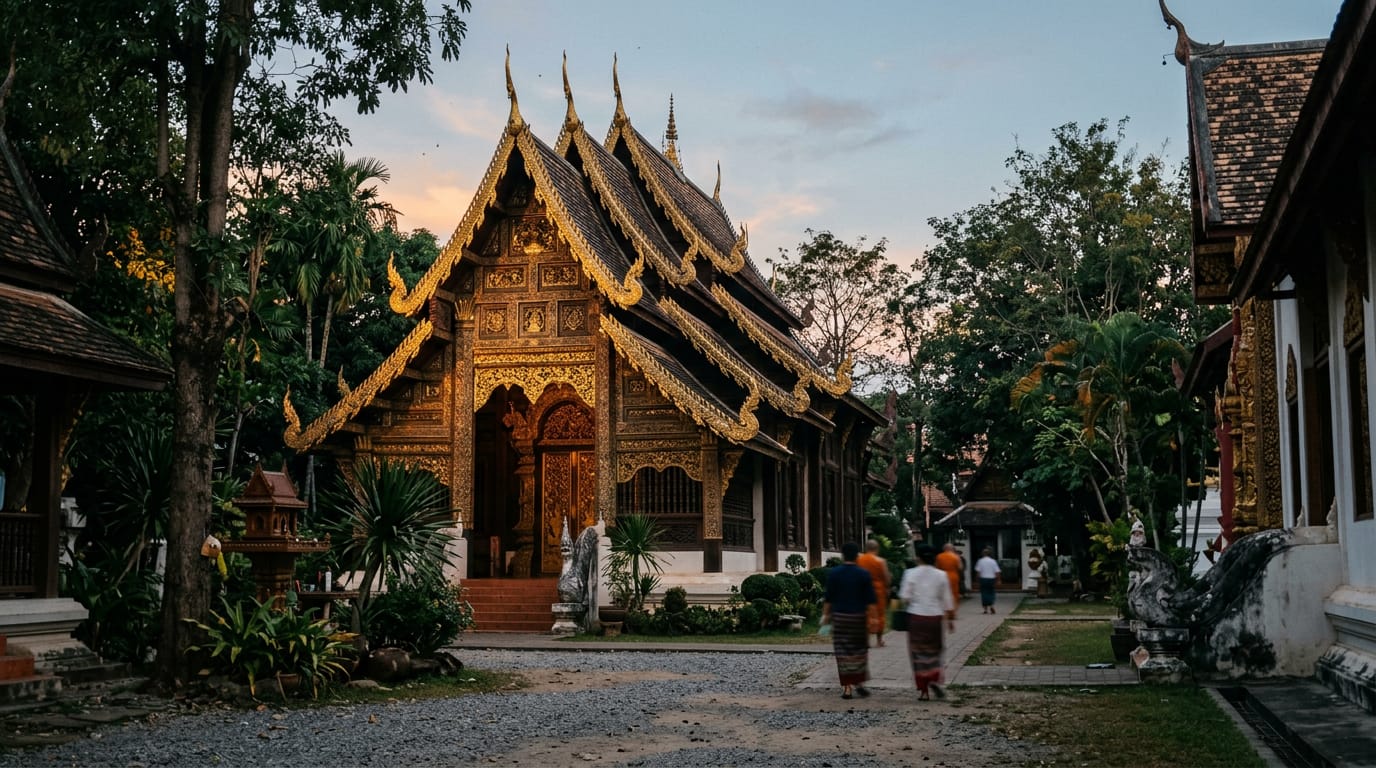
Wat Phra Singh
Wat Phra Singh is the most revered temple inside Chiang Mai's Old City, founded in 1345 by King Phayu of the Mangrai dynasty. Its Lai Kham viharn shelters the Phra Buddha Sihing — the Lion Buddha — which is paraded through the streets each Songkran. Together with its gilded chedi, carved teak gables and gold-leafed scripture library, the compound is the finest single example of Late Lanna architecture in northern Thailand.
Temple
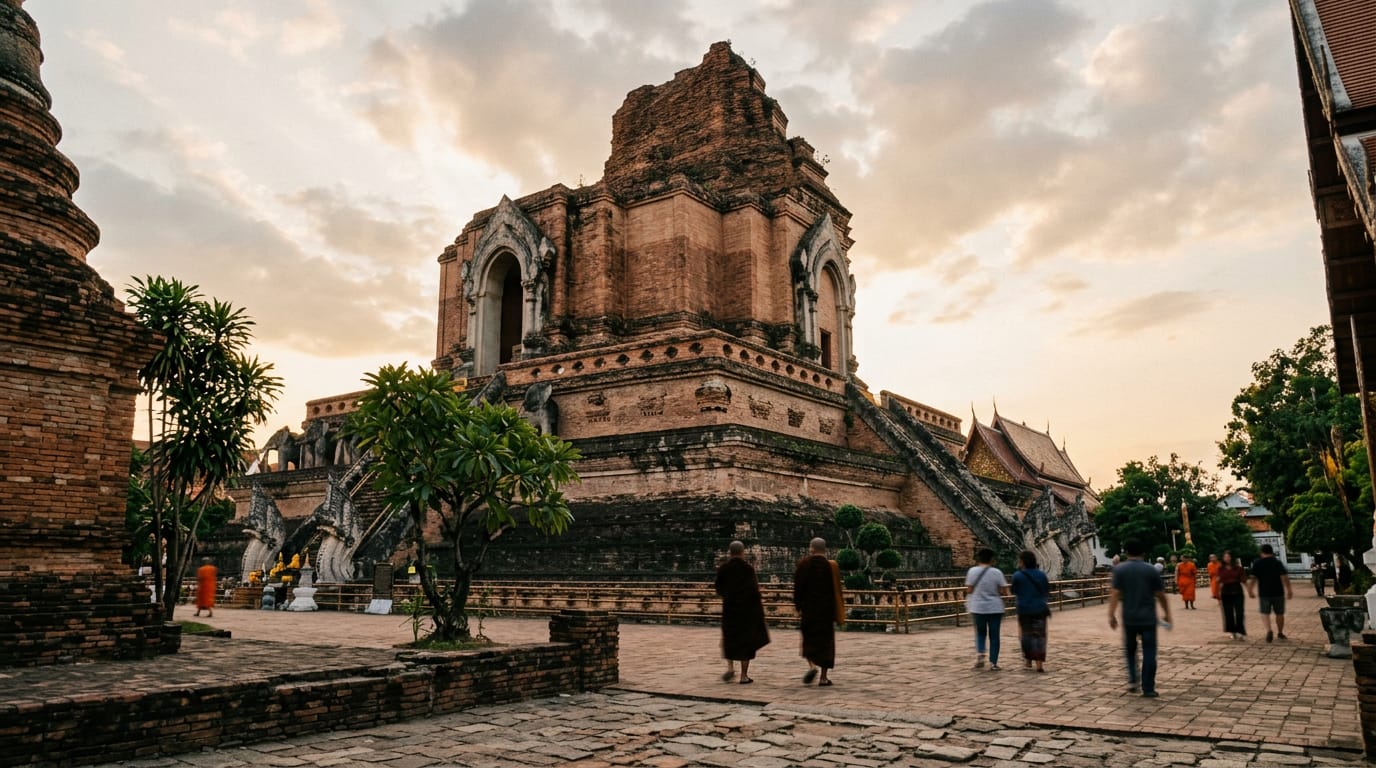
Wat Chedi Luang
Wat Chedi Luang holds the ruined 60-metre chedi that was once the tallest building in Lanna and still dominates the centre of Chiang Mai's Old City. Founded in 1391 by King Saen Muang Ma and completed in 1481 under Tilokaraj, it was partly toppled by the 1545 earthquake. The compound also houses the city pillar and Chiang Mai's active monk-chat programme.
Temple
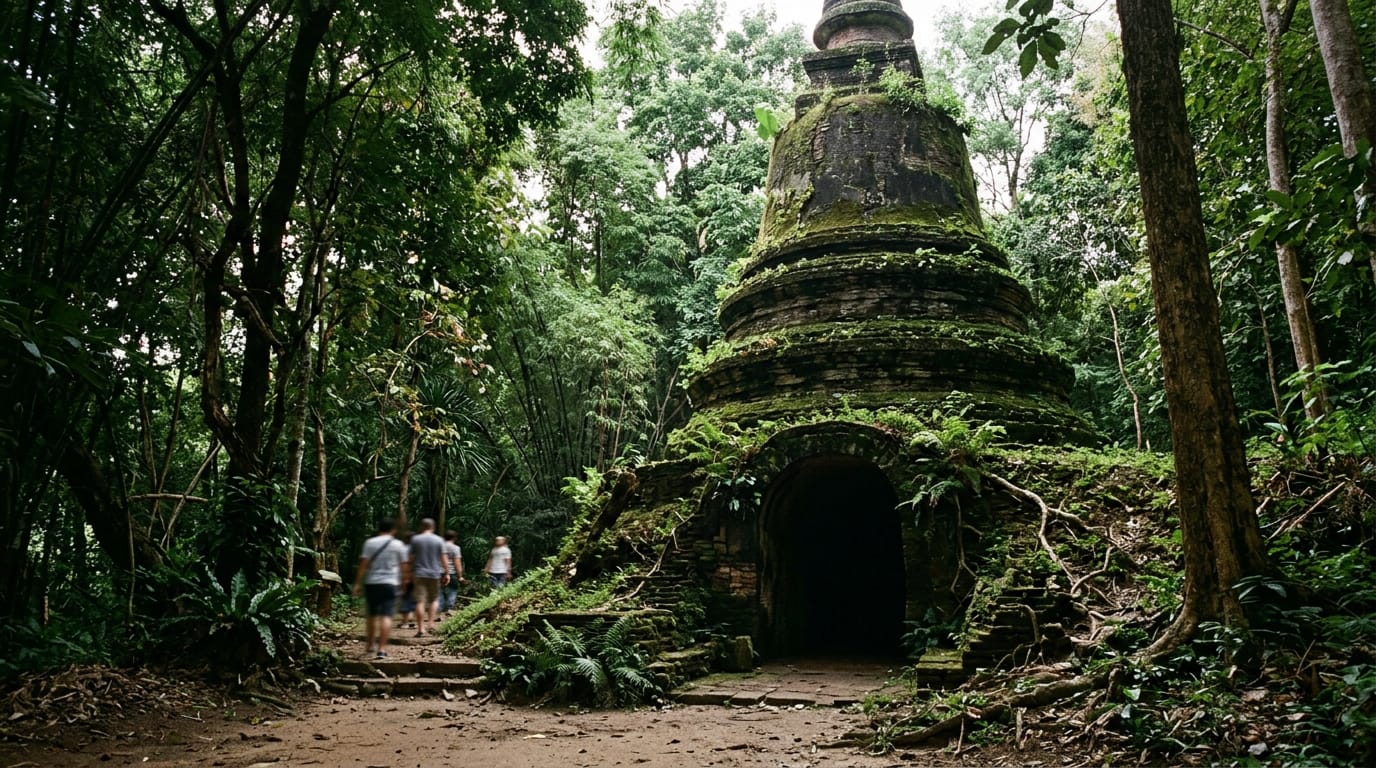
Wat Umong
Wat Umong is a forest monastery at the foot of Doi Suthep, founded by King Mangrai around 1297 for monks who preferred the quiet of the woods. Its defining feature is a set of ancient tunnels dug into the base of a Lanna chedi and painted with faded murals. A mossy stupa, a fish-and-turtle lake, and 'tree wisdom' signs in English on the trunks make it feel half an arboretum.