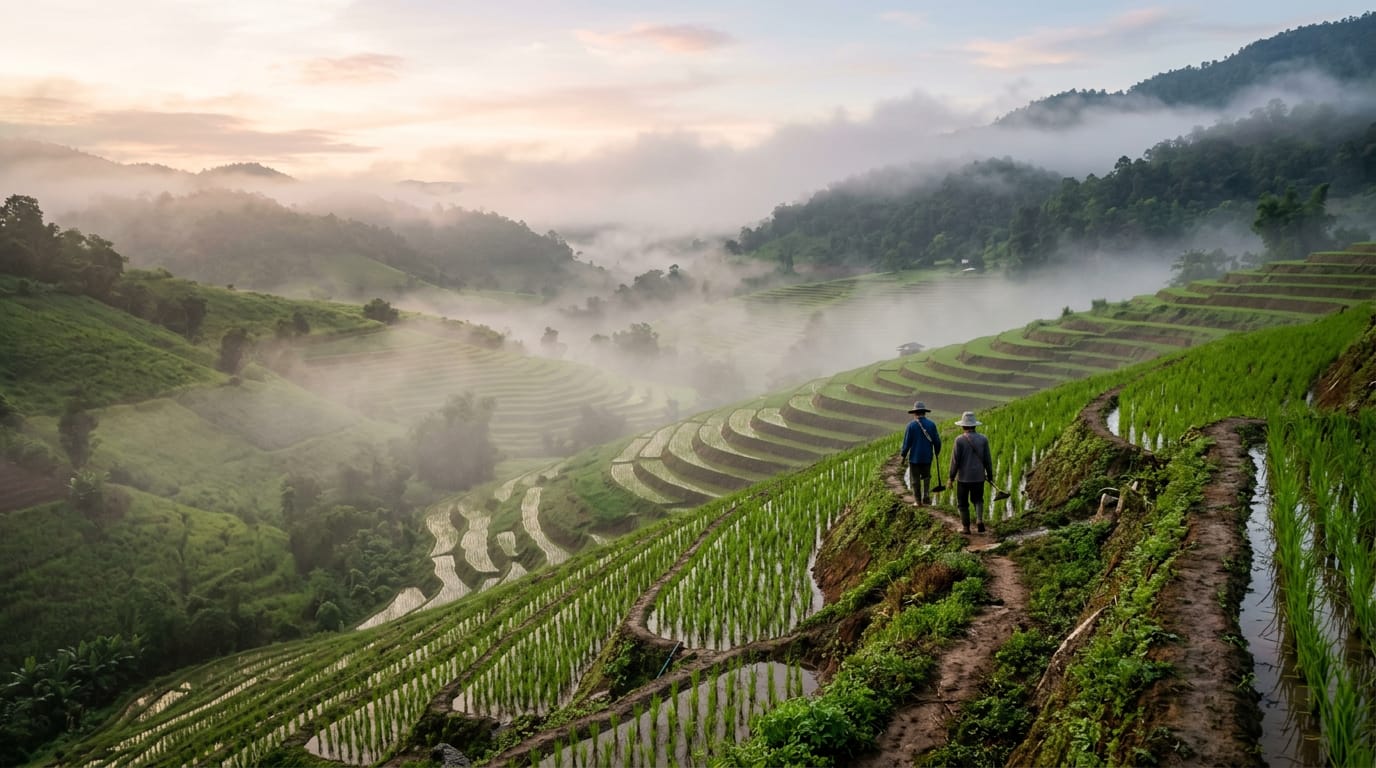
Thailand records around 1,100 bird species, more than any country in mainland Southeast Asia. The hills around Chiang Mai are a serious birding destination thanks to the elevation gradient of Doi Inthanon, the evergreen forest of Doi Suthep–Pui, the lowland belts of Mae Ping and the pheasant ridges of Doi Lang. A planned week in the cool season can produce 200 species without leaving the province.
Updated
Thailand sits at the crossroads of three of the world’s great bird regions. The Sino-Himalayan range to the north pushes a tongue of montane forest south through northern Thailand, the Sundaic rainforests of the peninsula reach up from the south, and the Indo-Burmese dry forest belt covers much of the central plain. The result is one of the richest avifaunas in mainland Asia: roughly 1,100 species recorded, of which some 950 occur regularly. Around 380 species have been recorded inside the boundary of Doi Inthanon National Park alone (doi is the northern Thai word for mountain).
For visiting birders, the practical implication is that northern Thailand punches well above its weight. The Chiang Mai region offers serious mountain birding within a ninety-minute drive of the city, productive lowland sites within thirty minutes, and a stable infrastructure of guides, hides and feeding stations that make ambitious species counts realistic for a week-long trip.
Why northern Thailand is a birding destination
Three factors combine. The first is elevation. Doi Inthanon’s summit at 2,565 m is the highest point in Thailand, and the mountain produces a near-continuous gradient from dry deciduous foothills through evergreen broadleaf forest into upper-montane oak, then cloud-forest, and finally a sphagnum bog at the top. Each band holds a different community of birds, and several of the high-elevation species occur nowhere else in the country.
The second is geographic position. Northern Thailand is the southern extremity of the breeding range for a series of Himalayan species, including Mrs Hume’s Pheasant, Ashy-throated Warbler and Spectacled Barwing, and the wintering range for an even larger group of Palearctic migrants that pour south down the Asian flyway each October. The mix changes through the year, but from November to February the resident community is supplemented by tens of thousands of arriving migrants.
The third is access. The mountains are wrapped in a network of well-maintained roads, the national parks are open to visitors, and the local birding community has been mapping reliable stake-outs for forty years. Communities along the foreign-language birding circuit on Doi Lang and Doi Ang Khang maintain feeding stations where notoriously skulking species come out into the open. Few tropical destinations offer this combination.
The flagship birding sites
Doi Inthanon
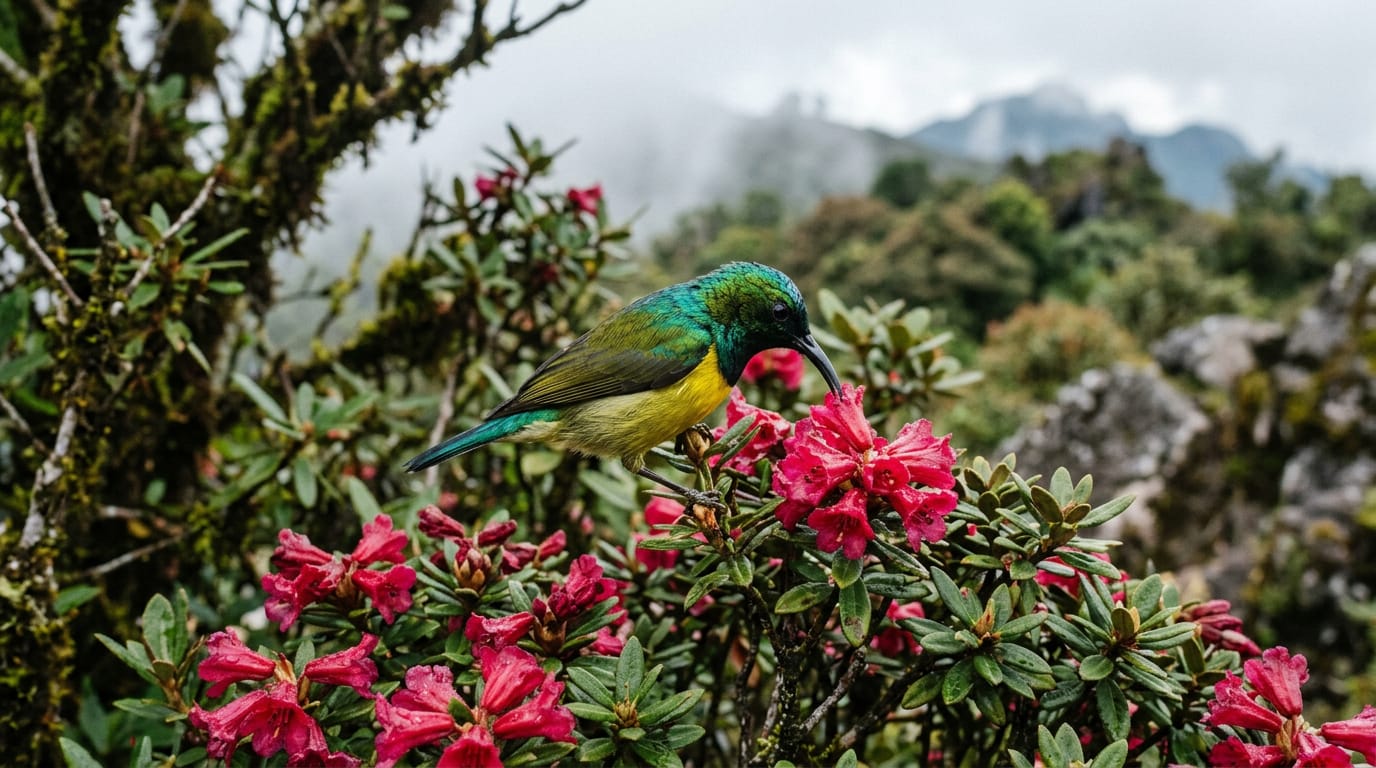
The headline site. The 482 km² national park covers the full elevation gradient and contains several distinct birding areas. The summit boardwalk at 2,565 m is the obvious target, with the sphagnum bog producing Green-tailed Sunbird, Ashy-throated Warbler, Yellow-bellied Fantail, Dark-sided Thrush and the very localised Pygmy Wren-babbler. The Mr Daeng nature trail nearby, formerly the Khun Wang trail, is reliable for Mrs Hume’s Pheasant on the best mornings, plus Snowy-browed Flycatcher, Rufous-winged Fulvetta and several laughingthrush species.
Mid-elevation sites around the park headquarters at 1,300 m hold White-browed Scimitar Babbler, Maroon Oriole and a wide variety of bulbuls. The Mae Pan road climbs through some of the best primary forest in the country. Lower elevations around the Vachiratharn waterfall produce Long-tailed Broadbill, several barbet species and the occasional Crested Serpent Eagle.
Doi Suthep–Pui
Doi Suthep is the closest mountain to Chiang Mai city and the easiest day-trip. Habitat is broadleaf evergreen forest on the upper slopes, mixed with cultivation lower down. Flagship species include Mountain Bulbul, Grey Bushchat, Rusty-naped Pitta (most often calling at dawn from the head of the San Khu valley) and the localised White-headed Bulbul. The park is also the most reliable site near the city for Slaty-backed Forktail along the streams.
Huay Tung Tao reservoir
A flat-water site twenty minutes from the old town, circled by an easy 4 km walking loop and productive for kingfishers, herons and wintering ducks. Common Kingfisher, White-throated Kingfisher and the much rarer Pied Kingfisher all occur. From November to February, the reservoir holds Lesser Whistling-duck and small flocks of Garganey. Cinnamon Bittern works the reedbeds.
Mae Ping National Park
The most accessible of the lowland dry-forest sites. Habitat is dipterocarp deciduous forest, ideal for the woodpecker and barbet guilds. Flagship species include the spectacular Black-headed Woodpecker, Burmese Shrike, Common Iora and several flowerpecker species. The park has been the most reliable Thai site for the elusive Indian Roller in recent years.
Doi Lang
A long ridge running along the Myanmar border at 1,500–2,000 m, three hours’ drive north of the city. Reliable for several northern montane species rarely seen elsewhere in Thailand, including Mrs Hume’s Pheasant (commoner here than on Doi Inthanon), Giant Nuthatch, Crimson-breasted Woodpecker, Himalayan Cutia and Spectacled Barwing. The feeding stations maintained by local Lahu villages (one of the six recognised hill-tribe peoples) on the east-side road produce close, prolonged views of all of the above. Best from January to mid-February.
Doi Ang Khang and Doi Chiang Dao
Two more ridges within day-trip range that are worth mentioning. Doi Ang Khang, west of Fang, is a small upland plateau with royal-project orchards that hold Daurian Redstart, Black-breasted Thrush and several rosefinch species in winter. Doi Chiang Dao, the limestone massif east of the road north, supports the only Thai population of Giant Nuthatch outside Doi Lang, and the trail up to the summit zone is one of the few routes in the country where Hume’s Treecreeper has been recorded. Permission for the upper trail must be arranged in advance through the park office.
By season
| Period | Mode | Notable species |
|---|---|---|
| Nov–Feb | Migrants peak | Warblers, thrushes, flycatchers, Mrs Hume’s Pheasant displays Jan |
| Mar–May | Smoke + heat | Limited birding mid-Mar to mid-Apr |
| Apr–Jun | Breeding | Pittas calling, broadbill nests, hornbill activity |
| Jul–Sep | Monsoon | Lowland birding only, leeches in hills, residents quiet |
| Oct | Transition | First migrants returning, monsoon withdrawing |
The cool season is the obvious time, with the highest species totals, the cleanest air and the most comfortable conditions for early starts. From late February through April, the smoke from agricultural burning fills the basin and reaches well up into the hills; birding on Doi Suthep can be unpleasant, and on the worst days the national parks close. Breeding activity from April to June is excellent in principle, but May heat is punishing and June brings the monsoon. From July through September, only lowland sites are really viable; the high mountains are cloud-bound, the trails are leech-ridden and resident species are quiet. October is the start of the autumn migration and a useful, if quiet, transitional month.
The winter migrant influx is the most exciting feature of the calendar. From late October, the first leaf warblers arrive from the north, followed through November by thrushes, flycatchers, redstarts and the bulk of the Phylloscopus complex. By December the wintering community has settled and remains in place until late February. Several of these species, including Eyebrowed Thrush, Daurian Redstart and Asian Brown Flycatcher, are abundant for three months and absent for the other nine. Wintering ducks build up on Huay Tung Tao and Doi Tao reservoir from November, with Garganey, Northern Pintail, Eurasian Wigeon and Tufted Duck the most regular. Raptor passage runs through October and November on the ridges, with Black Baza, Chinese Sparrowhawk, Japanese Sparrowhawk and Grey-faced Buzzard all passing in modest numbers. By March the winter community begins to thin, and by mid-April most of the migrants have moved north.
| Site | Flagship species |
|---|---|
| Doi Inthanon | Mrs Hume’s Pheasant, Green-tailed Sunbird, Ashy-throated Warbler, Pygmy Wren-babbler |
| Doi Suthep–Pui | Mountain Bulbul, Rusty-naped Pitta, Grey Bushchat, Slaty-backed Forktail |
| Huay Tung Tao | Pied Kingfisher, Lesser Whistling-duck, Cinnamon Bittern |
| Mae Ping | Black-headed Woodpecker, Burmese Shrike, Indian Roller |
| Doi Lang | Giant Nuthatch, Mrs Hume’s Pheasant, Himalayan Cutia, Spectacled Barwing |
What to bring
A pair of 8×42 or 10×42 binoculars is the indispensable tool. The light in the upper-montane forest can be poor under closed canopy, so glass with reasonable low-light performance is worth the weight. A spotting scope is worth carrying for Doi Lang and Huay Tung Tao but is overkill on the steeper trails of Doi Inthanon and Doi Suthep.
Craig Robson’s Birds of Thailand is the field guide of record, in print since 2000 and updated periodically. The illustrations are reliable, the range maps are honest and the text covers vocalisations. Pair it with the Merlin Bird ID app and its Thailand bird pack, which gives you sound identification and several reference photographs per species. The eBird Thailand portal lists current sightings and ranked hotspots for every site mentioned above.
For clothing, the cool season demands a fleece for dawn starts at altitude. Doi Inthanon’s summit can be near freezing in January; the trails to the bog have raised boardwalks that channel cold wind. Lower elevations are comfortable in shirt-sleeves. Bring insect repellent year-round and a head torch if you plan an owl walk. Long-sleeved layers in muted colours work well; avoid white and bright primary colours, which make difficult species more wary.
Local guides and clubs
The Bird Conservation Society of Thailand is the country’s main amateur organisation and a useful first contact for trip planning. The society organises occasional weekend trips, publishes the journal Bird Conservation and acts as the eBird Thailand administrator. A small ecosystem of local birding guides operates out of Chiang Mai, most of whom are former park rangers or long-time enthusiasts. A guided day at Doi Inthanon typically runs 3,500–5,000 baht (the Thai currency) for one to four guests, depending on transport. Half-day visits to Huay Tung Tao or Doi Suthep are cheaper. Multi-day trips to Doi Lang usually include accommodation in a Lahu village homestay.
If you are visiting for two days, take a guide for one of them and self-guide the other; the first will accelerate your learning curve and the second will let you apply it. For a full week, two guided days at Doi Inthanon and Doi Lang plus self-guided time on Doi Suthep and Huay Tung Tao is the standard productive itinerary, with a final day at Mae Ping for the dry-forest species. Most local guides will pick you up from a city hotel before 5 am, drive to the start point and have you at the first stake-out before sunrise.
Ethical birding
Stay on marked trails inside the national parks. Most of the upper-montane forest is fragile, and the boardwalks exist to keep observers out of the moss layer and the bog. Keep distance from active nests, particularly during the April-to-June breeding season; a 50 m buffer is sensible for ground-nesting species and for any pheasant. Do not use playback during the breeding season. Outside breeding, limit playback to one short burst and abandon it if the bird responds; repeated calls disrupt territorial behaviour even when they appear to “work” for the observer.
Take all rubbish out, including organic waste; banana skins and orange peel take months to break down and attract macaques to trails. Photograph from a respectful distance and never bait wild birds outside the established community feeding stations, which are managed under local agreement. The best birding day is one where the birds barely register that you were there.
Frequently asked questions
What's the best birdwatching site in Chiang Mai province?
Doi Inthanon National Park, without serious competition. The road climbs from 400 m to 2,565 m in under thirty kilometres, and each elevation band holds different habitat and different birds. The summit boardwalk, the Mr Daeng trail and the lower agricultural valleys can together produce 100 species in a single day for an organised group.
Can you see pheasants on Doi Inthanon?
Yes. Silver Pheasant is regularly seen on the lower slopes, especially along the Mae Pan road early in the morning. Mrs Hume's Pheasant has been recorded on the upper ridges and around the summit area but is genuinely rare and most visiting birders never connect with it.
What's the rare bird at the summit?
Two stand out. The Ashy-throated Warbler is a Himalayan species whose only Thai population breeds in the sphagnum bog at the summit. The Pygmy Wren-babbler skulks at the same altitude and is more often heard than seen. The Green-tailed Sunbird is more reliably visible and is one of the visual highlights of any visit.
When is birding season in northern Thailand?
November to February is the strongest window. Resident species are joined by large numbers of winter migrants from the Himalaya, central Asia and Siberia, including warblers, thrushes, flycatchers and ducks. Air quality is at its best and trails are dry. The cool, clear weather is ideal for early starts.
Do I need a guide for birding around Chiang Mai?
Not strictly, but a guide will multiply your species count if you have less than a week. Local guides know the calling territories, the current stake-outs for difficult species and the access permissions on private orchards and military-controlled ridges. Self-guided visits work well for general birding using Merlin and Robson's field guide.
What's the best month to visit Doi Lang?
January and February. The road is fully open, migrants are settled, and the bird feeders maintained by local communities are at peak activity. Earlier in the cool season the migrants have not all arrived; later, the burning haze begins to affect both birds and observers.
Can I see hornbills near Chiang Mai?
Hornbills are a southern-Thailand speciality but two species occur in the north. Oriental Pied Hornbill is occasional in the Mae Ping lowlands and around Sri Lanna reservoir. The much rarer Great Hornbill is reported from remote sections of Doi Inthanon and Doi Chiang Dao but should not be planned for.
What field guide should I bring?
Craig Robson's 'Birds of Thailand' (Princeton/Asia Books) is the standard work, in print since 2000 with multiple revisions. Pair it with the Merlin Bird ID app and its Thailand bird pack, which gives sound recognition and reliable photographs for the common species. The eBird Thailand portal is the best place to plan hotspots.
Is birding compatible with the rainy season?
Yes, with caveats. Breeding activity peaks from April to June, so song is at its loudest and many resident species are displaying. The trade-off is heat in May, storms from June and the absence of the winter migrants. Lowland sites work better than the high mountains in the wet.
Are there bird hides on the main mountains?
Yes. The Doi Inthanon summit boardwalk includes screens onto the bog, the Mr Daeng nature trail has feeders, and local communities on Doi Lang and Doi Ang Khang maintain feeding stations for sunbirds and laughingthrushes. These are usually free or take a small donation.