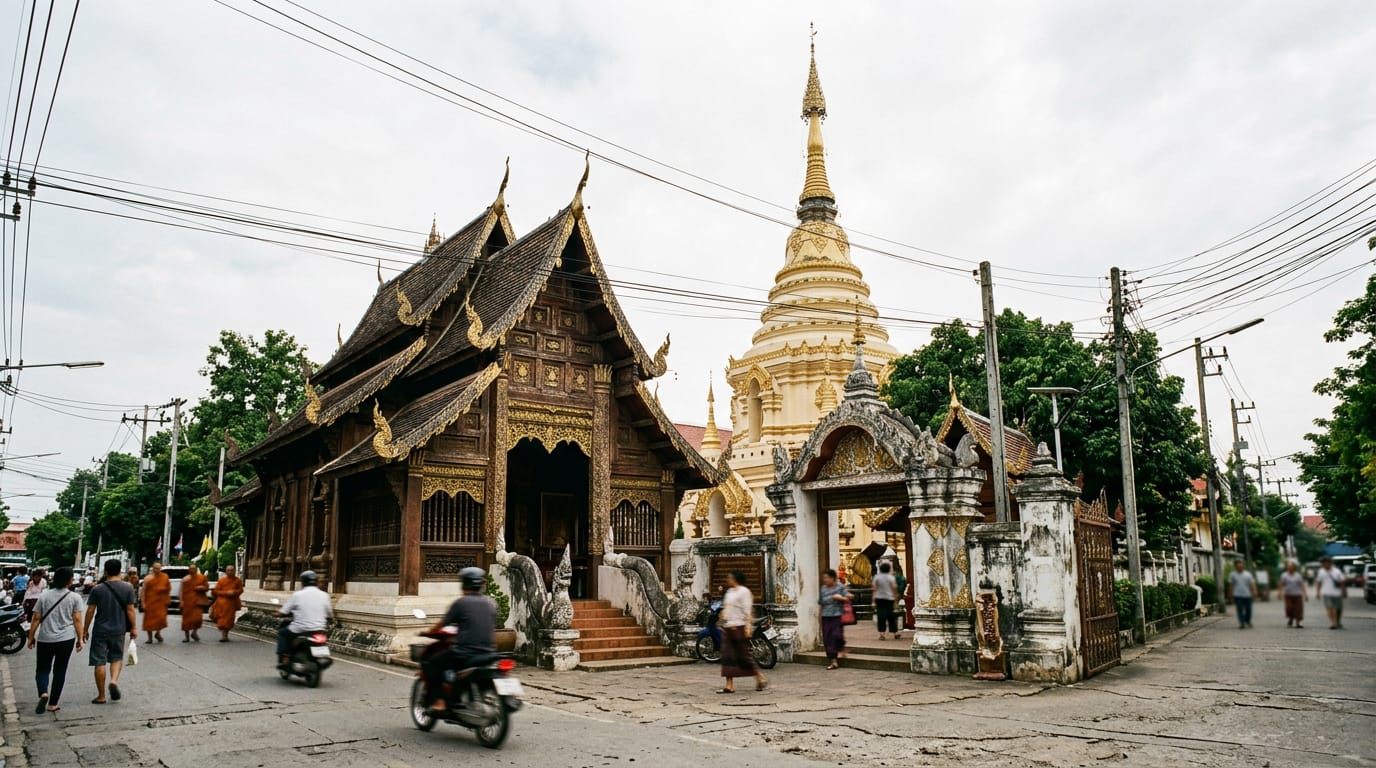
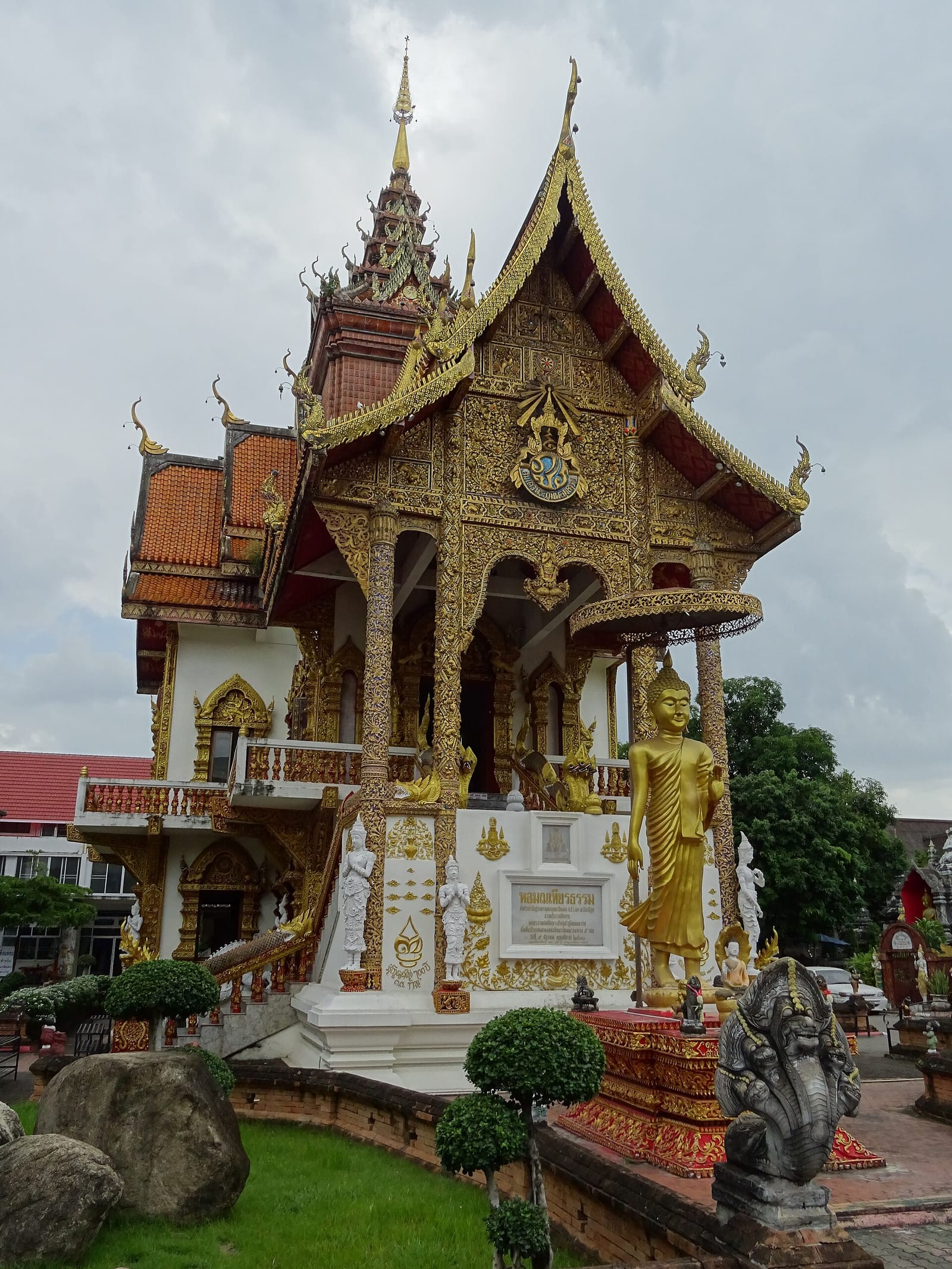
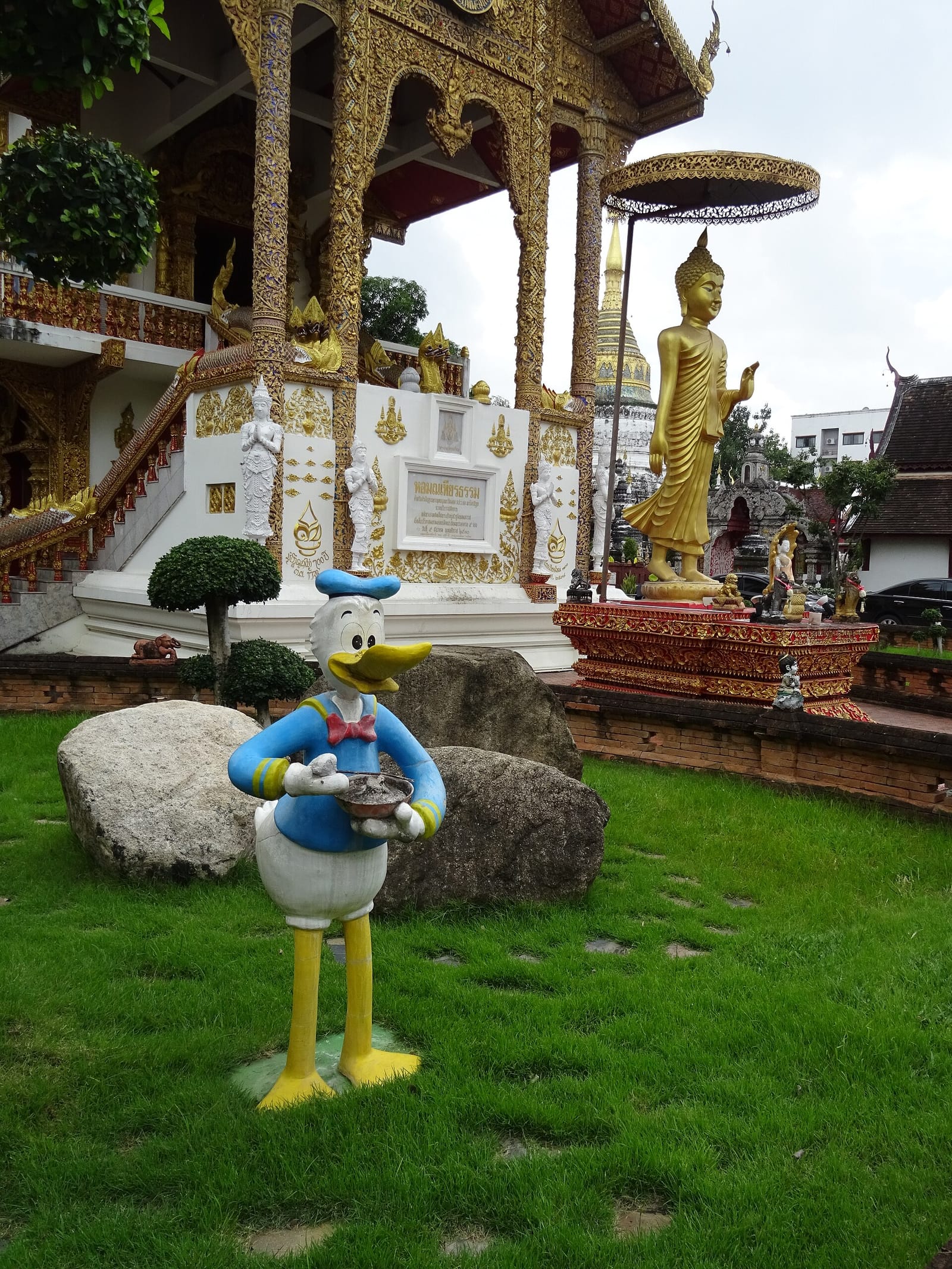
Wat Bup Pha Ram, the 'Flower Park Temple', sits on Tha Pae Road between the eastern moat and the Ping River. Founded in 1497 by King Muang Kaew, it carries three principal halls: a 19th-century Burmese-style chedi, an older teak viharn with rare painted murals, and a modern marble hall. A Donald Duck statue holding an alms bowl outside the dhamma hall has become a small local landmark.
Updated
Wat Bup Pha Ram is the ‘Flower Park Temple’ on Tha Pae Road, the busy strip that runs east from Tha Phae Gate to the Ping River. Most visitors walking the route between the Old City and the Night Bazaar pass it without stopping. They miss one of the most layered short visits in central Chiang Mai: a 1497 Mangrai foundation, an 1817 teak viharn with sixteenth-century mural fragments, a Burmese-style chedi from 1854, a modern marble hall from 1996, and (inexplicably) a small painted Donald Duck statue holding an alms bowl outside the dhamma hall.
History and significance
The temple was founded in 1497 by King Muang Kaew, the eleventh ruler of the Mangrai dynasty. Muang Kaew is best known today as the founder of Wat Sri Suphan on the southern side of the Old City, but he established several other compounds during his reign, of which Bup Pha Ram is the most easterly. The Pali-derived name means ‘Flower Park’ (bup-pha = flower, ram = park or garden) and reflects the original setting: the site was a royal flower garden before the temple was built and supplied flowers to the court for ceremonial use. The historic flower market of Chiang Mai, Tonlamyai, sits 600 metres east near the river and has supplied the temple with daily offerings continuously since the foundation.
The temple’s position explains its endurance. Tha Pae Road was the city’s main commercial artery long before it had that name: the route ran from the royal centre out through the east gate to the raft landing on the Ping River (tha pae means raft pier), where goods from the river trade came ashore. A temple on the road between the gate and the pier was never short of merchant patrons, and the compound’s successive rebuildings track the fortunes of that trade fairly closely.
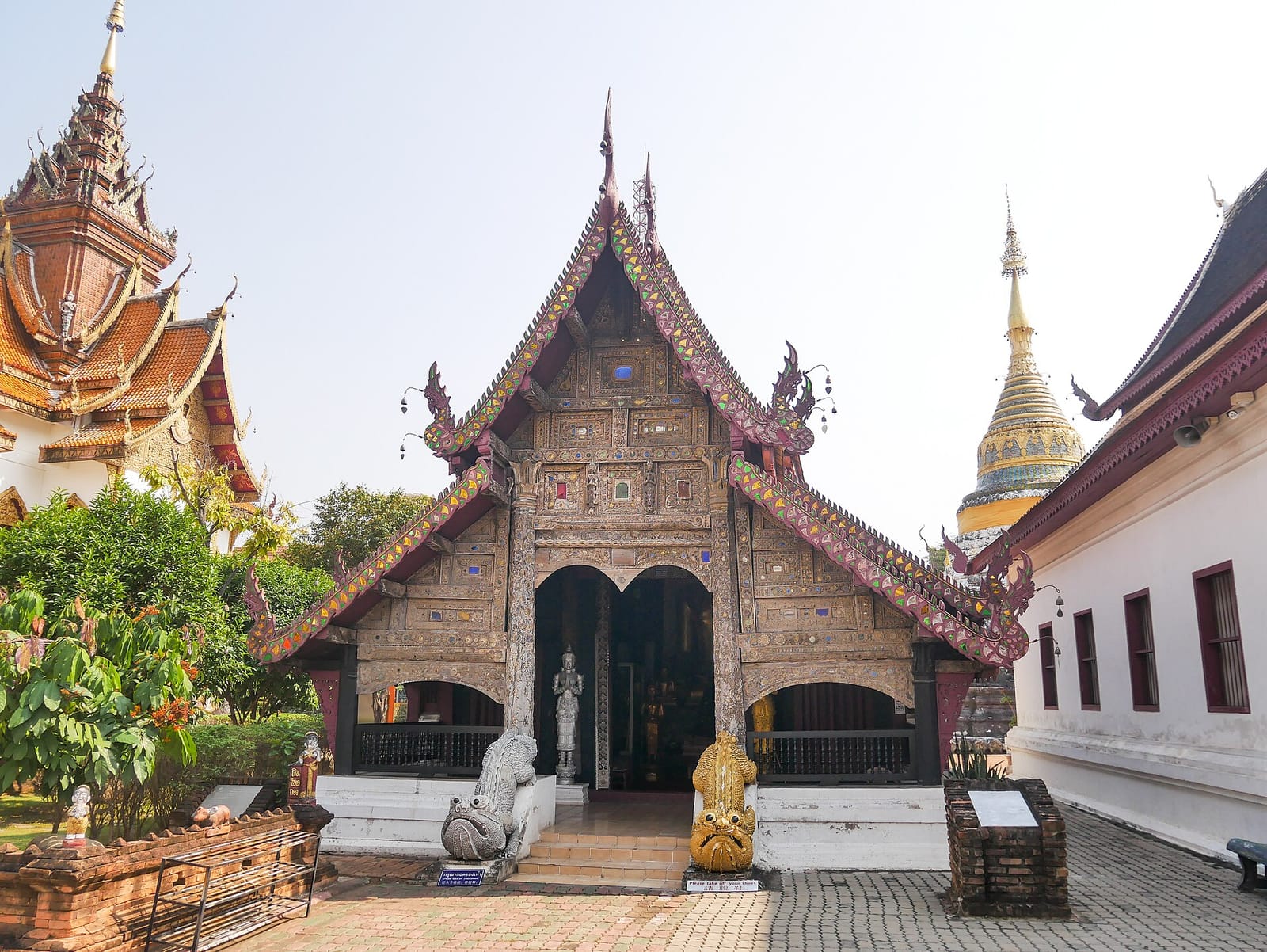
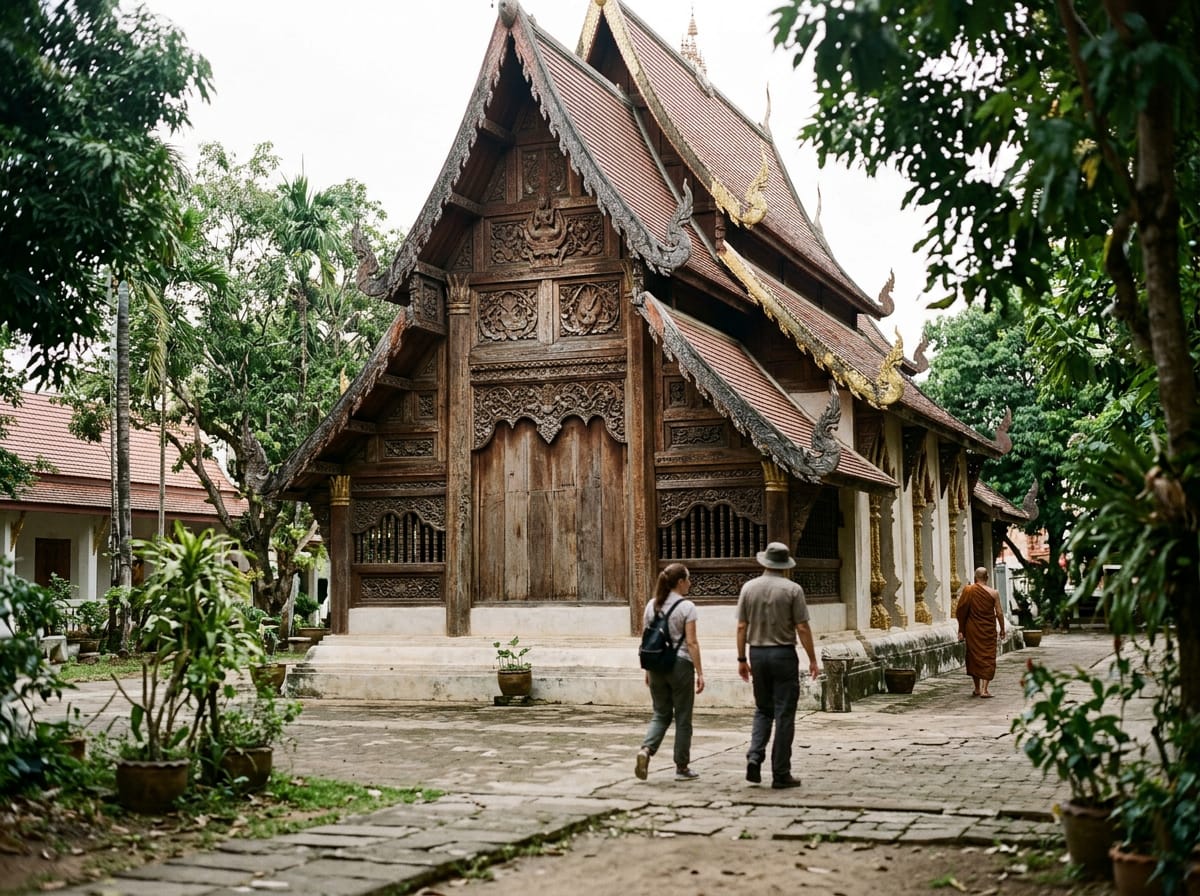
The compound went through the standard cycle of decline during the long Burmese occupations of the sixteenth, seventeenth and eighteenth centuries. The original buildings were burnt or abandoned. King Kawila’s restoration programme after 1797 reached this part of the city relatively late; the main teak viharn that visitors see today was built in 1817 by a senior monk under Kawila’s general charter. The viharn was placed on the foundations of the earlier 1497 hall, and some of the older mural fragments (particularly the village-life scenes on the lower walls) were preserved by being incorporated into the new plaster surfaces. This is why the murals carry two different stylistic periods at once: the lower panels are fragmentary sixteenth-century work, the upper and the columns are 1820s overpainting in a closely related style.
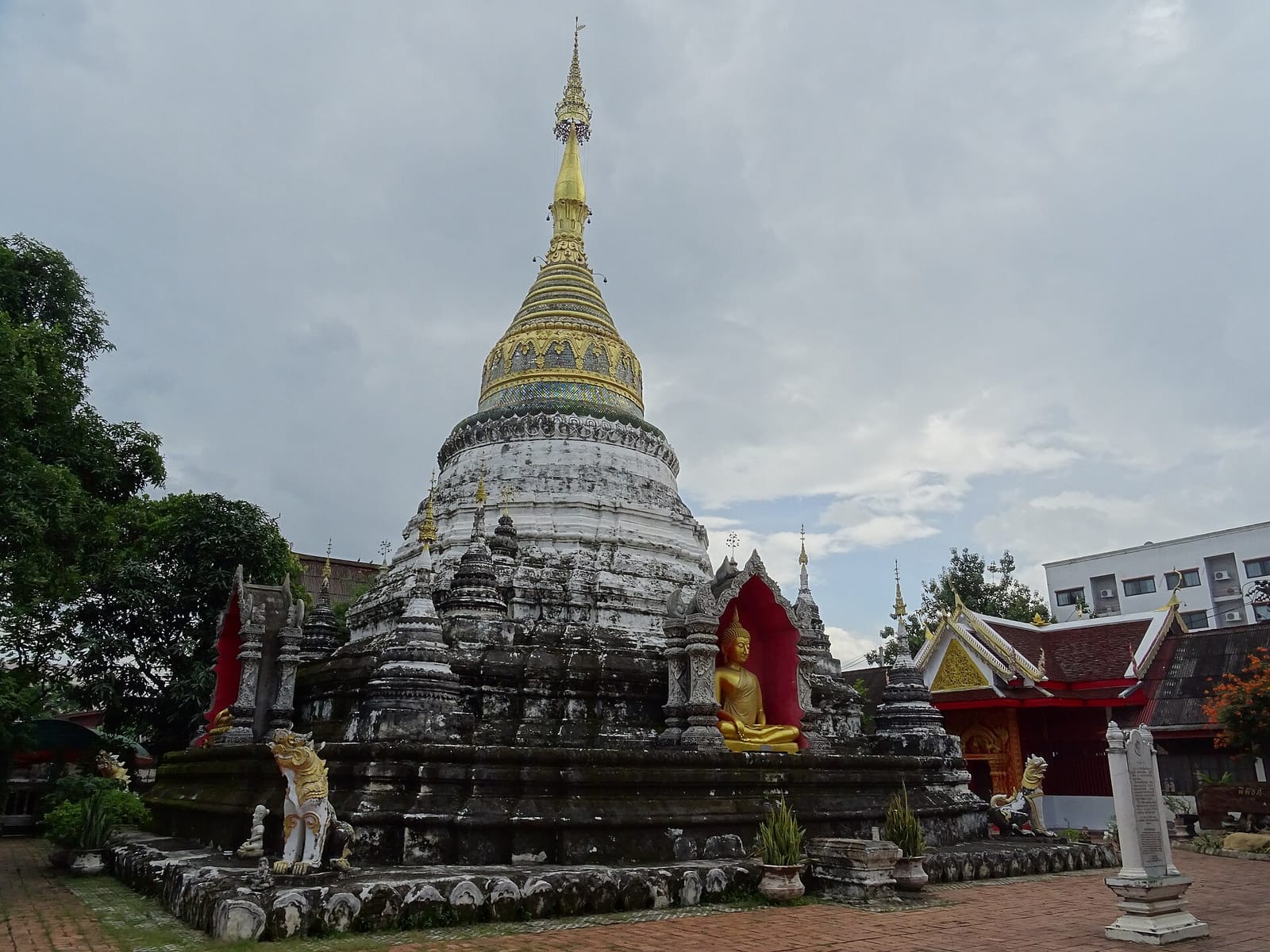
The most distinctive feature of the compound is its Burmese-style chedi, added in 1854. The mid-nineteenth century was a period of close economic and cultural exchange between northern Thailand and Burma, driven by the teak trade. Burmese merchants, scholars and monks moved freely between Mawlamyaing, Mandalay, the Shan states and Chiang Mai, and several Burmese-style chedis were built or restored in the city during this period. Wat Pa Pao in the north of the Old City is the best-known, but the Bup Pha Ram example is older and cleaner in proportion. The form is distinct: a stepped square base topped with a tall narrow spire, finished in white and gold, rather than the squat bell-and-octagon of Lanna chedis. It is one of the most legible pieces of Burmese architecture inside the Old City walls.
The third principal hall is recent. The marble hall, completed in 1996, was built to commemorate the 50th anniversary of King Bhumibol’s reign and to serve as the temple’s main assembly hall for the increased lay congregation that the surrounding Tha Pae district had developed by the 1990s. It is restrained 20th-century work (polished marble columns, a high ceiling, modest gilding) and provides an interesting contrast with the older buildings.
The temple is therefore unusually legible as a piece of layered architectural history: a Lanna teak viharn, a Burmese chedi and a modern marble hall stand side by side on one plot, each serving the same Mangrai-era foundation in a completely different idiom. Few compounds in the city show the layers as cleanly.
The Donald Duck statue in front of the dhamma hall is from a 1990s donation by a lay supporter who ran a toy business on Tha Pae Road. It is a Chiang Mai oddity, not a sacred image.
What to see
A full visit covers four features, all within a compact compound about 100 metres on each side.
The teak viharn
The teak viharn at the west of the compound is the temple’s most artistically significant building. It is a three-tiered Lanna hall in dark unpainted teak, with carved gables in the kanok flame motif, gilded bargeboards tapering into upturned naga fingers, and small carved wooden shutters along the side walls. The carving on the front gable is in the lai kham-style gilt-on-lacquer tradition, slightly less ornate than the textbook example at Wat Phra Singh but cleanly executed.
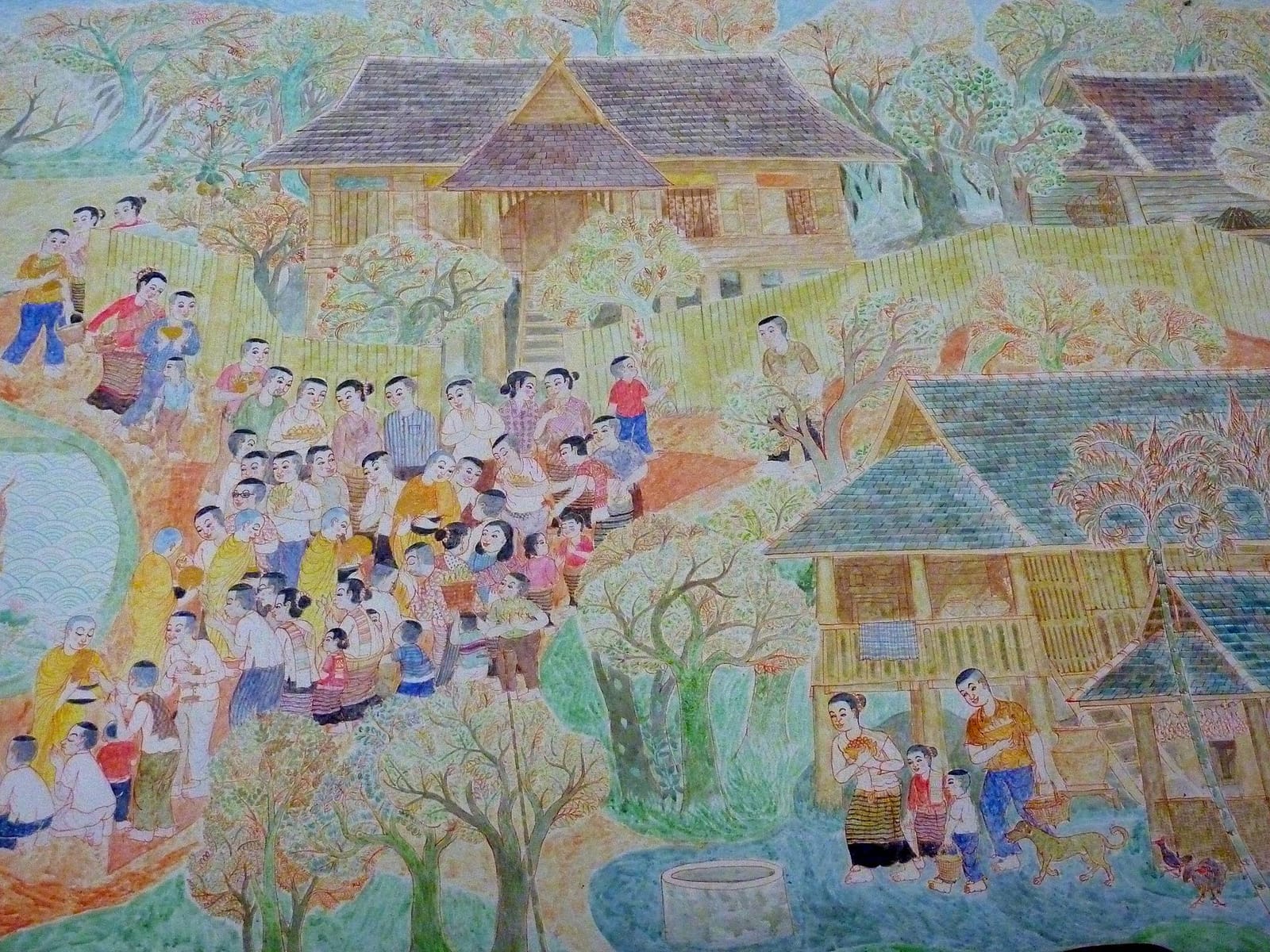
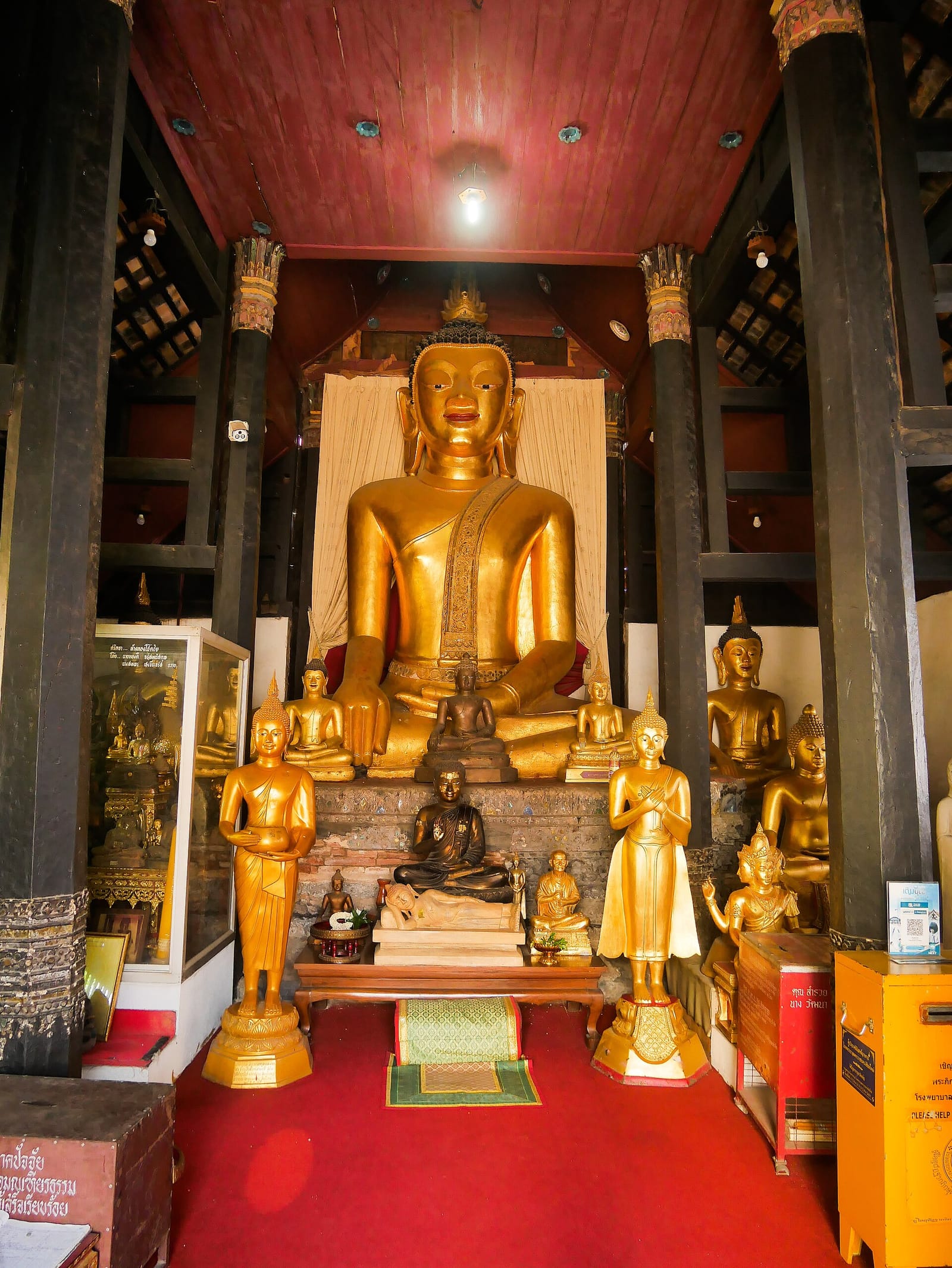
Inside, the principal Buddha image sits on a high gilded altar at the western end, in the maravijaya posture. The walls carry the mural cycle that is the main reason for visiting the temple. The lower panels (fragmentary, faded, in some places almost invisible) date to the sixteenth century and depict scenes of Lanna village life: market sellers, weavers, men smoking pipes, monks teaching novices to read. The detail is similar to the better-known Lai Kham viharn murals at Wat Phra Singh and probably reflects work by the same regional school. The upper walls and the column surfaces carry 1820s overpainting in a related style, with episodes from the Jataka tales (the previous lives of the Buddha) extending the older cycle upward.
Give the lower panels time to resolve. The sixteenth-century work does not announce itself; at first glance the south wall reads as water stains and shadow, and only after a minute do the figures separate from the ground. Work along the wall at a slow walk, a metre from the surface, and let your eyes adjust before deciding there is nothing there. The reward is the small human business of the scenes: the market sellers, the weavers, the men with their pipes, painted along the bottom of the sacred narrative. Lanna painters recorded their own world at eye level, and these walls are among the few places left where you can still see it.
Bring a small torch. The lighting inside the viharn is dim and the detail rewards a careful look. Photography is welcome; flash is discouraged because the older pigments are fragile.
The Burmese-style chedi
The 1854 Burmese chedi stands behind the teak viharn on a small raised terrace. The form is the standard Burmese Mon-influenced stepped square base of three diminishing tiers, topped with a tall narrow white spire that tapers to a small gilded hti (finial umbrella) at the top. Two pairs of chinthe (Burmese stylised lions) flank the entrance to the terrace, also distinctive of the Burmese tradition.
Stand near the terrace for a moment if there is any breeze. The hti carries a ring of small metal bells, in the Burmese manner, and their sound is faint enough that the traffic on Tha Pae Road usually swallows it. Early morning is the only reliable time to hear them.
Walk around the chedi clockwise once, the standard circumambulation direction. The view from the north-east side, with the teak viharn behind, is the best photograph of the compound and combines all three principal buildings (teak viharn, Burmese chedi, modern marble hall) in a single frame.
The marble hall
The 1996 marble hall sits to the east of the chedi and serves as the principal assembly hall for daily chanting. It is open during all compound hours and is the largest covered space in the temple. Architecturally it is restrained (polished marble columns, a steep pitched roof, modest gilding) but as a contemporary religious building it is one of the better small marble halls in the city. Step inside, sit briefly at the back, and step out again.
The ubosot and the gardens
The ordination hall sits at the rear of the compound, marked by sema boundary stones and used only for ordinations and major ceremonies. The exterior carving is fine work; the interior is usually closed. The gardens around all four buildings are well kept, with frangipani trees, small offering shrines and a stone water trough by the south wall where lay supporters bring rice in the morning.
The Donald Duck statue stands in front of the dhamma hall, alms bowl in hand. Take the photograph and move on.
How to visit
Wat Bup Pha Ram sits on Tha Pae Road, the main east-west street between the Old City moat and the Ping River. The temple gate is 200 metres east of Tha Phae Gate on the south side of the road.
From Tha Phae Gate, walk east along Tha Pae Road for 200 metres; the gate is on the right. The walk is 5 minutes through one of the busiest pedestrian stretches in central Chiang Mai. From the Night Bazaar at Chang Khlan Road, walk west along Tha Pae for 600 metres; the gate is on the left.
A red songthaew from anywhere in the city to Tha Phae Gate costs 30 to 50 baht, and the temple is then a short walk. A Grab directly to the temple is rarely worthwhile because the walk from Tha Phae Gate takes less time than the car ride during much of the day. From the airport, a taxi is 200 baht and takes 20 minutes.
Parking is awkward. The compound has no formal car park. Motorbikes can park on the verge directly outside the gate. The nearest paid car park is at the Tha Phae Gate plaza, 200 metres west, charging 20 baht per hour. The Saturday and Sunday Walking Streets close Tha Pae Road to vehicles in the late afternoon and evening, so plan around the timing.
The neighbourhood around the temple is the most concentrated commercial strip in central Chiang Mai. Cafes, restaurants, small art galleries and tailors line both sides of Tha Pae Road for the whole distance to the river. A coffee before the temple, a meal at one of the nearby restaurants after, and a walk to the river afterwards, particularly at sunset, is a pleasant rhythm.
If you are building a day around the temple, the sequence that works best runs east to west: flowers and breakfast near the river, the temple in mid-morning quiet, then the moat and the Old City compounds before lunch. Doing it the other way round puts you on Tha Pae Road at its hottest and most clogged.
Etiquette and dress code
The standard rules apply. Cover shoulders and knees; vests, short shorts, sheer tops and miniskirts are not permitted inside any of the three principal halls. Sarongs are lent in a basket by the teak viharn entrance. Shoes come off before entering any of the three halls. Hats and sunglasses should be removed inside. Sit with your legs tucked to the side rather than crossed before any Buddha image. Do not point your feet at an image. Women should not hand objects directly to monks. Photography is welcome throughout the compound; flash near the older mural panels in the teak viharn is discouraged. Drones are not permitted anywhere inside the Old City moat.
Best time to visit
The temple is at its best in the late afternoon, between 15:30 and 17:00, when warm west light catches the carved teak gables of the older viharn and the Burmese chedi reads cleanly against the eastern sky. The 16:30 evening chanting in the marble hall begins shortly after the best photography light fades.
Weekday mornings are the quietest visiting time, typically only a handful of foreign visitors and a small number of local lay supporters arriving with rice for the morning alms round. The temple is one of the few inside the Old City moat where you can reliably find space and quiet at any time of day.
If you come in the morning, walk in from the east the way the offerings do. Tonlamyai market is already trading at dawn; buy a phuang malai (a threaded jasmine garland) for around 20 baht on Praisani Road, carry it the 8 minutes to the temple and leave it at the altar in the teak viharn. Flowers have travelled this road to this altar for five centuries, and taking one yourself costs less than a coffee.
Saturday and Sunday afternoons are different. The Tha Phae Walking Street (Sunday) and the Saturday Wua Lai street to the south both feed pedestrian traffic past the temple gate, and the compound is correspondingly busier with curious passers-by. The temple itself stays open and the chanting still takes place, but the gate area is loud.
The full-moon Buddhist holy days (Wisakha Bucha in May, Asanha Bucha in July, Makha Bucha in February) bring quiet wian thian candlelight processions around the Burmese chedi at dusk. The processions are particularly atmospheric because the chedi’s tall white form lights well from below.
Nearby and related
Wat Bup Pha Ram sits in the cluster of temples and markets that run between Tha Phae Gate and the Ping River, and pairs naturally with neighbours both inside and just outside the moat.
- Wat Chedi Luang — the great ruined royal chedi of the Old City, 10 minutes’ walk west inside the moat. The natural anchor for any Old City temple morning.
- Wat Phra Singh — the principal Late Lanna royal temple, 18 minutes’ walk further west, holding the Phra Buddha Sihing and the celebrated Lai Kham viharn murals that are stylistically related to the Bup Pha Ram murals.
- Tonlamyai Flower Market — the historic flower market that has supplied Wat Bup Pha Ram with offerings since the 1490s, 8 minutes’ walk east on Praisani Road just before the Ping River.
- The Chiang Mai Night Bazaar on Chang Khlan Road sits 12 minutes’ walk south-east, short of the Ping River, and is the natural evening continuation of a Tha Pae temple-and-market walk.
Photos
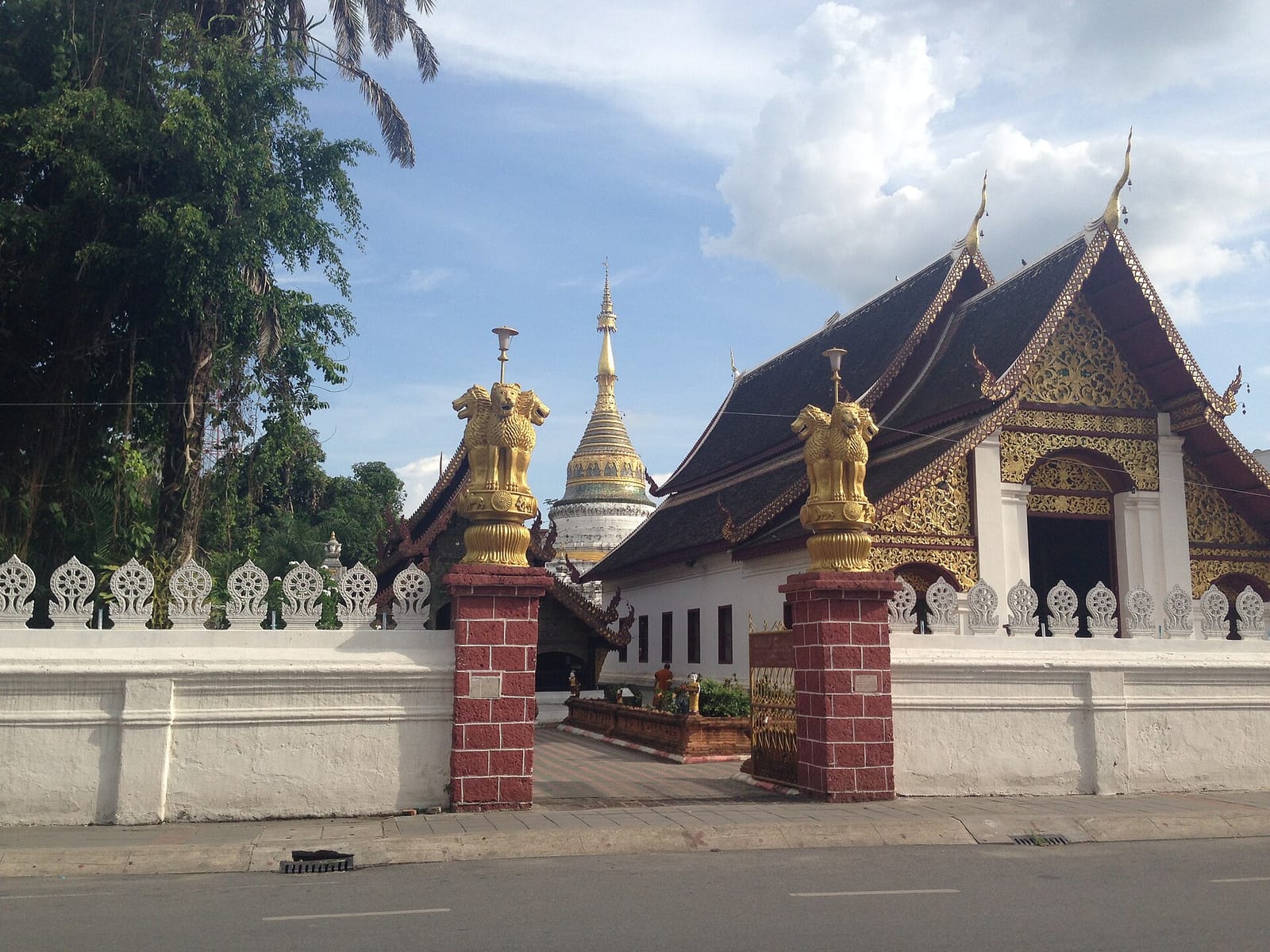
Frequently asked questions
What time does Wat Bup Pha Ram open?
Wat Bup Pha Ram opens daily at 06:00 and closes at 17:00. All three principal halls are accessible during these hours. Morning chanting takes place at 06:30 in the marble hall and evening chanting at 16:30. The compound is one of the few in the city that often stays half-open later than 17:00 because monks live in residential cells along the south wall and the gates are not locked until sundown.
Is there an entry fee at Wat Bup Pha Ram?
No. Entry is free for everyone. A donation box stands inside each hall — 20 baht is customary if you light incense or candles. The temple does not sell tickets and has no separate fee for any of the three halls or for the Burmese chedi. Monk chats are also free, with a donation appreciated.
Where is Wat Bup Pha Ram?
Wat Bup Pha Ram sits on Tha Pae Road about 200 metres east of Tha Phae Gate, between the Old City moat and the Ping River. The street address is 143 Tha Pae Road. From Tha Phae Gate the walk is 5 minutes east along the main pavement; from the Night Bazaar, which sits between the temple and the Ping River, it is 12 minutes west. The temple is easy to spot from the road; inside, the Donald Duck statue in front of the dhamma hall is the landmark everyone photographs.
Why is there a Donald Duck statue at the temple?
The painted concrete Donald Duck statue, shown holding an alms bowl in front of the dhamma hall, is a quirky donation from a former lay supporter of the temple who ran a small toy business on Tha Pae Road in the 1990s. The figure was placed as a playful gesture for children attending the temple school. Successive abbots have kept it because it has become a small local landmark and because it draws children into the compound. It has no religious significance. Visitors photograph it; the temple shrugs.
What is the dress code for Wat Bup Pha Ram?
Shoulders and knees must be covered for both men and women. Sarongs are lent at a basket by the teak viharn entrance, free of charge. Shoes come off before entering any of the three principal halls — the teak viharn, the marble hall and the ubosot. The chedi enclosure and the courtyards can be walked in normal footwear. Hats and sunglasses should be removed inside the halls.
What are the rare murals inside the teak viharn?
The teak viharn carries painted murals on its interior walls that date in part to the 16th century and in part to a 19th-century restoration. The earlier panels depict scenes of Lanna village life — markets, weavers, monks teaching novices to read, hill-tribe traders bringing goods to the city — with the same close detail of daily life seen in the celebrated Lai Kham viharn murals at Wat Phra Singh. The 16th-century work is fragmentary but identifiable; the 19th-century overpainting is more complete. Together they constitute one of the lesser-known but historically significant mural cycles in the city. Bring a torch — the lighting inside the viharn is dim.
What is the Burmese-style chedi?
The principal chedi at Wat Bup Pha Ram is a Burmese-style stupa rebuilt in the mid-19th century when Chiang Mai had close economic ties to the Shan states and the Konbaung dynasty of Burma. The form is distinct from Lanna chedis — a stepped square base topped with a tall, narrow white-and-gold spire, very different from the bell-on-octagon of Wat Chiang Man. The Burmese workmanship reflects the wider history of Burmese influence in 19th-century northern Thailand, when teak traders and Buddhist scholars moved freely between Mawlamyaing, Mandalay and Chiang Mai. It is one of the cleanest examples of Burmese chedi architecture in the city.
How long does a visit to Wat Bup Pha Ram take?
Allow 30 to 45 minutes for a full visit covering the three principal halls, the Burmese chedi, the gardens and the ubosot. Photographers interested in the teak viharn murals should add 20 minutes for them with a torch. The compound is compact and the route around it is short. Many visitors stop here briefly on the walk from Tha Phae Gate to the river or back, and a 20-minute visit is reasonable if time is tight.
Is Wat Bup Pha Ram busy with tourists?
No, despite its location 200 metres from Tha Phae Gate. Most visitors walking from the Old City to the Night Bazaar pass the gate without stopping, partly because the temple has no famous single feature and partly because the compound is set back slightly from the road. Coach groups rarely visit. The result is one of the most pleasant short temple visits inside the moat-and-river district — busy enough to feel alive but never crowded.
Can I visit during evening chanting?
Yes. Evening chanting begins at 16:30 in the marble hall and lasts about 40 minutes. Sit at the back with your feet tucked to the side. Do not photograph during the service. The chanting is in Pali — a language no longer spoken outside Buddhist liturgy — and the rhythm is hypnotic. Stay for ten minutes or for the whole service; both are fine. The compound itself fills with the smell of incense and the soft chime of the temple bell.
When was Wat Bup Pha Ram built?
Wat Bup Pha Ram was founded in 1497 by King Muang Kaew, the eleventh ruler of the Mangrai dynasty. The same king founded several other Chiang Mai temples in the same period, including the original ordination hall at what is now Wat Sri Suphan. The teak viharn at Bup Pha Ram dates from a major 1817 rebuilding under King Kawila; the Burmese-style chedi was added in 1854; the modern marble hall was built in 1996 to commemorate the 50th anniversary of King Bhumibol's reign. The three layers — Lanna teak, Burmese chedi, modern marble — make the temple unusually legible as a piece of religious architectural history.
What is the flower market connection?
The name Wat Bup Pha Ram means 'Flower Park Temple' and the temple was originally surrounded by flower gardens. The historic flower market of Chiang Mai — Tonlamyai market — sits about 600 metres east, just before the Ping River, and has supplied flowers to the temple since the foundation. Monks from Wat Bup Pha Ram still buy daily flower offerings at Tonlamyai. A visit to both, combined with the Saturday Tha Phae walking street that runs past the temple gates on Saturday evenings, makes a coherent half-day in the eastern Old City.
Related guides
Temple
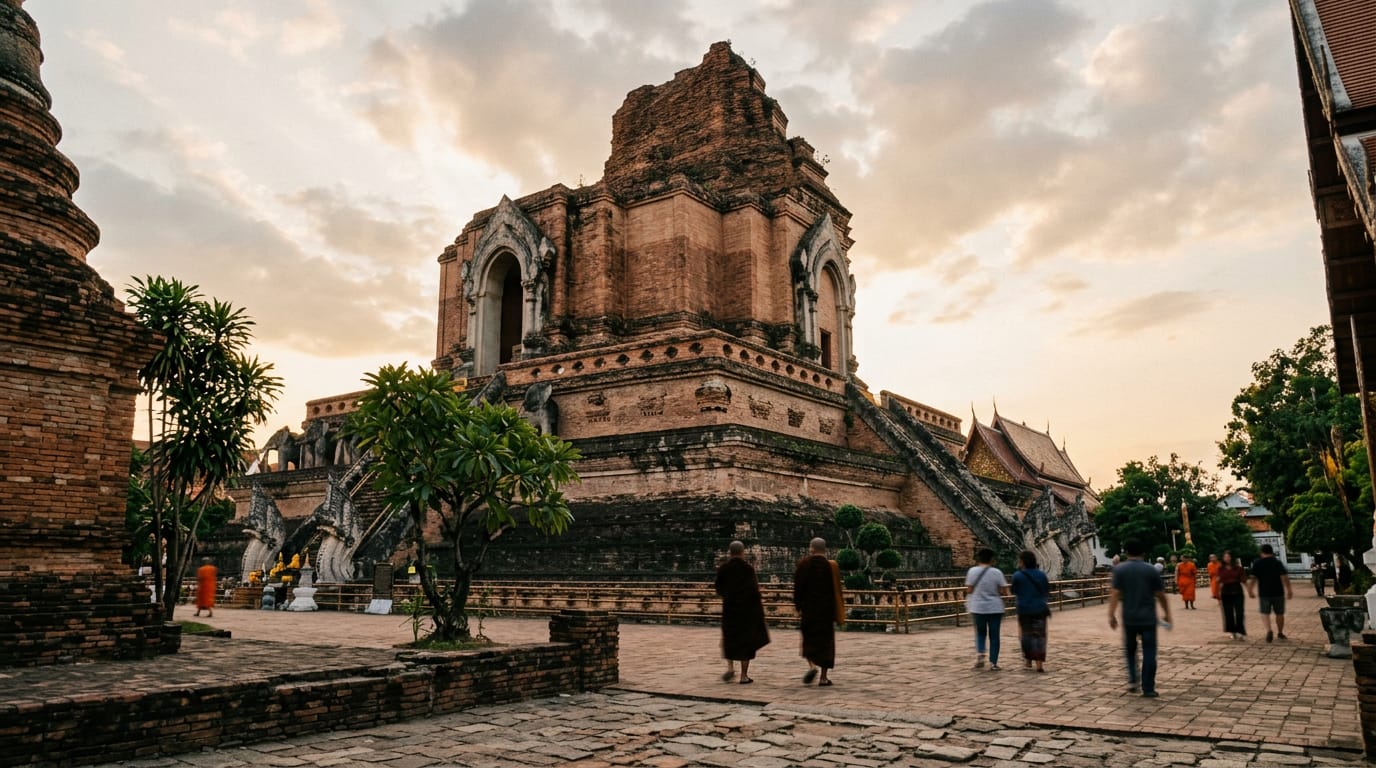
Wat Chedi Luang
Wat Chedi Luang holds the ruined 60-metre chedi that was once the tallest building in Lanna and still dominates the centre of Chiang Mai's Old City. Founded in 1391 by King Saen Muang Ma and completed in 1481 under Tilokaraj, it was partly toppled by the 1545 earthquake. The compound also houses the city pillar and Chiang Mai's active monk-chat programme.
Temple
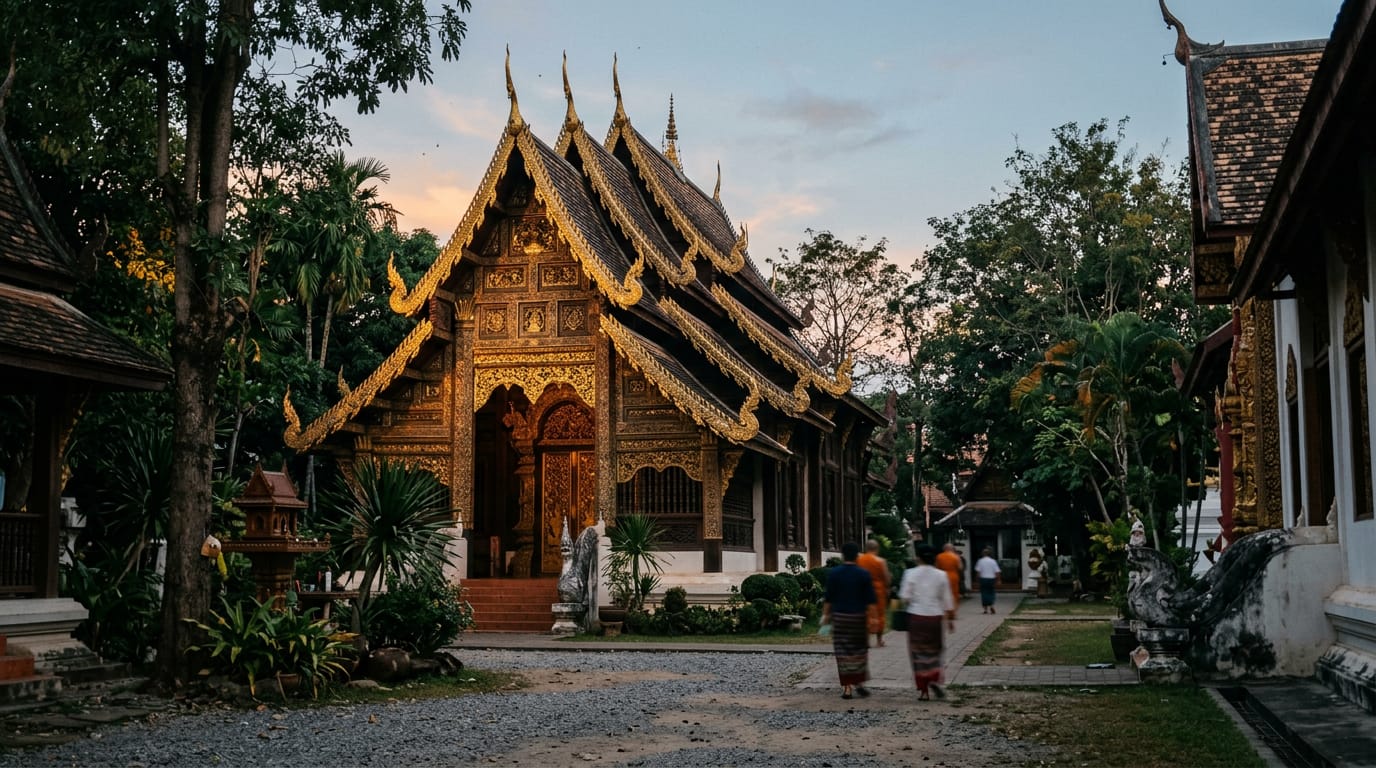
Wat Phra Singh
Wat Phra Singh is the most revered temple inside Chiang Mai's Old City, founded in 1345 by King Phayu of the Mangrai dynasty. Its Lai Kham viharn shelters the Phra Buddha Sihing — the Lion Buddha — which is paraded through the streets each Songkran. Together with its gilded chedi, carved teak gables and gold-leafed scripture library, the compound is the finest single example of Late Lanna architecture in northern Thailand.
Market
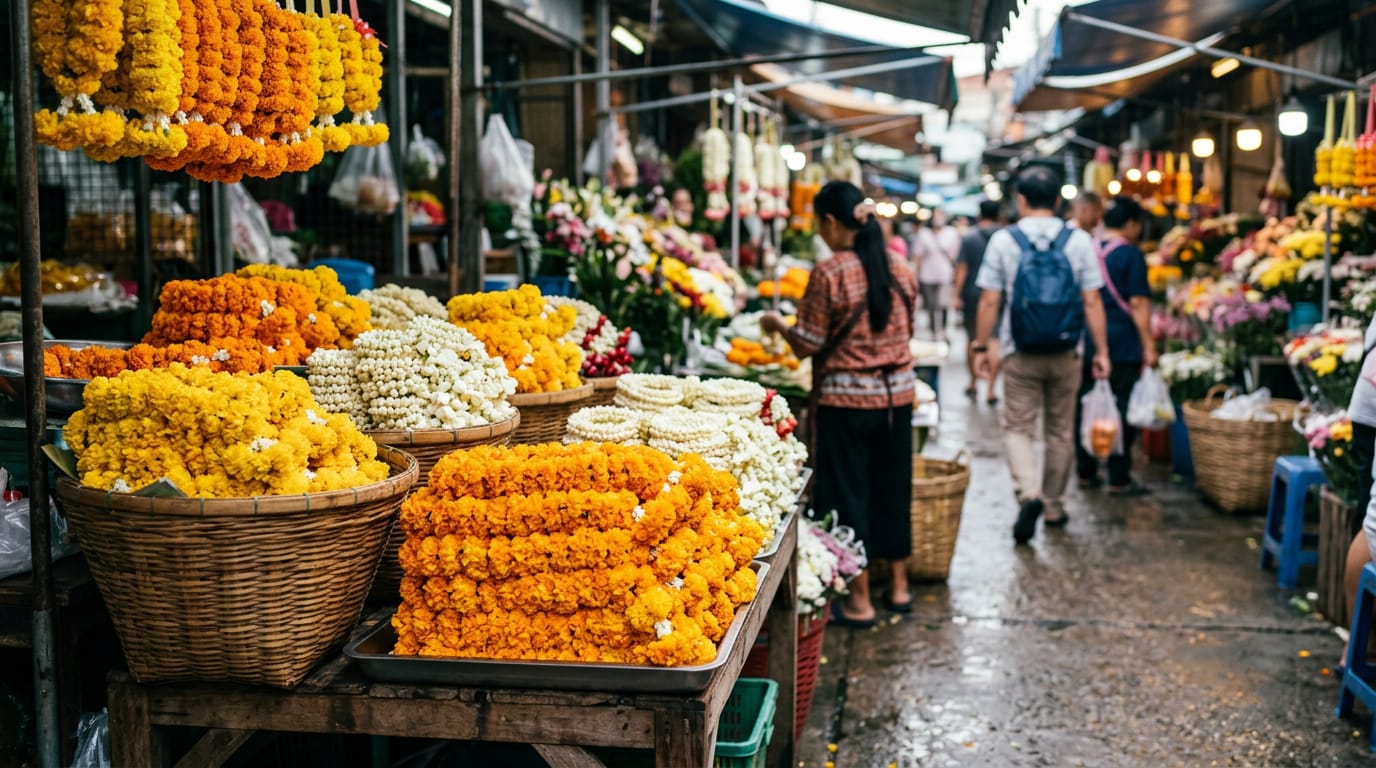
Chiang Mai Flower Market
The Chiang Mai Flower Market (Talat Dok Mai) is the city's main wholesale and retail bazaar for cut flowers and ceremonial garlands, on a 400-metre stretch of Praisani Road beside the Ping River, behind Warorot Market in Chang Moi. Trading is continuous, with wholesale lorries arriving 03:00–06:00; in February 2026 it supplies the 49th Chiang Mai Flower Festival floats.