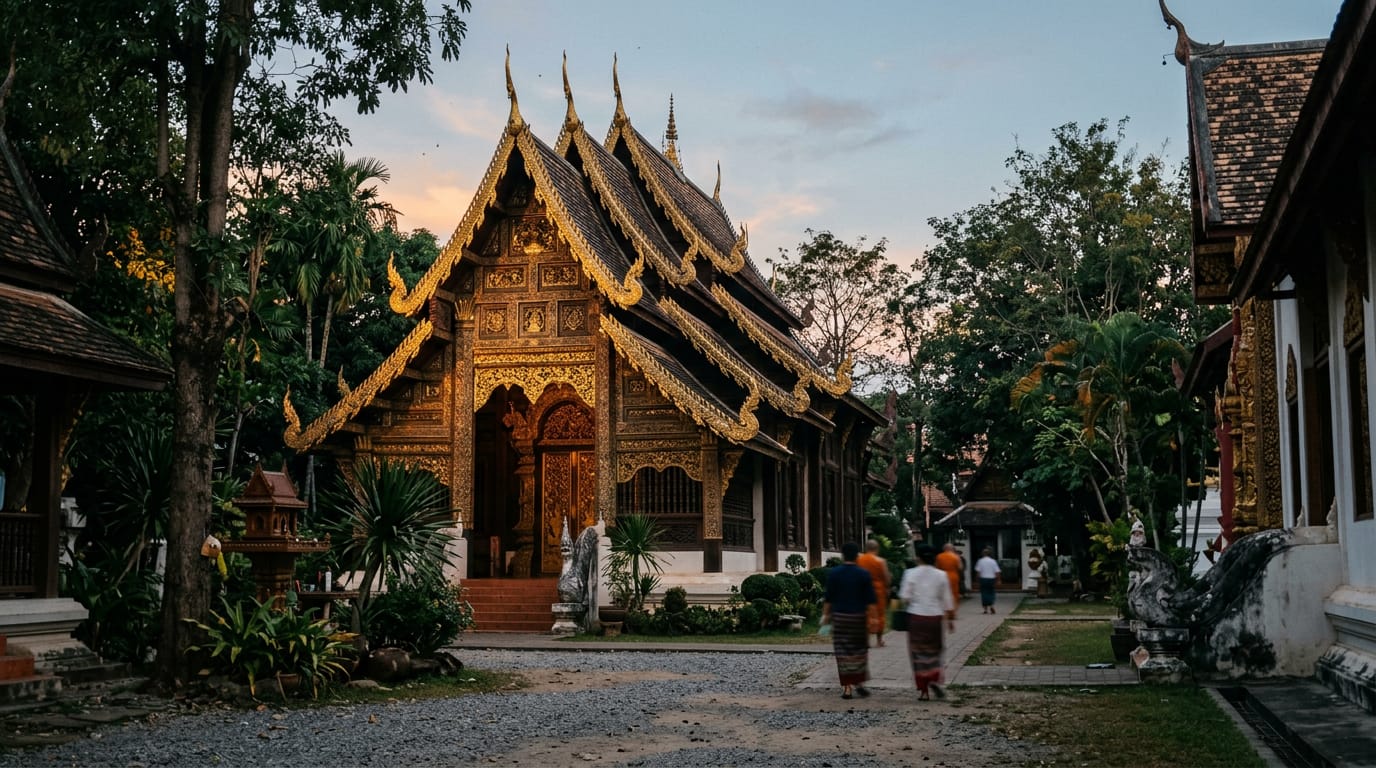
Wat Phra Singh is the most revered temple inside Chiang Mai's Old City, founded in 1345 by King Phayu of the Mangrai dynasty. Its Lai Kham viharn shelters the Phra Buddha Sihing — the Lion Buddha — which is paraded through the streets each Songkran. Together with its gilded chedi, carved teak gables and gold-leafed scripture library, the compound is the finest single example of Late Lanna architecture in northern Thailand.
Updated
Wat Phra Singh is the spiritual heart of Chiang Mai’s Old City. Founded in 1345 and continuously occupied for nearly seven centuries, it holds the Phra Buddha Sihing — the Lion Buddha — and shelters the finest surviving example of Late Lanna temple architecture in northern Thailand. For most visitors it is the first stop inside the moat and, for many, the most memorable.
History and significance
The temple was founded in 1345 by King Phayu, the fifth ruler of the Mangrai dynasty that had established Chiang Mai forty-nine years earlier. Phayu built it to enshrine the ashes of his father, King Kham Fu, in a bell-shaped chedi whose form set the template for royal Lanna stupa design. The compound was originally called Wat Lichiang Phra; it took its current name in 1367 when the Phra Buddha Sihing image was brought from the southern city of Nakhon Si Thammarat and installed in the Lai Kham viharn.
For the next two centuries Wat Phra Singh served as the principal royal temple of the Mangrai kings, hosting coronations, state funerals and the annual rains-retreat ceremonies. The fall of Chiang Mai to the Burmese in 1558 began a long decline. By the end of the eighteenth century the Old City had been largely abandoned, the temples sacked or left to the forest. Restoration began under King Kawila after 1796, when the Lanna royal house re-established itself with Siamese backing and rebuilt the wat. The Lai Kham viharn in its present form is essentially a Kawila-era structure on much older foundations, completed around 1806.
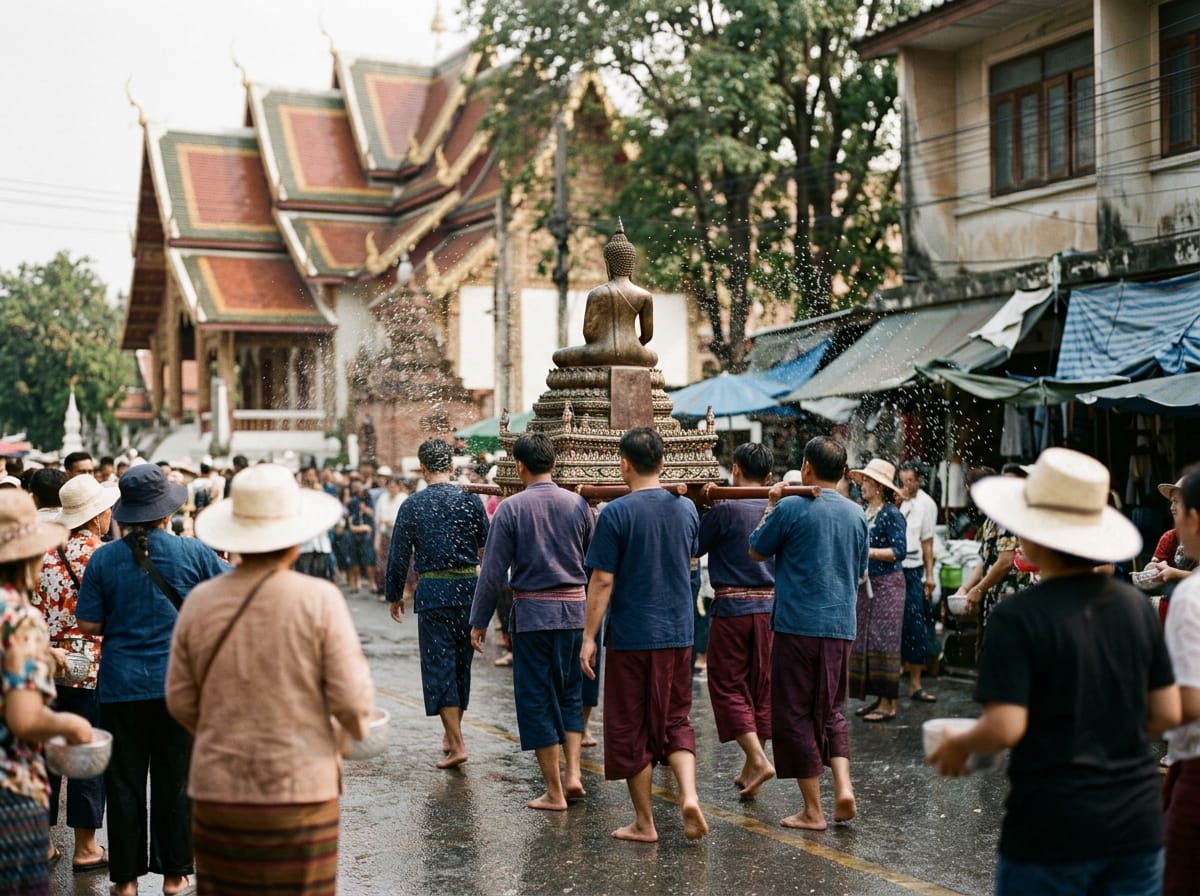
The principal relic of the temple is the Phra Buddha Sihing itself. Tradition holds that the image was cast in Sri Lanka in the second century, brought first to Sukhothai, then to Ayutthaya, before being received in Chiang Mai. Modern scholarship places its actual casting in fourteenth-century Lanna, but the legend is what matters to worshippers: the image is treated as a national palladium and is one of three identical Phra Buddha Sihing images claimed by separate temples (the others are in Bangkok and Nakhon Si Thammarat). Each Songkran the Chiang Mai image is carried in procession along Ratchadamnoen Road, an event that draws tens of thousands of devotees and remains the defining ceremony of the Lanna religious calendar.
Wat Phra Singh has been a royal temple of the third class since 1935 and is one of only a handful of compounds in the kingdom permitted to display the seven-tiered umbrella over its principal Buddha. Today it functions both as an active monastery — around forty monks and novices live in the residential cells along the south wall — and as a centre for Lanna manuscript preservation, with several thousand palm-leaf scriptures held in the temple library.
What to see
A complete visit covers six structures. They sit close together within a compact walled compound, so the route is short.
The Lai Kham viharn
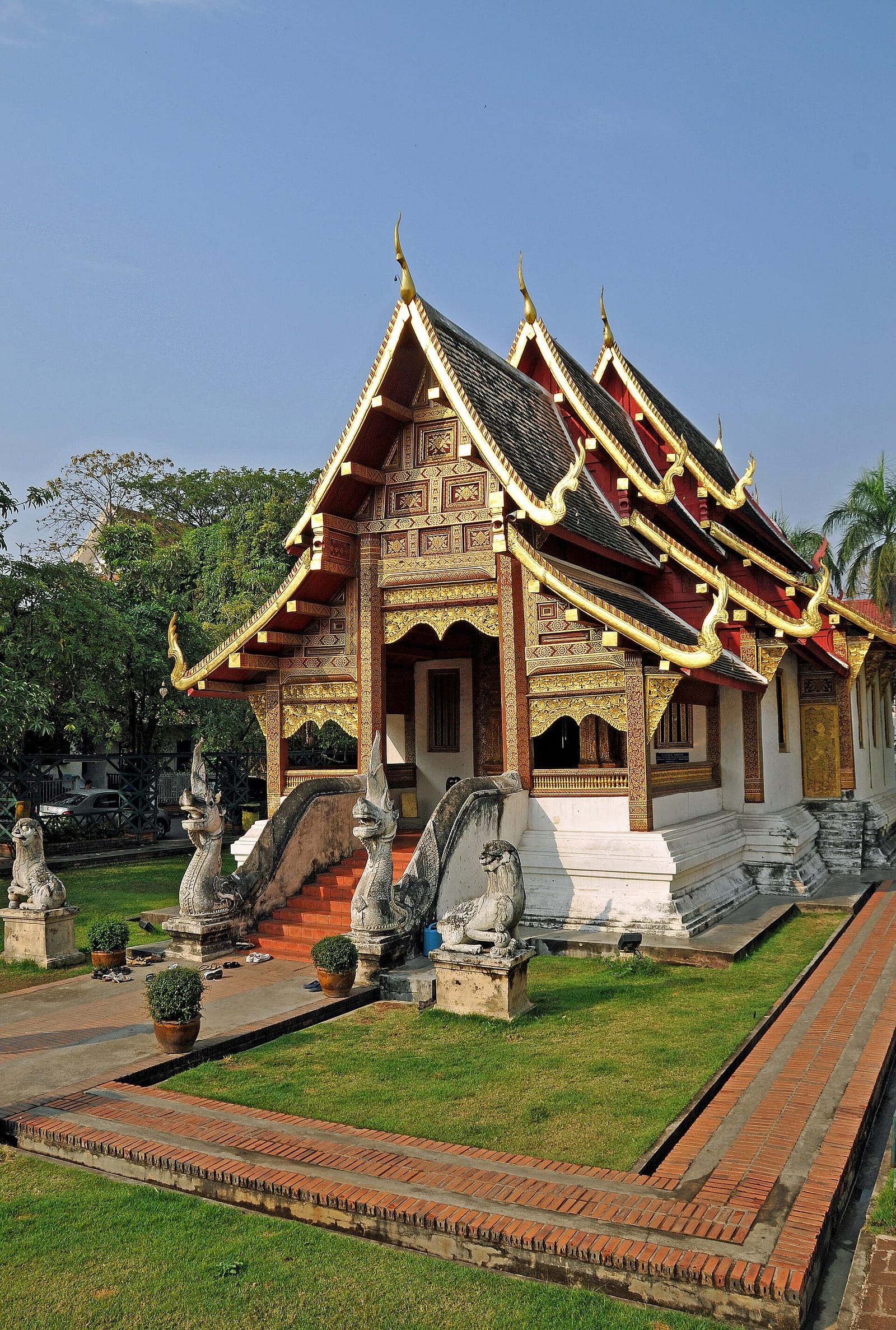
The Lai Kham (literally ‘gold pattern’) viharn is the small assembly hall to the southwest of the main viharn. It is the principal artistic treasure of Wat Phra Singh and arguably of Lanna architecture. The exterior is built in three diminishing tiers of teak roof, each gable carved with the kanok flame motif and finished in the lai kham technique — gilded patterns applied to a black lacquer ground, then sealed and burnished. The bargeboards taper into elongated naga fingers that point upwards, a Lanna signature.
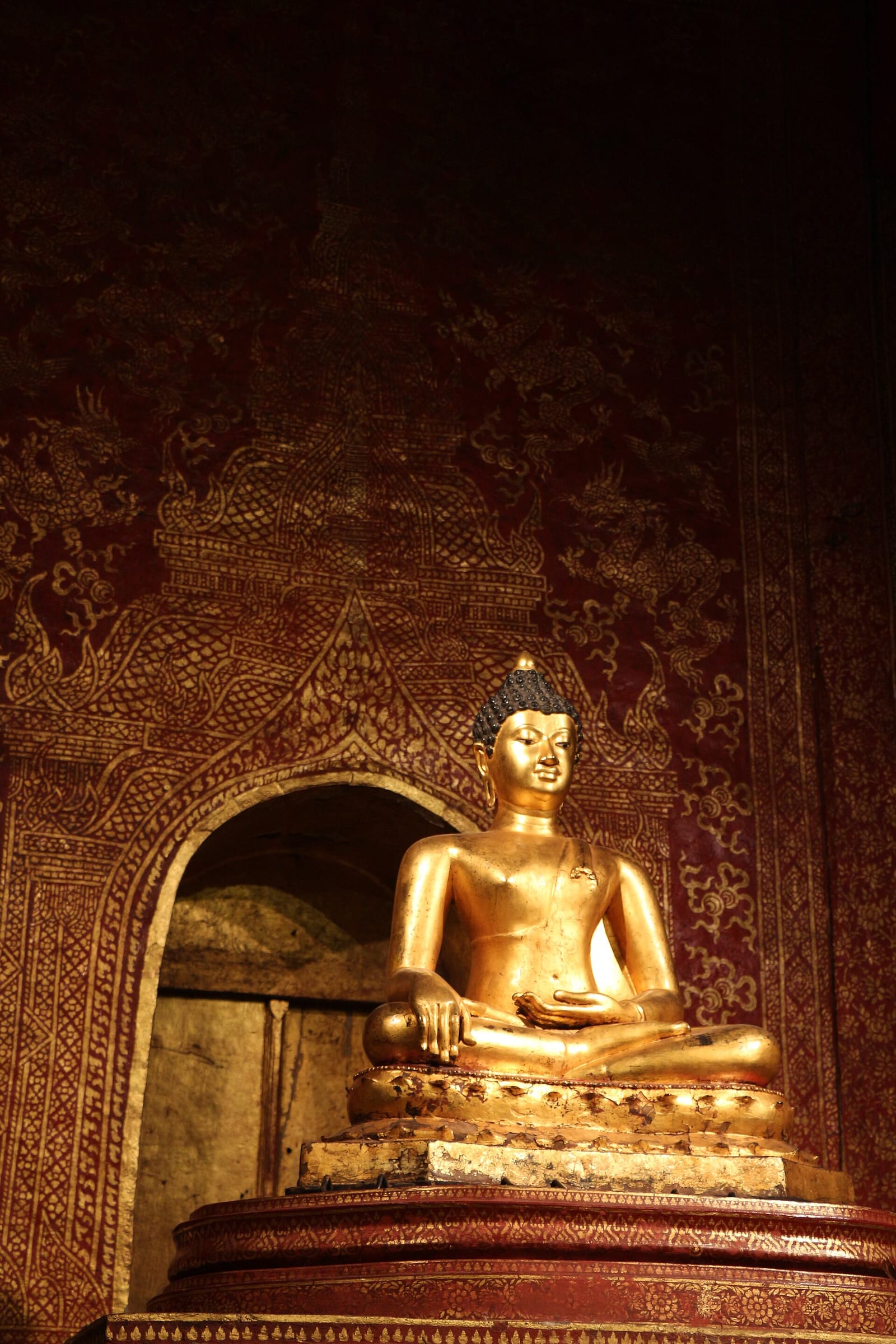
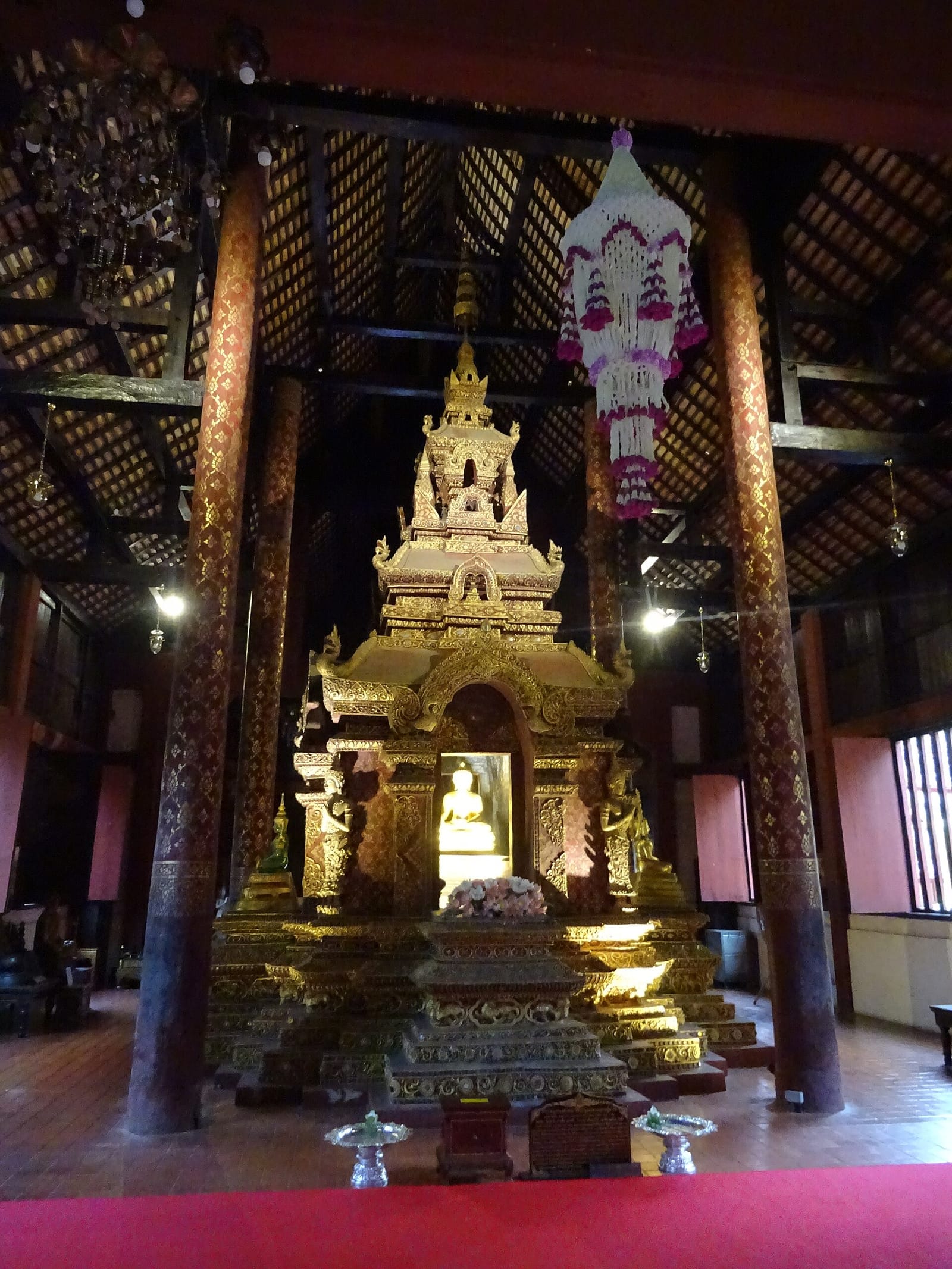
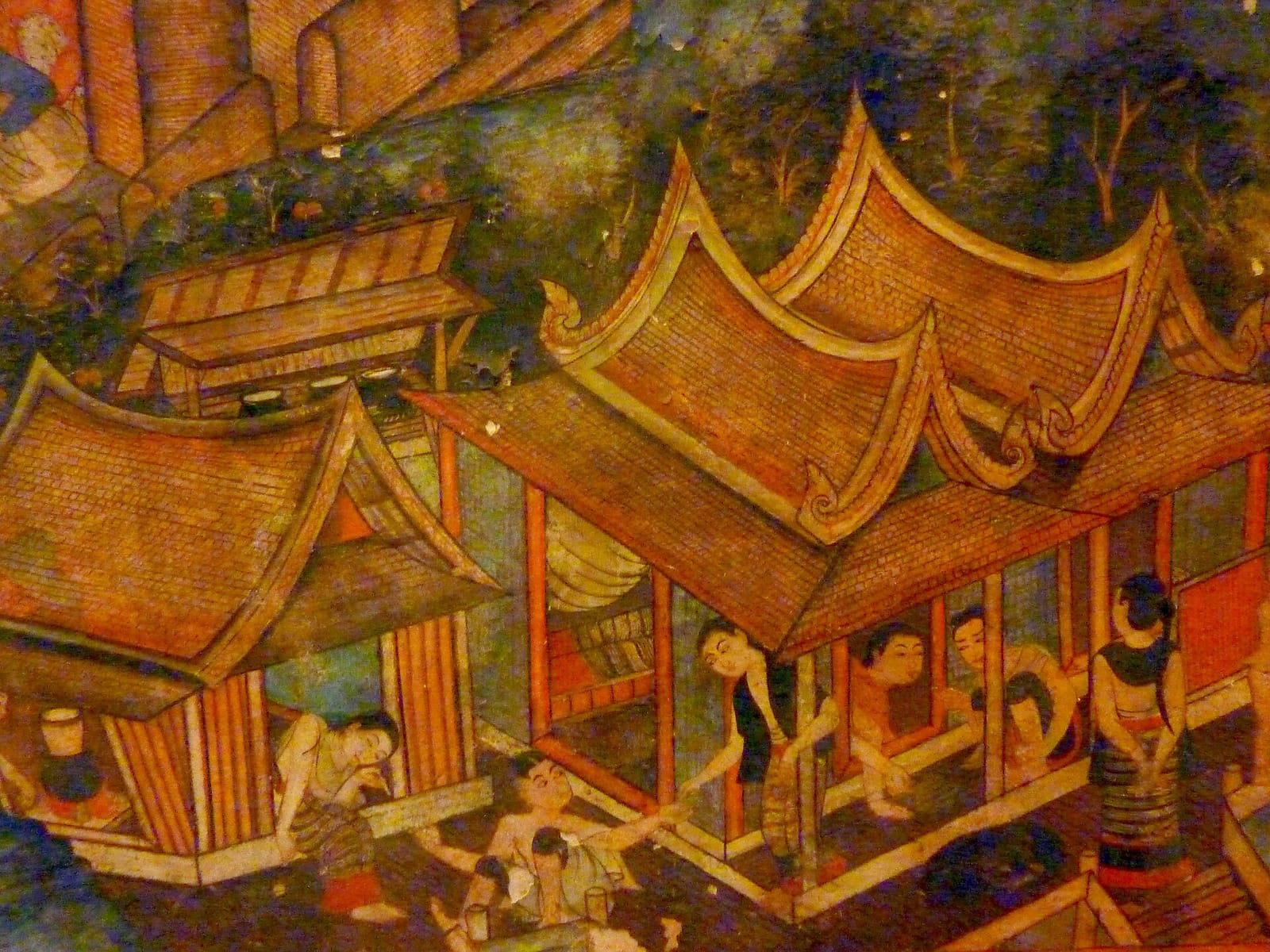
Inside, the Phra Buddha Sihing sits on a raised altar at the western end. The image is just 80 cm tall and modest in proportion compared to the giants of Bangkok or Ayutthaya — its power lies in its history and patina, not its scale. The walls carry an extraordinary mural cycle painted in the 1860s by an unknown local artist. The north wall narrates the Sang Thong folk tale (the prince born inside a golden conch); the south wall tells the Suwannahong story. The painter slipped in dozens of vignettes of contemporary Lanna life: women at backstrap looms, hill-tribe traders bartering at the gate, men smoking long-stemmed pipes, monks teaching novices to read. Bring a torch — the lighting is dim and the detail rewards patience.
The main viharn
The viharn luang, on the central axis just inside the eastern gate, is the larger assembly hall used for daily ceremonies. It was rebuilt in 1925 after a fire and lacks the antiquity of the Lai Kham building, but it is a fine example of early-twentieth-century revival Lanna, with a wide nine-tiered roof and gilded lacquer columns. The principal image is a large copper-alloy Buddha in the maravijaya posture, flanked by two standing disciples.
The chedi
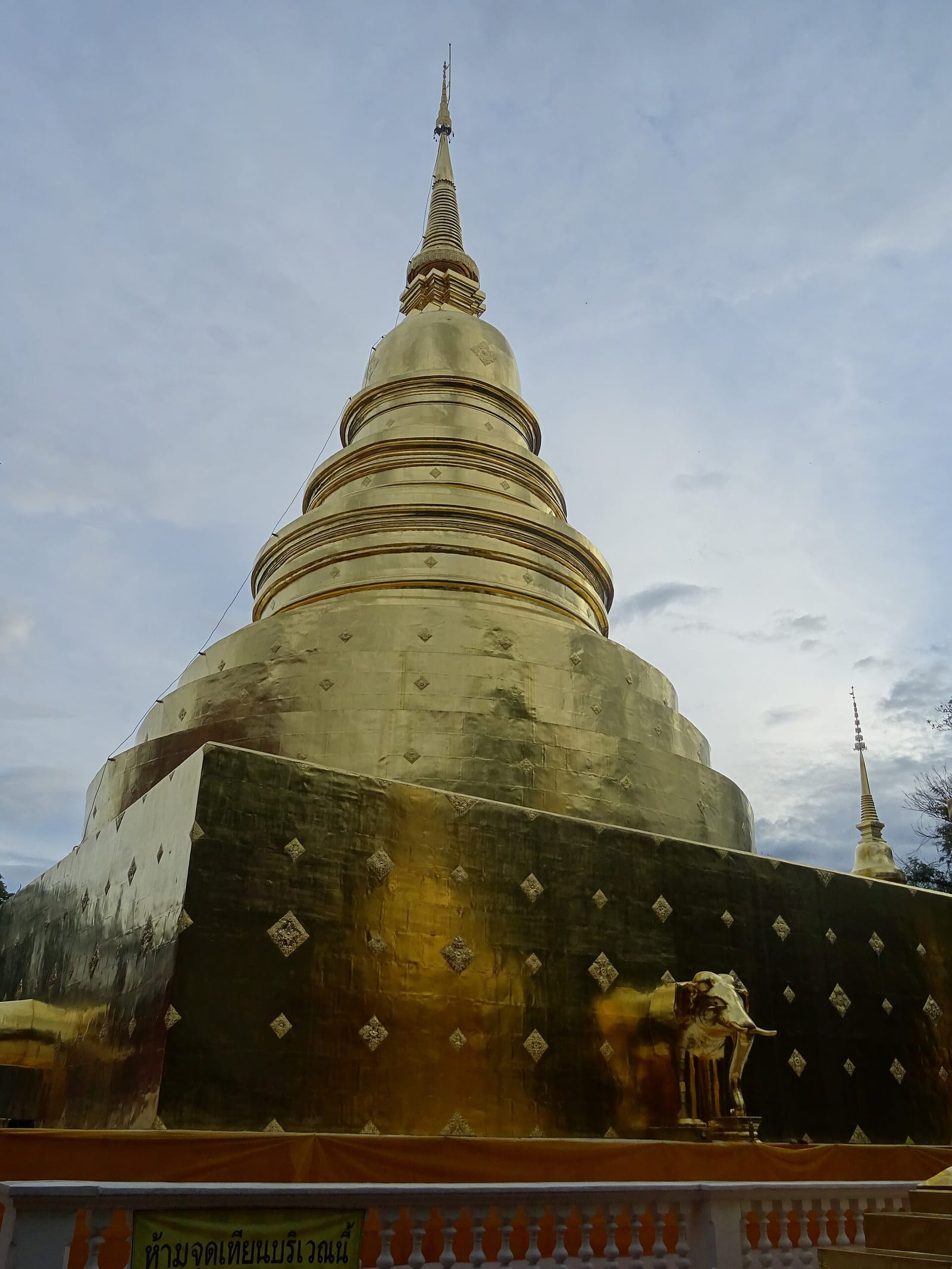
Behind the main viharn rises the bell-shaped chedi built by Phayu in 1345 to hold his father’s ashes. It is encased in copper gilded plates added during the 1806 restoration and stands about 24 metres high. The base is octagonal with eight elephant buttresses at the corners — a Lanna borrowing from earlier Sukhothai forms. The four small subsidiary chedis at the corners of the platform hold relics of later abbots.
The ubosot
The ordination hall sits in its own walled enclosure to the north, marked by eight sema boundary stones in the form of seated stone lions. It is open only during ordinations and major ceremonies, but the exterior carving — particularly the nak sadung serpent gable finials — is worth circling. Women may walk around the building but should not enter the inner enclosure.
The ho trai
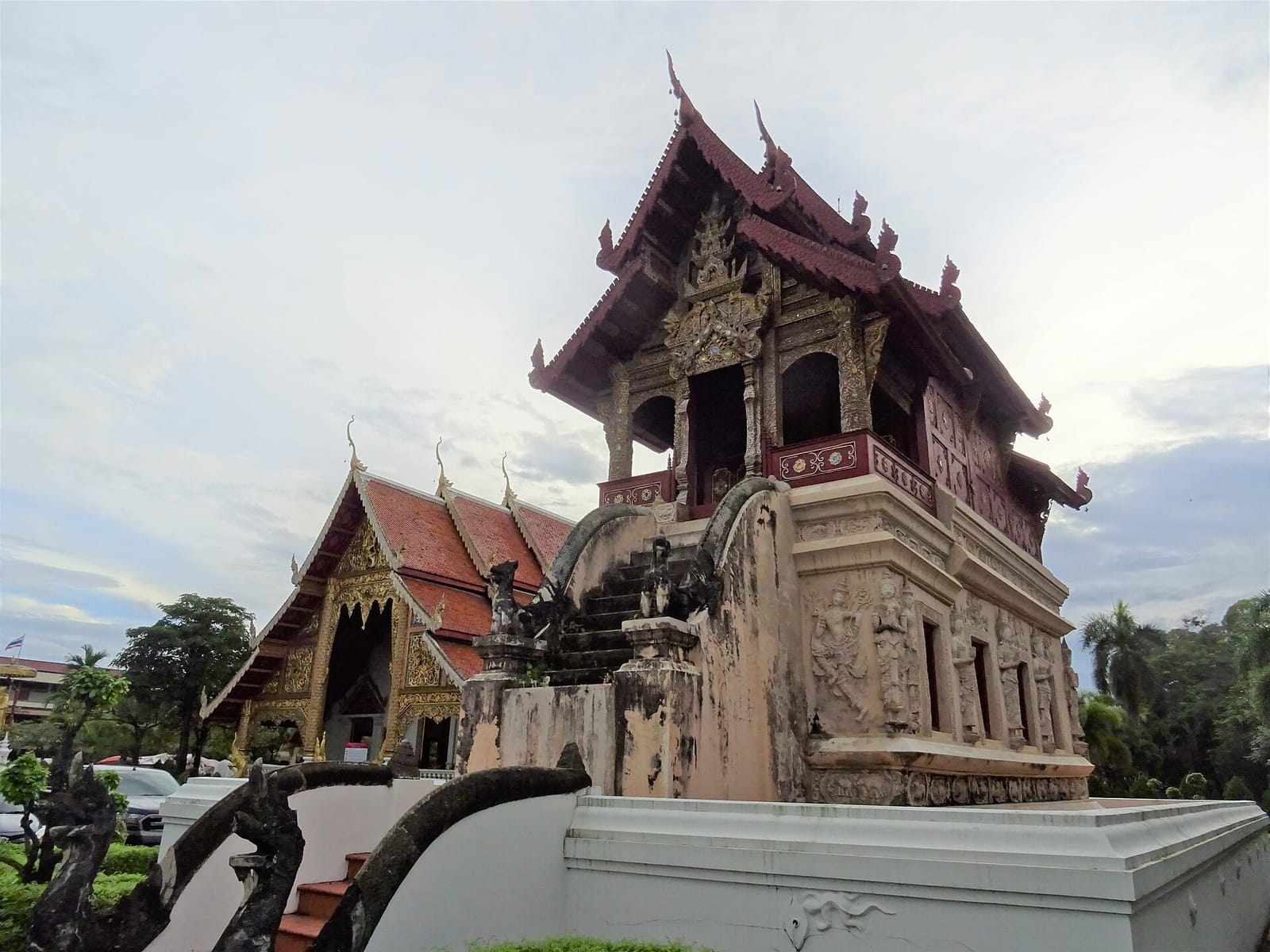
The ho trai, or scripture library, stands on a high masonry plinth at the southern edge of the compound. The raised platform protected manuscripts from termites, flooding and rodents. The teak upper storey is decorated with stucco angels in shallow relief, and its small windows have shutters carved with mythical kinnari figures. It is one of the most photographed ho trai in Thailand. The building is locked, but the exterior is visible from every angle.
The Sangha cloisters
Along the north wall, a small museum displays Lanna manuscripts, lacquerware bowls, ceremonial offerings and historical photographs of the temple. The cloisters themselves house residential cells and an open kitchen where alms-rice is cooked each morning. The kitchen is not a tourist site, but if you arrive at 06:30 you will see lay supporters delivering rice and curry through the gate.
How to visit
Wat Phra Singh sits at the western end of Ratchadamnoen Road, the main east–west spine of the Old City. From Tha Phae Gate at the eastern moat, walk straight along Ratchadamnoen for about 1.2 km and the temple appears in front of you. The walk takes 15 to 18 minutes and passes Wat Phan Tao, Wat Chedi Luang and several smaller compounds — so plan it as a temple crawl rather than a direct line.
From Chiang Mai International Airport, the temple is 4 km north-east. A metered taxi costs 150 to 200 baht and takes 15 minutes outside rush hour. Grab fares are usually 130 to 180 baht. Red songthaew (shared pickup trucks) operate on a hail-and-share basis from anywhere inside the city — flag one, name the destination as ‘Wat Phra Singh’ and pay 30 baht per person if it is already heading that way, or 100 to 150 baht if you charter the whole vehicle.
Parking is awkward. A small paid car park sits on Samlan Road just south of the temple, charging 20 baht per hour, and it fills by mid-morning during the cool season. Motorbikes can park free along Singharat Road. Most visitors staying inside the moat walk; most visitors staying outside leave their vehicle near Tha Phae Gate and walk the rest of the way.
The neighbourhood immediately around the temple is one of the quietest in the Old City. Singharat Road has several small cafes, a vegetarian restaurant run by the temple itself (open 08:00–14:00, no English menu, no problem), and the excellent Lanna Folk Museum five minutes’ walk north. The Sunday Walking Street begins at Tha Phae Gate and runs all the way along Ratchadamnoen, ending at the temple gates — visit late on a Sunday afternoon and you can light incense, then walk back through the market as the sun goes down.
Etiquette and dress code
The rules are the same as at any major Thai temple but enforcement at Wat Phra Singh is unusually strict because of the volume of visitors.
- Shoulders and knees must be covered for both men and women. Vests, short shorts, sheer tops and miniskirts are turned away at the gate.
- Sarongs are lent at a stand by the Lai Kham viharn entrance for a 100 baht refundable deposit.
- Shoes come off before entering any viharn, the ubosot or the museum. Leave them on the racks provided — they will be safe.
- Hats and sunglasses should be removed before entering any building.
- Sit with your legs tucked to the side rather than crossed when seated in front of a Buddha image. Do not point your feet at the image.
- Women should not hand objects directly to monks. Place items on the floor or on a cloth that the monk can pick up himself.
- Do not climb on the chedi, the platforms or the elephant buttresses.
- Photography is permitted everywhere, but flash is discouraged near the Lai Kham murals because it accelerates pigment fading. Never photograph monks without asking.
- Drones are not permitted anywhere inside the Old City moat.
Best time to visit
The temple is at its best either early — 06:00 to 08:30, before the tour groups arrive — or late, from 16:00 until closing at 17:00, when the afternoon sun catches the gilded chedi side-on. The light for photographing the Lai Kham viharn is best in the first hour after sunrise, when the eastern gable is lit directly.
Avoid 10:30 to 14:00, particularly between November and February, when coach groups from Chinese and Russian tour operators concentrate in the compound. Wednesday and Friday are noticeably quieter than weekends, when the Sunday Walking Street also brings local visitors.
The full-moon days of the Buddhist calendar — Wisakha Bucha in May, Asanha Bucha in July, Makha Bucha in February — are special. The compound fills with lay supporters in white robes carrying lotus flowers, candles and incense, and the evening wian thian circumambulation around the chedi at sunset is one of the great sights of Chiang Mai. Visitors are welcome to join, walking three times around the chedi clockwise with a lit candle.
Nearby attractions
Wat Phra Singh sits at the centre of the densest concentration of historic temples in northern Thailand. A morning’s walk can cover four or five of them.
- Wat Chedi Luang — the ruined 60-metre chedi of the old royal temple, ten minutes’ walk east along Phra Pokklao Road.
- Wat Chiang Man — the oldest temple in Chiang Mai, founded by King Mangrai in 1296, a 12-minute walk north towards the Chang Phueak corner of the moat.
- Wat Phan Tao — a small all-teak viharn just east of Wat Chedi Luang, particularly photogenic in late afternoon.
- The Chiang Mai Arts and Cultural Centre on the Three Kings monument plaza, five minutes’ walk east.
- The Sunday Walking Street — runs the full length of Ratchadamnoen Road every Sunday from 16:00, ending at the temple gates.
A short note on Lanna style
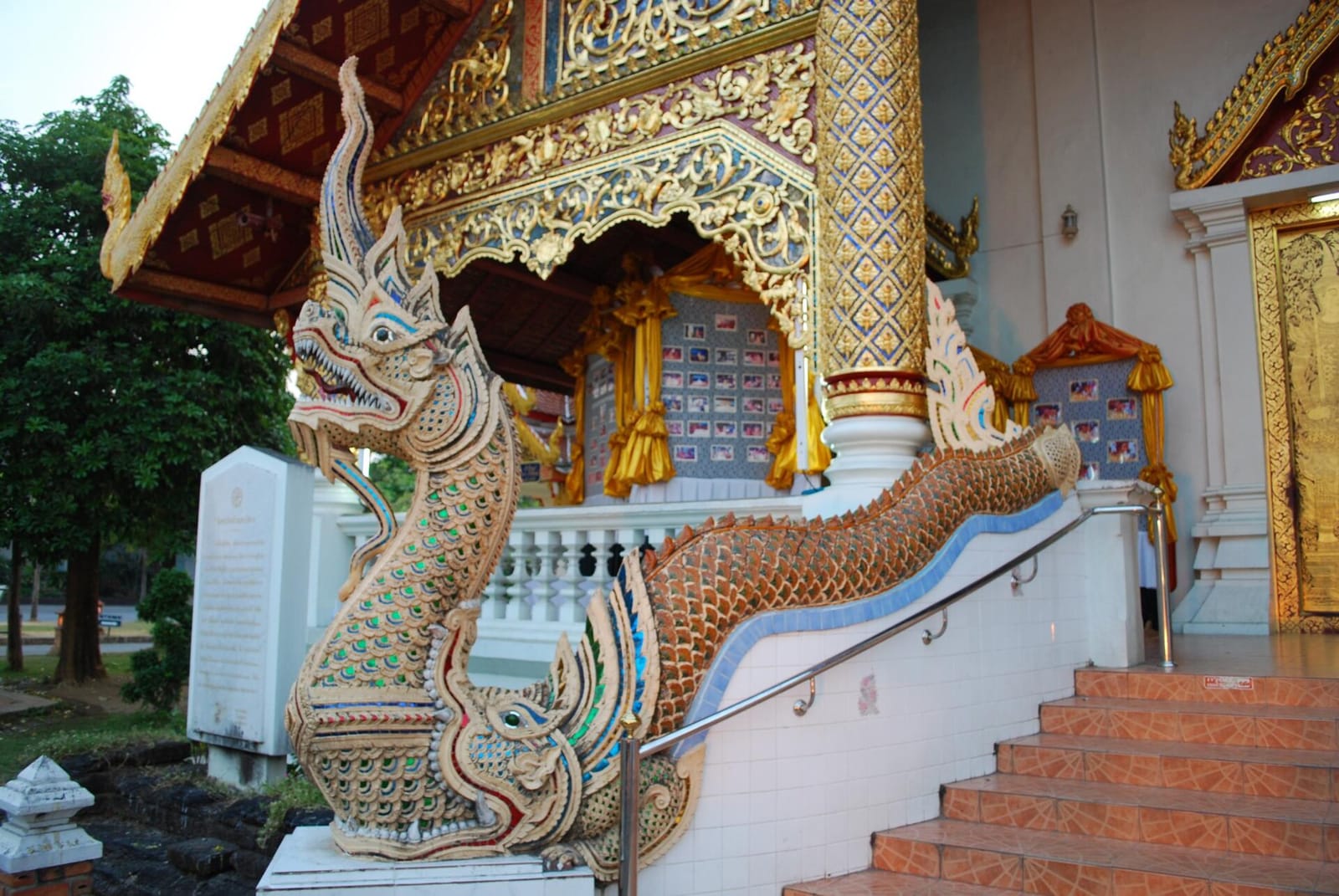
Lanna architecture differs from the Bangkok-Ayutthaya style most visitors arrive expecting. The differences are easy to read once you know what to look for. Lanna roofs are lower-pitched, with two or three diminishing tiers separated by short vertical breaks rather than the steep single sweep of central Thai temples. Gables carry pierced wood carving rather than the gilded stucco of Ayutthaya. Bargeboards taper into long upturned naga fingers — sometimes called cho fa in central Thai but always more elongated here. The lai kham technique of gilded pattern on black lacquer is unique to Lanna and appears on viharn pillars, ceiling beams and window shutters.
Chedis tend to the bell-shape with octagonal bases and elephant buttresses, descended from the Sukhothai school rather than the Khmer-influenced corn-cob prang of Ayutthaya. Wat Phra Singh shows every one of these features in textbook form. Once you have read it here, you will recognise the same vocabulary in every Lanna temple you visit.
For the longer visit
If you have only 45 minutes, walk through the Lai Kham viharn, around the chedi and into the main viharn — that covers the highlights.
If you have 90 minutes, add the ho trai, the museum and a slow second look at the Lai Kham murals with a torch. The detail in the painted vignettes — a boy stealing mangoes, a monkey untying a turban, a woman scolding her husband — is one of the great pleasures of any Thai temple and rewards a careful eye.
If you have two or three hours, time your visit for the late afternoon and stay until the 17:00 chanting. Sit on the worn teak boards inside the main viharn, well to the back, and listen to the Pali liturgy carry over the hum of cicadas outside. Then leave by the south gate onto Samlan Road, walk five minutes east to Wat Chedi Luang for the lighting of evening lamps around the ruined chedi, and end your afternoon at one of the cafes opposite the Three Kings monument. It is the best half-day in the Old City.
Photos
Frequently asked questions
What time does Wat Phra Singh open?
Wat Phra Singh opens daily at 06:00 and closes at 17:00. The principal viharns shut their doors at 17:00 sharp, but the compound itself stays open until dusk, so you can still walk around the chedi and the ho trai for another half hour. The temple holds chanting at around 06:00 and again at 17:00 — these are not tourist performances, so observe quietly from outside the doorway. There is no late opening on full-moon days, but extended hours apply during Songkran in April when the temple is the centre of the city's celebrations.
How much is the entry fee for Wat Phra Singh?
Entry to the compound is free, but a 40 baht fee is charged to enter the Lai Kham viharn where the Phra Buddha Sihing is enshrined. Thai nationals enter free of charge. The ticket also covers the main viharn and the museum building behind the chedi. Pay at the small booth to the left of the Lai Kham entrance. Donations to the alms bowls inside the viharns are voluntary and customarily small — 20 baht is fine.
Where is Wat Phra Singh located?
Wat Phra Singh sits at the western end of Ratchadamnoen Road, the main east–west axis of Chiang Mai's Old City, with its entrance facing east towards the Three Kings monument. The street address is 2 Singharat Road, Phra Singh subdistrict, Mueang Chiang Mai. From Tha Phae Gate it is a flat 15-minute walk along Ratchadamnoen. Most visitors arrive on foot from somewhere inside the Old City moat.
How long should I spend at Wat Phra Singh?
Allow 45 to 60 minutes for a focused visit covering the Lai Kham viharn, the main viharn, the chedi and the ho trai scripture library. Photographers and anyone interested in the murals should budget closer to 90 minutes. If you also want to see the small museum behind the chedi and sit for a while in the shaded cloisters, two hours is realistic. Visiting on a Sunday evening lets you combine the temple with the Sunday Walking Street, which finishes at the temple gates.
What is the dress code for Wat Phra Singh?
Shoulders and knees must be covered for both men and women. Vests, shorts above the knee, sheer or strapless tops and short skirts are not permitted inside the viharns. Sarongs are lent free of charge at a small stand by the Lai Kham viharn entrance — you leave a 100 baht refundable deposit. Shoes come off before entering any viharn, the ubosot or the museum. Hats and sunglasses should be removed inside. Photographing yourself with your back to a Buddha image is considered very rude.
Can women enter Wat Phra Singh?
Yes. Women can enter every part of Wat Phra Singh that is open to the public, including the Lai Kham viharn, the main viharn and the ubosot. The only restriction at Lanna temples generally applies to women approaching monks directly or touching their robes — when offering something to a monk, place the item on a cloth or tray that he can then pick up. Inside the viharn, sit with your legs tucked to the side rather than crossed.
What is inside the Lai Kham viharn?
The Lai Kham viharn houses the Phra Buddha Sihing, a small bronze image in the maravijaya posture said to have been cast in Sri Lanka and brought to Chiang Mai in 1367. The walls carry late-nineteenth-century murals showing the Sang Thong folk tale on one side and the Suwannahong story on the other, painted with rare detail of Lanna village life — weavers, hill-tribe traders, opium pipes, courting couples. The carved teak gables outside the building, in the lai kham gilt-on-lacquer technique, are among the finest surviving in northern Thailand.
Can I take photos inside Wat Phra Singh?
Photography is welcomed in the compound and inside the viharns. Flash is discouraged near the murals because it accelerates pigment fading. Tripods are technically not permitted in the viharns but small monopods are usually tolerated outside busy periods. Never photograph monks without asking first, and never position yourself so that a Buddha image appears below or behind you in the frame. Drones are not allowed anywhere within the Old City moat without a permit.
How do I get to Wat Phra Singh from Tha Phae Gate?
Walk straight west along Ratchadamnoen Road for about 1.2 km and the temple appears directly in front of you at the western end. The walk takes 15 to 18 minutes at an unhurried pace and passes most of the Old City's smaller temples on the way. A red songthaew from Tha Phae costs 30 baht per person if you flag a shared one, or 100 to 150 baht if you charter the whole vehicle. The grab-style fare is around 80 baht.
Is there parking near Wat Phra Singh?
A small paid car park sits just south of the temple, on Samlan Road, charging 20 baht per hour. It fills up by mid-morning during the cool season. Motorbikes can usually park free along Singharat Road or in the side lanes north of the temple. Driving inside the Old City is slow and the one-way system is confusing, so most visitors leave their vehicle in a hotel car park and walk.
When was Wat Phra Singh built?
Wat Phra Singh was founded in 1345 by King Phayu of the Mangrai dynasty, on a site previously occupied by an earlier shrine. The principal Lai Kham viharn dates in its current form to a major restoration in 1806 under King Kawila, who rebuilt much of Chiang Mai after the Burmese were expelled. The bell-shaped chedi behind the viharns was built to enshrine the ashes of King Phayu's father, King Kham Fu. The temple has been continuously occupied by monks for nearly seven centuries.
Is Wat Phra Singh worth visiting?
For anyone interested in northern Thai art and architecture, Wat Phra Singh is the single most rewarding temple in Chiang Mai. Its Lai Kham viharn is the textbook example of Late Lanna design, the murals inside are nationally important and the Phra Buddha Sihing is one of the most venerated images in the country. If you visit only one temple in the Old City, this is it. Combine it with the ruined chedi of Wat Chedi Luang ten minutes' walk to the east for a full picture of Lanna religious architecture in two stops.
What happens at Wat Phra Singh during Songkran?
During the Thai New Year in mid-April, the Phra Buddha Sihing is carried out of the Lai Kham viharn and placed on a high palanquin for a slow procession along Ratchadamnoen Road. The faithful pour scented water over the image as it passes, an act of merit-making believed to bring rain and prosperity. The procession usually leaves the temple gates around 09:00 on 13 April. The temple compound itself becomes the focal point of Old City Songkran activities and is extremely crowded — arrive at 07:00 if you want to photograph the image before it is carried out.
Related guides
Temple
Wat Chedi Luang
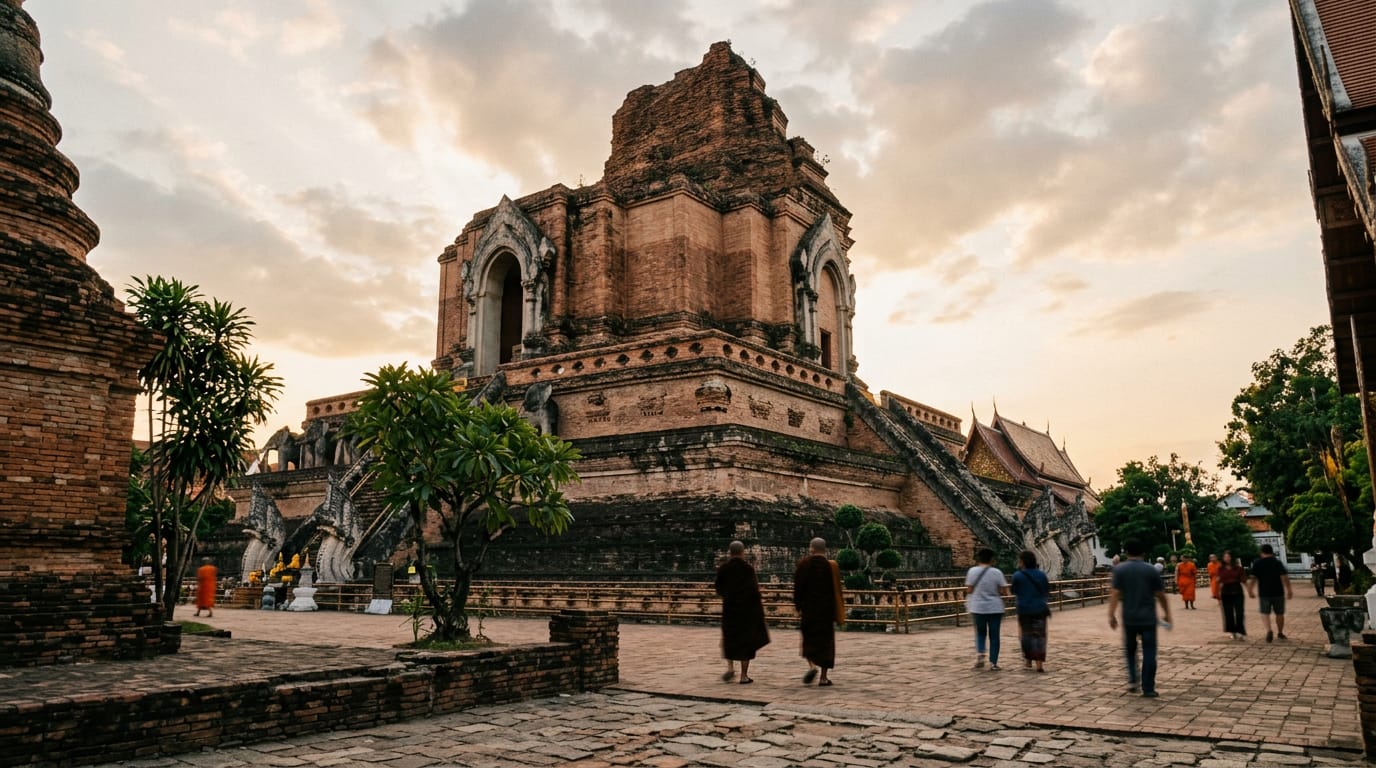
Wat Chedi Luang holds the ruined 60-metre chedi that was once the tallest building in Lanna and still dominates the centre of Chiang Mai's Old City. Founded in 1391 by King Saen Muang Ma and completed in 1481 under Tilokaraj, it was partly toppled by the 1545 earthquake. The compound also houses the city pillar and Chiang Mai's active monk-chat programme.
Temple
Wat Chiang Man
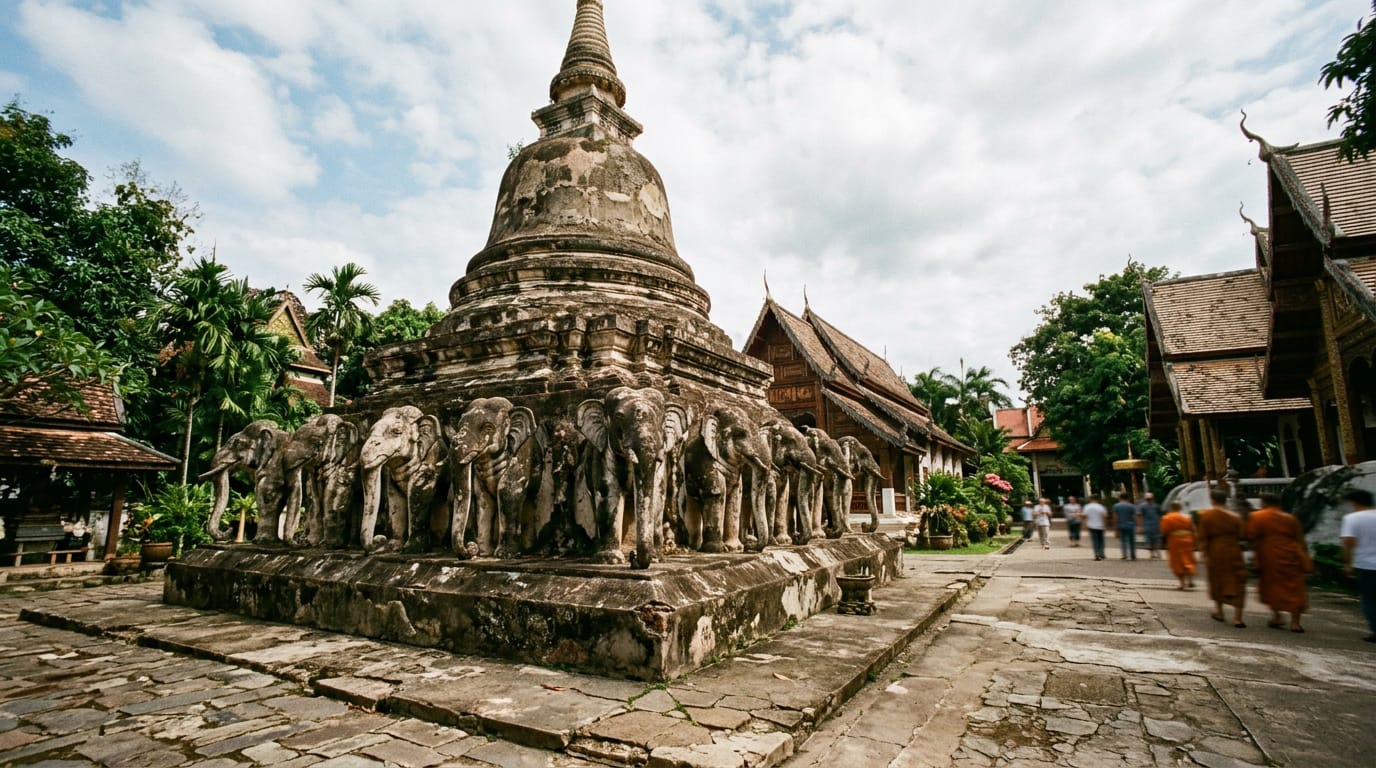
Wat Chiang Man is the oldest temple in Chiang Mai, founded in 1297 by King Mangrai as the first building inside his new walled city. Its Chedi Chang Lom, ringed at the base by fifteen elephant statues in stucco, set the template for Lanna stupa design. The Phra Sila marble Buddha and the crystal Phra Setangkhamani are kept inside a locked viharn.
Temple
Wat Suan Dok
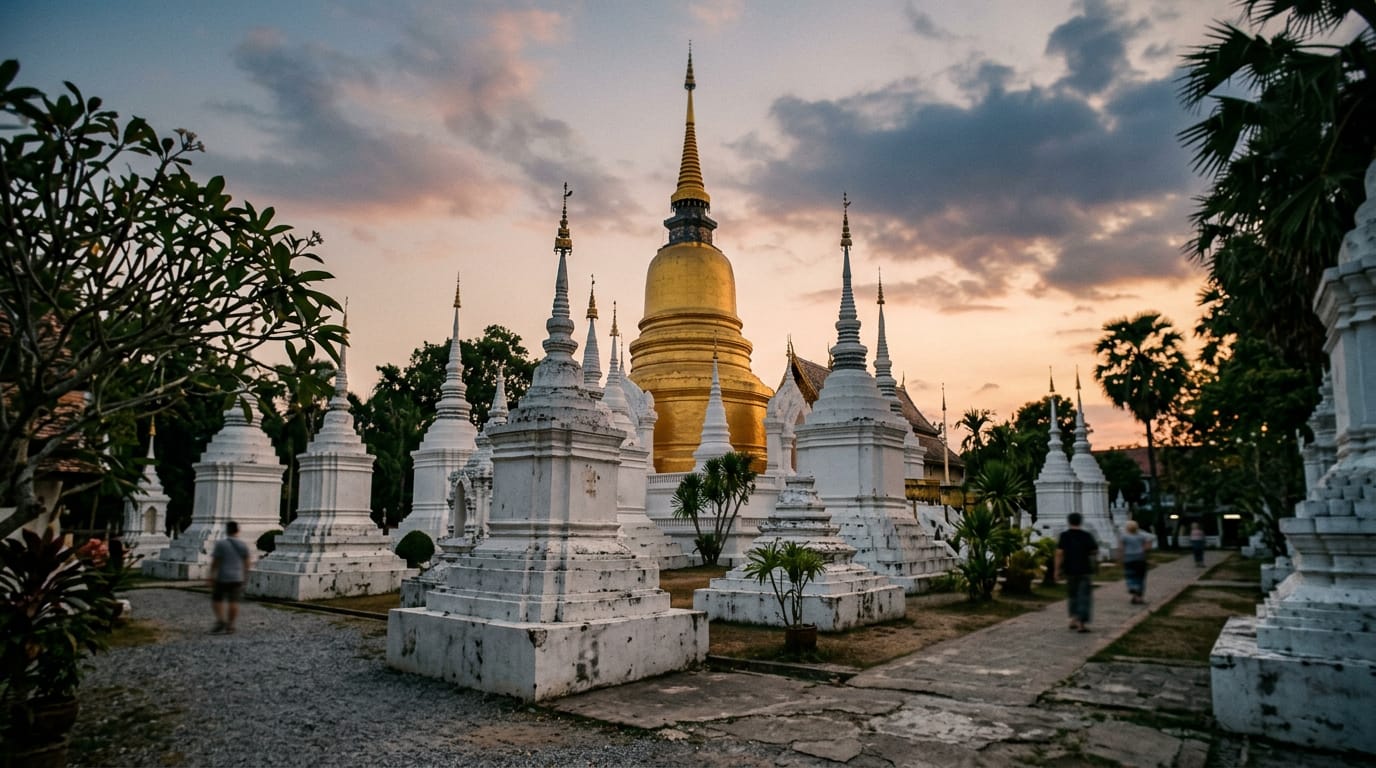
Wat Suan Dok, the 'Flower Garden Temple', sits outside the western moat on Suthep Road. Founded in 1370 by King Kuena to house a relic later carried up Doi Suthep by a white elephant, it is best known for its cluster of whitewashed royal chedis (the cremation memorials of the Mangrai dynasty) and for weekday Monk Chat sessions with novice monks.