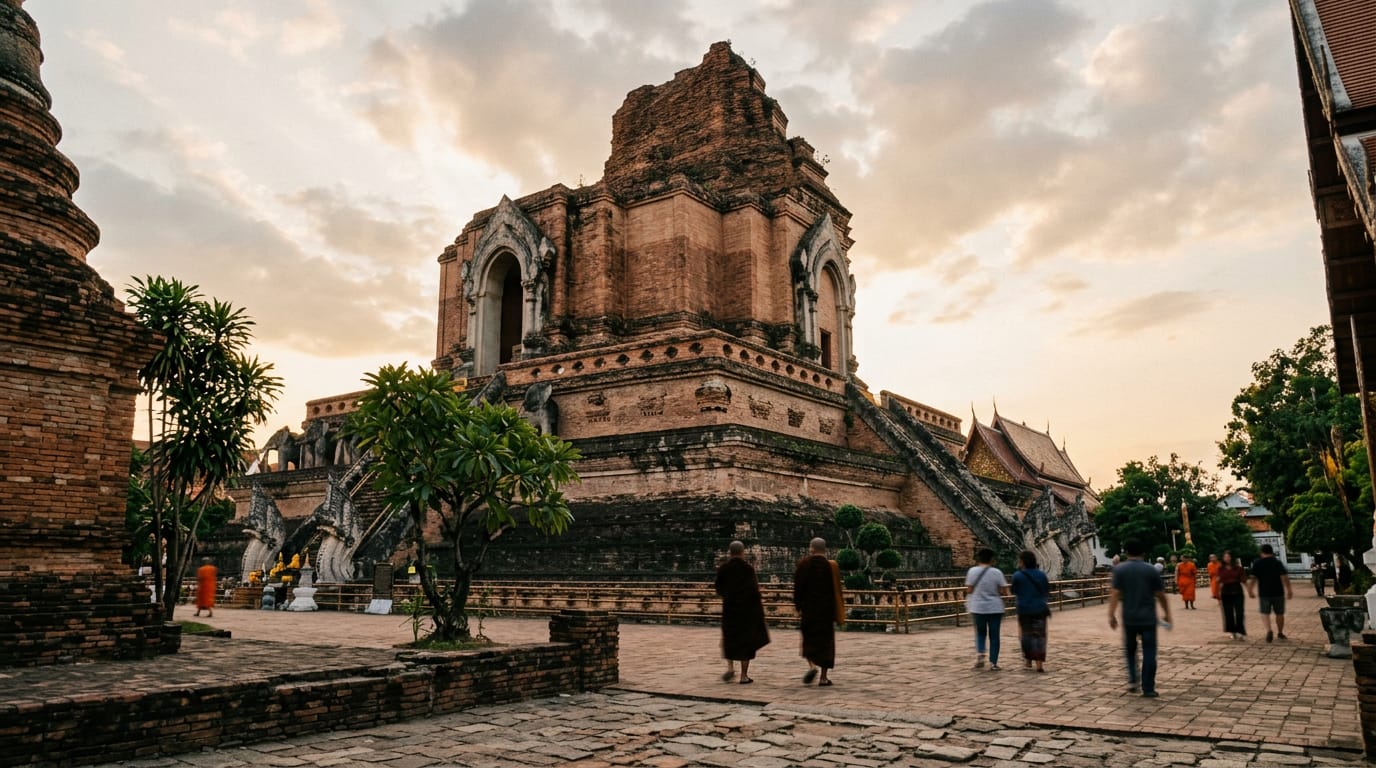
Wat Chedi Luang holds the ruined 60-metre chedi that was once the tallest building in Lanna and still dominates the centre of Chiang Mai's Old City. Founded in 1391 by King Saen Muang Ma and completed in 1481 under Tilokaraj, it was partly toppled by the 1545 earthquake. The compound also houses the city pillar and Chiang Mai's active monk-chat programme.
Updated
Wat Chedi Luang holds the ruined giant of Chiang Mai. The 60-metre chedi at the centre of the compound was once the tallest building in the Lanna kingdom and one of the largest religious structures in Southeast Asia. An earthquake in 1545 toppled the upper third and the resources for a rebuild never appeared. What is left is the most dramatic single ruin in northern Thailand and a working monastery that has occupied the same plot for six hundred and thirty-five years.
History and significance
The temple was founded in 1391 by King Saen Muang Ma, the seventh ruler of the Mangrai dynasty, to house the ashes of his father King Kuena — the same Kuena who, eight years earlier, had founded Wat Phra That Doi Suthep on the mountain west of the city. The original chedi was a relatively modest structure, perhaps 30 metres high. Construction continued under successive kings for almost a century. The chedi reached its full height of around 80 metres in 1481 under King Tilokaraj, the most powerful of the Mangrai rulers, whose long reign saw the kingdom’s territory extend deep into the Shan States and northern Laos.
For sixty-four years the chedi was the tallest structure in Lanna and one of the tallest in Southeast Asia. It dominated the skyline of the Old City from every direction; the upper levels would have been visible from twenty kilometres away across the Ping Valley. The eastern niche of the chedi held the Emerald Buddha, brought to Chiang Mai from Lampang by Tilokaraj in 1468 and kept here for eighty-four years. That image — Thailand’s most revered Buddha figure, now in Bangkok — was the single most important religious object in the kingdom, and Wat Chedi Luang’s stewardship of it for nearly a century is the foundation of its modern status.
The earthquake of 1545 changed everything. Modern seismologists estimate the event at magnitude 7 or larger, with its epicentre close to the city. The upper third of the chedi came down. The Lanna kingdom was in political decline by then — succession disputes had weakened the central state — and the resources for a rebuild were never assembled. Thirteen years later, in 1558, Burmese forces took Chiang Mai and held the city for two and a quarter centuries. Any prospect of restoration ended. The Emerald Buddha was carried first to Luang Prabang, then to Vientiane and finally to Bangkok, where it remains.
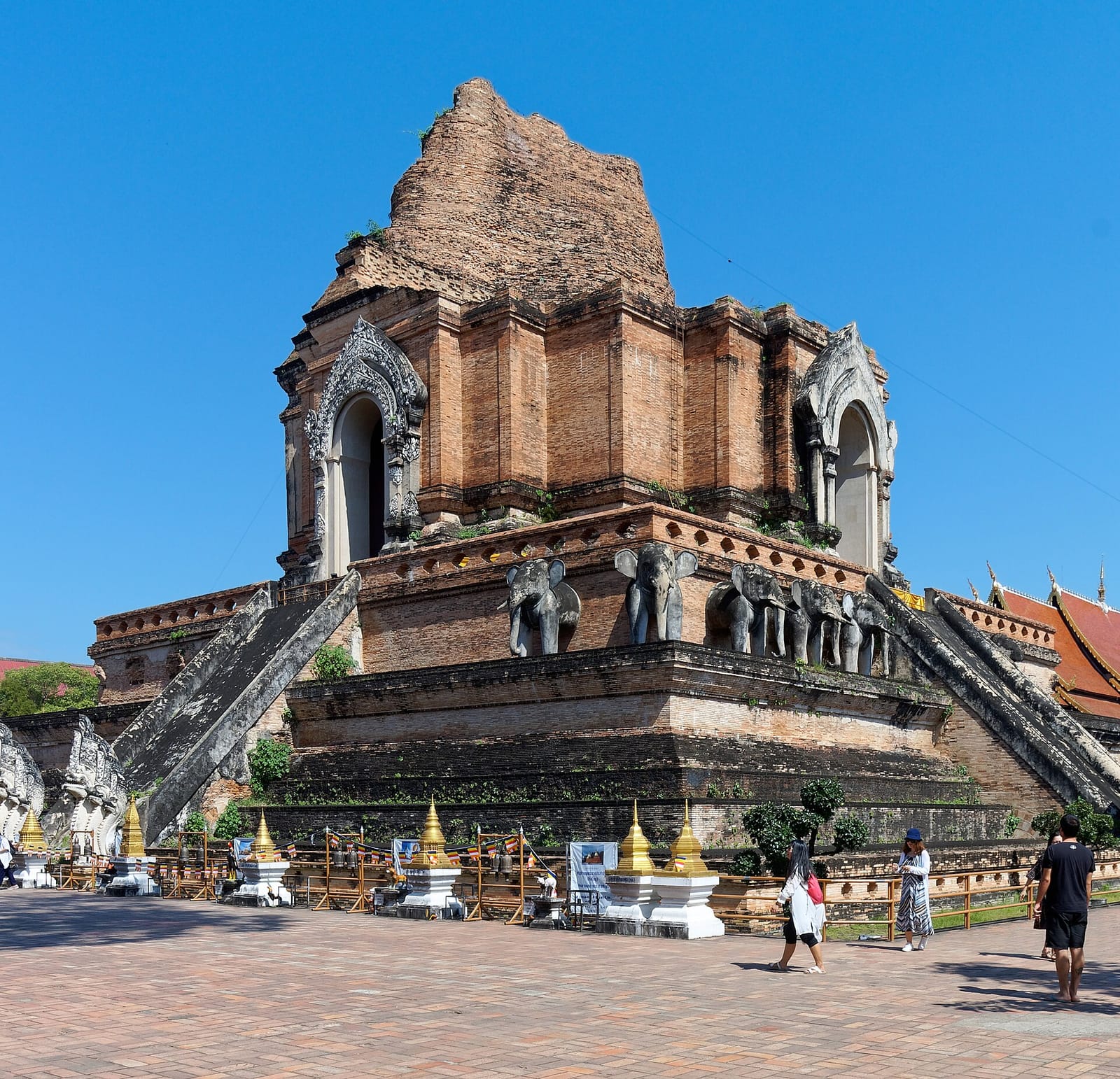
The chedi has stood at its current height of about 60 metres ever since the earthquake. A partial restoration in the 1990s, funded by UNESCO and the Thai Fine Arts Department, rebuilt the elephant figures along the lower platform, stabilised the eastern face and added a jade replica of the Emerald Buddha in the eastern niche. The upper levels were deliberately left unrestored. The temple itself remained continuously occupied through Burmese rule and the nineteenth-century Lanna revival, and is today an active monastery with around 60 resident monks and novices, the longest-running monk-chat programme in Chiang Mai and a Buddhist studies college serving the surrounding districts.
What to see
The compound is unusually open, with most of its significant structures arranged around the chedi at the centre. Allow at least 45 minutes to cover everything; 90 minutes if you stop for a monk chat.
The great chedi
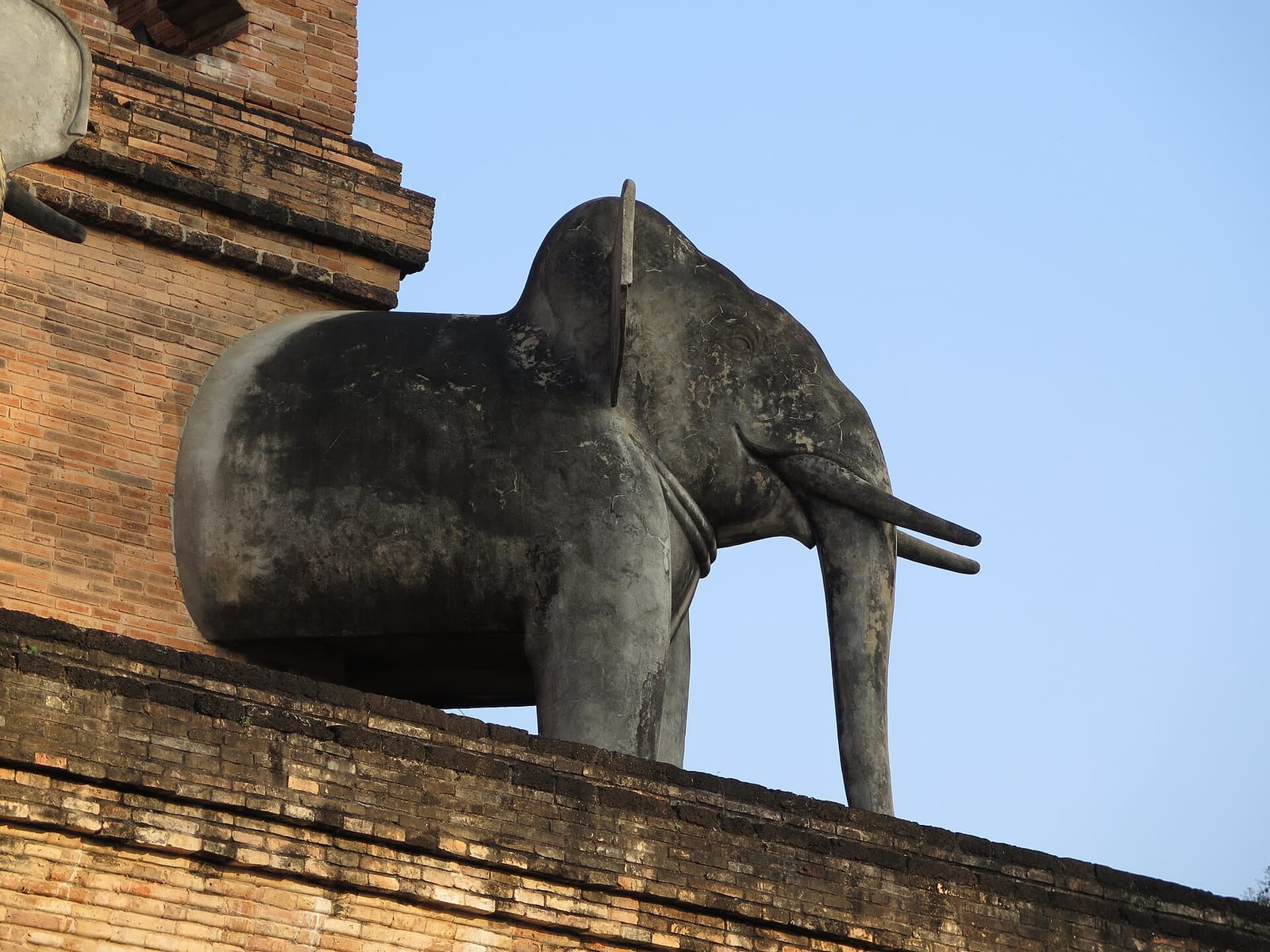
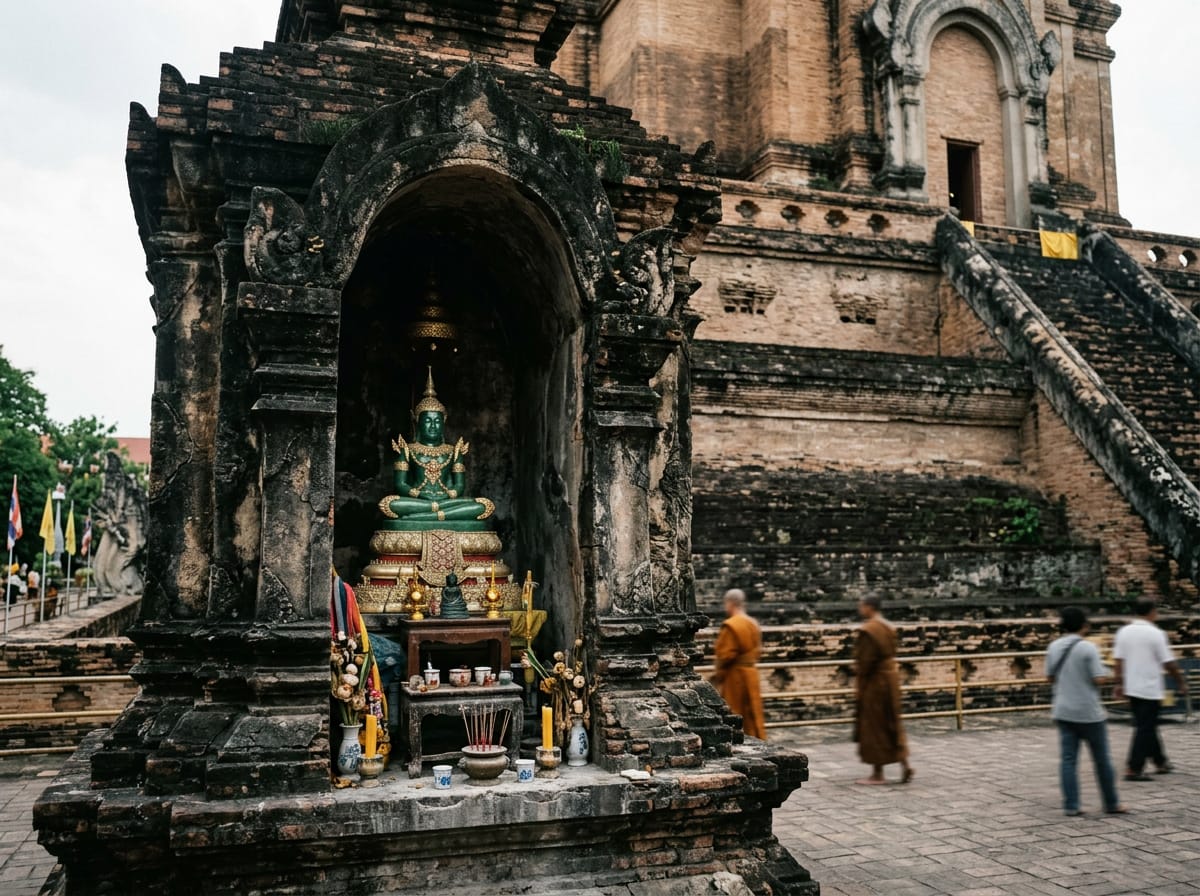
The chedi itself is the obvious centrepiece. It is built on a square stepped base 44 metres across, rising through a series of receding terraces to the truncated stump where the spire once rose. The lower base carries large elephant figures along each face, modelled in stucco over a brick core. Most of these were rebuilt in the 1990s after the originals were lost to earthquake damage and centuries of weather. Niches at the four cardinal points hold Buddha images; the eastern niche houses the jade replica of the Emerald Buddha installed during the restoration.
Walk three times around the platform clockwise, keeping to the marked path. Do not climb on the structure. The masonry is fragile in places and the temple’s stewardship board has resisted suggestions that the chedi be fully rebuilt: the ruin in its current state, they argue, is the more honest monument to the kingdom’s history than any reconstruction would be.
The principal viharn
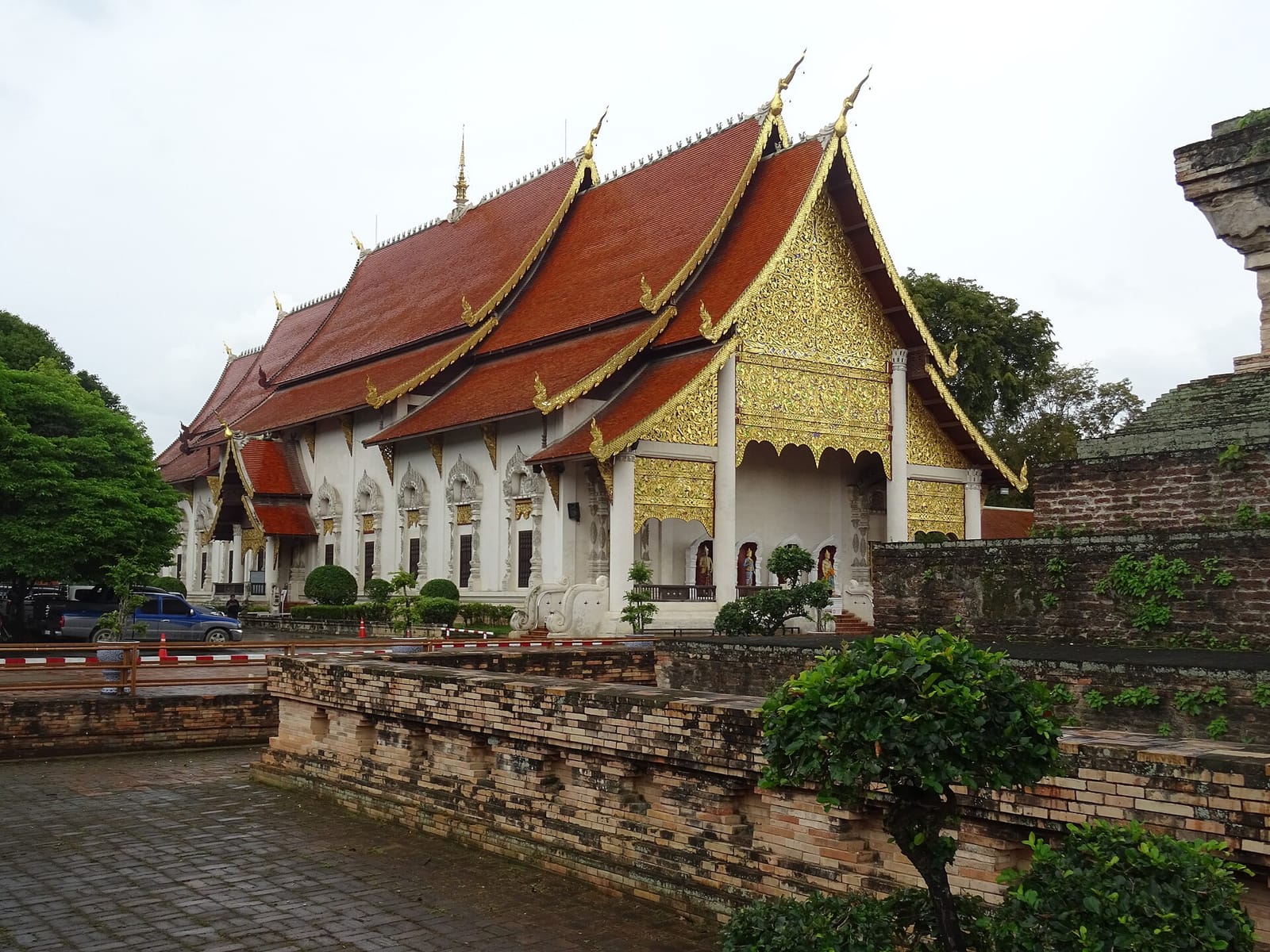
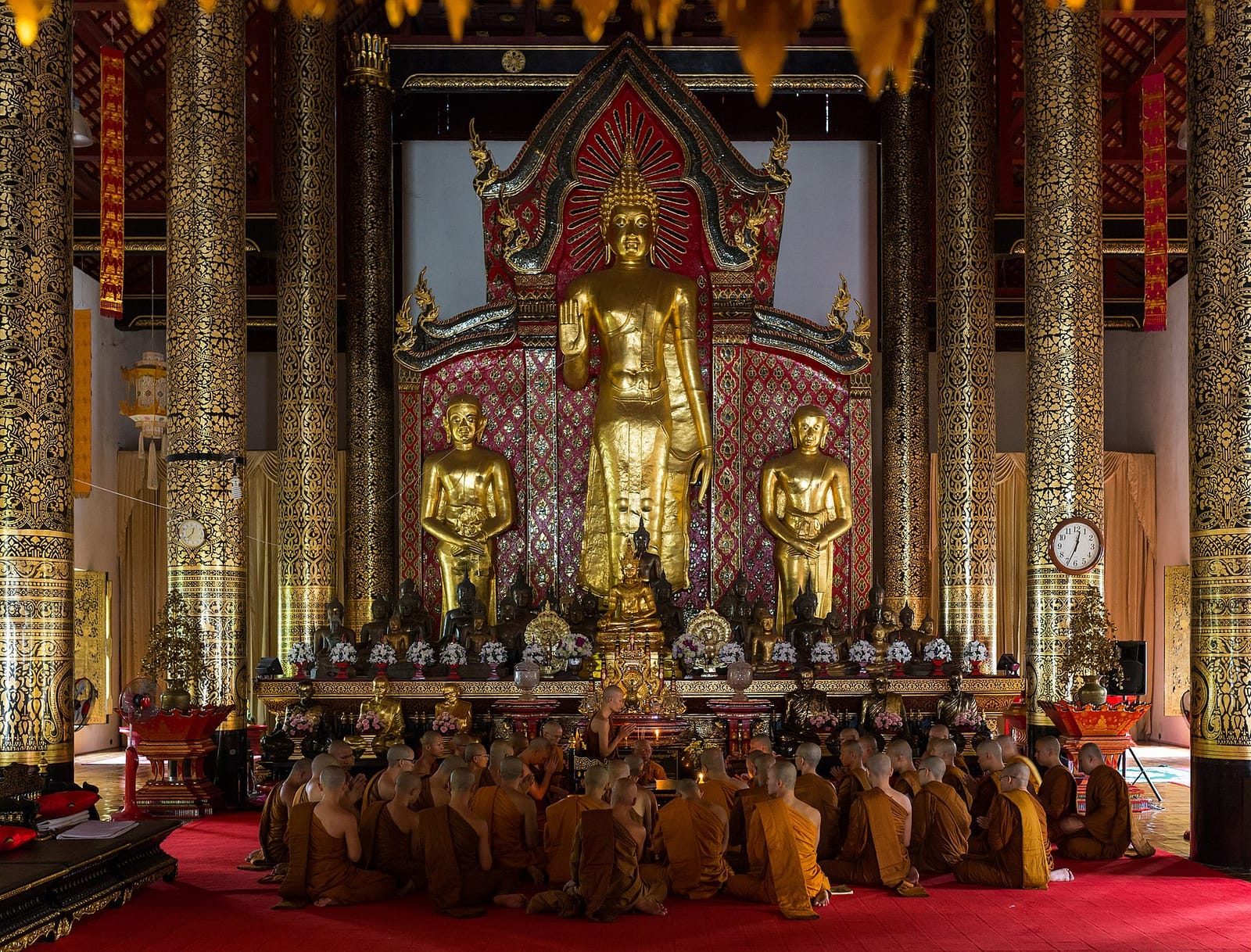
The large viharn at the front of the compound, facing east onto Phra Pokklao Road, was rebuilt in 1928 in a Lanna-influenced revival style after the previous building was destroyed by termite damage. It is the most active part of the temple, used for daily chanting and major ceremonies. The principal image is a tall standing Buddha in the abhayamudra posture — right hand raised in the gesture of dispelling fear — attended by smaller seated figures along the sides. The painted ceiling shows lotus medallions in gold leaf on a red ground. Morning chanting at 06:30 and evening chanting at 18:00 are open to anyone seated quietly at the rear.
The ubosot
The ordination hall, the ubosot, sits to the north of the chedi in its own walled enclosure. It is the oldest surviving building in the compound, dating in its current form to the early eighteenth century, though the foundations are older still. The eight sema boundary stones around the building are carved in the form of crouching lions and are unusually fine. The interior is closed to visitors except during ordinations.
The Lak Mueang city pillar shrine
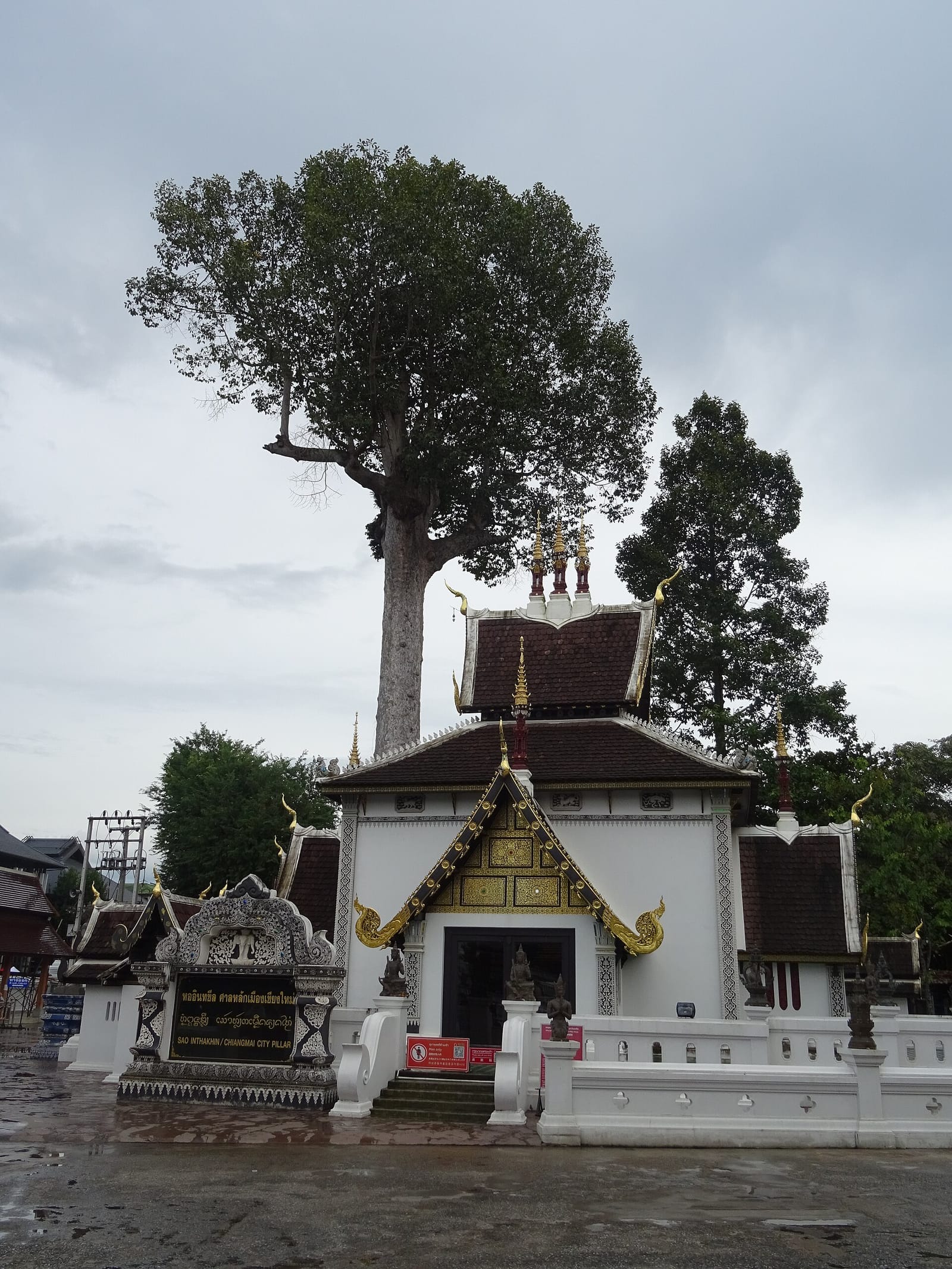
A small white-walled enclosure to the south-west of the chedi houses the Lak Mueang, the city pillar of Chiang Mai. The pillar is a carved stone shaft set vertically into the floor, treated as the residence of the city’s tutelary spirits. It was moved to its present site in 1800 from an earlier shrine nearer the western moat. Three enormous yang trees — wood-oil trees of the genus Dipterocarpus — shade the enclosure and are said to have been planted at the same time as the pillar’s relocation. The Inthakhin ceremony, held here over a week in May or early June, is one of the major Chiang Mai festivals.
By long-standing custom women are asked not to enter the inner enclosure of the shrine. They may approach the outer wall and leave offerings of flowers and incense at the gate. The custom is honoured rather than enforced; the dressed-stone surround makes the rule obvious without a sign.
The ho trai
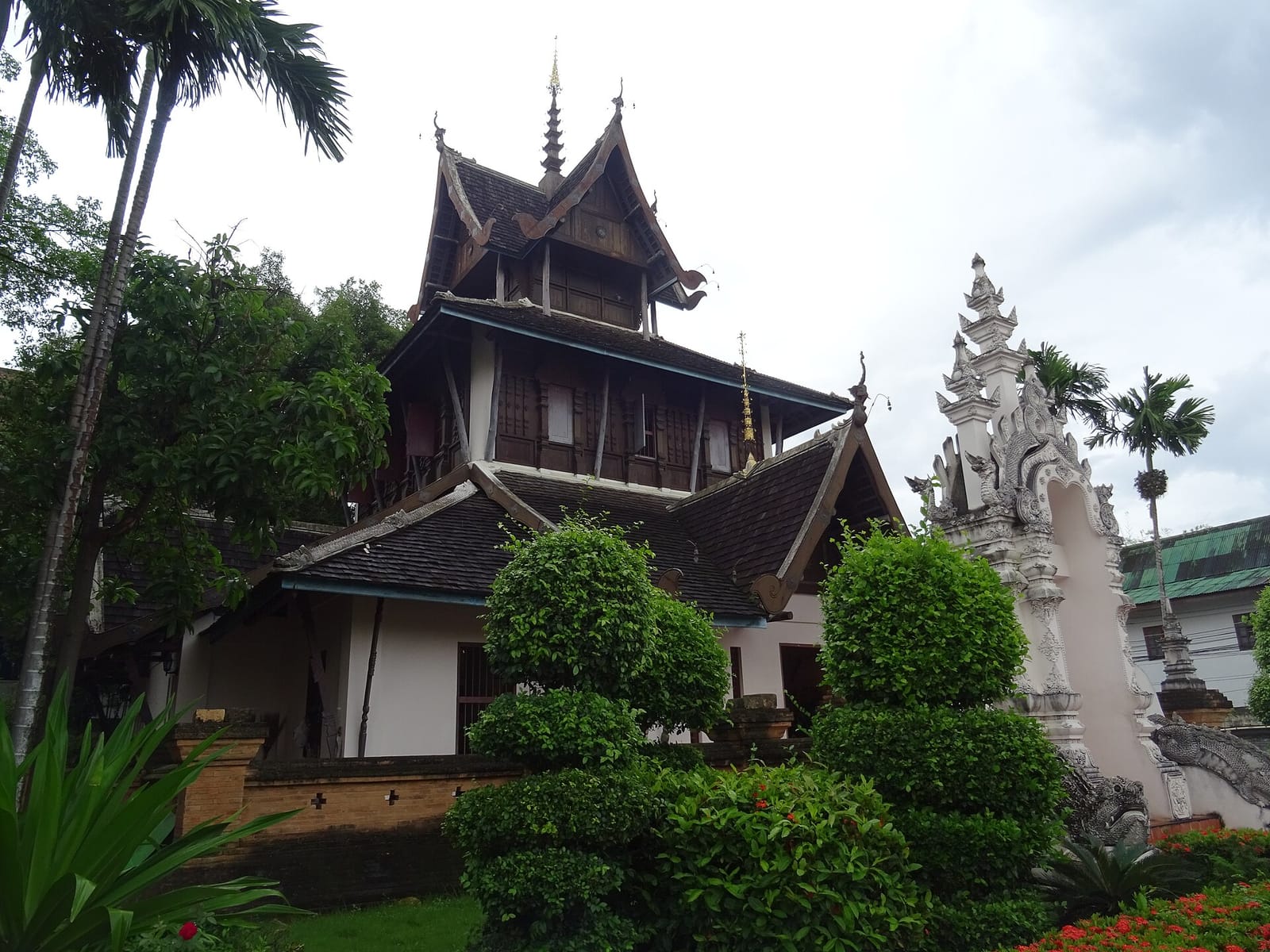
A small ho trai, or scripture library, stands on a high masonry plinth at the north-eastern corner of the compound. The plinth keeps palm-leaf manuscripts dry and away from termites and rats. The teak walls of the upper storey carry shallow stucco reliefs of lotus medallions and kinnari figures, and the small windows have shutters carved with the naga serpent motif. The building is locked but worth photographing from the south side, where the morning light catches the reliefs.
The monk-chat pavilion
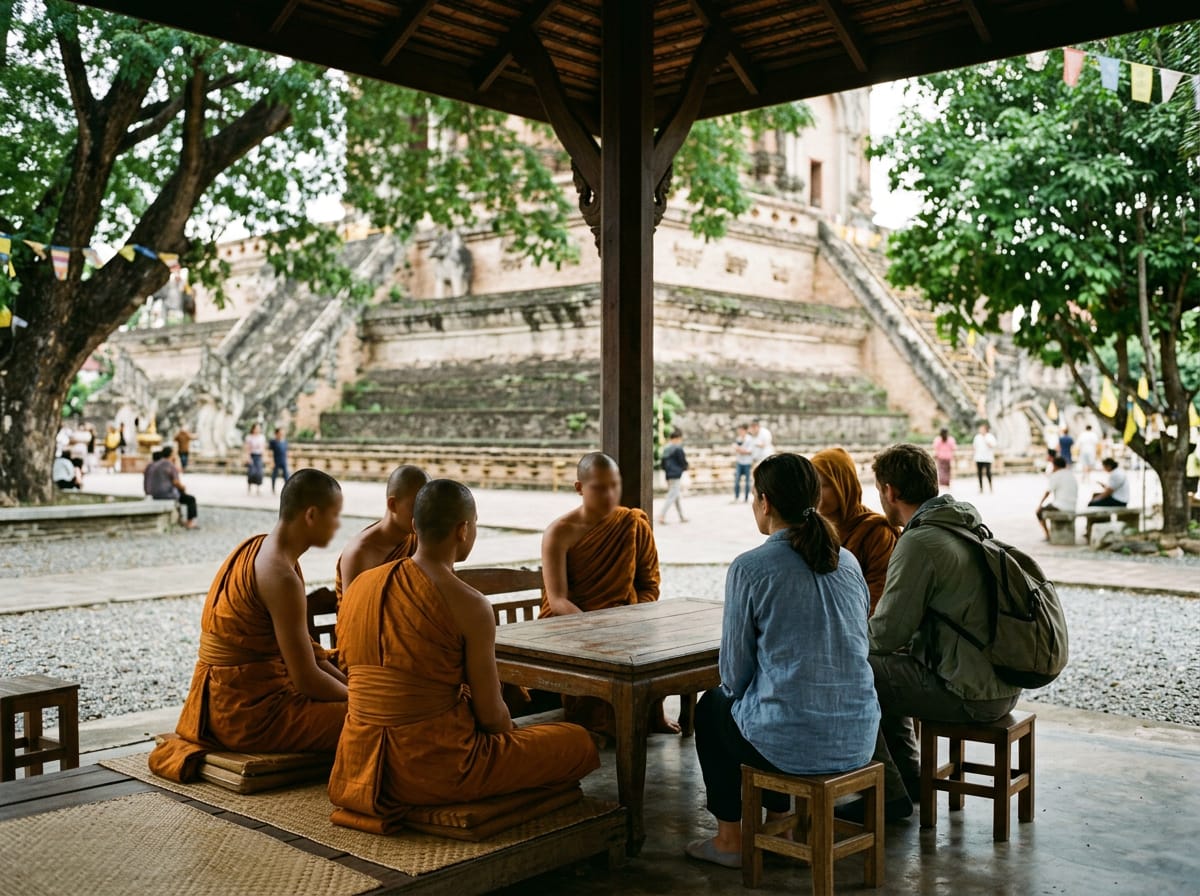
The temple’s monk-chat programme has run since 1993, the longest-established of its kind in Chiang Mai. Novice monks — typically aged between sixteen and twenty-two — sit at tables in an open-air pavilion north of the chedi from 09:00 to 18:00 every day, welcoming conversations with foreign visitors in English. There is no charge. Sit at any table where a monk is alone, introduce yourself and let the conversation find its own subject. Many visitors expect to ask questions about Buddhism; in practice the novices are at least as interested in asking about the visitor’s country, family and work. Conversations usually last 20 to 40 minutes. Dress modestly. Do not photograph the novices without asking first.
Reclining Buddha and minor shrines
A small reclining Buddha sits in its own viharn at the southern edge of the compound. The image is 18th-century, in copper alloy, and rests on a tiered base of red and gold lacquer. Beyond it a row of smaller shrines holds donor images from the nineteenth and twentieth centuries — minor figures by Lanna standards but worth a slow walk along the south wall.
How to visit
Wat Chedi Luang sits at the geographic centre of the Old City. From Tha Phae Gate at the eastern moat, walk west along Ratchadamnoen Road for about 700 metres, then turn left onto Phra Pokklao Road; the temple gate is 100 metres on your right. The walk takes 10 to 12 minutes and is flat the whole way. From Wat Phra Singh at the western end of Ratchadamnoen it is a two-minute walk east on Samlan Road.
From Chiang Mai International Airport the temple is 4 km north-east. A metered taxi costs 150 to 200 baht and a Grab car around 130 baht. Red songthaew (shared pickup trucks) operate throughout the Old City — flag one, name the destination as ‘Wat Chedi Luang’ and pay 30 baht per person shared or 100 to 150 baht chartered.
Parking is awkward. A small paid car park in front of the temple charges 20 baht per hour and fills by 09:30 in high season. A larger municipal car park sits two minutes north near the Three Kings monument, charging 40 baht per hour. Motorbikes can park free along Phra Pokklao Road. Most visitors arrive on foot.
The neighbourhood is one of the busiest parts of the Old City. Phra Pokklao Road has half a dozen cafes within a short walk, the Three Kings monument plaza is two minutes north and the Saturday Walking Street begins at Chiang Mai Gate ten minutes south. Pair the temple with Wat Phra Singh two minutes west for a 90-minute morning, or with the Saturday Walking Street for a longer afternoon.
Etiquette and dress code
The temple is more strictly policed than most Old City compounds because of the monk-chat programme — the novices and the visitor-services team take dress and behaviour seriously.
- Shoulders and knees must be covered for both men and women.
- Sarongs are lent free at the east gate, with a 100 baht refundable deposit.
- Shoes come off before entering any viharn, the ubosot and the inner enclosure of the Lak Mueang.
- Hats and sunglasses should be removed before entering any building.
- Walk around the chedi clockwise; never anticlockwise.
- Do not climb on the chedi or any of the elephant figures.
- Women should not enter the inner enclosure of the Lak Mueang. The outer wall is open to everyone.
- Sit with legs tucked to one side rather than crossed when seated in front of a Buddha image.
- Photography is welcomed in the compound; flash is discouraged inside the viharns. Never photograph monks without asking.
- Drones are not permitted anywhere inside the Old City moat.
Best time to visit
The chedi is at its most photogenic in the first hour after sunrise, when the eastern face is lit directly and the upper masonry catches a warm side-light. From 16:00 onwards the western face takes the late sun and the whole structure throws a long shadow across the platform. Both windows are good. The middle of the day from 11:00 to 14:00 is harsh and crowded, particularly in the November-to-February high season.
The monk-chat programme runs from 09:00 to 18:00 daily, but the best window for unhurried conversations is between 14:00 and 16:30, when the morning rush of coach groups has cleared and the novices are usually less in demand.
Full-moon Buddhist holy days bring a noticeable change to the compound. Wisakha Bucha in May, Asanha Bucha in July and Makha Bucha in February all draw evening wian thian circumambulation processions around the chedi at sunset, with visitors welcome to walk three times clockwise carrying a lit candle.
The annual Inthakhin ceremony in late May or early June is the temple’s biggest event. For a full week, thousands of residents bring flower offerings to the city pillar shrine. The compound is decorated with candles, the chedi is lit at night and food stalls fill the surrounding lanes. It is the most atmospheric time to visit if you can match the date — search for ‘Inthakhin’ before booking. The Yi Peng and Loy Krathong festival in November also touches the temple, though the lantern release itself takes place along the Ping River rather than here.
Nearby attractions
Wat Chedi Luang sits at the densest point of the Old City temple network. A morning’s walk covers several major sites.
- Wat Phra Singh — the principal Lanna royal temple, two minutes’ walk west on Samlan Road.
- Wat Phan Tao — a small all-teak viharn directly next door to the north, particularly fine in late afternoon light.
- The Three Kings monument and the Lanna Folk Museum — two minutes’ walk north on Phra Pokklao Road.
- Wat Chiang Man — the oldest temple in the city, founded by King Mangrai in 1296, ten minutes’ walk north towards the Chang Phueak corner.
- The Saturday Walking Street — begins at Chiang Mai Gate ten minutes’ walk south on Saturday evenings from 16:00.
A short note on Lanna style
The Wat Chedi Luang chedi shows an unusual blend of influences. The square stepped base with elephant figures along each face is a Khmer borrowing, descended ultimately from the eleventh-century reliquaries of Angkor and absorbed into Lanna design via Sukhothai. The bell-shaped middle section and the receding terraces above are pure Lanna, in the same family as the chedis of Wat Phra Singh and Doi Suthep but built at three times their scale. The upper levels — now missing — would have carried a tall conical spire in the Lanna style, terminating in a multi-tiered umbrella finial.
The principal viharn, the ubosot and the ho trai are textbook Lanna in their roof forms: low-pitched, multi-tiered teak roofs with carved kanok flame gables, naga finials extending the bargeboards into upward-pointing serpent fingers, and lacquered pillars inside finished with the gold-on-black lai kham technique. Read the buildings here against the smaller Wat Phra Singh up the road and the mountain Wat Phra That Doi Suthep above the city; together the three temples cover the full vocabulary of the northern style.
For the longer visit
If you have 45 minutes, walk through the principal viharn, circle the chedi three times and visit the Lak Mueang shrine. That covers the essentials.
If you have 90 minutes, add a monk-chat conversation in the pavilion north of the chedi. Sit down at any table where a novice is alone, introduce yourself and let the conversation find its subject. It is the most rewarding 30 minutes a visitor can spend in any Chiang Mai temple, and the novices are at least as interested in asking questions as they are in answering them.
If you have a half day, combine the temple with a slow walk west to Wat Phra Singh and a circuit of the smaller compounds along Singharat Road, then walk south to the Saturday Walking Street if it is a Saturday or to the Sunday Walking Street end-point at Wat Phra Singh if it is a Sunday. The Old City has more than thirty active temples within the moat and the densest part of the network is the kilometre between Wat Chedi Luang and the western wall. A morning here is the best introduction the city offers to its history.
Photos
Frequently asked questions
What time does Wat Chedi Luang open?
Wat Chedi Luang opens daily from 06:00 to 18:00. The viharns and the inner compound around the chedi are accessible throughout these hours. The monk-chat programme, where novice monks practise English with visitors, runs every day from 09:00 to 18:00 in a dedicated pavilion to the north of the chedi. Morning chanting is held at around 06:30 and evening chanting at 18:00; visitors are welcome to sit quietly at the rear of the principal viharn during these. The compound stays partly open in the evening for the early sections of the Saturday Walking Street nearby.
How much is the entry fee for Wat Chedi Luang?
Foreign visitors pay 40 baht for entry, payable at the booth just inside the eastern gate on Phra Pokklao Road. Thai nationals enter free of charge. The ticket covers the principal viharn, the chedi platform, the ubosot and the city pillar shrine within the compound. The monk-chat programme is free. Donations to the alms boxes in front of each Buddha image are voluntary and 20 baht is a customary amount. The temple does not charge separately for the small museum behind the chedi.
Where is Wat Chedi Luang?
Wat Chedi Luang sits at the geographic centre of Chiang Mai's Old City, on Phra Pokklao Road about 200 metres south of the Three Kings monument. The address is 103 Phra Pokklao Road, Phra Singh subdistrict. From Tha Phae Gate it is a flat 10-minute walk west along Ratchadamnoen Road, then a short left onto Phra Pokklao. From Wat Phra Singh it is a two-minute walk east. The Old City moat is the most useful landmark — the temple is roughly equidistant from all four gates.
How long should I spend at Wat Chedi Luang?
Allow 45 to 75 minutes. A focused visit covering the great chedi, the principal viharn, the Lak Mueang city pillar shrine and the ho trai takes 45 minutes. Add 30 minutes for a monk-chat conversation, which is the most rewarding part of a visit for many people. Photographers and anyone interested in the elephant figures along the base of the chedi should budget closer to 90 minutes. Combine the visit with Wat Phra Singh two minutes' walk west and you have a half-day in the Old City.
What is the dress code for Wat Chedi Luang?
Shoulders and knees must be covered for both men and women. Vests, short shorts, miniskirts and sheer or strapless tops are not permitted in the inner compound around the chedi or inside any viharn. Sarongs are lent at a small stand inside the east gate, with a 100 baht refundable deposit. Shoes come off before entering any viharn, the ubosot or the inner enclosure of the Lak Mueang shrine. Hats and sunglasses should be removed inside any building. The dress code is enforced more strictly here than at most Old City temples because of the monk-chat programme.
Can women enter Wat Chedi Luang?
Women may enter the compound, all three viharns, the ubosot and the chedi platform. The only restriction applies at the inner enclosure of the city pillar shrine, the Lak Mueang, where women are traditionally asked not to enter — a custom rather than a rule, observed from the gate to keep the line of the pillar clear of distractions during ceremonies. Women may approach the outer wall of the shrine and offer flowers and incense there. The restriction does not apply to the rest of the compound.
What is the monk-chat programme?
The monk-chat programme has run at Wat Chedi Luang since 1993 and is the longest-established of its kind in Chiang Mai. Novice monks, typically aged 16 to 22, sit at tables in a dedicated open-air pavilion north of the chedi and welcome conversations with foreign visitors in English. It is genuinely two-way: the novices practise their English and the visitor learns about monastic life. There is no charge. Conversations usually last 20 to 40 minutes. Sit at any table where a monk is alone; do not interrupt one already in conversation. Dress modestly and do not photograph the novices without asking.
Why is the chedi half-ruined?
The chedi reached its full height of around 80 metres by 1481, making it the tallest structure in the Lanna kingdom and one of the tallest in Southeast Asia at the time. In 1545 a severe earthquake — by modern estimates magnitude 7 or larger — struck the city and brought down the upper third of the chedi. The Lanna kingdom was in political decline; the resources for a rebuild were not available, and Burmese occupation in 1558 ended any prospect of restoration. The chedi has stood at its current height of about 60 metres ever since. A partial restoration in the 1990s, funded by UNESCO and the Thai Fine Arts Department, rebuilt the missing elephant figures along the base and stabilised the eastern face, but left the upper levels deliberately unrestored.
Can I climb the chedi?
No. The chedi platform is open for circumambulation along the four lower faces, but climbing onto the structure itself is forbidden and constantly monitored. The inner masonry is fragile in places following the earthquake damage and a 2014 study found multiple sections at risk of further collapse. Walk three times around the platform clockwise — never anticlockwise — keeping to the marked path. Touching the chedi to leave gold leaf is permitted only on the four niche images at the cardinal points, not on the masonry itself.
What is the Emerald Buddha connection?
The Emerald Buddha — Thailand's most revered Buddha image, now housed at Wat Phra Kaew in Bangkok — was kept inside the eastern niche of Wat Chedi Luang's chedi from 1468 to 1552, a period of 84 years. It was brought to Chiang Mai by King Tilokaraj after being discovered at Wat Phra Kaew Don Tao in Lampang. It was taken to Luang Prabang in 1552, then to Vientiane, and finally to Bangkok in 1784. A jade replica was placed in the eastern niche during the 1990s restoration to mark the image's long association with the temple. The replica is visible from the chedi platform and is not a copy of the original — the original Emerald Buddha is jasper, not emerald, and the replica is jade chosen for its colour.
How do I get to Wat Chedi Luang from Tha Phae Gate?
Walk west along Ratchadamnoen Road for about 700 metres, then turn left onto Phra Pokklao Road; the temple is 100 metres on your right. The walk takes 10 to 12 minutes at an easy pace and is flat the whole way. A red songthaew costs 30 baht per person shared or 100 baht chartered. Grab fares are around 70 baht. Most visitors walk and combine the trip with Wat Phra Singh two minutes further west, making a 25-minute return walk from Tha Phae Gate.
Is there parking near Wat Chedi Luang?
A small paid car park sits in front of the temple on Phra Pokklao Road, charging 20 baht per hour and filling by 09:30 in high season. A larger municipal car park is two minutes north on Phra Pokklao, near the Three Kings monument, charging 40 baht per hour. Motorbikes can park free along Phra Pokklao Road or in any of the small side lanes north and south of the temple. As with most Old City temples, walking from a moat-side hotel is the simplest option.
When was Wat Chedi Luang built?
The temple was founded in 1391 by King Saen Muang Ma to house the ashes of his father King Kuena — the same Kuena who founded Wat Phra That Doi Suthep. The chedi was begun under Saen Muang Ma and continued by successive kings, reaching its full height of around 80 metres in 1481 under King Tilokaraj. It stood at that height until the earthquake of 1545. The principal viharn at the front of the compound was rebuilt in 1928 in a Lanna-influenced revival style; the much older ubosot to the north dates in its current form to the early eighteenth century.
Is Wat Chedi Luang worth visiting?
For anyone interested in the history of the Lanna kingdom or the scale of pre-Burmese Chiang Mai, Wat Chedi Luang is essential. The ruined chedi is the most visible reminder anywhere in the city of what Chiang Mai was before 1545. The monk-chat programme is the most direct way for a visitor to ask questions about Thai Buddhism. Together with Wat Phra Singh two minutes' walk west, it forms the natural focus of a first morning in the Old City. Visit at sunrise for the light on the chedi, or in late afternoon for the monk chat and the evening chanting.
What is the Lak Mueang city pillar?
The Lak Mueang, or city pillar, is the spiritual foundation stone of Chiang Mai. It was moved to its current site within Wat Chedi Luang in 1800, having previously stood at Wat Sadeu Muang nearer the Suan Dok Gate. It is housed in a small white-walled enclosure shaded by three large yang trees said to have been planted at the same time as the pillar's relocation. The pillar itself is a carved stone shaft set vertically into the floor. Each year the city's tutelary spirits are honoured here in the Inthakhin ceremony, a week-long festival in May or early June that draws thousands of residents to make offerings. Women are traditionally asked not to enter the inner enclosure.
Related guides
Temple
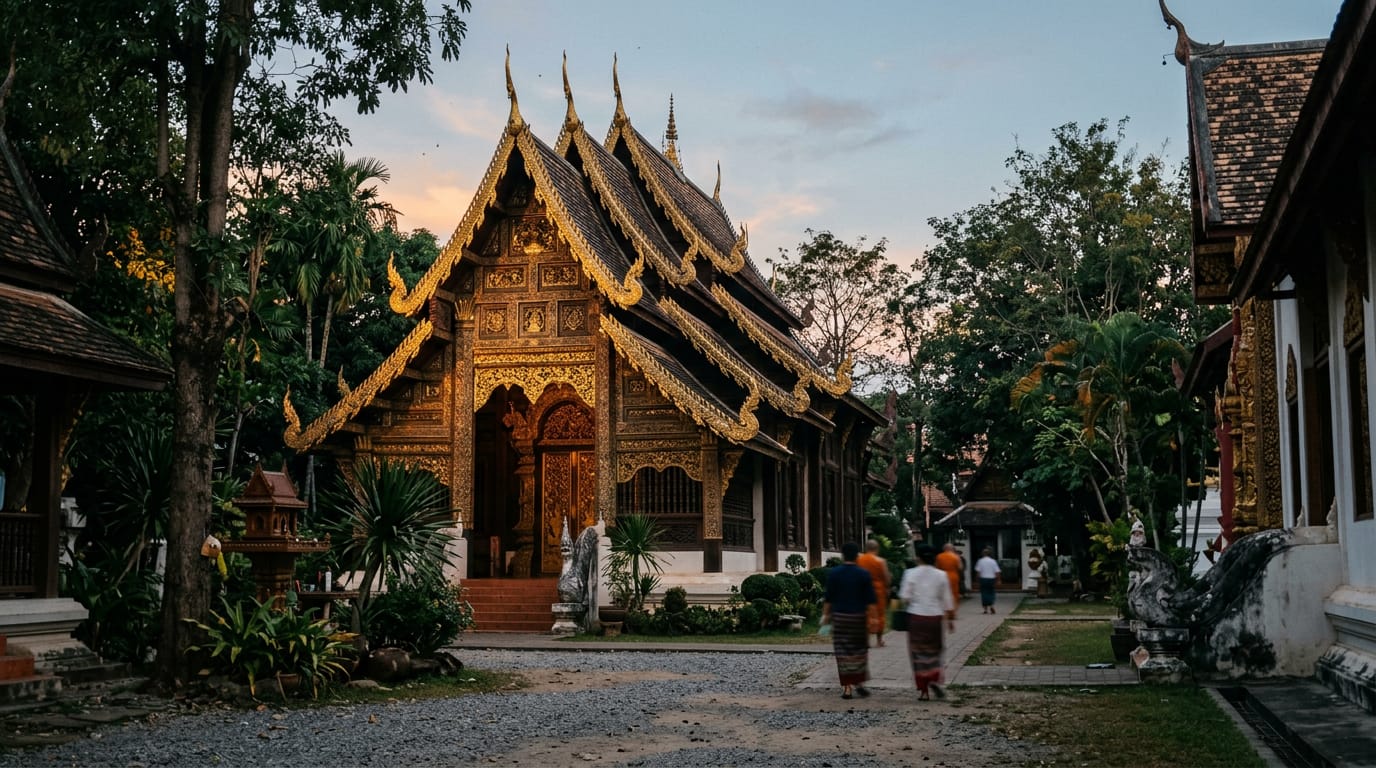
Wat Phra Singh
Wat Phra Singh is the most revered temple inside Chiang Mai's Old City, founded in 1345 by King Phayu of the Mangrai dynasty. Its Lai Kham viharn shelters the Phra Buddha Sihing — the Lion Buddha — which is paraded through the streets each Songkran. Together with its gilded chedi, carved teak gables and gold-leafed scripture library, the compound is the finest single example of Late Lanna architecture in northern Thailand.
Temple
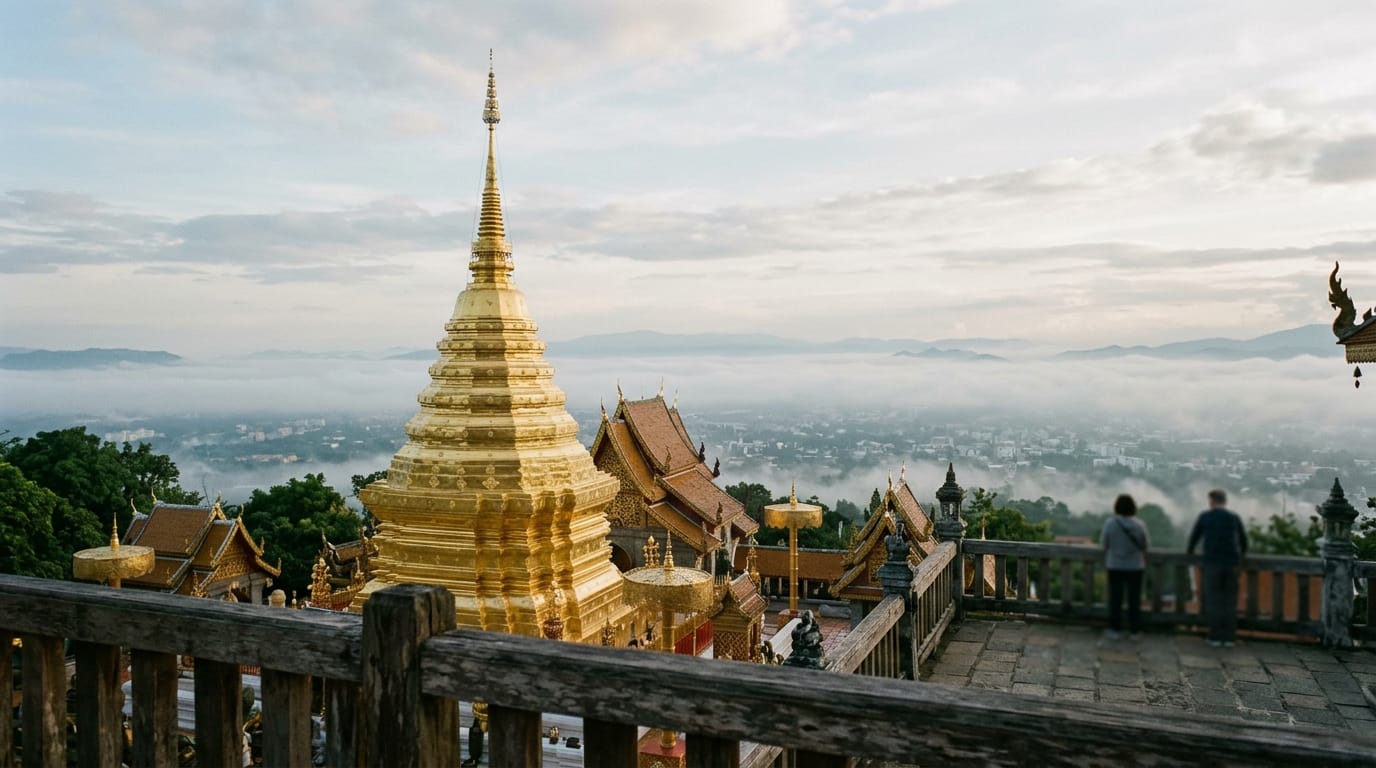
Wat Phra That Doi Suthep
Wat Phra That Doi Suthep is the mountain temple that watches over Chiang Mai from a forested ridge 1,073 metres above the city. Founded in 1383 by King Kuena to enshrine a Buddha relic carried up the mountain on the back of a white elephant, its gilded chedi has been the spiritual centre of northern Thailand for six centuries. A 306-step naga-flanked staircase or a small cable car carries visitors to a courtyard with one of the great views of the Ping Valley.
Temple
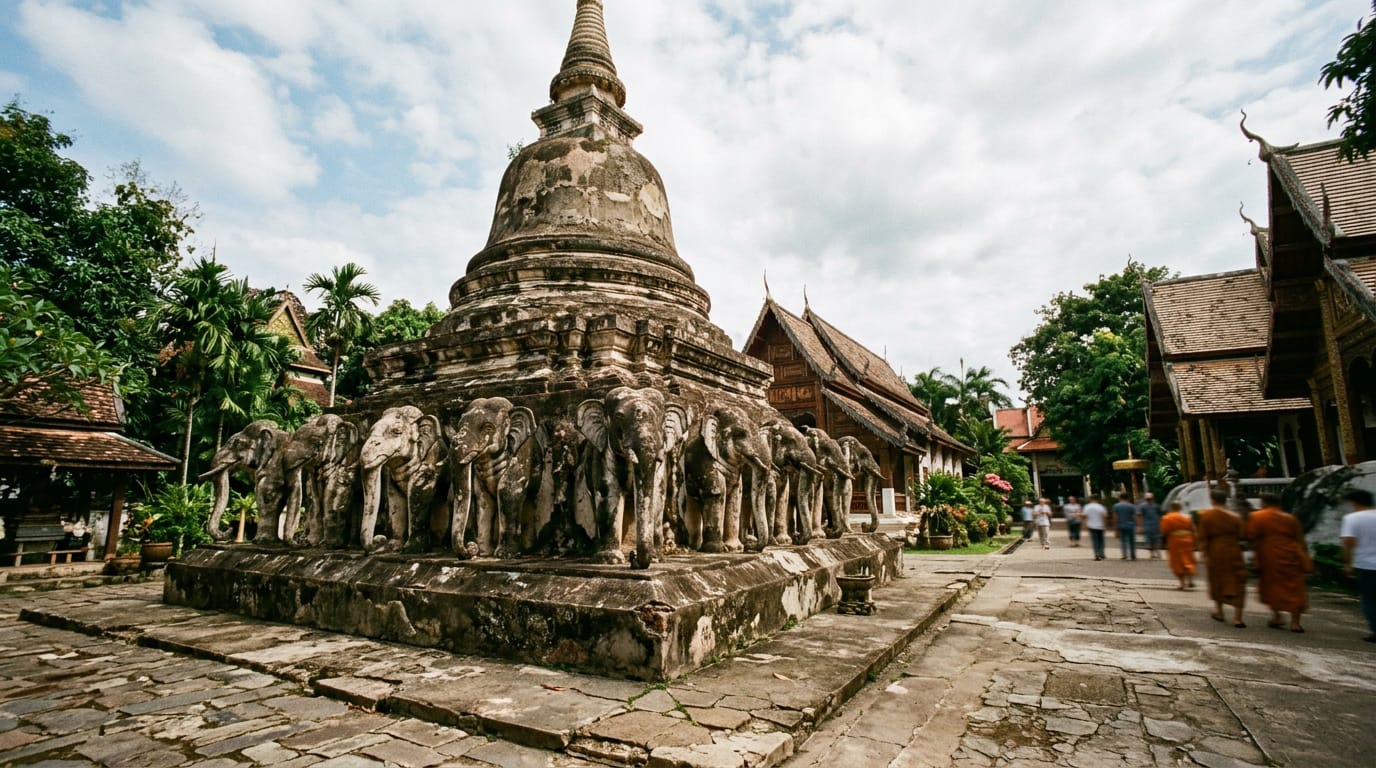
Wat Chiang Man
Wat Chiang Man is the oldest temple in Chiang Mai, founded in 1297 by King Mangrai as the first building inside his new walled city. Its Chedi Chang Lom, ringed at the base by fifteen elephant statues in stucco, set the template for Lanna stupa design. The Phra Sila marble Buddha and the crystal Phra Setangkhamani are kept inside a locked viharn.