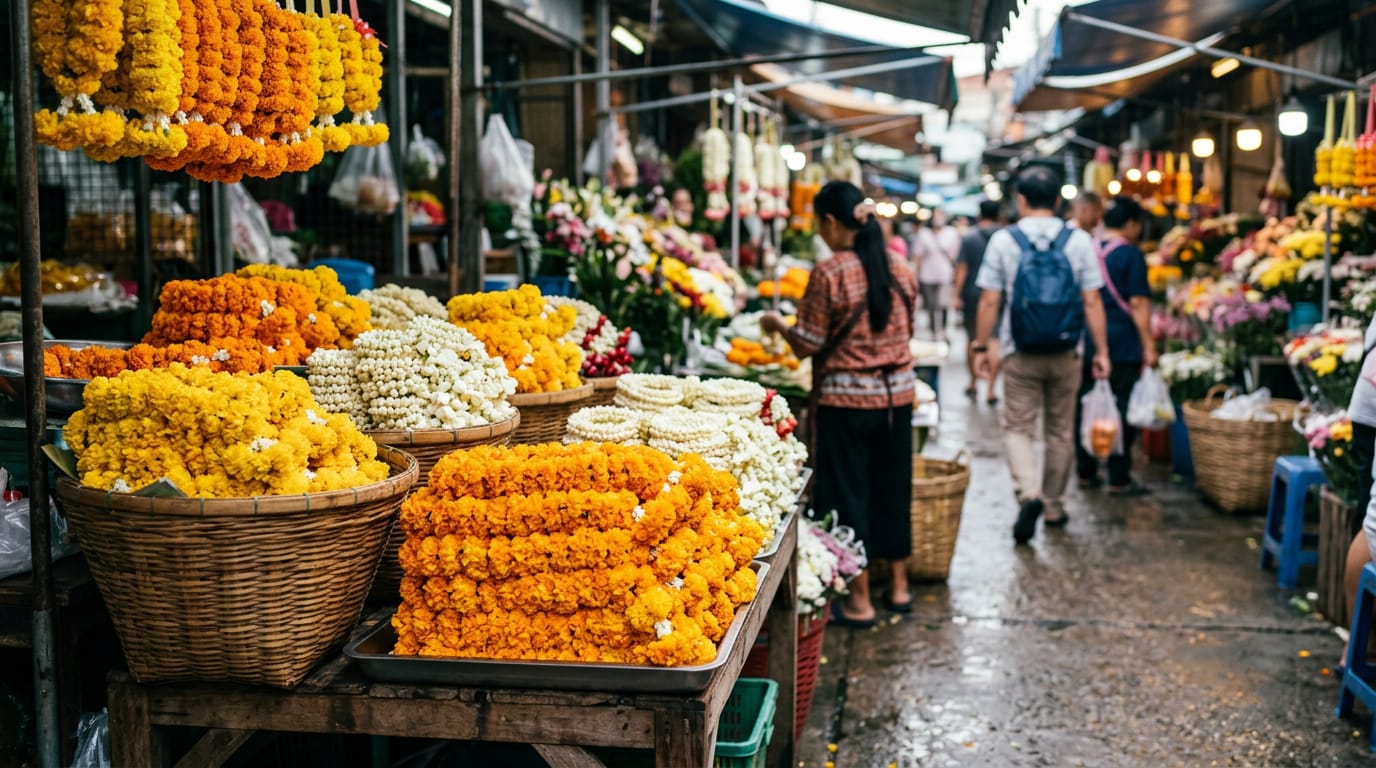
The Chiang Mai Flower Market (Talat Dok Mai) is the city's main wholesale and retail bazaar for cut flowers and ceremonial garlands, on a 400-metre stretch of Praisani Road beside the Ping River, behind Warorot Market in Chang Moi. Trading is continuous, with wholesale lorries arriving 03:00–06:00; in February 2026 it supplies the 49th Chiang Mai Flower Festival floats.
Updated
The Chiang Mai Flower Market is one of those places that resists tidy description. By 05:00 it is a working wholesale yard, with crates of marigolds piled higher than the buyers; by 09:00 it is a row of immaculate florists arranging orchids for hotel lobbies; by midday it has settled into the slower trade of garland makers threading jasmine for the city’s temples. The market sits on a single strip of Praisani Road, directly behind the better-known Warorot Market and pressed against the western bank of the Ping River. It has worked this way, in roughly this location, for more than a century.
History and place
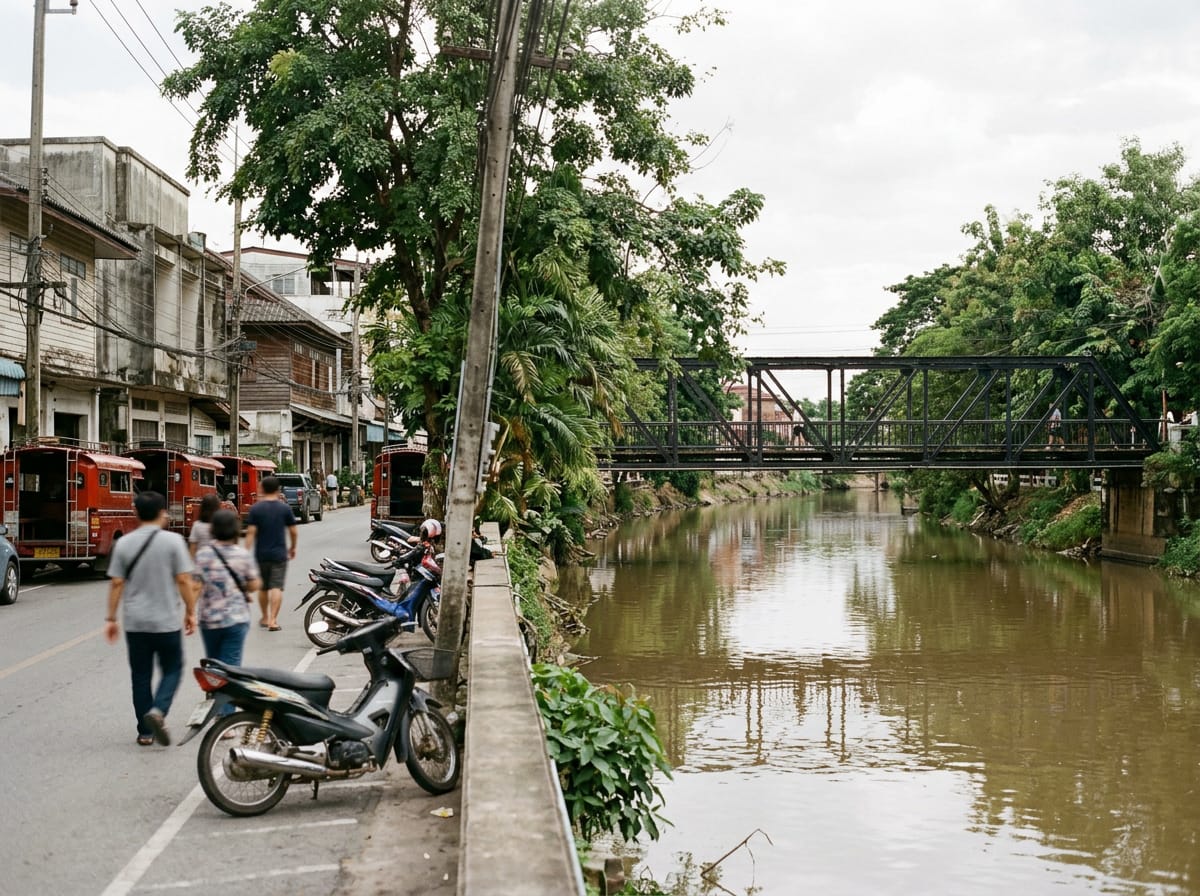
The market grew up on land that, in the late 19th century, lay just outside the eastern moat of the old walled city. When King Inthawichayanon ceded customs control of Chiang Mai’s river trade to Bangkok in the 1880s, the Ping River bank between the present-day Iron Bridge (Saphan Lek) and Nawarat Bridge became the principal landing for goods coming upriver from Lampang and downriver from the northern Lanna principalities. Chinese merchants from Yunnan and the Teochew-speaking south, who had already settled in the Chang Moi quarter as cloth and dry-goods traders, gradually extended their stalls down toward the water. Two or three of the current wholesale families on Praisani Road trace their line directly to this first generation, and the Hokkien temple on Wichayanon Road still keeps a register of the original 1898 stallholders.
Flowers came into the mix because the surrounding area was already a ceremonial hub. The royal Lanna household at Khum Chao Burirat, less than 400 metres west, required fresh garlands daily for its private shrine. The growing Chinese community needed flowers for the joss houses on Wichayanon Road. The temples of Wat Saen Fang, Wat Mahawan and Wat Bupparam, all within a 600-metre arc, between them consumed thousands of puang malai (threaded flower offering) garlands a week. By the 1920s, a recognised flower market had taken hold, initially a few dozen stalls clustered around the post office on Praisani Road (hence the road’s name).
The flower trade and the Warorot dry-goods market grew up symbiotically. Warorot’s wholesalers needed the early-morning foot traffic that the flower lorries brought; the flower vendors needed Warorot’s banking, packaging suppliers and the small kitchens that fed their crews. When the present concrete Warorot building was completed in 1959, the flower stalls deliberately stayed outside, holding their position on the open-air Praisani strip. They have been there ever since, weathering the 2005 fire that gutted half of Warorot and the 2011 floods that put the riverside row knee-deep in muddy water.
What you’ll find
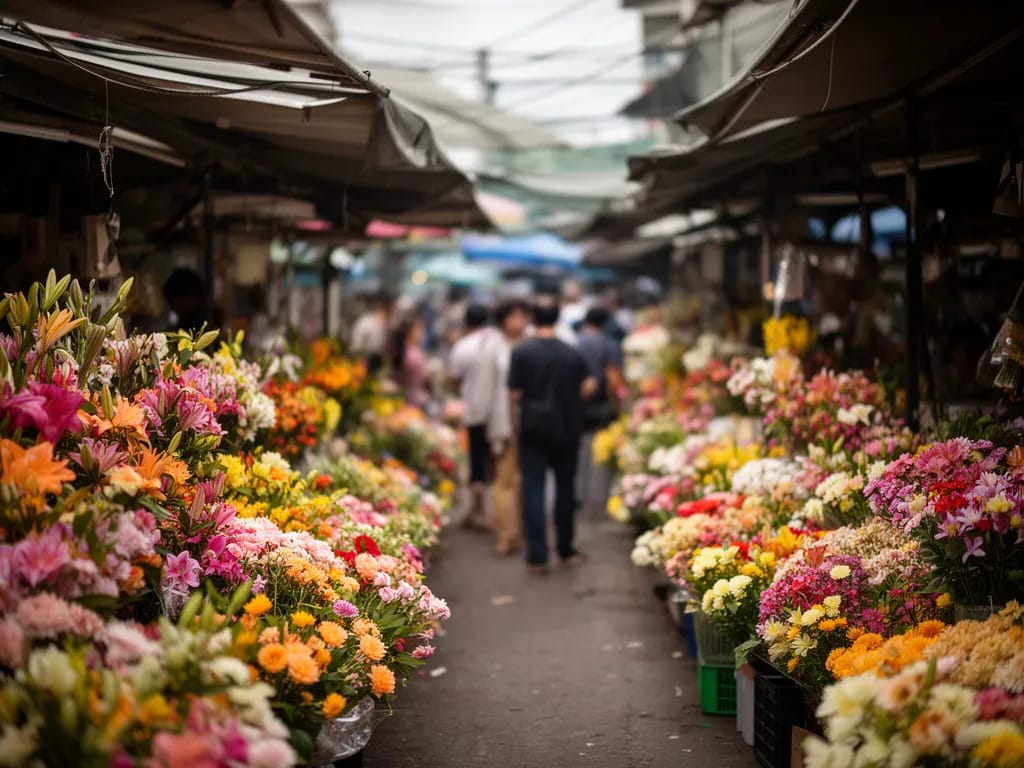
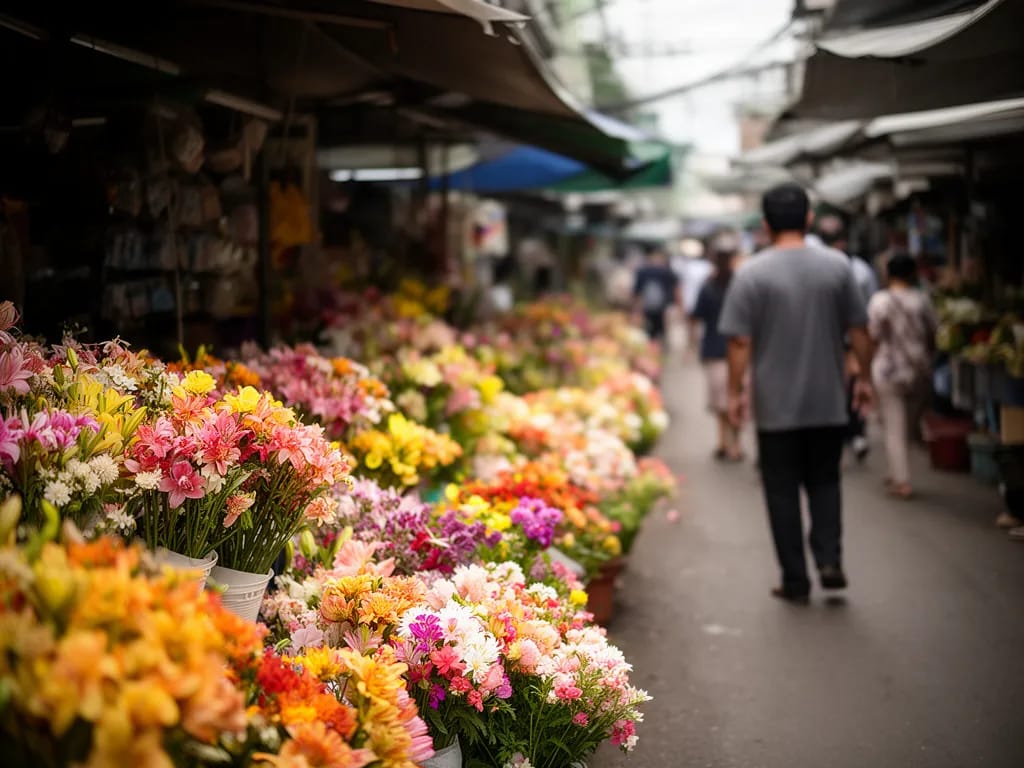
The trading strip is loosely organised by flower type, but the boundaries blur. Walk the 400 metres slowly and you will pass the full range.
Marigolds
Marigolds are the workhorse of the market. The bright orange dao reuang variety is sold loose by the kilogram (80–120 baht), in pre-strung garlands at 20 to 40 baht each, and in the giant temple-scale garlands that drape over Buddha images. A single stall in the wholesale row will move 200 to 400 kilograms of marigold heads on a normal weekday and double that in the run-up to a festival. The flowers come almost entirely from the smallholder fields around Mae Rim, San Pa Tong and Doi Saket. Marigolds are the standard offering at any wat in Chiang Mai because the orange is read as a sign of devotion and the dense flower head holds its shape for two or three days.
Jasmine
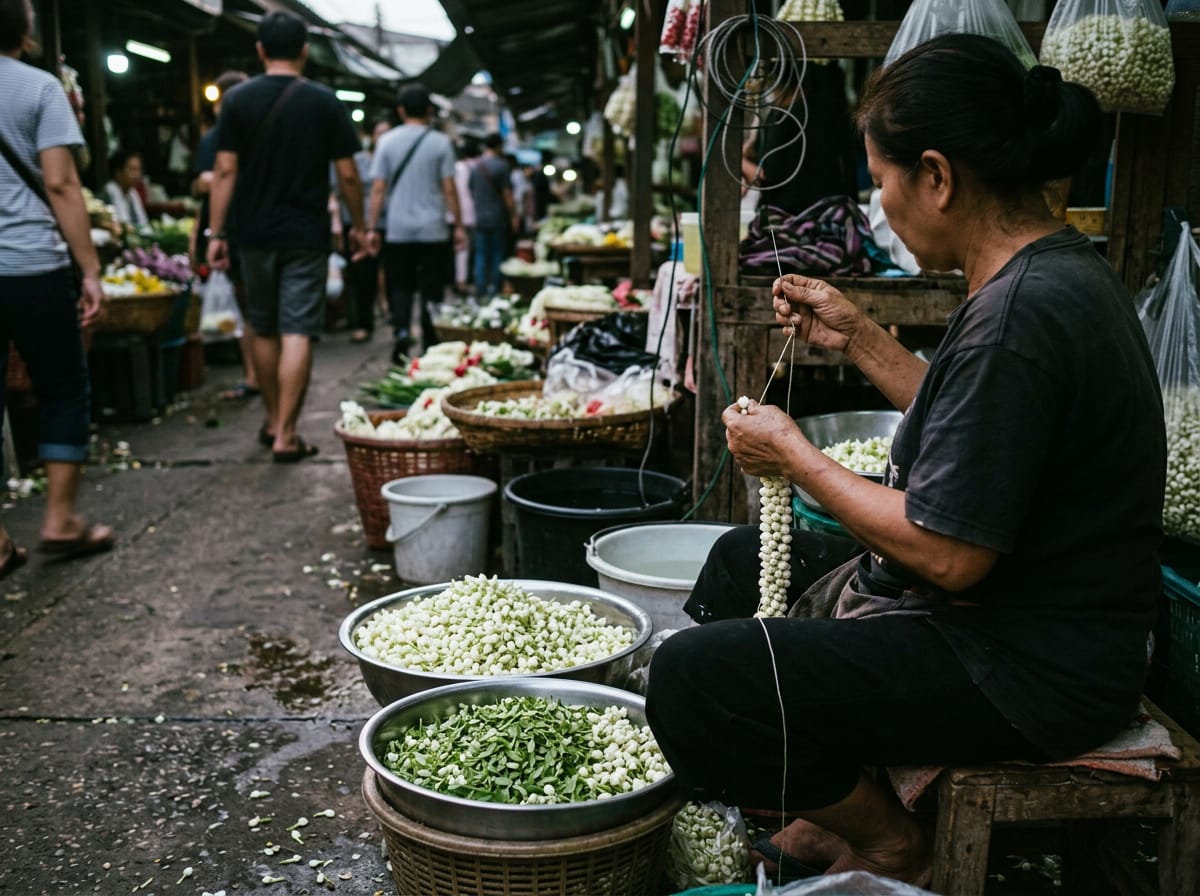
Mali (jasmine) is the white workhorse, threaded into puang malai garlands for shrines, personal offerings and Mother’s Day. The buds are sold by the half-kilogram in small flat baskets, kept cool with chipped ice. A garland maker can thread a finished puang malai in under three minutes; the women at the southern end of the row, near the riverside, are the fastest in the city. Watch their hands and you will see why the price (20–40 baht per garland) is in fact a bargain.
Orchids
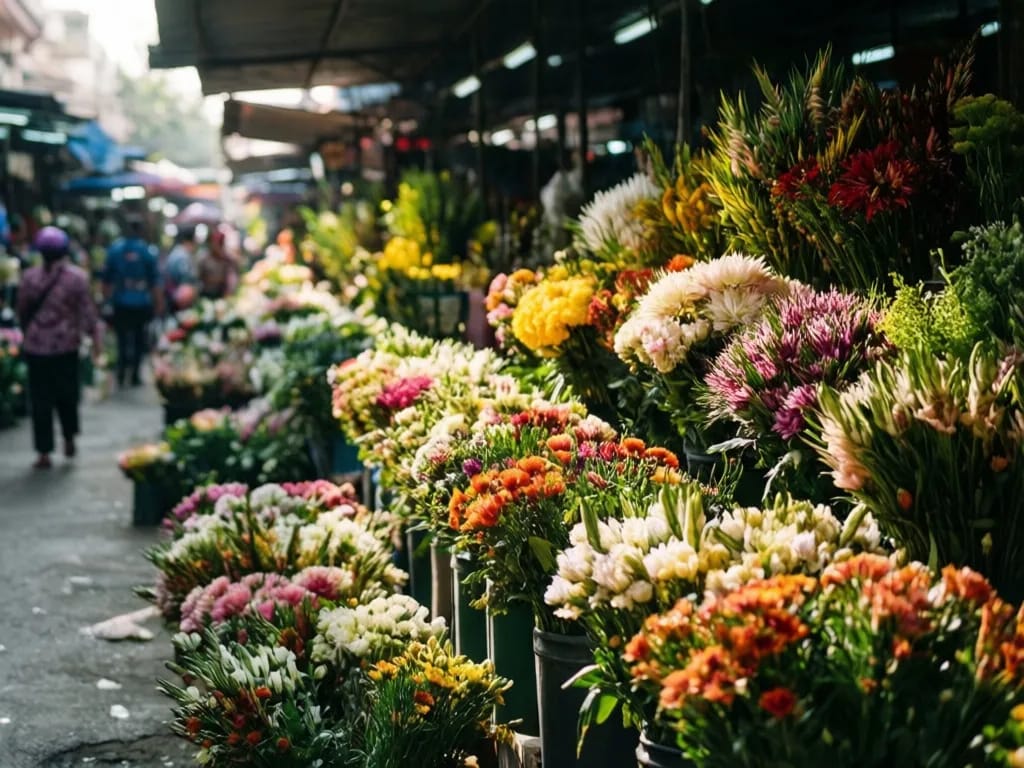
Orchids are the wholesale heart of the market. White dendrobium sprays travel up from Bangkok’s central markets and the Mae Rim greenhouses; pink and purple cymbidiums come down from the highland nurseries around Doi Pui. A 10-stem bundle of dendrobium sells for around 80 baht at the 04:00 wholesale rate and 160 baht at the 10:00 retail rate. The orchid stalls also supply the hotel florists across the Old City and most of the Mae Ping cruise boats.
Lotus
Lotus buds, in the closed bullet shape used for Buddhist offerings, are sold from low baskets near the riverside row. White and pink buds run 10 baht each; the rare yellow buds reach 25 baht. The classic offering at Wat Phra Singh is a single lotus bud, three incense sticks and a square of gold leaf, and most pilgrims pick up the lotus on their way through here.
Gerbera and chrysanthemum
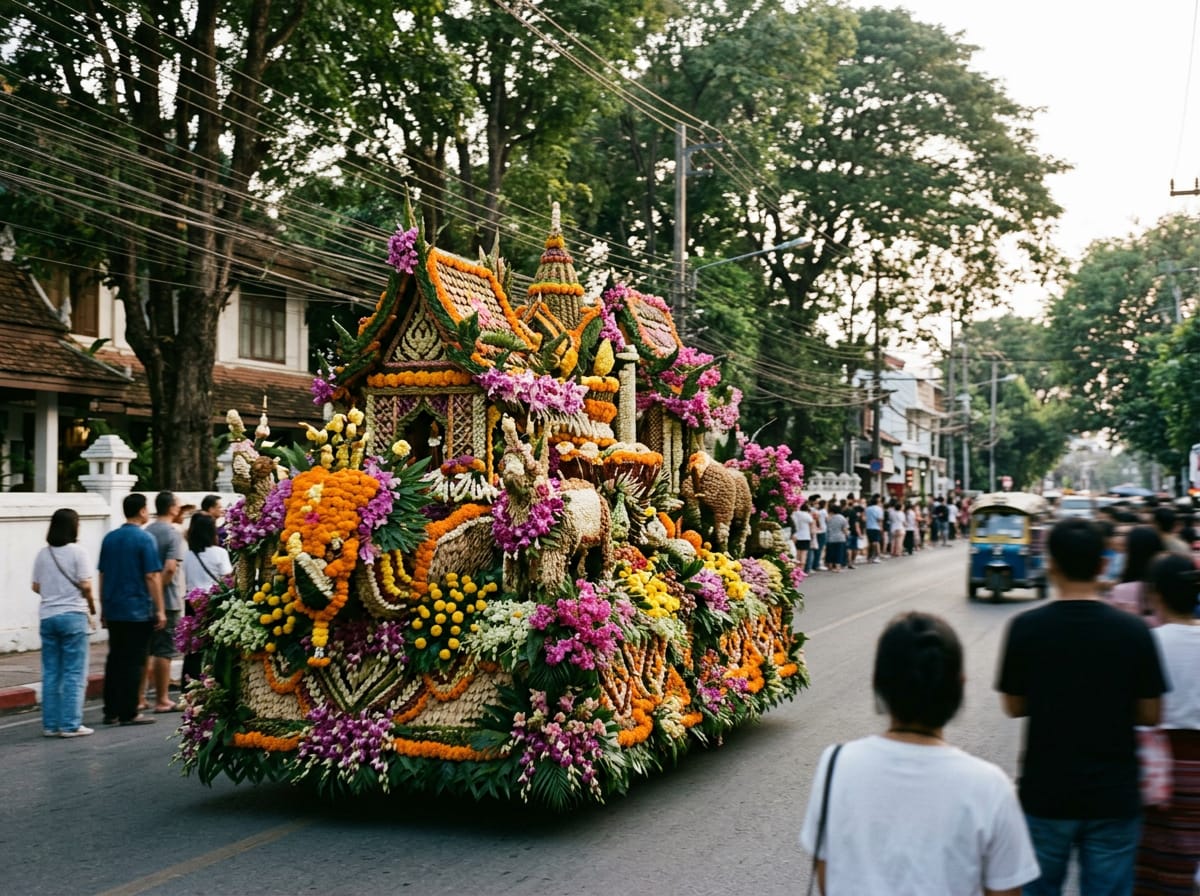
The dyed gerbera daisies, fanned out in extraordinary blues, greens and purples, look almost artificial. They are real flowers dyed at source by the growers in San Pa Tong. The chrysanthemums and gerbera are the structural skin of the Chiang Mai Flower Festival parade floats: tens of thousands of single heads are pinned into chicken wire over wooden frames to create the floral sculptures that move along Tha Pae Road on the festival Saturday.
Specialist cut-flower vendors
A handful of stalls at the southern end of the row supply event florists with the more unusual stems: torch ginger, Siamese tulip (in season July to October), heliconia, anthurium and the local highland flowers from Doi Inthanon. Prices here are negotiable; bring a sample bouquet from a competitor and the stallholder will quote against it. The seasonal calendar is worth keeping in mind. Lotus peaks May through September, when the Buddhist Lent (Khao Phansa) drives the highest temple demand of the year. Marigolds are reliable year-round but quality dips in late October as growers reset their fields. Highland orchids are at their best November to February, when the cool, dry weather sharpens the colours. Roses imported from Mae Hong Son and the higher villages around Pai are at their best between December and early February. Jasmine, grown in the low-lying paddies around San Pa Tong, is reliable from March to November and thin in the cool dry month of December.
How to navigate
The market has three loose zones. The wholesale row runs along the western (inland) side of Praisani Road, near the post office, and is busiest before 06:00. The retail row sits along the eastern (riverside) side, with permanent canvas-roofed stalls open through the day. The makers’ stalls, half a dozen low tables where women thread puang malai garlands by hand, cluster at the southern end of the strip, opposite the entrance to Warorot.
Most visitors enter from the north, walking down Wichayanon Road from the Iron Bridge end of Tha Pae Road. This drops you into the wholesale activity first and lets you walk south through the retail stalls, finishing at the makers’ tables. From there, a single five-step staircase leads directly into Warorot Market for breakfast or coffee. Exit south onto Chang Moi Road for a quick songthaew (shared pickup-truck taxi) back to the Old City.
If you only have 30 minutes, walk the western (wholesale) side north to south, then the eastern (retail) side south to north. That covers everything and you finish where the food is.
A few practical notes on the layout. The footway is narrow and shared with motorbike sidecars; step aside when you hear a horn. The covered makers’ stalls at the southern end are the only shaded section, useful in the hot months between March and May. Public toilets are 50 metres south, inside the Warorot ground floor, and cost 5 baht. There are two ATMs on Wichayanon Road, 100 metres west, and several currency-exchange booths inside Warorot if you arrive without baht.
Best time to visit
The best window depends on what you are after. For the wholesale spectacle, head down between 03:00 and 06:00. The night air is cool, the head-torches are still on, the marigold sacks are still piled higher than the buyers, and the orchid trucks are unloading. By 06:30 the wholesale traffic has thinned and the retail stalls are setting up. From 08:00 to 11:00 the market is at its photogenic peak: stalls full, garland makers working, hot morning light bouncing off the river.
Avoid the mid-afternoon stretch between 13:00 and 16:00 during the February to April burning season. The smoke from agricultural fires in the surrounding province often pushes the city’s air quality reading into the unhealthy band, and the open-air market sits in the lower river basin where the haze settles. A morning visit during these months is fine; an afternoon one is not.
The rhythm of the market resets each evening at around 18:00, when a smaller wave of office workers and home buyers stops in for next-day offerings. It is the most relaxed time to talk to vendors and the prices for the day’s remaining stock often drop by 20 to 30 per cent.
Weekdays and weekends do feel different. Tuesday to Thursday are the working market’s quietest days, with the smallest crowds and the easiest access to the wholesale row. Friday afternoon picks up as hotels stock for weekend events. Sunday mornings are the busiest non-festival day of the week, because the Sunday walking street florists buy their stock here from 04:00 to 06:00 before setting up on Ratchadamnoen Road in the afternoon. If you want the calmest possible visit, aim for a Wednesday between 09:00 and 11:00.
The Flower Festival tie-in
The Chiang Mai Flower Festival is the market’s busiest week of the year. The 49th edition runs 13–15 February 2026, with the centrepiece grand parade departing Nawarat Bridge at 08:00 on Saturday 14 February. The parade route travels west across the bridge, south along Tha Pae Road, through Tha Phae Gate and along Ratchadamnoen Road to finish at Suan Buak Hat Park in the south-western corner of the Old City.
For the three days before the parade, the market supplies the floats. Each amphoe (district) of Chiang Mai province builds its own float, with teams of 20 to 40 volunteers working through the night on Charoenrat Road, on the eastern side of the Iron Bridge. The chrysanthemum and gerbera growers triple their normal output for the week, and the wholesale strip of Praisani Road runs almost without interruption between 02:00 on Thursday and 06:00 on Saturday. If you want to see the market in its most concentrated form, the predawn hours of Saturday 14 February are the moment.
The market also supplies the smaller satellite events: the floral arrangement competition at Suan Buak Hat, the Miss Chiang Mai Flower pageant and the temple-decoration competition at the participating wats around the Old City. Read the full festival programme on the Chiang Mai Flower Festival page. If you plan to watch the parade itself, the best vantage points sit between Tha Phae Gate and the Three Kings Monument; arrive by 07:00 to secure a kerbside spot. If you would rather see the floats up close, the assembly area on Charoenrat Road is open to the public on Friday 13 February from roughly 14:00 onward, and most district teams welcome questions as they work.
Photography etiquette
The market is a generous subject. Wide shots from the public footpath are unproblematic. Stallholders are used to cameras and most of the wholesale buyers will ignore you. Where care is needed is in close portraits of the garland makers. These are mostly older women, working long hours on low stools, and a portrait that catches them mid-thread can be one of the best you take in Chiang Mai. Ask first. The Thai phrase tai roop dai mai (may I take a photo?) is sufficient; a small purchase before or after is appreciated. Avoid placing your camera or lens between a vendor and a paying customer. Tripods are workable outside the 03:00–06:00 wholesale rush. Drones are not flown here and the river corridor is too close to populated buildings to make it advisable.
Where to eat nearby
The food options are excellent and close. Step through the southern entrance and into the ground floor of Warorot Market, where Lam Duan Faa Ham serves the city’s best-known khao soi (northern curry noodle soup) from 09:00 to 14:00 daily (60 baht a bowl). The dry sai oua herb sausage from the stalls along the eastern wall of Warorot makes a good takeaway. For coffee, cross the Iron Bridge to Charoenrat Road, where the riverside cafés (Woo Cafe and Brown Sugar are the long-standing local choices) sit directly opposite the market and let you watch the river while the morning trade winds down.
Inside Warorot itself, the Chinese-Thai Talat Ton Lamyai food court on the ground floor is the cheapest serious meal in the area: kuay tiew noodles, kanom jeen (fresh rice-flour noodles with curry) and northern Thai curries, mostly under 60 baht. Skip the upstairs restaurant level, which is geared to coach tours.
Nearby and after
Step directly south into Warorot Market — the two markets share a wall and most locals treat them as a single trip. Wat Saen Fang, with its distinctive Burmese-style chedi, is a five-minute walk west on Tha Pae Road and rewards a quick stop. On weekends in the cooler months, the Sunday walking street through the Old City starts at 16:00 along Ratchadamnoen Road, about 20 minutes’ walk west of the flower market, and makes a natural late-afternoon continuation. Cross the Iron Bridge and you reach the Charoenrat Road riverside strip, with the Anantara hotel, Wat Ket and the small but well-curated Chiang Mai City Arts and Cultural Centre annex within ten minutes’ walking distance.
Photos
Frequently asked questions
Where is the Chiang Mai flower market?
The Chiang Mai Flower Market sits on Praisani Road in Chang Moi sub-district, immediately behind Warorot Market and a short walk west of the Ping River's Iron Bridge (Saphan Lek). From Tha Phae Gate it is roughly 850 metres east along Tha Pae Road and then a left turn at the post office. The trading strip runs about 400 metres parallel to the river, with wholesale stalls at the northern end and retail florists toward the southern end. Most local taxi drivers know it as Talat Dok Mai or simply the flower market behind Kad Luang.
What time does the Chiang Mai flower market open?
Stalls trade around the clock, but the rhythm of the market changes through the day. Wholesale lorries from the Mae Rim and San Pa Tong growers arrive between 03:00 and 06:00, when prices are lowest and buyers from hotels, temples and event florists collect their orders. Retail garland makers open from roughly 06:00 onward, with full activity by 08:00. The afternoon, between 14:00 and 17:00, is the quietest stretch. A second smaller flurry runs from 18:00 to about 21:00 as office workers stop by for next-day offerings.
Is the flower market free to enter?
Yes. The Chiang Mai Flower Market is a public street market and there is no entry fee, ticket or barrier. You can walk the full 400-metre Praisani Road strip at any hour. Stallholders expect that not every visitor will buy, though browsing during the pre-dawn wholesale rush can get in the way of working buyers, so consider visiting after 06:30 if you only want to look. Photography is permitted from the public footpath; close-up portraits of vendors should still be asked for politely before you raise the camera.
What flowers can I buy at the Chiang Mai flower market?
The everyday offer is dominated by marigolds (dao reuang), jasmine (*mali*), white and purple orchids, lotus buds and roses. You will also find chrysanthemums, gerbera daisies (often dyed in vivid blues and greens), gladioli, gypsophila, tuberose, asters and seasonal local blooms such as torch ginger and Siamese tulip. During the build-up to the Flower Festival in late January and early February, the volume of chrysanthemums and gerbera triples, because these are the workhorse flowers used to skin the parade floats. Cut flowers are sold by the bundle or by the kilogram; ready-made *puang malai* garlands are sold by the piece.
When is the best time to visit the Chiang Mai flower market?
For photographers and early risers, 04:30 to 06:00 captures the wholesale market at full intensity: stacked crates, head-torches, motorbike sidecars laden with orchids and the steady smell of jasmine. For comfortable browsing and to actually speak with vendors, 08:00 to 10:00 is ideal — the air is still cool, the garland makers are working at their fastest pace and most stalls have their fresh stock on display. The single best day of the year to visit is the Saturday morning of the Chiang Mai Flower Festival in early February, when the parade floats are being assembled on Charoenrat Road just across the bridge.
Can tourists buy flowers at the wholesale prices?
In practice, yes, provided you buy in wholesale quantities. A single bundle of roses or orchids is sold at retail; a full crate or 10-kilogram sack of marigolds is sold at the wholesale rate, which can be 40 to 60 per cent below the per-stem price. Wholesale buying is straightforward at the northern end of Praisani Road between 03:00 and 06:00. Vendors do not generally negotiate at length, so the asked price is usually the price. Expect to pay around 80 to 120 baht per kilogram for loose marigold heads and 20 to 40 baht for a single *puang malai* garland.
How is the flower market connected to the Chiang Mai Flower Festival?
The market is the festival's physical engine. In the three days before the parade, the wholesale strip operates almost without interruption, supplying tens of thousands of chrysanthemums, gerbera daisies and marigolds to the float-building teams from each of Chiang Mai's amphoes. The floats themselves are assembled along Charoenrat Road, on the eastern side of the Iron Bridge, less than 300 metres from the market. The 49th Chiang Mai Flower Festival runs 13–15 February 2026, with the grand parade leaving Nawarat Bridge at 08:00 on Saturday 14 February and travelling south along Tha Pae Road to Suan Buak Hat Park.
How do I get to the flower market from the Old City?
From Tha Phae Gate, walk east along Tha Pae Road for about 850 metres, cross at the post office (Praisani means post in Thai, hence the road name), and turn left. Walking takes 10 to 12 minutes. A red *songthaew* shared taxi from anywhere inside the Old City costs 30 baht per person and takes around 8 minutes; ask for Kad Luang or Talat Warorot. By bicycle the ride is flat and takes 6 minutes. Grab cars are widely available and charge 50 to 80 baht for the same trip. There is no dedicated tourist car park; motorbikes use the kerbside on Wichayanon Road.
Are puang malai garlands at the market suitable for hotel offerings or shrines?
Yes. The *puang malai* garlands sold at the Chiang Mai Flower Market are the same ones used by households, hotels and businesses across the city for daily offerings at spirit houses, Buddha images and personal shrines. The classic configuration is a tight loop of white jasmine buds finished with a tail of folded rose petals and a single marigold. Small offering garlands cost 20 to 40 baht; larger temple garlands run from 60 to 200 baht. They keep best refrigerated and should be used within 24 hours. If you are presenting one at a *wat*, drape it on the offering tray rather than directly on the Buddha image.
Is photography allowed at the flower market?
Photography from the public street is welcome and the market is one of the most photographed spots in Chiang Mai. Wide shots of the stacked flowers, garland makers and the riverside backdrop are uncontroversial. For close-up portraits of stallholders, particularly the older women who thread *puang malai* by hand, a brief smile and the Thai phrase tai roop dai mai krap or ka (may I take a photo?) is the local courtesy. Tripods are tolerated outside the 03:00–06:00 wholesale window but get in the way during the rush. Drones are not permitted over the market or the river.
Is the flower market open during Songkran or other Thai holidays?
The market trades through every public holiday, including Songkran (13–15 April), Loy Krathong, the King's Birthday and Chinese New Year. Volumes actually rise during Buddhist holidays because demand for *puang malai* and lotus buds for temple offerings increases. The only modest slowdown is during the second week of April, when several of the older Chinese-Thai wholesalers close for one or two days around the Qing Ming grave-sweeping festival. Even then, retail stalls along the riverside row stay open.
Related guides
Market
Warorot Market (Kad Luang)
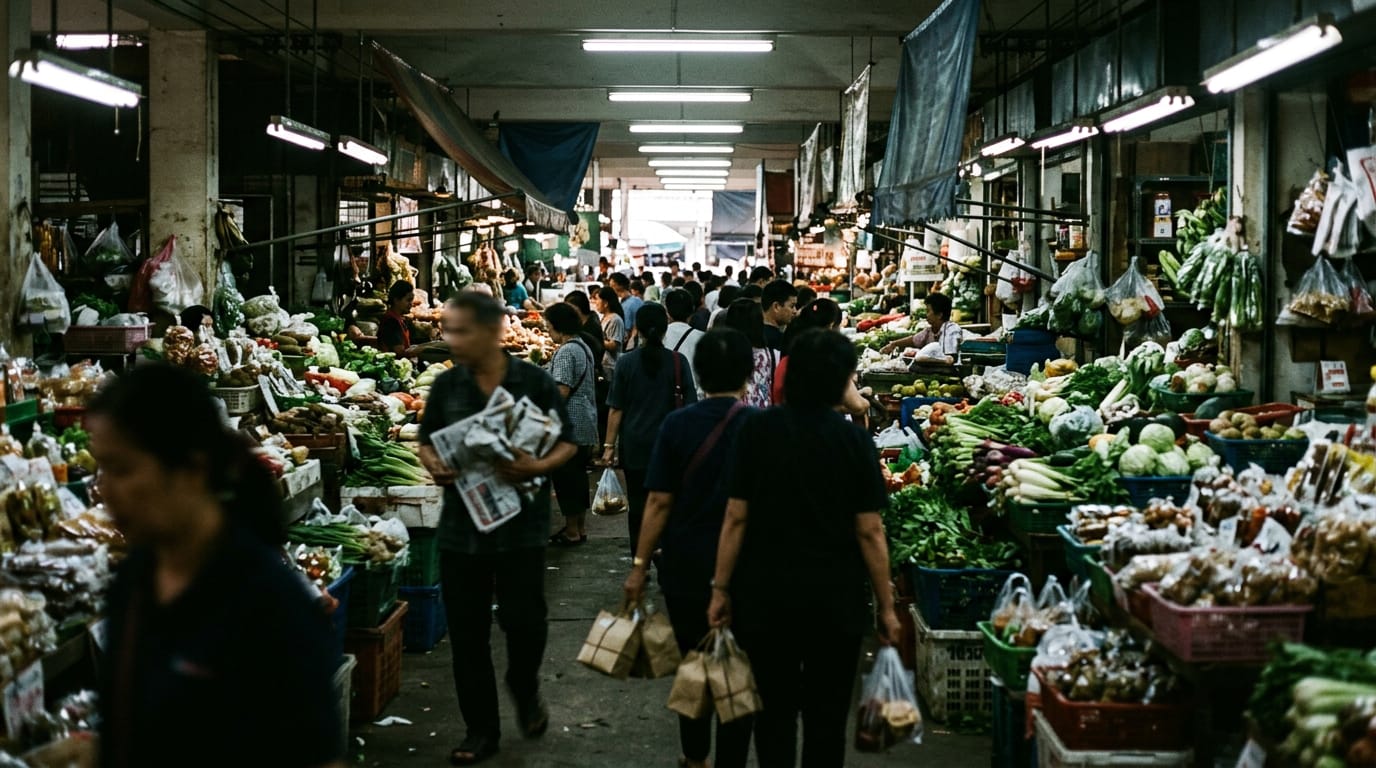
Warorot Market, known locally as Kad Luang, is Chiang Mai's largest and oldest fresh market, set just east of Tha Phae Gate against the Ping River. Three trading floors plus a dense weave of surrounding lanes carry produce, fabric, kitchenware, Chinese pastry, sai oua sausage and the city's most reliable kao soi, with the Flower Market and Talat Ton Lamyai pressed against its northern wall.
Market
Saturday Walking Street (Wua Lai Road)
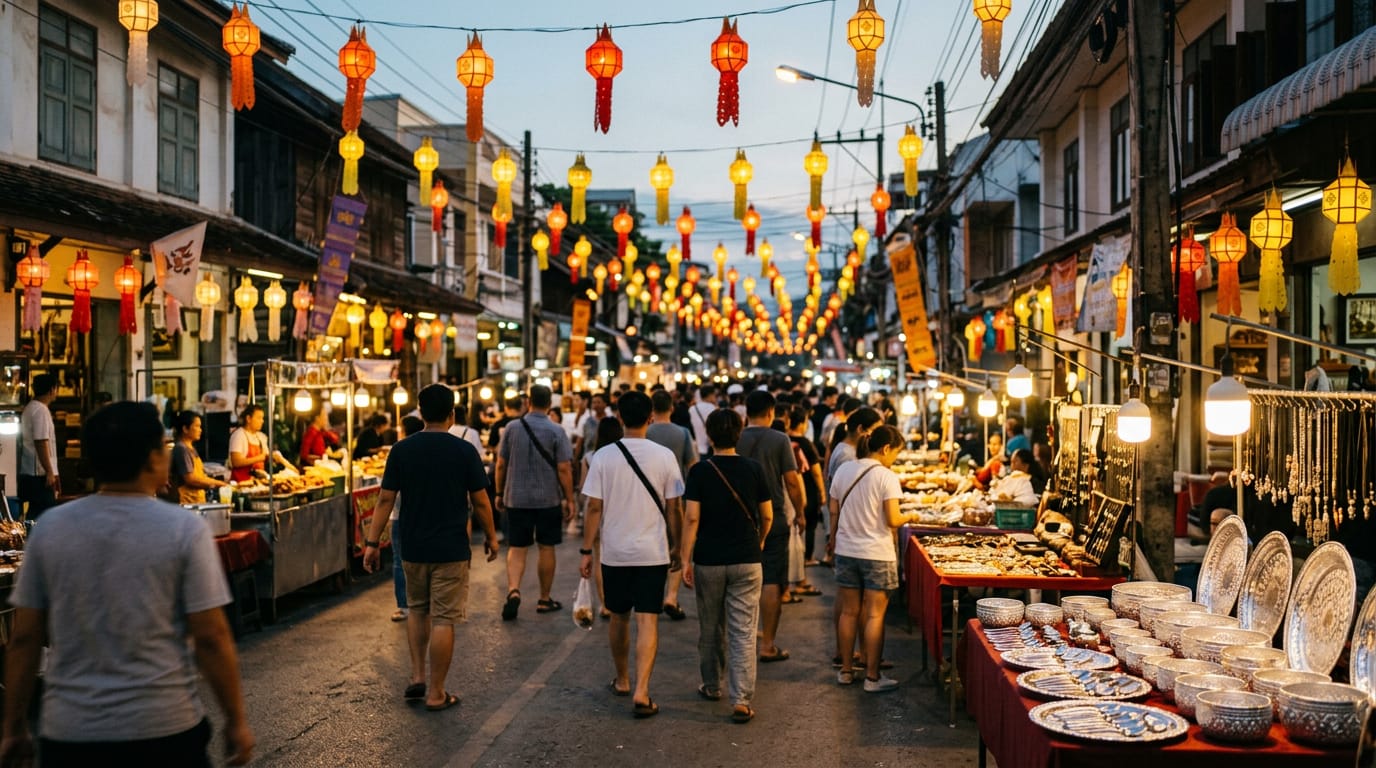
Chiang Mai's Saturday Walking Street runs the length of Wua Lai Road, the silversmith quarter immediately south of the Chiang Mai Gate. Open every Saturday from 16:00 to 22:00, it is smaller, more local and more craft-led than its Sunday counterpart, with silverware, lacquerware and Lanna handicrafts beside food stalls and the Songkran procession route on day one of the New Year festival.
Market
Sunday Walking Street (Ratchadamnoen Road)
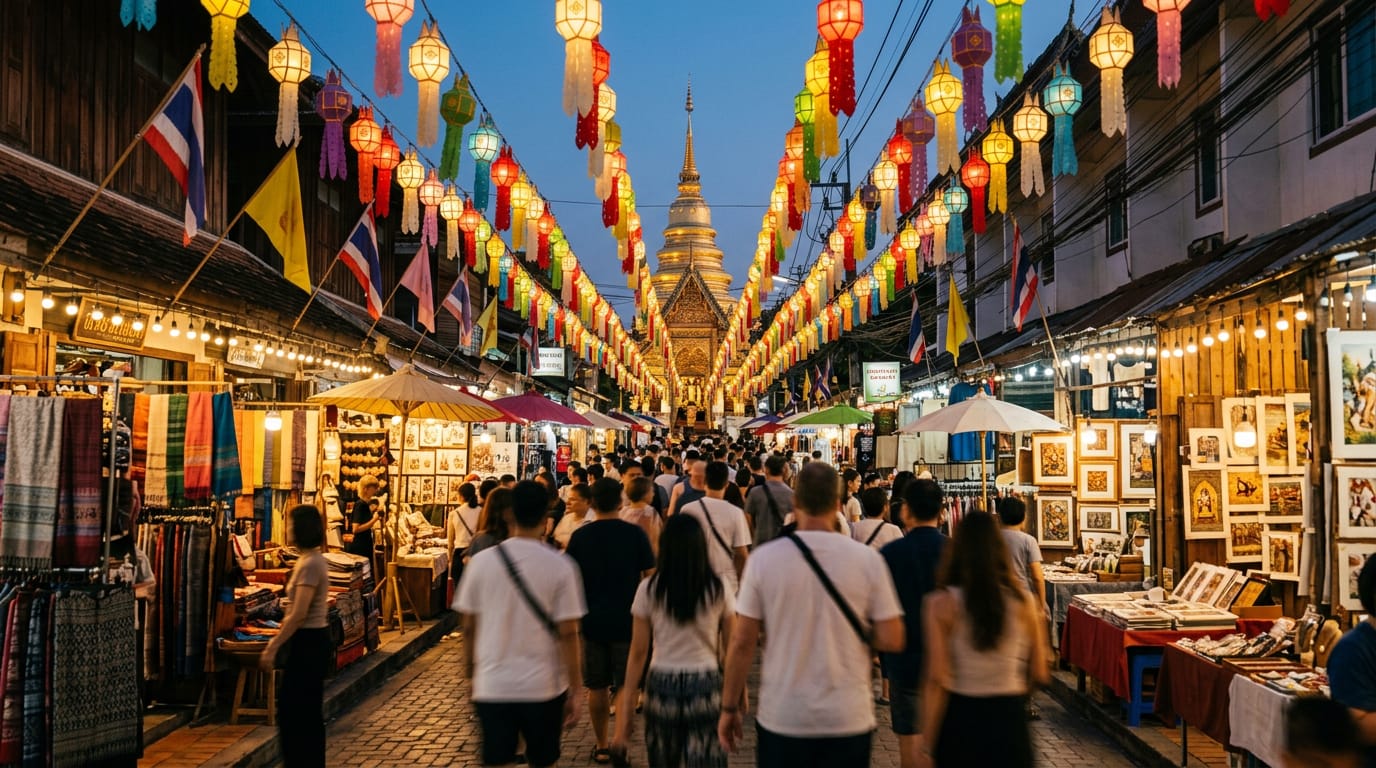
The Sunday Walking Street fills Ratchadamnoen Road through the heart of the Old City from Tha Phae Gate west to Wat Phra Singh. Around 700 vendors set up every Sunday from 16:00 to 22:00, with handicraft, paper umbrellas, silk, lanterns and three temple courtyards turned into food clusters along the route. It is the biggest weekly walking street in Chiang Mai.
Festival
Chiang Mai Flower Festival
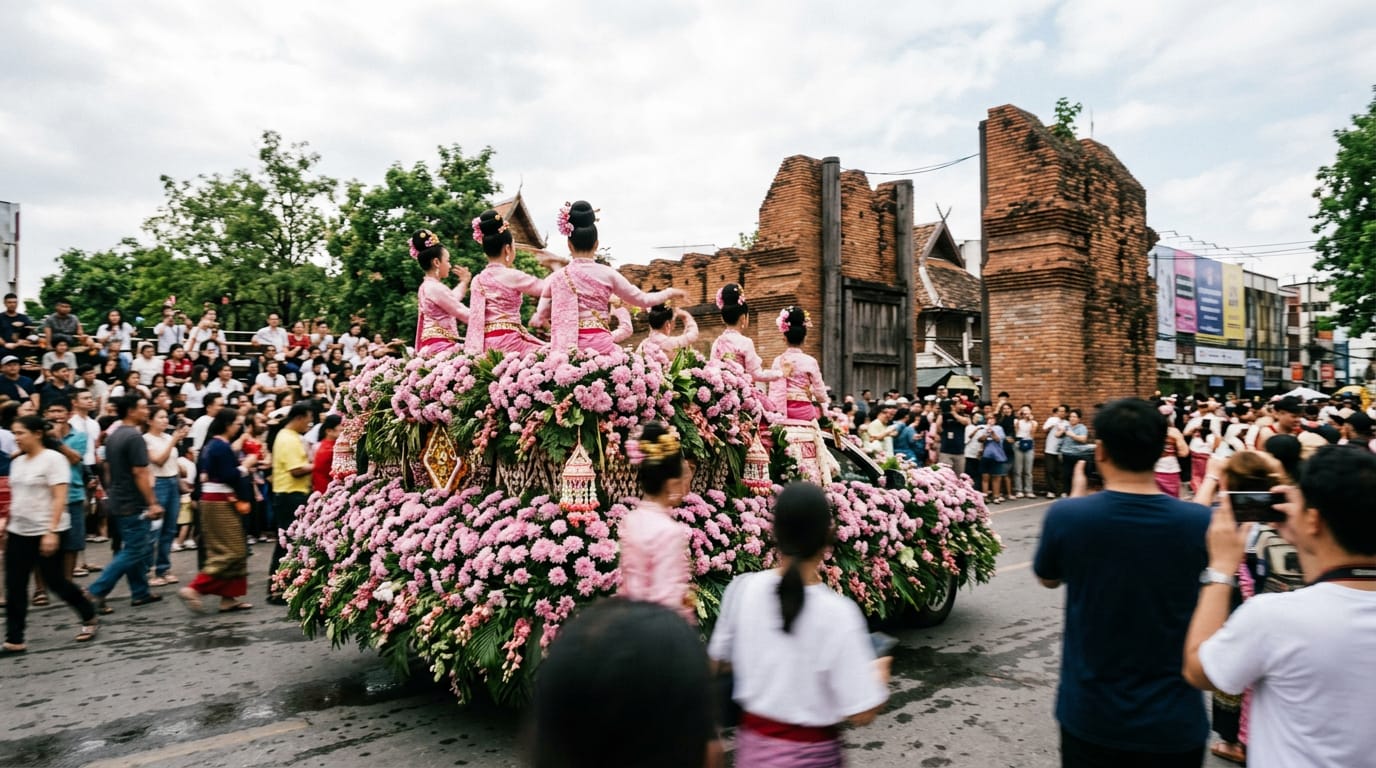
The Chiang Mai Flower Festival is the city's annual three-day celebration of cool-season blooms, held the first full weekend of February at Suan Buak Hat Park. The 49th edition runs 13–15 February 2026, with the headline parade of flower-covered floats setting off at 08:00 on Saturday 14 February from Nawarat Bridge along Tha Pae Road to Suan Buak Hat. Free entry, beauty pageant on Friday night, and northern Thailand's largest cool-flower trade fair across the weekend.