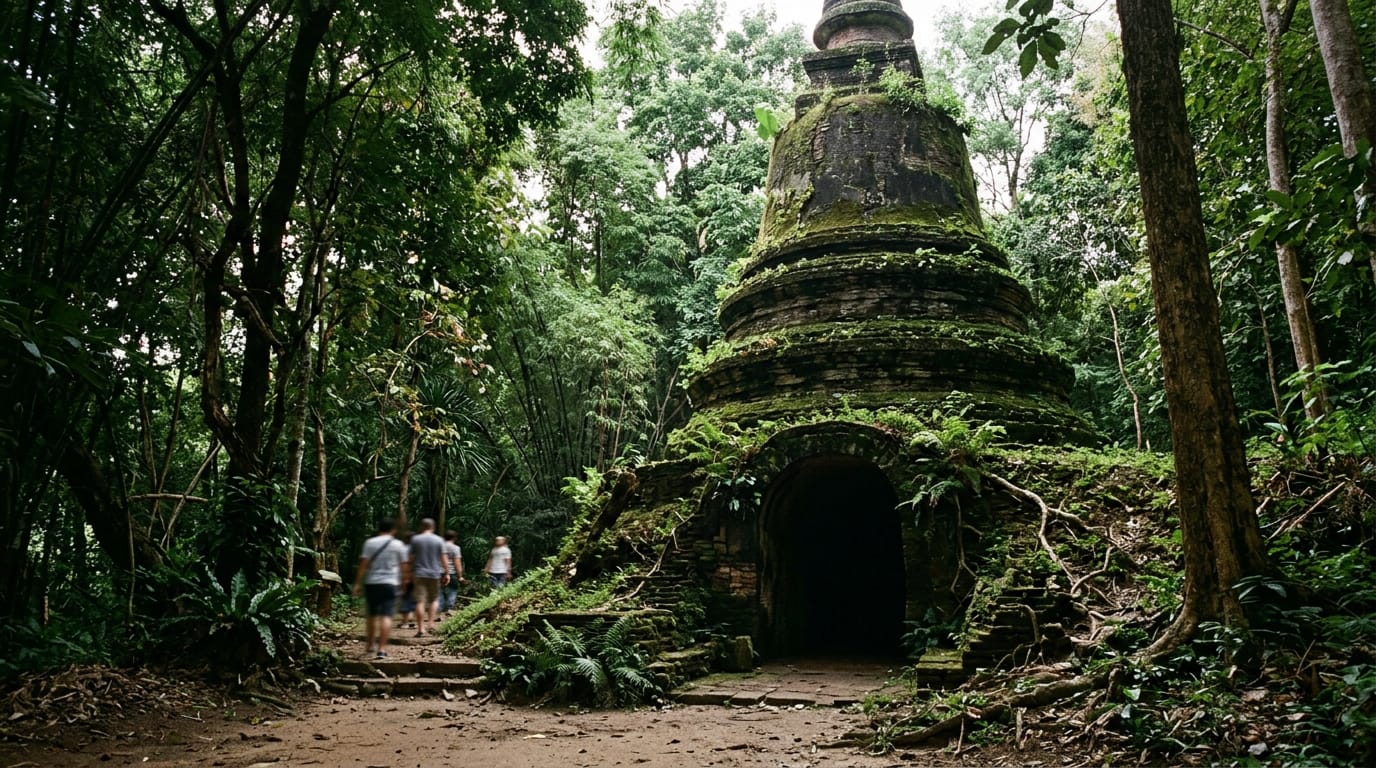
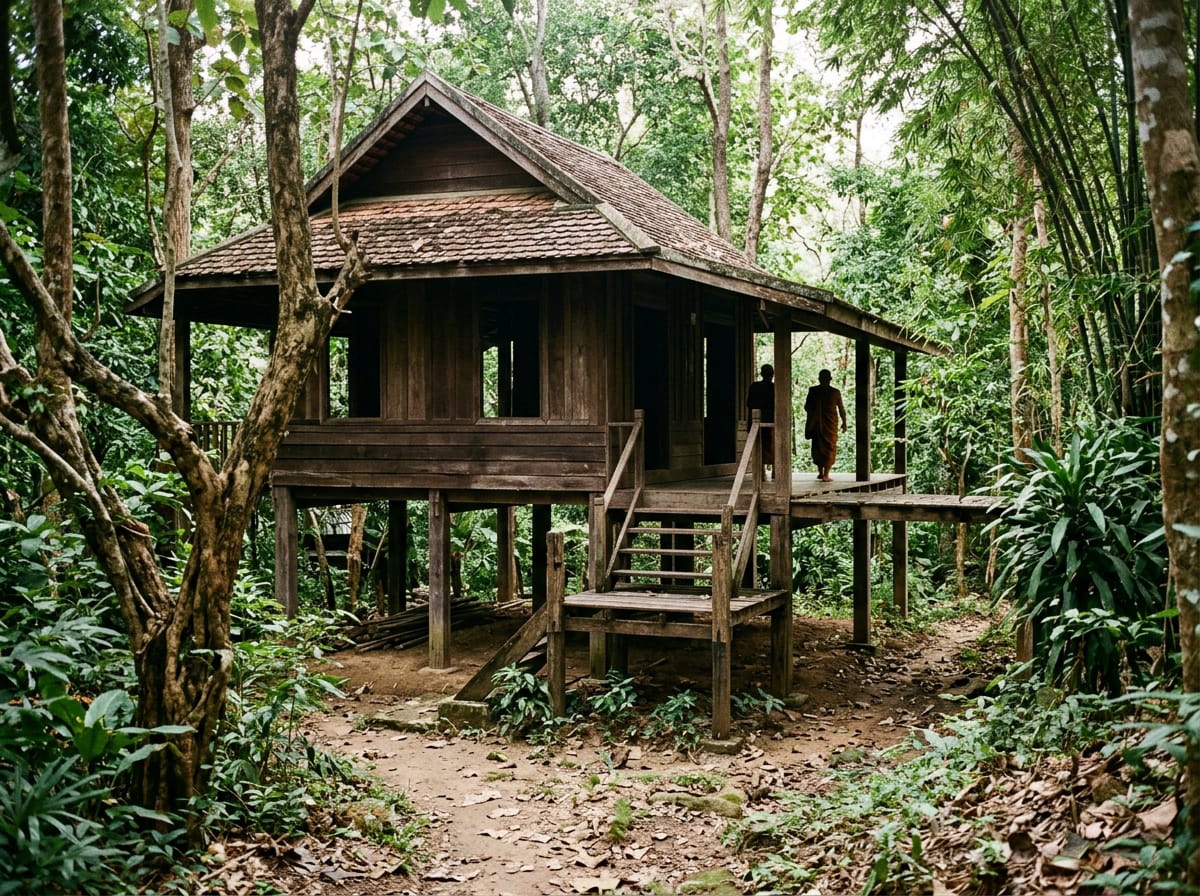
Wat Umong is a forest monastery at the foot of Doi Suthep, founded by King Mangrai around 1297 for monks who preferred the quiet of the woods. Its defining feature is a set of ancient tunnels dug into the base of a Lanna chedi and painted with faded murals. A mossy stupa, a fish-and-turtle lake, and 'tree wisdom' signs in English on the trunks make it feel half an arboretum.
Updated
Wat Umong is the temple of the forest and the tunnels. It sits at the foot of Doi Suthep, well west of the Old City and the standard temple circuit, set inside several hectares of woodland that feel a long way from the centre of Chiang Mai. King Mangrai founded it around 1297 for monks who preferred the quiet of the forest to the city. Seven centuries later it is still a working forest monastery, and it still surprises casual visitors with a kind of quietness that nothing closer to the Old City can match.
History and significance
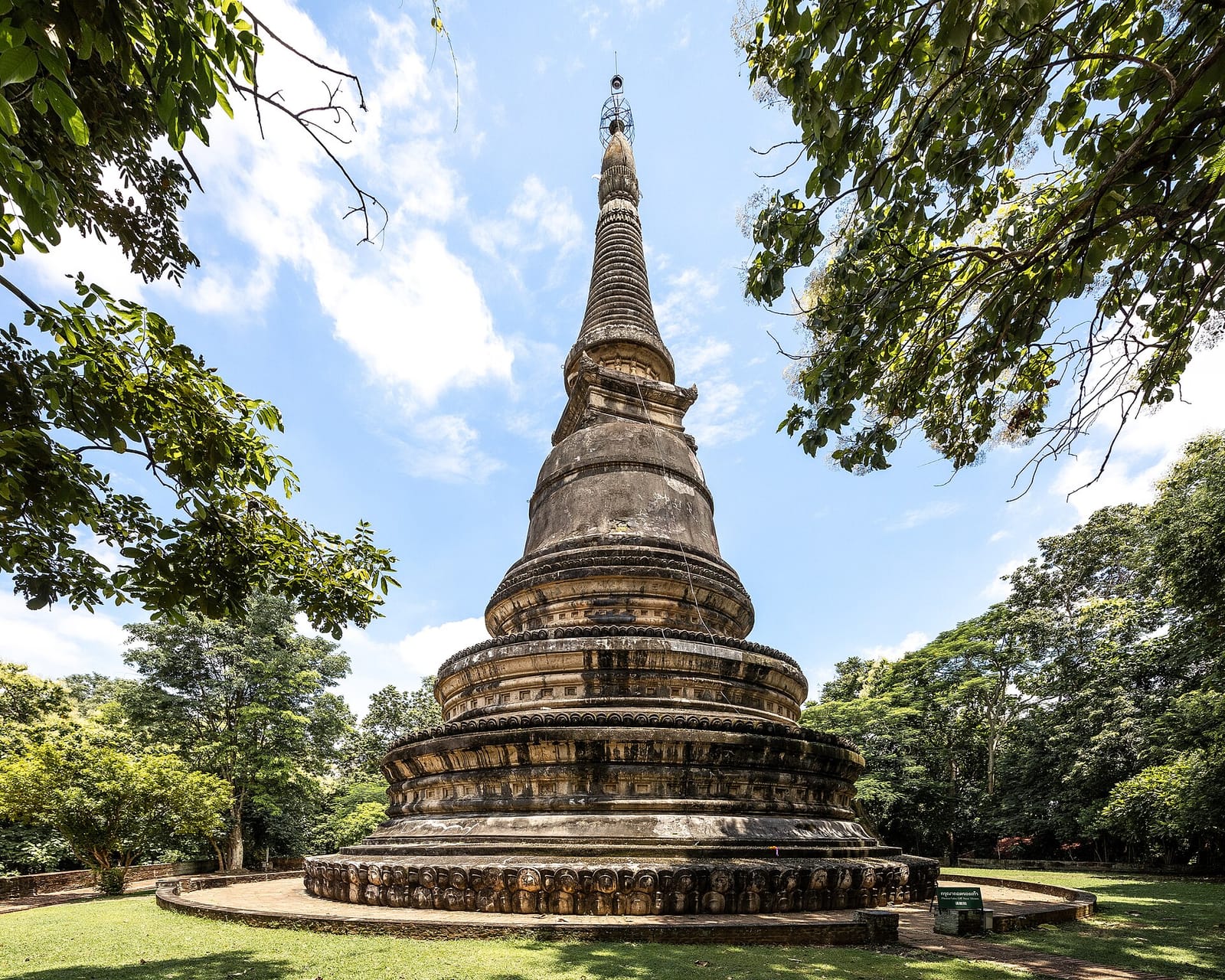
The standard chronicle gives the foundation date as 1297, the same year as Wat Chiang Man inside the new city walls. The two temples were paired from the start. Wat Chiang Man served the king and the citizens; Wat Umong served the forest monks of the aranyavasi tradition, who needed to live apart from settled life in order to pursue intensive meditation. Mangrai endowed the compound with land that ran from the base of Doi Suthep down to what is now Canal Road, and built a small bell-shaped chedi on a raised mound at the centre.
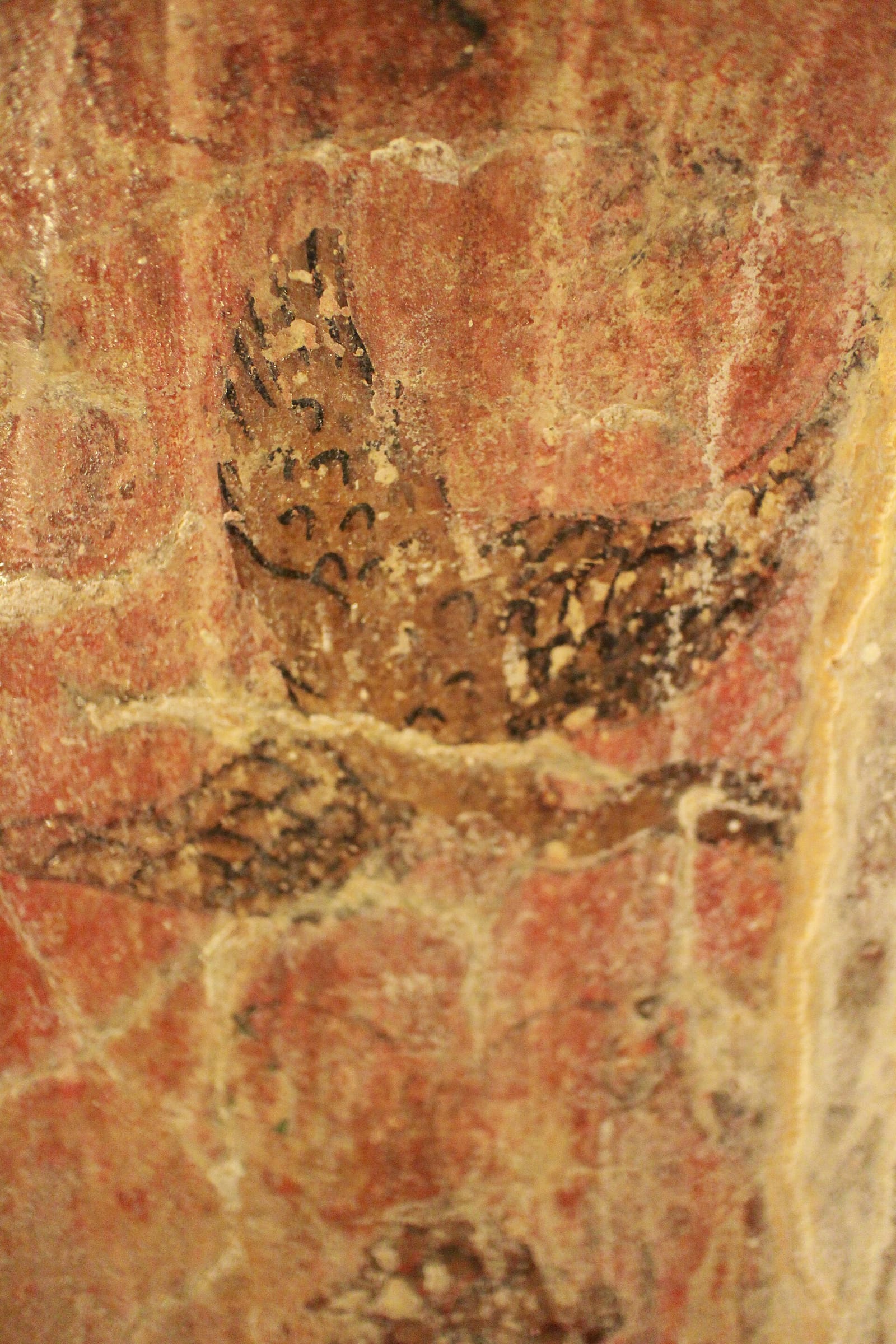
The tunnel system that defines the modern compound was added later, around 1380, under King Kuena. The temple chronicle records that Kuena built the tunnels for a particular monk, Thera Jan, who was famous for his learning but suffered from a restless mind. Kuena had three short corridors dug into the base of the existing chedi and had their walls painted with images intended to calm and absorb the monk’s attention: peacocks, lotuses, geometric patterns drawn from the earlier mural traditions of Lanna and Sukhothai. The story is at least partly legendary, but the tunnels themselves are very real, and the mural fragments still visible inside the chambers are among the oldest surviving paintings in northern Thailand.
The compound went through long periods of abandonment. The Burmese conquests of the sixteenth and seventeenth centuries hit forest monasteries hard, since their isolation meant they had no city walls to protect them and their lay supporters could not always reach them. By the early nineteenth century Wat Umong was a ruin, the chedi overgrown, the tunnels half-flooded. King Kawila’s nineteenth-century restoration programme reached most of the city temples but did not reach this far west. The temple was effectively dead for over a century.
The modern Wat Umong dates from 1948, when Ajahn Pannananda, a senior figure in the twentieth-century Thai forest revival, re-established it as a working meditation centre. The chedi was consolidated, the tunnels cleared, a new main viharn built on the eastern edge of the compound, and meditation halls added on the higher ground at the back. The ‘tree wisdom’ signs in Thai and English were added in the 1980s under a later abbot. The compound now hosts both Thai and foreign meditators, with residential retreats running through most of the year and casual sittings welcomed at any time.
The full modern name is Wat Umong Suan Phutthatham (‘garden of Buddhist teaching’), and the second half is meant seriously. The revival generation had close ties to the reform movement of Buddhadasa Bhikkhu, the southern teacher whose plain-spoken approach to dharma shaped twentieth-century Thai Buddhism, and the temple’s small library and teaching hall still carry that imprint. The emphasis here has always fallen on practice and study rather than ornament, which is why a seven-hundred-year-old royal foundation has no gilded viharn to show for it.
The temple has therefore a triple identity: an ancient royal foundation, a modern forest monastery, and a low-key visitor attraction that draws roughly a hundred foreign tourists a day. The three sit together more comfortably than you might expect.
What to see
A full visit covers four areas, none of which require backtracking. Plan a circular walk: tunnels and chedi first, viharn and lake second, meditation halls and forest paths third, fish lake last.
The tunnels and the ancient chedi
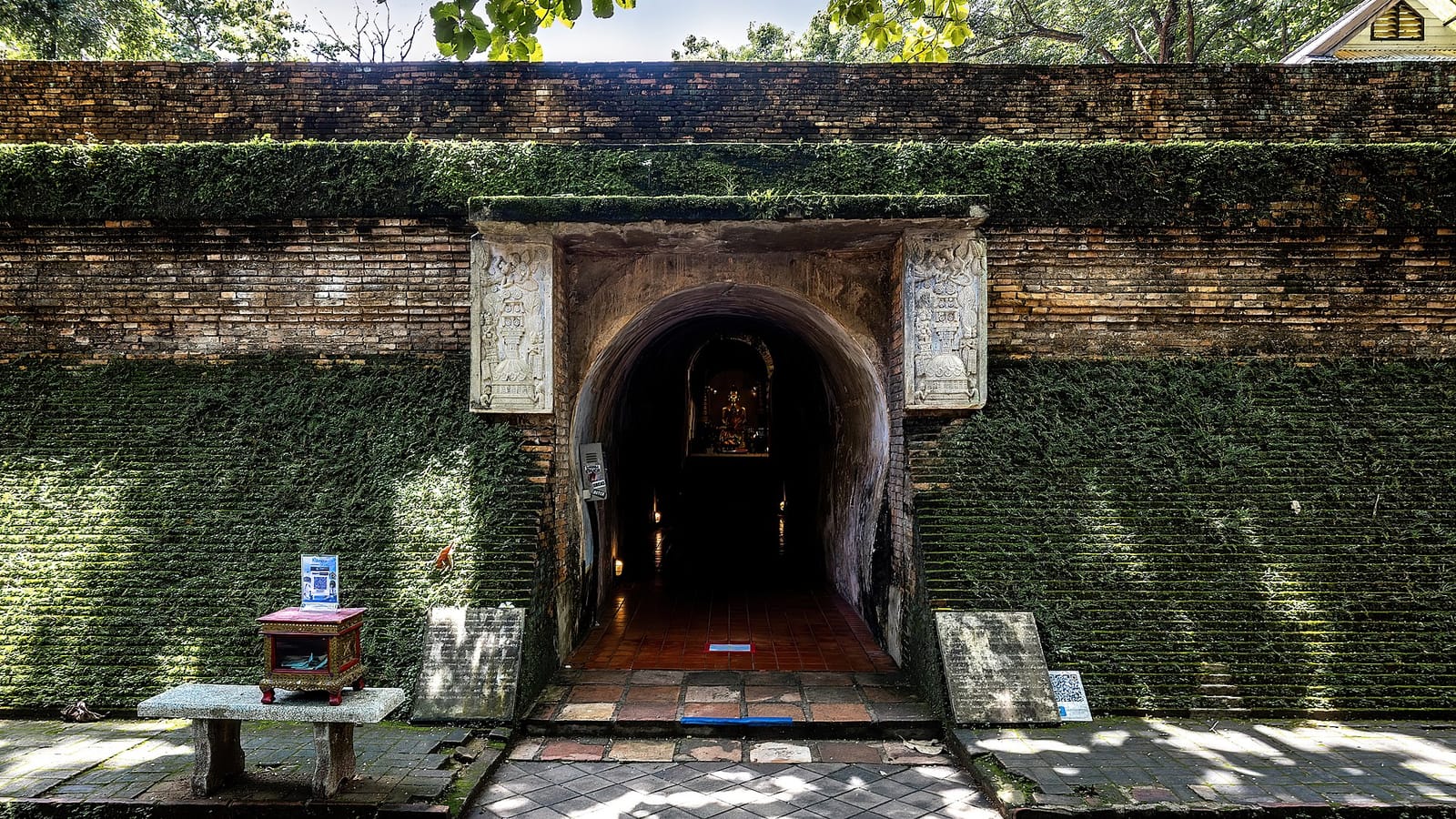
The tunnel entrance is at the base of the old Lanna chedi at the centre of the compound, marked by a low arched brick opening with a single bare bulb inside. The corridor inside is narrow, two abreast at most, and ducks under the chedi mound. Three corridors meet at small inner chambers, each holding a Buddha image and a niche for offerings.
The walls carry mural fragments. Most are too worn to read in detail, but in better-preserved patches you can make out peacocks with spread tails, lotus flowers, vine scrolls, geometric medallions. The pigments are mineral (red ochre, yellow ochre, black charcoal) and have survived because the tunnels stay cool and dry year-round. The chambers are dim; bring a small torch if you want to study the murals closely. Sit for a few minutes in the central chamber. The acoustics carry whispers further than seems reasonable, and chanting reverberates as if the chedi above were a sounding board.
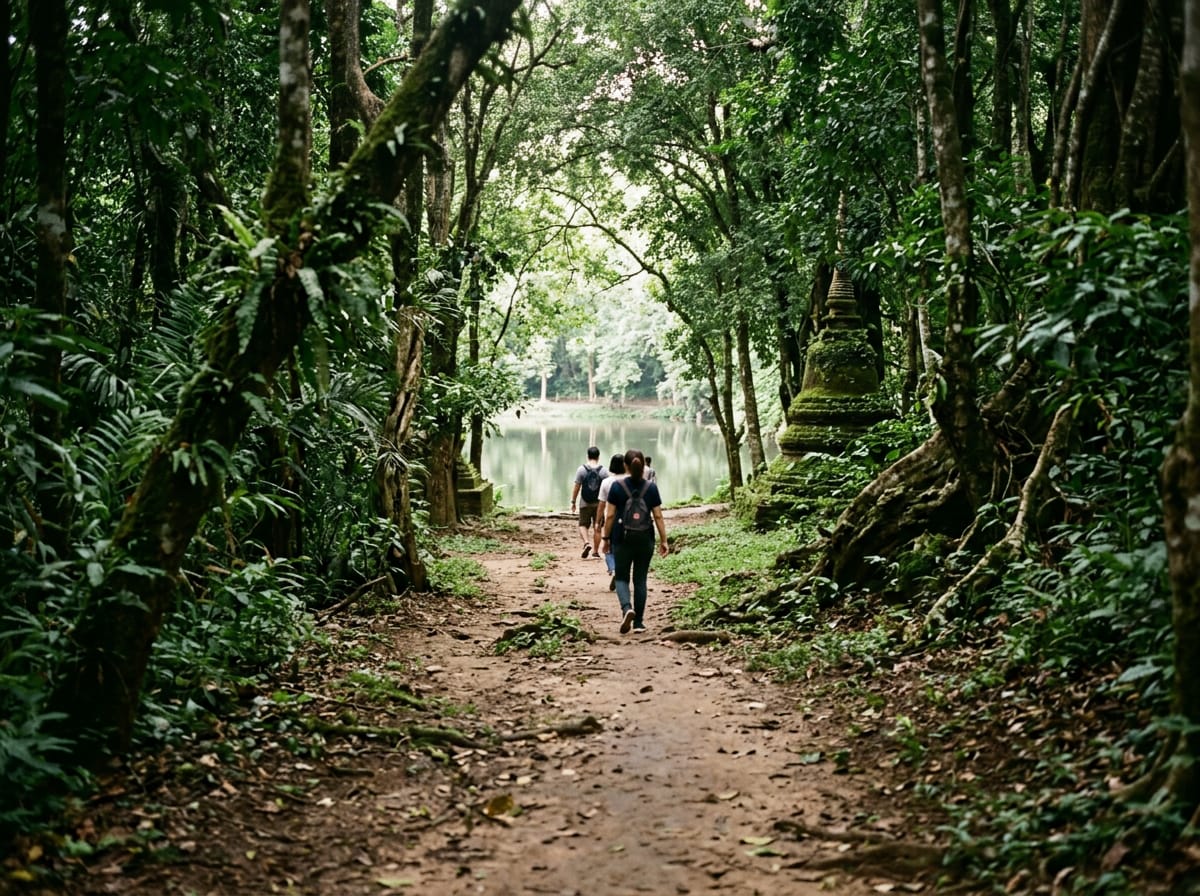
Above ground, the chedi itself is the most photogenic structure in the compound. Moss and lichen cover the lower courses; vines climb the upper bell. The Mangrai-era brickwork is visible where the plaster has fallen away. Walk a slow circuit around it; there is no fence and the surrounding ground is uneven but stable.
The broken Buddha garden
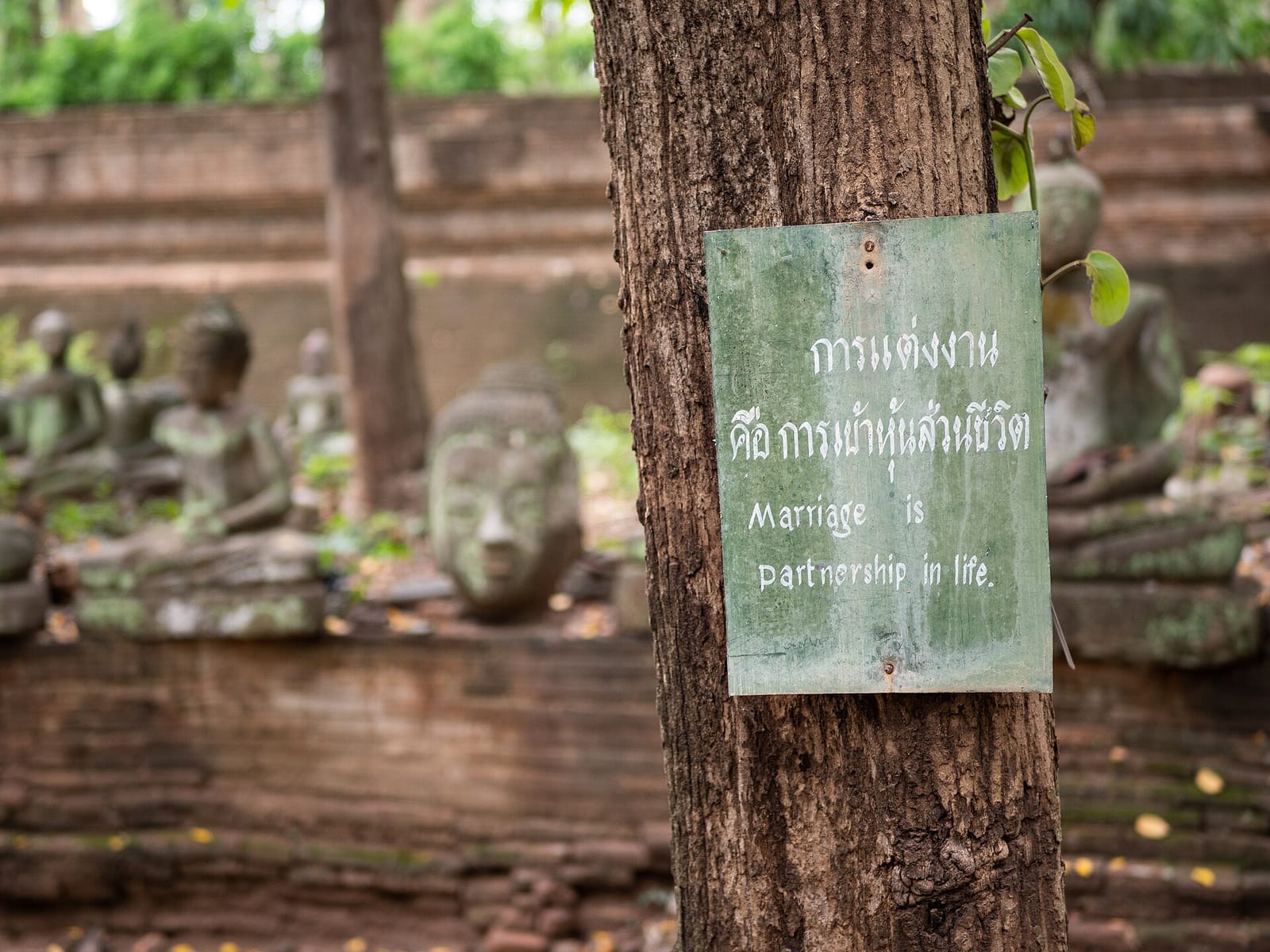
A short way from the chedi mound, scattered under the trees, lies a collection of damaged Buddha images: heads without bodies, torsos without heads, hands raised in blessing with nothing behind them. They are old images from this and other compounds, broken by time, weather or looters, and brought here rather than discarded, since a Buddha image cannot respectfully be thrown away. Moss has claimed most of them. The effect is closer to an overgrown sculpture garden than to a ruin, and photographers tend to spend longer here than anywhere else in the compound. Early light, coming low through the trees, suits it best.
The main viharn
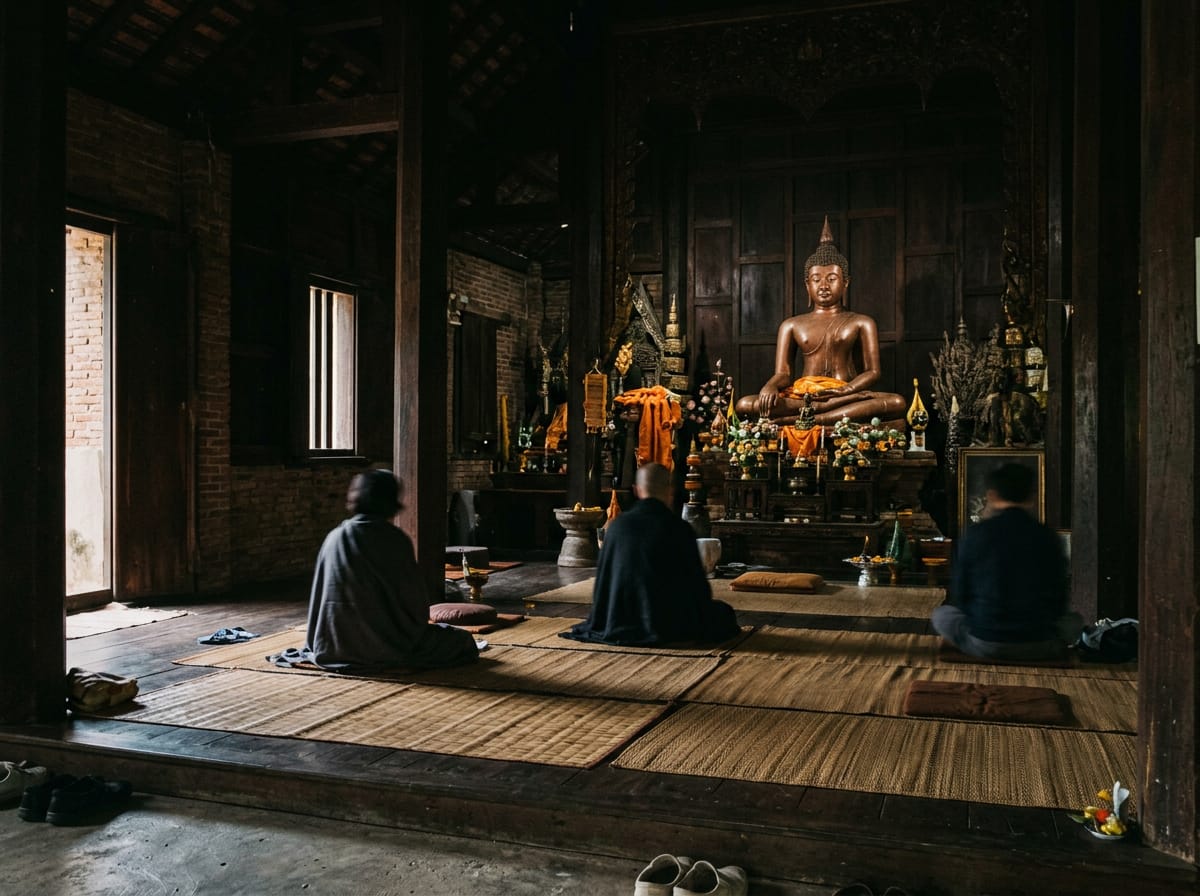
The viharn luang sits to the east of the chedi, a modest single-storey hall built in 1948 in restrained Lanna style. Inside, a seated Buddha image in the maravijaya posture occupies the central altar; meditation mats are stacked along the side walls for visitors who want to sit. The viharn is open through the day and chanting takes place at 06:00 and 17:00. The hall behind it, larger and open-sided, is used for the Sunday dharma talks.
The fish lake
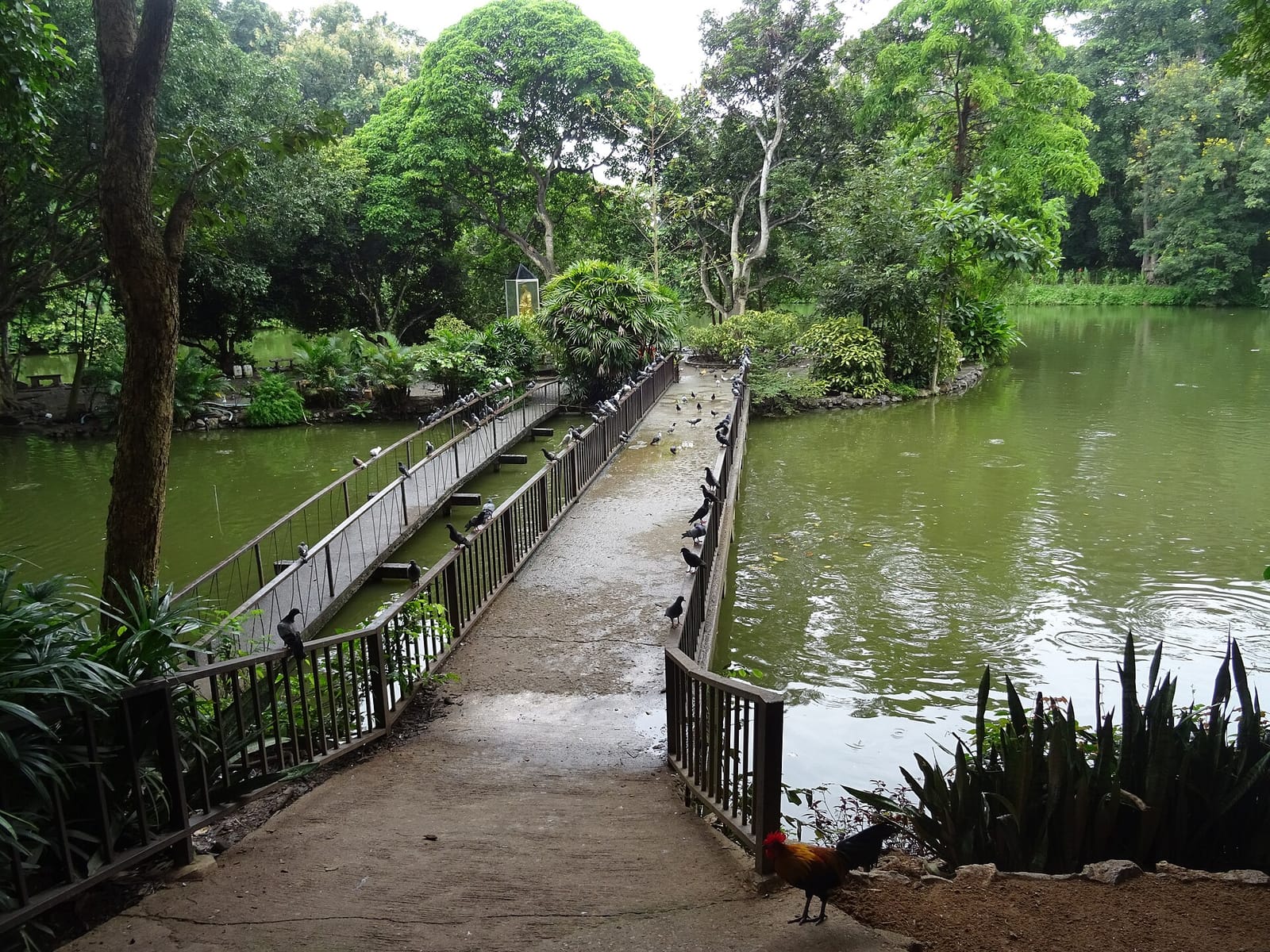
A shaded path winds south from the main viharn for about 200 metres to a small lake fringed with banyan trees. The lake holds large carp and a substantial population of soft-shelled turtles, all of whom respond instantly to anyone arriving with a bag of pellets (sold by the lakeside for 20 baht). The water surface boils when food is thrown in; children find this entertaining, and small wooden platforms make safe viewing spots. The Buddhist merit-making tradition of releasing animals, plod sat, is observed here in a small way, with a stall selling fish and eels for ritual release. The practice is controversial in conservation terms; the temple operates within the local norm.
The forest paths and tree wisdom signs
Behind and around the chedi, paved paths wind through several hectares of woodland that are partly natural and partly planted. Nailed to trees along the paths are small wooden plaques, each carrying a short Buddhist proverb in Thai and English. The signs are deliberately low-key, easy to walk past and easy to ignore. Reading them as you walk takes about 30 minutes and is one of the genuinely original experiences offered by any temple in the city. Among them are ‘The mind is everything; what you think you become’, ‘Patience is the highest virtue’ and the more startling ‘A wise man avoids evil as he avoids stepping in mud’.
The meditation halls at the back of the compound are open to visitors during sitting hours. Mats and cushions are provided; sit silently for as long as suits.
Meditation and retreats
Wat Umong is one of the easier places in Chiang Mai for a foreigner to move from reading about meditation to actually doing some. The casual end requires nothing. Walk into the meditation hall behind the main viharn during opening hours, take a mat, and sit for as long as you like. Nobody will instruct you and nobody will disturb you.
The Sunday talk is the next step up. The teaching is in plain English, the guided sitting is short, and questions afterwards are answered without jargon. If that lands, ask at the office near the entrance gate about residential retreats. These run in blocks of three, seven or ten days, with registration at least a week ahead. Retreatants wear white, keep the eight precepts (which include not eating after midday) and observe silence outside teaching sessions. The day starts before dawn and alternates sitting and walking meditation; it is physically undramatic and mentally anything but. The schedule here is gentler than the intensive vipassana course at nearby Wat Ram Poeng, which makes Wat Umong a reasonable choice for a first retreat.
Even without sitting, the monastery’s rhythm is visible if you come early. Before the 08:00 opening the monks are out on the alms round in the surrounding lanes; by mid-morning the single main meal of the day is finished, and the afternoon goes to study and the endless sweeping of leaves that forest monasteries seem to generate. Evening chanting at 17:00 closes the public day.
How to visit
Wat Umong sits 5 km west of the Old City moat, at the foot of Doi Suthep, on a small access road leading off Suthep Road just past Soi Wat Umong.
From Tha Phae Gate, a Grab costs 100 to 130 baht and takes 15 minutes outside rush hour. A red songthaew from Tha Phae costs 50 baht per person on a shared ride or 200 baht to charter. The Grab is usually the easiest option for a first-time visitor; the songthaew is cheaper but requires more confidence about where to get off.
From Wat Suan Dok, the temple is 4 km further west along Suthep Road. A shared songthaew is 30 baht; a Grab is 60 baht. Walking is possible (about 50 minutes through a mix of university streets and quiet residential lanes) but only attractive in the cool season.
From the airport, a taxi to Wat Umong is 200 baht and takes 20 minutes. Many visitors arrive in the morning, spend an hour or two at the temple, and continue up the mountain to Wat Phra Thad Doi Suthep afterwards.
Parking is free inside the compound gates. The car park is large and rarely full. Motorbikes can park free along the inner verge.
Etiquette and dress code
The conventions are the standard Theravada rules. Cover shoulders and knees. Sarongs are lent near the tunnel entrance. Shoes come off before entering the tunnel chamber, the main viharn and the meditation halls; the forest paths and the lake area can be walked in normal footwear. Remove hats and sunglasses inside any building. Sit with your legs tucked to the side rather than crossed before any Buddha image. Do not point your feet at an image or at a monk. Women should not hand objects directly to monks; use the cloth provided. Photography is welcome throughout, including in the tunnels, but flash near the murals is discouraged because the pigments are fragile. Drones are not permitted in the forest reserve that surrounds the temple.
Best time to visit
The temple is at its best in the first two hours after the 08:00 opening, when the forest is cool, the birdsong loud, and the coach groups have not yet arrived. The light inside the tunnels is unchanged at any hour because they are artificially lit, but the walk between the chedi and the lake is much more pleasant before 10:00.
Sunday afternoons are the second-best time. The English dharma talk at 15:00 in the open-sided hall behind the chedi is open to everyone, lasts about an hour, and includes a 20-minute guided sitting. It is welcoming rather than crowded, typically 30 to 60 attendees in a hall that seats 100. No registration is required. Arrive 10 minutes early.
Avoid the middle of the day from December to February, when the coach circuit sometimes stops here for an hour and the lake area becomes briefly busy. The rest of the compound is large enough to escape into. The rainy season from June to October is in some ways the best time, with brilliant green moss on the old chedi and forest paths that smell of wet earth, but expect afternoon downpours and bring an umbrella.
Birdwatchers should note the compound separately. The woodland holds the common foothill species, bulbuls and drongos among them, and the birds here are noticeably indifferent to people. The first hour after opening is as productive as anywhere this close to the city; see the birds of Thailand page for what to look for around Chiang Mai.
Nearby and related
Wat Umong sits at the western edge of the city, at the base of the road that climbs Doi Suthep. It pairs naturally with the other temples on the same axis.
- Wat Suan Dok — the ‘Flower Garden Temple’ 4 km east, holding the white royal chedis of the Mangrai dynasty. Combine it with Wat Umong by visiting Umong in the morning and Suan Dok at sunset.
- Wat Phra Thad Doi Suthep — the famous gilded mountain chedi 12 km further up the road, founded in 1383 with the second piece of King Kuena’s relic. A natural continuation from Wat Umong if you are heading up the mountain.
- Doi Suthep — the mountain itself, with hiking trails through the national park and the small Hmong village of Doi Pui near the summit.
- The Chiang Mai University campus, the Arts Centre and the Nimmanhaemin cafe district all sit between Wat Umong and the Old City and make convenient stops on the way back.
Photos
Frequently asked questions
What time does Wat Umong open?
Wat Umong opens daily at 08:00 and closes at 17:00. The tunnel chamber and the main viharn close at 17:00 sharp, but the lake and forest paths are accessible until dusk. Sunday dharma talks in English begin at 15:00 in the open-sided hall behind the chedi and run for about an hour. Morning chanting takes place at 06:00 — outside formal opening hours, but visitors who attend a meditation retreat are welcome at it.
Is there an entry fee at Wat Umong?
No. Entry to the compound is free for everyone. Donations are welcomed in the boxes inside the tunnel chamber and the main viharn — 20 baht is customary. The fish food sold by the lake costs 20 baht a bag and goes directly to feeding the temple's carp and turtles. Meditation retreats are charged separately, typically 500 to 1,500 baht per day depending on duration and whether accommodation is included.
Where is Wat Umong?
Wat Umong sits at the foot of Doi Suthep, about 5 km west of the Old City, on Suthep Road. The street address is 135 Moo 10, Suthep subdistrict. From Tha Phae Gate it is a 15-minute Grab ride (around 100 baht) or a 25-minute red songthaew journey. From Wat Suan Dok the temple is 4 km further west along the same road. Many visitors combine the two.
What are the tunnels at Wat Umong?
The tunnels are a system of narrow brick passages dug into the base of an old Lanna chedi at the centre of the compound. Three short corridors meet at small interior chambers, each holding a Buddha image and ending with a niche for offerings. The walls carry faded mural fragments — peacocks, lotus flowers, geometric patterns — that probably date to the early Lanna period and represent some of the oldest surviving paintings in northern Thailand. The tunnels are cool, dim and quiet. The whole circuit takes about 10 minutes to walk.
Why was Wat Umong built underground?
The standard explanation, recorded in the temple chronicle, is that King Mangrai built the tunnels for a particular monk — Thera Jan, a skilled scholar who suffered from a wandering mind. Mangrai had the corridors painted with images that would calm and absorb the monk's attention while he meditated. The story is probably partly legendary, but the tunnels did serve a real purpose: they allowed meditation in cool, dark, undisturbed conditions during the hot months, when the rest of the compound is sweltering. The acoustic effect inside the chambers is also striking, with chanting carrying further than in the open.
What is the dress code for Wat Umong?
Shoulders and knees must be covered for both men and women. The dress code is slightly less strictly enforced at Wat Umong than at Wat Phra Singh because the compound is a forest monastery rather than a tourist temple, but the rules are the same. Sarongs are lent by the tunnel entrance. Shoes come off before entering the tunnel chamber, the main viharn and the meditation halls. The lake and forest paths can be walked in normal footwear.
Can I meditate at Wat Umong?
Yes. Wat Umong is one of the senior forest meditation centres in Chiang Mai and runs both casual and residential programmes. Casual visitors can sit in the meditation hall behind the main viharn during opening hours; mats are provided. The Sunday afternoon dharma talk at 15:00 includes a short guided sitting in English. For residential retreats — typically 3, 7 or 10 days — register at the office near the entrance gate at least a week in advance. Retreatants wear white, follow eight precepts, and observe silence outside of teaching sessions.
Is Wat Umong busy with tourists?
It is one of the quieter major temples in the city. Coach groups occasionally stop here in the middle of the day but the compound is large and forested enough to absorb them, and outside those windows the temple feels genuinely meditative. Sunday afternoons during the English dharma talk are the busiest period for foreign visitors, but the talk itself is welcoming rather than crowded — typically 30 to 60 attendees in a hall that seats 100.
What are the 'tree wisdom' signs?
The tree wisdom signs are small wooden plaques nailed to the trunks of trees throughout the forested part of the compound, each carrying a short Buddhist proverb or piece of dharma teaching in Thai and English. The signs were the project of a former abbot in the 1980s and have been added to since. They are a gentle prompt to walk slowly and read as you go. Examples include 'Patience is the highest virtue' and 'The mind is everything; what you think you become'. Walking the full circuit and reading the signs takes about 30 minutes.
Can I feed the fish and turtles?
Yes. The lake at the southern edge of the compound holds large carp and a substantial population of soft-shelled turtles, all of whom are accustomed to being fed. Bags of pellets are sold by the lake for 20 baht each. The water boils when food is thrown in — children find this hugely entertaining. Releasing fish, turtles or eels into the lake is also a popular merit-making practice; the temple has a small stall selling captive animals for release.
When was Wat Umong founded?
Wat Umong was founded by King Mangrai around 1297 — the same year as Wat Chiang Man — although the compound has been substantially rebuilt several times since. The original Mangrai-era structures are the lower walls of the central chedi and the tunnel system itself. The temple was abandoned for much of the seventeenth and eighteenth centuries during the long Burmese occupation, when forest monasteries were particularly hard hit, and was restored as a working monastery in 1948 by Ajahn Pannananda, a senior teacher of the modern forest tradition.
What can I see near Wat Umong?
Wat Umong sits at the foot of the road that climbs Doi Suthep, so most visitors combine it with either Wat Suan Dok (4 km east, between the temple and the Old City) or Wat Phra Thad Doi Suthep (12 km up the mountain, the gilded chedi above the city). The Chiang Mai University Arts Centre is 5 minutes east, and the foot of the Doi Suthep climb starts another 2 km up the road. The compound itself is large enough that you can spend a full morning here without leaving.
Related guides
Temple
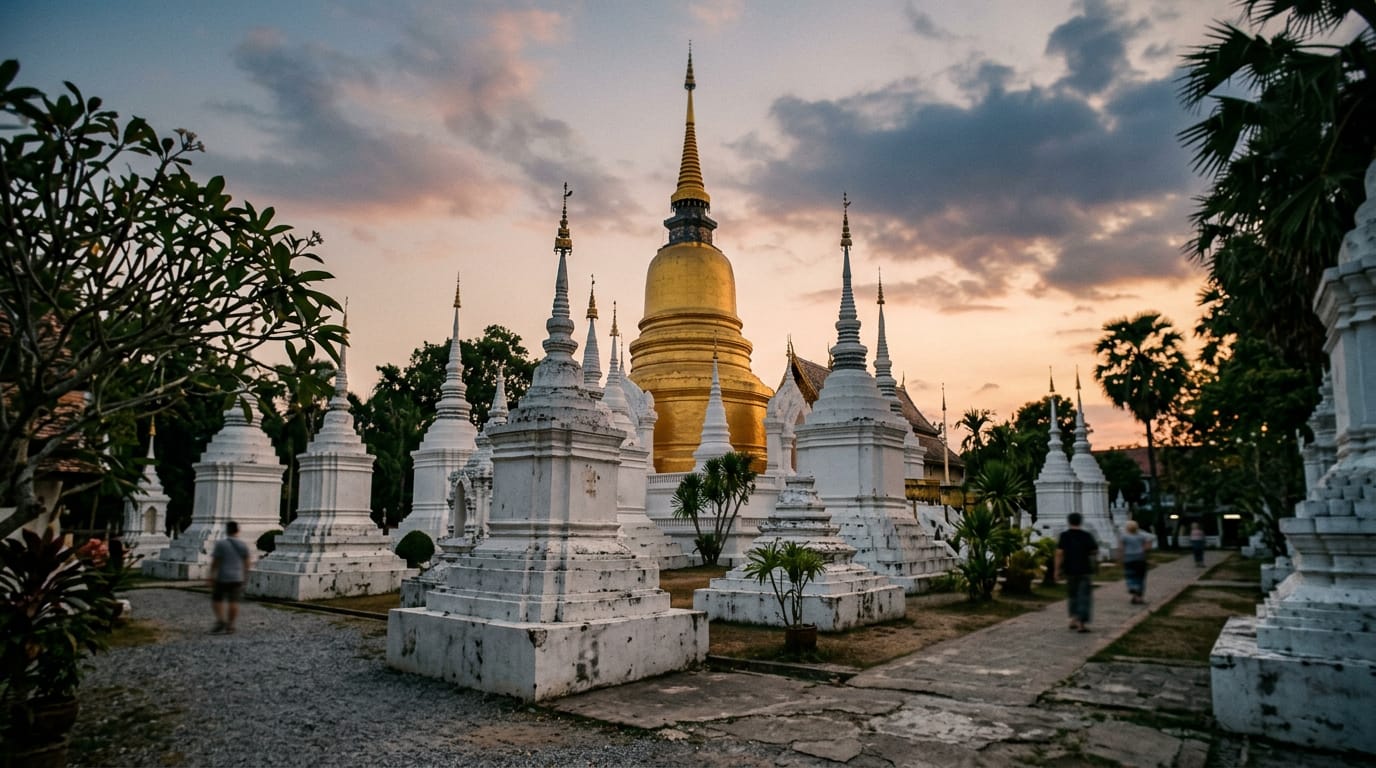
Wat Suan Dok
Wat Suan Dok, the 'Flower Garden Temple', sits outside the western moat on Suthep Road. Founded in 1370 by King Kuena to house a relic later carried up Doi Suthep by a white elephant, it is best known for its cluster of whitewashed royal chedis (the cremation memorials of the Mangrai dynasty) and for weekday Monk Chat sessions with novice monks.
Temple
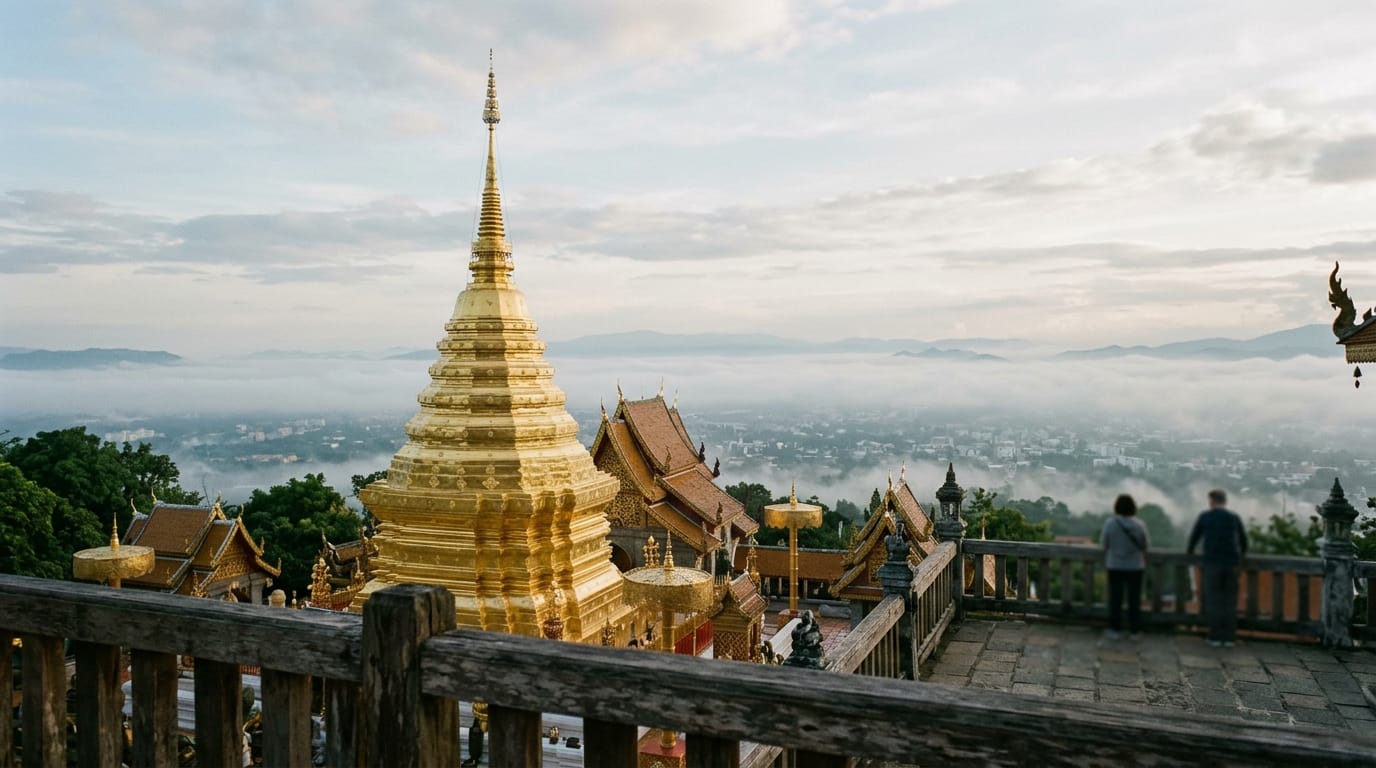
Wat Phra That Doi Suthep
Wat Phra That Doi Suthep is the mountain temple that watches over Chiang Mai from a forested ridge 1,073 metres above the city. Founded in 1383 by King Kuena to enshrine a Buddha relic carried up the mountain on the back of a white elephant, its gilded chedi has been the spiritual centre of northern Thailand for six centuries. A 306-step naga-flanked staircase or a small cable car carries visitors to a courtyard with one of the great views of the Ping Valley.
Sight
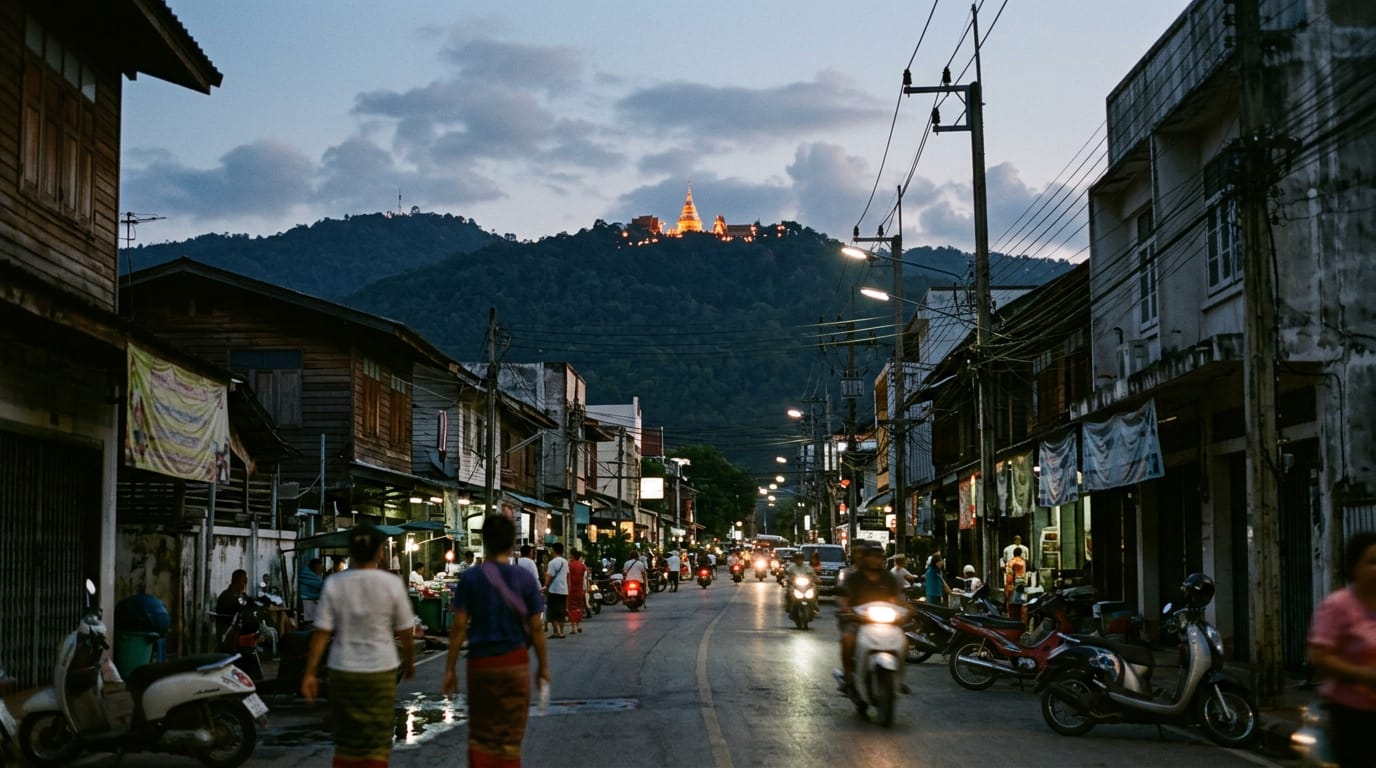
Doi Suthep
Doi Suthep is the 1,676 m mountain that rises straight out of the western suburbs of Chiang Mai. The mountain holds the city's most photographed temple at 1,073 m, the king's winter palace, a Hmong village near the summit and several waterfalls — and is a separate destination from the temple of the same name, which sits on its flank.