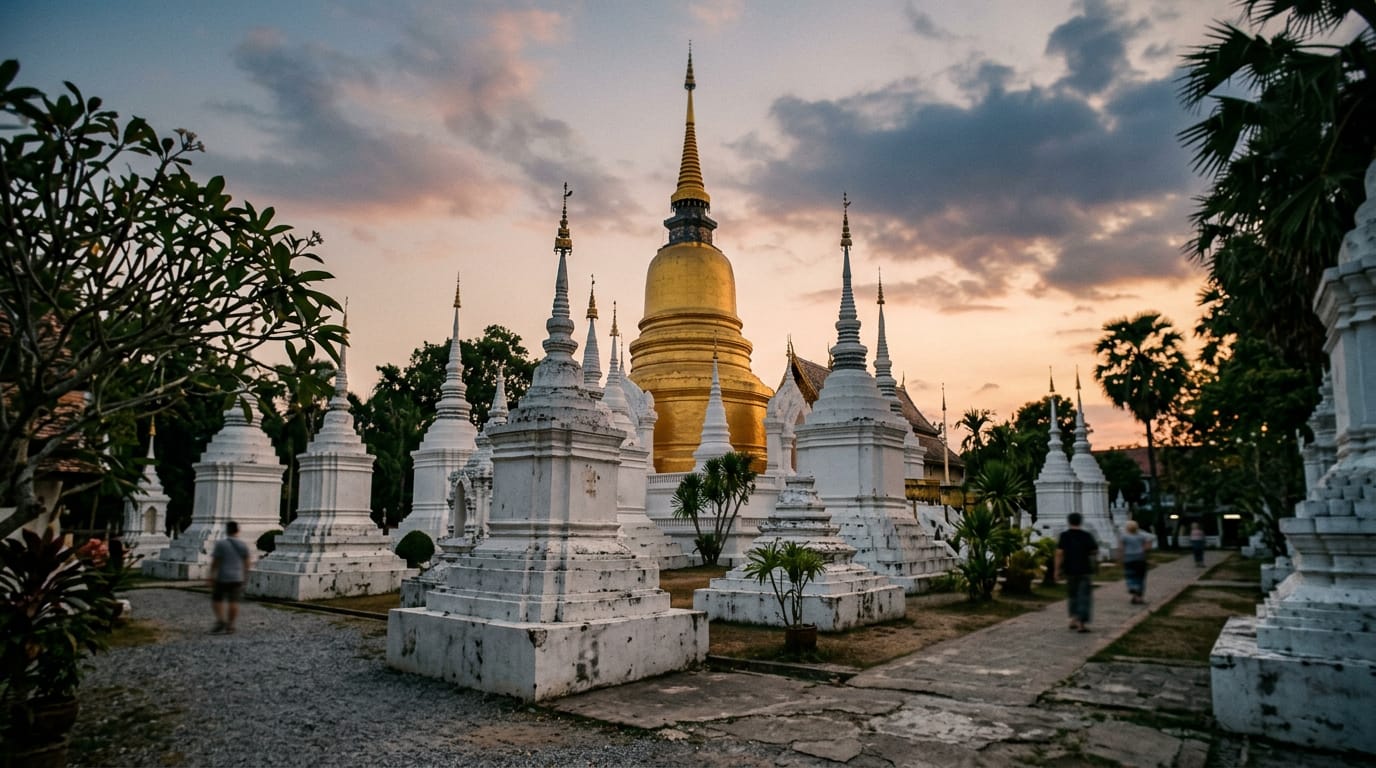
Wat Suan Dok, the 'Flower Garden Temple', sits outside the western moat on Suthep Road. Founded in 1370 by King Kuena to house a relic later carried up Doi Suthep by a white elephant, it is best known for its cluster of whitewashed royal chedis (the cremation memorials of the Mangrai dynasty) and for weekday Monk Chat sessions with novice monks.
Updated
Wat Suan Dok is the temple of the white chedis at sunset, and the temple where most casual visitors first get a chance to ask a Thai monk a direct question and receive a direct answer. It sits just outside the western moat of the Old City, set back from Suthep Road behind an open courtyard. Its name means ‘Flower Garden Temple’.
History and significance
The site was a royal pleasure garden when King Kuena, sixth of the Mangrai kings, acquired it in 1370. Kuena had invited a forest-monk teacher, Sumana Thera, from Sukhothai to settle in Chiang Mai and act as a senior teacher to the Lanna sangha. Sumana brought with him a small Buddha relic that he had received from a teacher of his own further south. According to the temple chronicle, when the relic was honoured at Wat Suan Dok for the first time it split into two pieces of identical brilliance.
Sumana mattered as much as the relic. He belonged to the reformed forest lineage that Sukhothai had received from Sri Lanka, and Kuena brought him north precisely to plant that ordination line in Lanna soil. Wat Suan Dok became its first northern base, and the school of monks that grew from it is still known in Lanna religious history as the Suan Dok lineage. The stricter Sinhalese discipline spread from this compound through the monasteries of the kingdom over the following decades, which is why the chronicles treat the temple as a teaching foundation first and a relic shrine second. That pattern has held for six centuries: the compound still works primarily as a place where monks are trained.
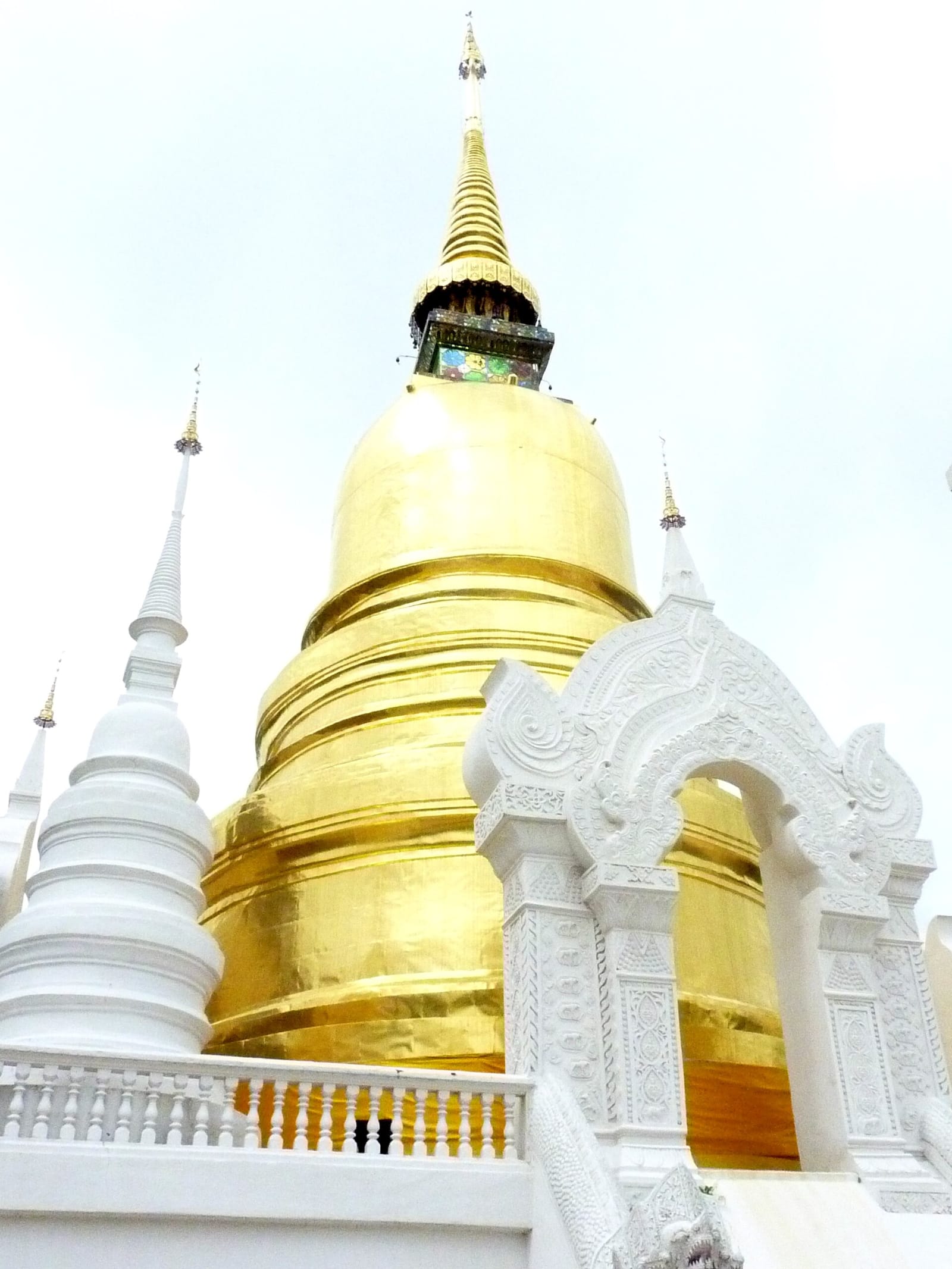
Kuena interpreted this as a sign that the relic should be enshrined in two places. He installed one piece in the principal chedi at Wat Suan Dok, the 48-metre gilded stupa that still dominates the compound. The second piece was placed in a casket on the back of a white elephant. The animal was set free at the temple gates, walked west out of the city, climbed the foothills, and collapsed near the summit of Doi Suthep, the mountain that watches over Chiang Mai. The spot of its collapse became Wat Phra Thad Doi Suthep, founded in 1383. The two temples are sister foundations, and on the same hilltop axis. The line from the principal chedi at Wat Suan Dok runs straight up the mountain to its twin.
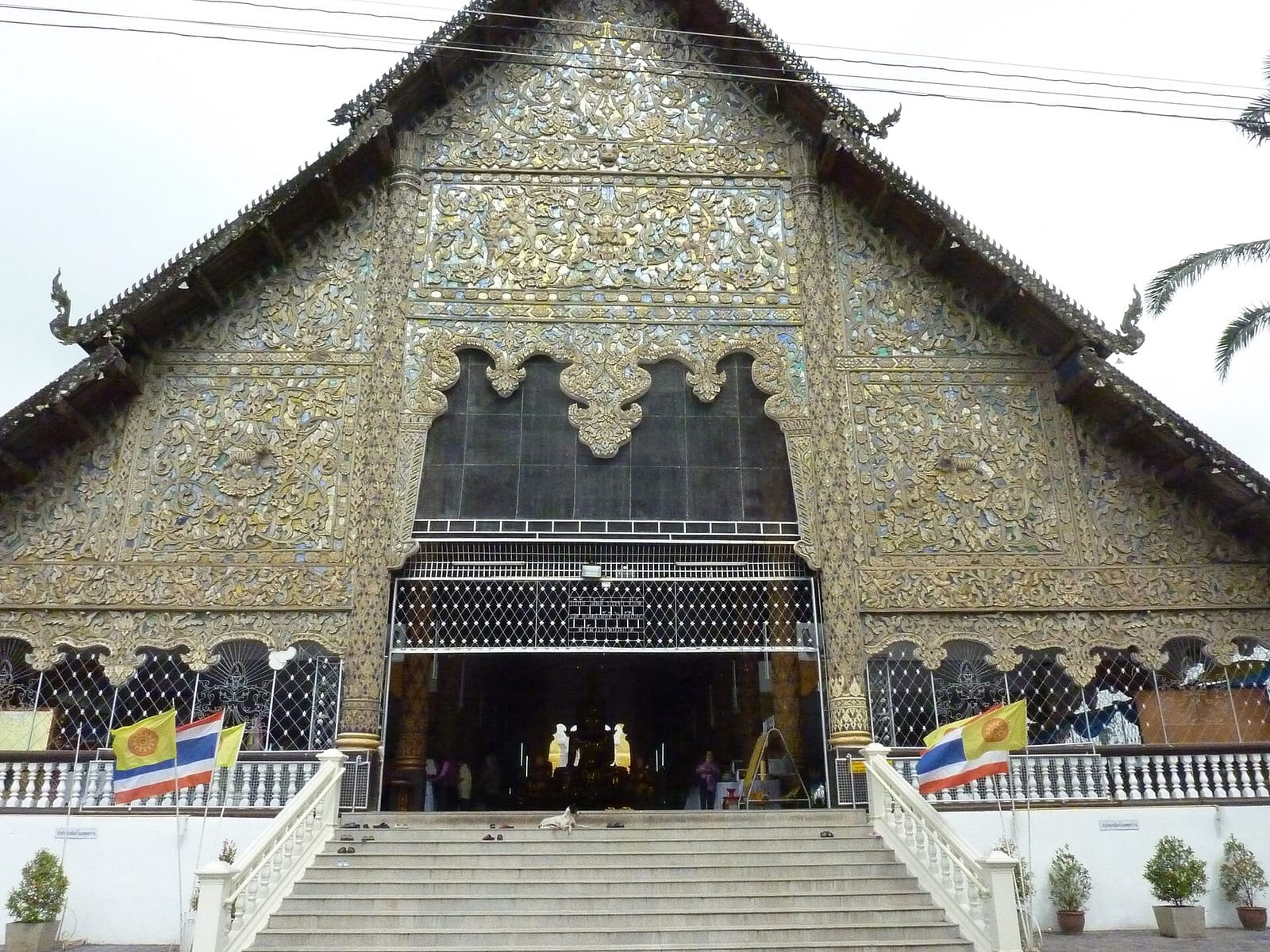
For most of the next two centuries Wat Suan Dok was one of the senior royal temples of the Mangrai dynasty, used for the rains-retreat ceremonies of the king’s own teacher and for the major Buddhist festivals. The dynasty collapsed in 1558 with the Burmese conquest, and the temple declined into a forest ruin. King Kawila restored the principal viharn in 1797. The current main hall, with its five tall Lanna gables and unusually open structure, dates from a further rebuilding in 1932.
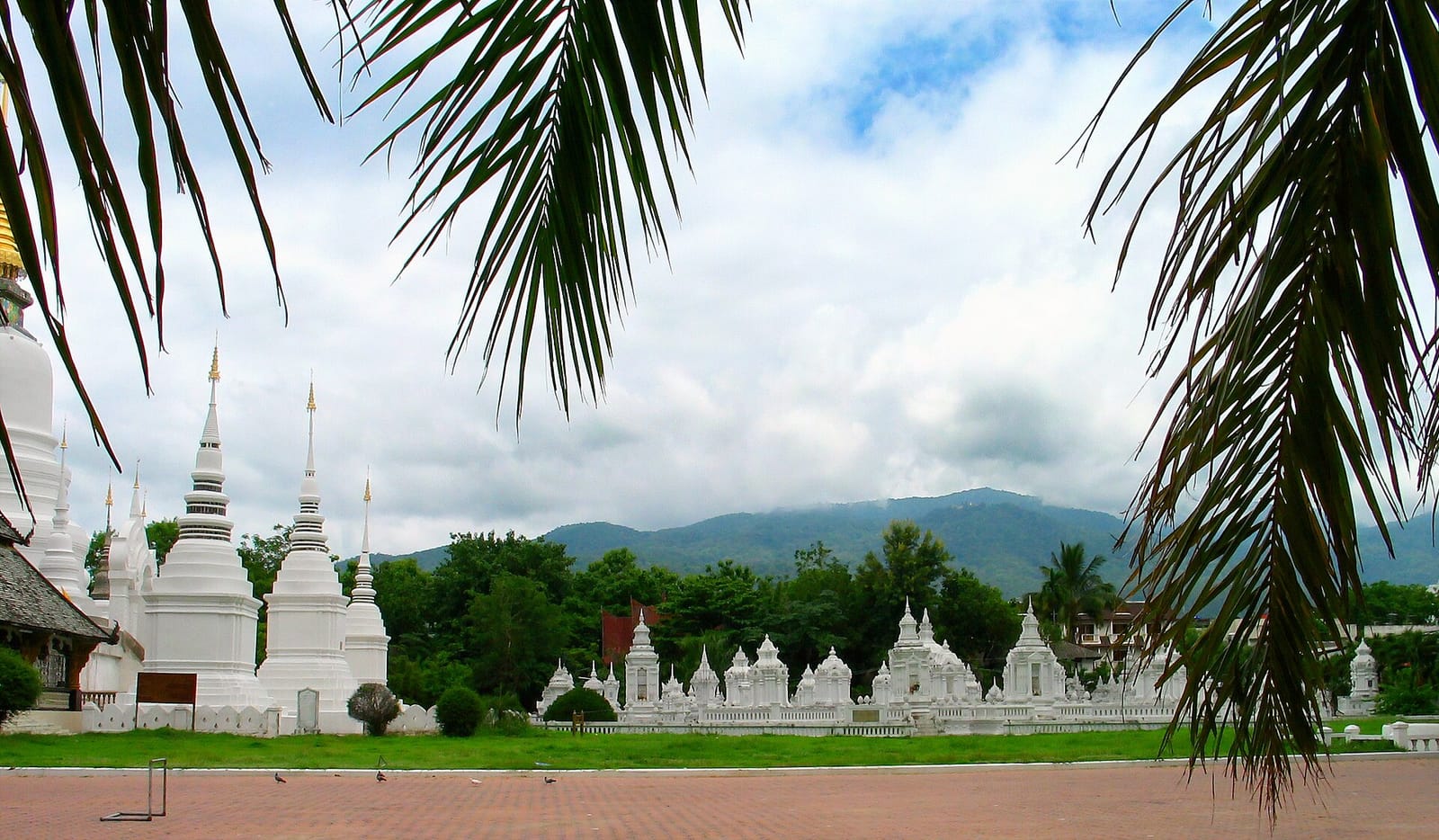
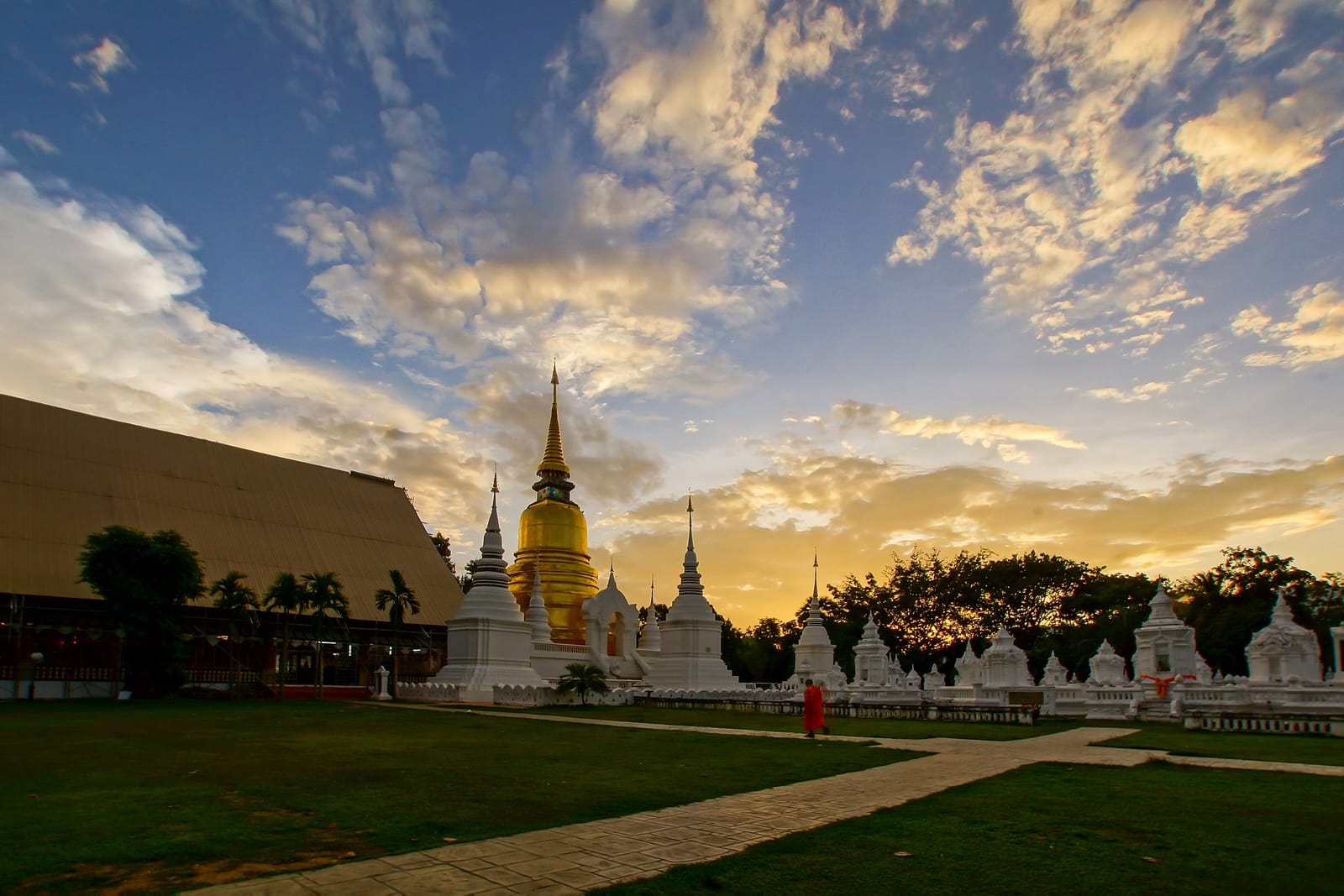
The cluster of small whitewashed chedis west of the main stupa is the temple’s other defining feature and the most photographed. These are not part of the original 1370 compound. They were moved here in 1909 from a smaller royal cemetery at the foot of Doi Suthep (that site had become inconvenient) and contain the cremated ashes of Mangrai-dynasty kings and princes. The largest of them belongs to King Kawila, the second founder of the city; the others trail down through later generations of the royal line, ending with a memorial to Princess Dara Rasmi, the Lanna princess who became a consort of King Chulalongkorn of Siam. Together they form the most coherent royal cemetery cluster anywhere in northern Thailand. Local people still leave flowers at the base of Kawila’s chedi on his commemorative days.
The temple is also the principal teaching site of the Mahachulalongkornrajavidyalaya University Chiang Mai campus (one of the two state Buddhist universities), which is why so many young novice monks live here and why the Monk Chat programme works as well as it does.
What to see
A full visit covers four main features. The compound is large and walking between them gives a much better sense of the temple’s scale than crowded Old City compounds allow.
The principal chedi
The main chedi rises directly behind the viharn and stands 48 metres tall. The shape is bell-on-bell (a tall lower bell carrying a smaller upper bell, with a long stepped spire above), a Sukhothai form rather than the more typically Lanna bell-on-octagon of Wat Chiang Man. The exterior is finished in gilded copper plates that catch the afternoon sun across the entire western side. Walk slowly around it; the four small subsidiary stupas at the corners of the platform mark the cardinal directions.
The white royal chedis
The cluster of about thirty small whitewashed chedis sits to the west of the principal stupa in a single open courtyard. Each is shaped as a miniature lotus-bud spire on a square plinth, and each holds the ashes of a member of the Chiang Mai royal family. The largest, near the centre, contains King Kawila’s remains. Smaller chedis trail outward to junior princes and consorts. The cluster is open ground (there is no fence around individual memorials) and you are welcome to walk between them. The shot of the white spires with Doi Suthep behind them is one of the most photographed views in the city, particularly from around 17:45 between October and February when the sun sets directly over the mountain.
The main viharn
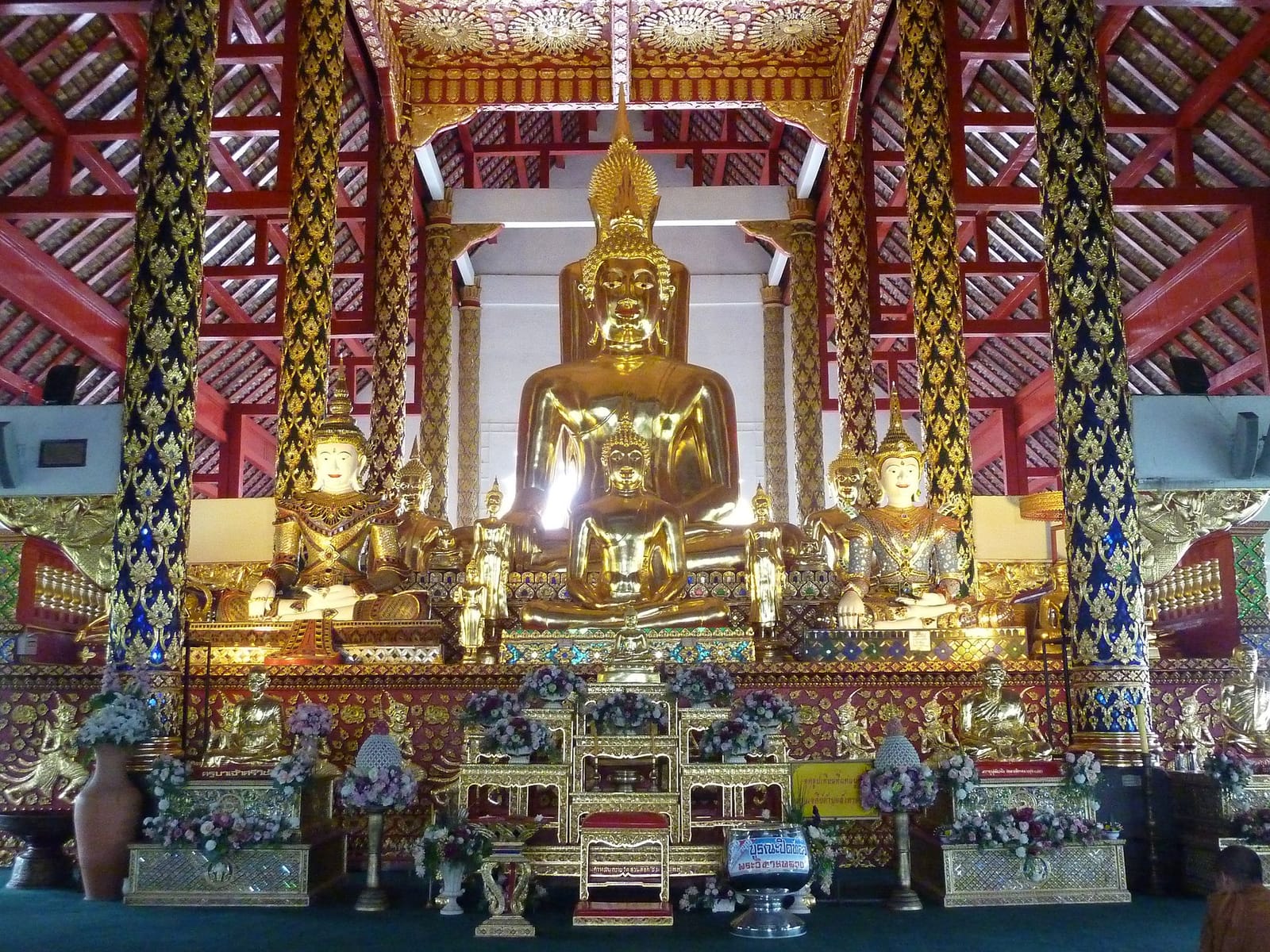
The viharn luang at the eastern edge of the compound is an open-sided assembly hall with five tall Lanna gables along its length, no exterior walls between the columns, and a wide raised teak floor. The openness is unusual for Lanna temples and reflects the 1932 rebuilding, when ventilation was prioritised. The principal Buddha image is a large bronze in the maravijaya posture, seated on a high gilded altar at the western end. Walk to the back and turn around to look at the gilded ceiling beams and the carved bargeboards from the inside; the work is finer than at most more famous compounds.
The ubosot
The ordination hall sits in its own walled enclosure to the south, marked by sema boundary stones. The structure is smaller and more conventionally enclosed than the main viharn, with classic three-tiered Lanna roof and gilded gable carving. The hall is generally open during daytime hours; visitors are welcome inside if they are dressed appropriately and shoes are removed.
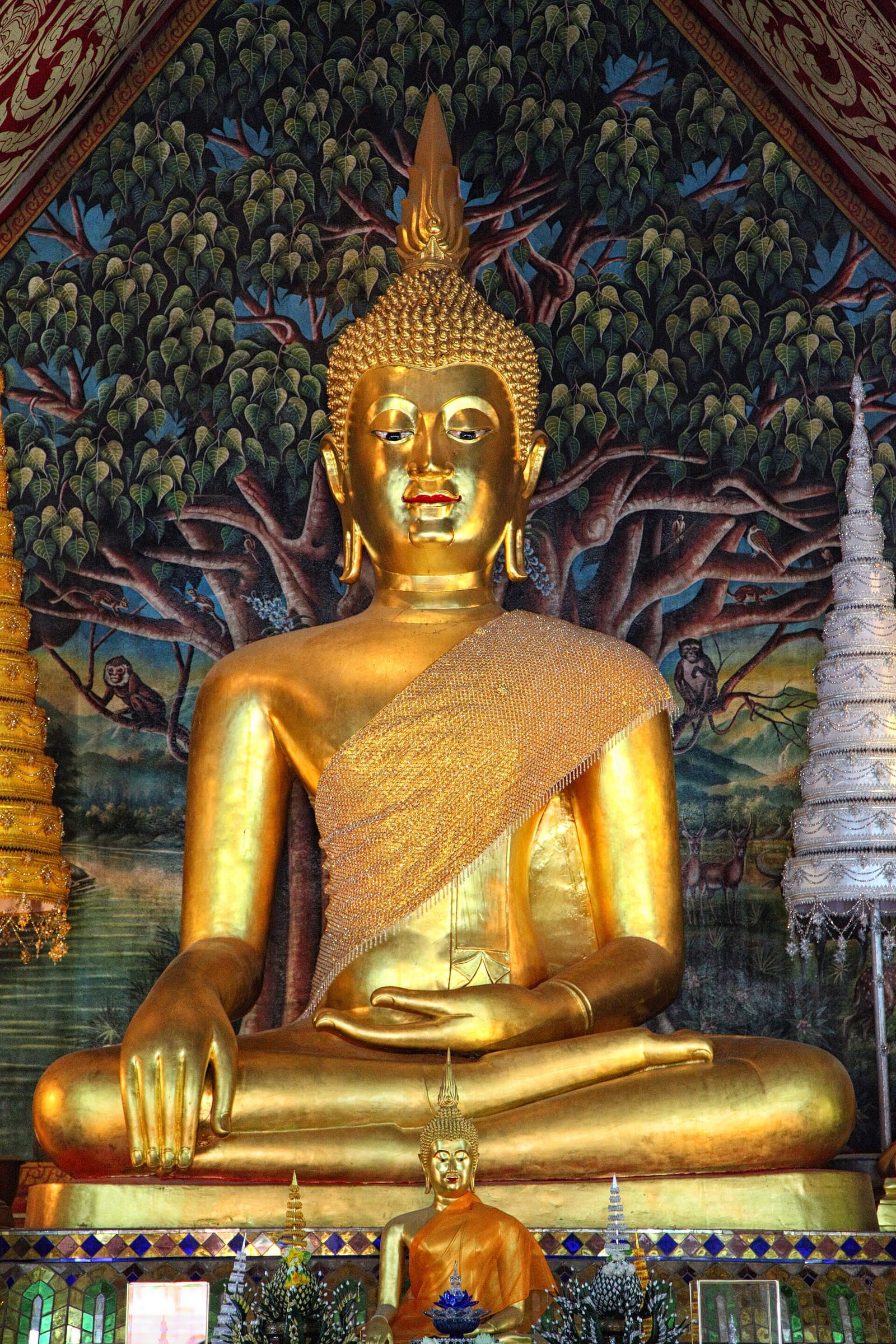
The hall’s main occupant justifies the detour. Phra Chao Kao Tue is a large seated bronze cast in sections on the orders of King Mueang Kaeo early in the sixteenth century, at the height of Lanna’s golden age of bronze casting, and it is among the biggest old bronzes anywhere in northern Thailand. The name refers to the quantity of metal used: nine tue (an old Lanna unit of weight). The casting is unusually fine for its size, with none of the heaviness that large images of the period often carry. Most visitors never see it because the ubosot looks closed from the outside. Try the door.
Monk Chat
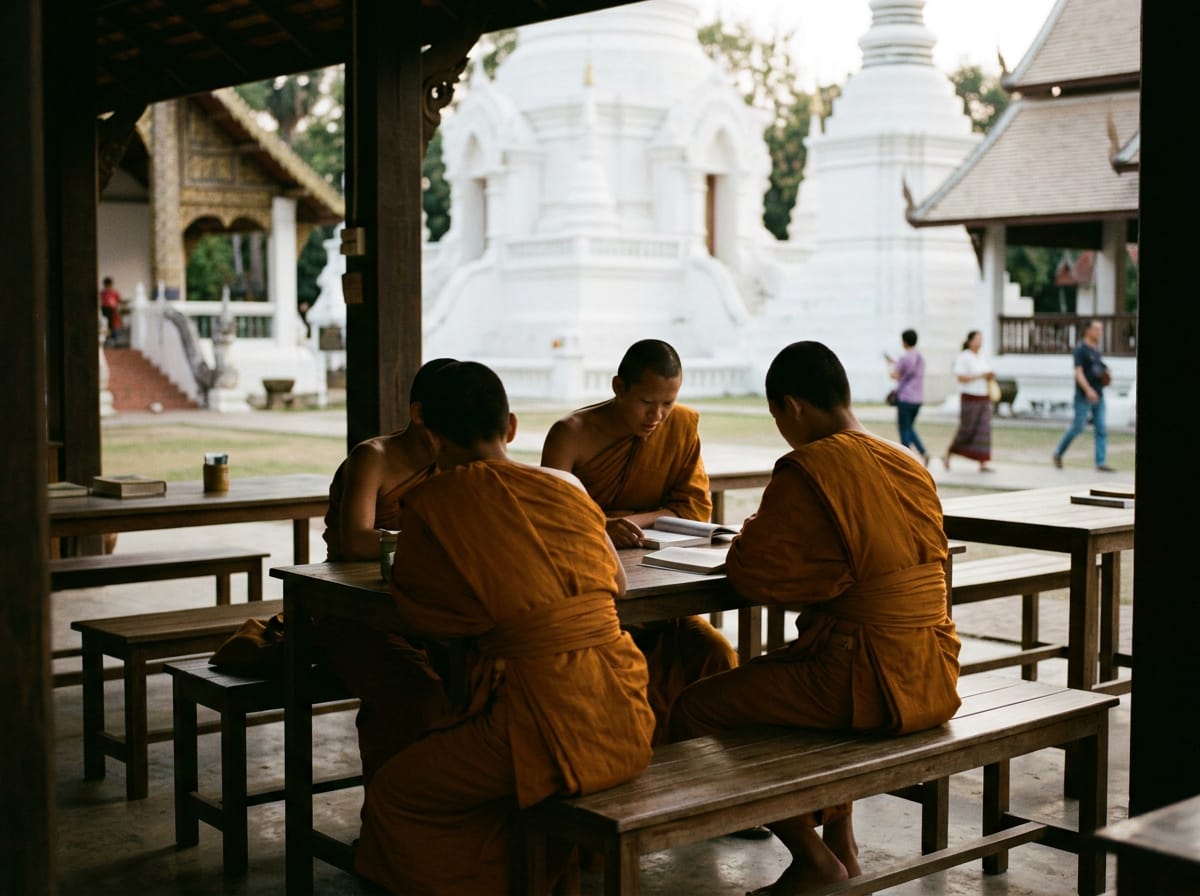
The conversation programme deserves more than the footnote most guides give it. On weekday evenings between 17:00 and 19:00, novice monks from the Buddhist university set out plastic tables and chairs on the open ground south of the chedi courtyard, and anyone can sit down. No booking, no fee, no minimum stay.
The exchange runs in both directions. You ask about meditation or the rules of the robe; the novices ask where you are from, what people in your country make of Buddhism, how a particular English idiom works. Many of them grew up in villages in the far north or across the border in Shan State, and these sessions are their main practice ground for spoken English. A question that seems too basic to ask (‘why do monks not eat after midday?’) usually gets the most considered answer, because it is the kind they have thought hardest about themselves.
A few practical notes. Women should sit across the table rather than beside a novice, and hand nothing to him directly. Photographs are fine if you ask first. If the conversation runs past 19:00 the novices will excuse themselves for evening chanting rather than admit they need to leave, so watch the time on their behalf. And come with a real question rather than a quiz. The difference is obvious to them within a minute.
How to visit
Wat Suan Dok sits on Suthep Road, 600 metres west of Suan Dok Gate in the Old City moat. From inside the Old City the walk takes 8 to 10 minutes along Suthep Road. From Tha Phae Gate the walk is 25 to 30 minutes, or 5 minutes by songthaew.
A red songthaew from anywhere inside the city or from the Nimmanhaemin area costs 30 to 50 baht per person on a shared ride, or 100 to 150 baht to charter. From Tha Phae Gate, expect 50 baht shared or 120 baht charter. A Grab from the Old City is around 80 baht. From Chiang Mai International Airport, a metered taxi to the temple is 150 to 200 baht and takes 15 minutes.
Parking is straightforward. A free car park sits inside the temple gates on the south side of the compound. Motorbikes can park free along the western boundary fence. The compound is large enough to absorb several coach groups without feeling crowded, so coach visits during mid-morning are noticeable but not oppressive.
The temple is on the same road as the start of the Doi Suthep climb, so many visitors going up the mountain stop here on the way out or back. Plan it as a dedicated visit of an hour rather than a quick checkpoint; sunset photography needs time, and Monk Chat needs even more.
There is decent food without leaving the grounds. Pun Pun, a small vegetarian restaurant connected to an organic farming project outside the city, occupies a shaded corner of the compound and serves northern Thai dishes at street-stall prices. It keeps daytime hours only, which makes it a sensible lunch stop between a morning at Wat Umong and an afternoon wait for the sunset light.
Etiquette and dress code
The conventions are the same as at every active Thai temple. Cover shoulders and knees; vests, short shorts and miniskirts are turned away at the viharn door. Loaner sarongs sit in a basket near the entrance, free of charge against a 100 baht refundable deposit. Shoes come off before entering the viharn and the ubosot. Hats and sunglasses should be removed inside. Sit with your legs tucked to the side rather than crossed when seated before any Buddha image. Do not point your feet at an image, or at a monk. Women should not hand objects directly to monks; place items on the cloth provided. Photography is welcome throughout the compound. Drones are not permitted.
Festivals and ceremonies
On the major Buddhist holy days the temple holds an evening wian tian, a candlelit walk three times around the principal chedi. Visitors may join. Buy a small set of candle, incense and flowers from the tables near the viharn for about 20 baht, fall in behind the line of monks and lay people, and keep a walking pace. Visakha Bucha, in May or early June, draws the largest crowd, and the white chedis lit by several hundred candle flames are worth rearranging an evening for.
During Yi Peng and Loy Krathong in November the compound is strung with paper lanterns and the chedi courtyard stays open into the evening. It is a quieter place to spend the festival than the riverbank, and the lanterns rising over the western suburbs read clearly against the dark bulk of Doi Suthep.
The Buddhist university also uses the compound for its own term and ordination ceremonies, so on some mornings you will find several hundred monks seated in rows in the open viharn. Visitors are not turned away on these days; keep to the edges and let the rows form without weaving through them.
Best time to visit
The temple has two distinct best times. For photography, come at sunset between October and February when the sun drops directly behind Doi Suthep. From around 17:30 the western light begins to silhouette the white chedi cluster; from 17:45 to 18:15 the composition with the mountain behind is at its best. Bring a wide lens. In the wet season, June to October, sunset is a lottery, but the afternoon storms wash the dust out of the air and the clearest mountain backdrops of the year follow them.
For Monk Chat, come any weekday between 17:00 and 19:00. The novices set up at small tables on the open ground to the south of the chedis; sit down, introduce yourself, and ask whatever you are curious about. Sessions are run by students of the on-site Buddhist university and are not staged for tourists. Avoid Saturdays and Sundays when Monk Chat does not run and the temple is busier with local Thai visitors.
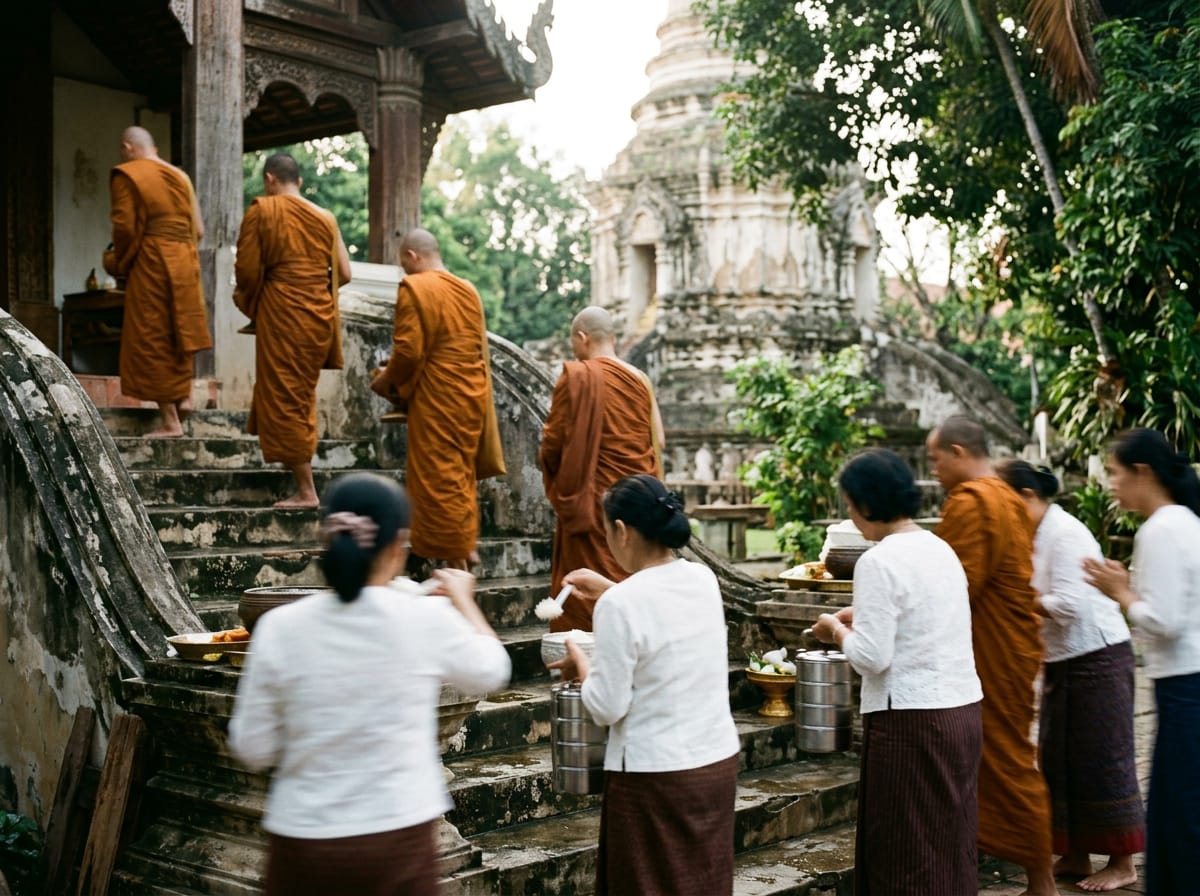
For the alms round, come at 06:15 to 06:45, when the monks process out of the main gate to receive food offerings on the pavement along Suthep Road. Buy a tray of rice and fruit from the small stalls outside the gate for 50 to 100 baht; offer it kneeling, with both hands and a slight bow.
Nearby and related
Wat Suan Dok is the natural anchor of the western-edge temple cluster, linked by relic, history and lineage to the mountain temples above.
- Wat Phra Thad Doi Suthep — the sister temple at the summit of Doi Suthep, where the white elephant carried the second piece of King Kuena’s relic in 1383. 17 km west; reachable from outside Wat Suan Dok by shared songthaew (50 to 80 baht per person).
- Wat Umong — the forest tunnel temple 4 km further west on the lower slopes of Doi Suthep, founded around the same period by King Mangrai. Combine it with a sunset visit to Wat Suan Dok by visiting Umong in the morning and Suan Dok in the late afternoon.
- Wat Phra Singh — the principal Lanna royal temple inside the Old City, 15 minutes east on foot, holding the Phra Buddha Sihing.
- Doi Pui to Doi Suthep — the ridge walk between the two summits above the city, for anyone pairing temples with a day in the national park. The road up the mountain starts from this side of town, so Wat Suan Dok makes a natural first or last stop on a hiking day.
- The Nimmanhaemin cafe district sits 10 minutes’ walk north of Wat Suan Dok, useful for a meal before the evening Monk Chat or after a sunset photography session.
Photos
Frequently asked questions
What time does Wat Suan Dok open?
Wat Suan Dok opens daily at 06:00 and closes at 17:00. The compound is partially accessible later than this — the chedi cluster is in an open courtyard that can be walked through until about 19:00, particularly during the Monk Chat sessions on weekday evenings. Morning chanting begins at 06:00 and evening chanting at 17:00. The temple stays open later for the major Buddhist holy days.
Is there an entry fee for Wat Suan Dok?
No. Entry is free for everyone. A donation box sits inside the main viharn — 20 baht is customary if you light incense. The Monk Chat sessions on Monday to Friday evenings are also free, although a small donation to the monks' education fund is welcomed. The temple bookshop near the chedi sells English-language books on Buddhism for 100 to 300 baht.
Where is Wat Suan Dok located?
Wat Suan Dok sits on Suthep Road, about 600 metres west of Suan Dok Gate in the Old City moat. The street address is 139 Suthep Road. From Tha Phae Gate the walk is around 25 minutes; from the centre of the Old City it is 15 minutes. The Maharaj Hospital is directly opposite, which makes the temple easy to locate by taxi or Grab.
What are the white chedis at Wat Suan Dok?
The cluster of small whitewashed chedis to the west of the main stupa contains the ashes of members of the Chiang Mai royal family — the descendants of King Mangrai who ruled the Lanna kingdom from 1296 until the Burmese conquest in 1558. The memorials were moved here in 1909 from a smaller compound near the Royal Palace site. There are about thirty of them in total. The largest belongs to King Kawila, who recaptured Chiang Mai from the Burmese in 1796 and is regarded as the second founder of the city.
What is Monk Chat?
Monk Chat is an open conversation programme that lets visitors talk with novice monks at Wat Suan Dok in informal English. The novices are students at the affiliated Mahachulalongkornrajavidyalaya University, practising their language skills while answering questions about Buddhism and daily monastic life. Sessions run Monday to Friday from 17:00 to 19:00 at tables set up on the temple grounds. There is no fee. Topics are open — visitors ask about meditation, dietary rules, ordination, the role of women, the relationship between Buddhism and politics, anything reasonable. Stay 15 minutes or an hour; both are fine.
What is the dress code for Wat Suan Dok?
Shoulders and knees must be covered for both men and women. Shorts above the knee, vests and sleeveless tops are not permitted inside the viharn. Sarongs are lent free of charge by the entrance — leave a 100 baht refundable deposit. Shoes come off before entering the viharn and the ubosot. The chedi courtyard outside is technically still consecrated ground, so dress respectfully even when wandering between the white memorials.
Is Wat Suan Dok good for sunset photography?
Yes — it is one of the best sunset locations in Chiang Mai. The whitewashed chedi cluster faces west, with Doi Suthep rising behind them. From around 17:45 to 18:30 between October and February the sun sets directly over the mountain, silhouetting the chedis and the principal gilded stupa together. Bring a wide lens; the cluster is dense and a focal length around 24 mm captures it best. The shot is well known and you will not be alone, but the courtyard is large enough to find space.
How do I get to Wat Suan Dok from the Old City?
Walk west on Suthep Road from Suan Dok Gate — 600 metres, around 8 minutes. A red songthaew from inside the Old City costs 30 to 50 baht per person. A Grab from Tha Phae Gate is around 80 baht. The temple is on the same road as the start of the Doi Suthep climb, so visitors heading up the mountain often stop here on the way.
Can I attend the morning alms-giving?
Yes. The monks of Wat Suan Dok process out of the main gate at around 06:15 to collect alms from lay supporters who line the pavement on Suthep Road. Visitors are welcome to participate by offering rice or fruit — buy a tray of offerings from the small market stalls outside the temple from 05:30 onwards, for around 50 to 100 baht. Kneel on the pavement, offer the items with both hands and a slight bow, do not touch the monks' robes. The whole event takes about 30 minutes and is one of the most genuine moments of daily monastic practice you can witness in the city.
When was Wat Suan Dok built?
Wat Suan Dok was founded in 1370 by King Kuena, the sixth ruler of the Mangrai dynasty, to enshrine a Buddha relic given to him by a forest monk from Sukhothai. The relic was said to have multiplied into two pieces while it was being honoured. One piece was kept at Wat Suan Dok in the principal chedi; the other was placed on the back of a white elephant which was set free and wandered until it collapsed on the summit of Doi Suthep — the site of what is now Wat Phra Thad Doi Suthep. The two temples are sister foundations.
Is Wat Suan Dok worth visiting?
Yes, for two distinct reasons. The chedi cluster at sunset is genuinely one of the most photographable scenes in Chiang Mai and unlike anything else inside or near the city. And the Monk Chat sessions are the easiest way for a casual visitor to ask the questions about Buddhism that the silence of other temples does not allow. Together they make Wat Suan Dok worth a dedicated late-afternoon visit, rather than a quick walkthrough in the middle of the day.
Are women allowed inside Wat Suan Dok?
Yes. Women can enter every part of Wat Suan Dok that is open to the public, including the main viharn, the chedi courtyard and the Monk Chat tables. The usual Theravada conventions apply during Monk Chat — sit on the side of the table designated for women if one is marked, do not hand objects directly to a monk, and place items on the cloth provided rather than reaching across. The novices are trained for these conversations and will guide you if anything is unclear.
Related guides
Temple
Wat Phra That Doi Suthep
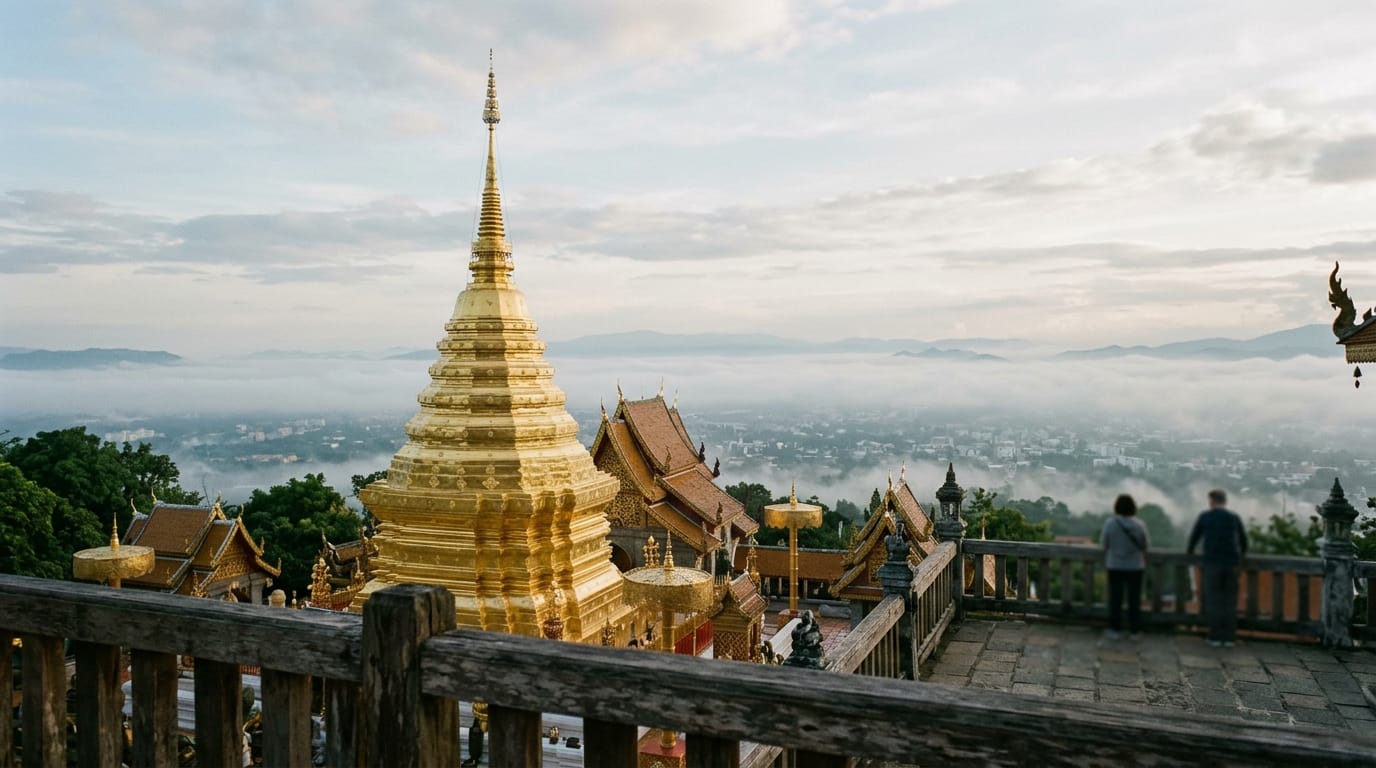
Wat Phra That Doi Suthep is the mountain temple that watches over Chiang Mai from a forested ridge 1,073 metres above the city. Founded in 1383 by King Kuena to enshrine a Buddha relic carried up the mountain on the back of a white elephant, its gilded chedi has been the spiritual centre of northern Thailand for six centuries. A 306-step naga-flanked staircase or a small cable car carries visitors to a courtyard with one of the great views of the Ping Valley.
Temple
Wat Umong
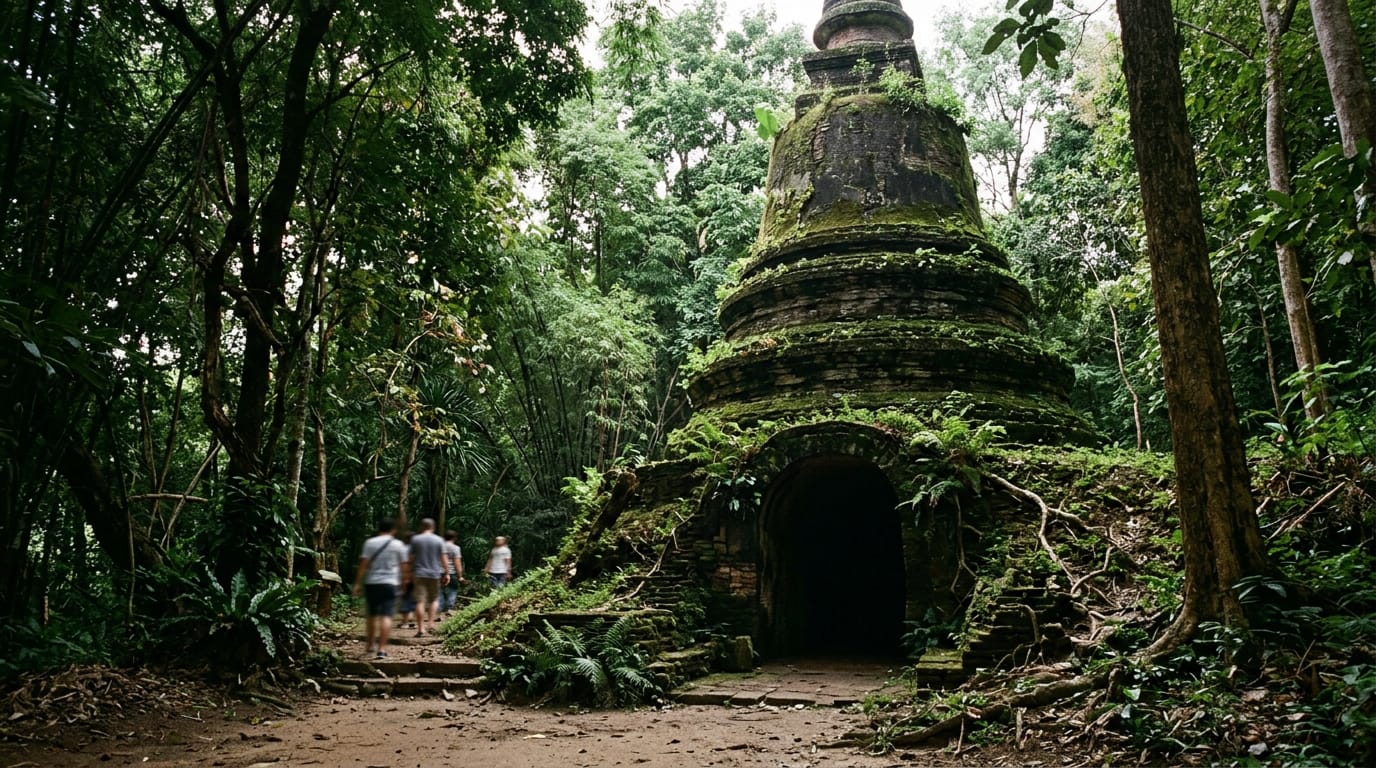
Wat Umong is a forest monastery at the foot of Doi Suthep, founded by King Mangrai around 1297 for monks who preferred the quiet of the woods. Its defining feature is a set of ancient tunnels dug into the base of a Lanna chedi and painted with faded murals. A mossy stupa, a fish-and-turtle lake, and 'tree wisdom' signs in English on the trunks make it feel half an arboretum.
Temple
Wat Phra Singh
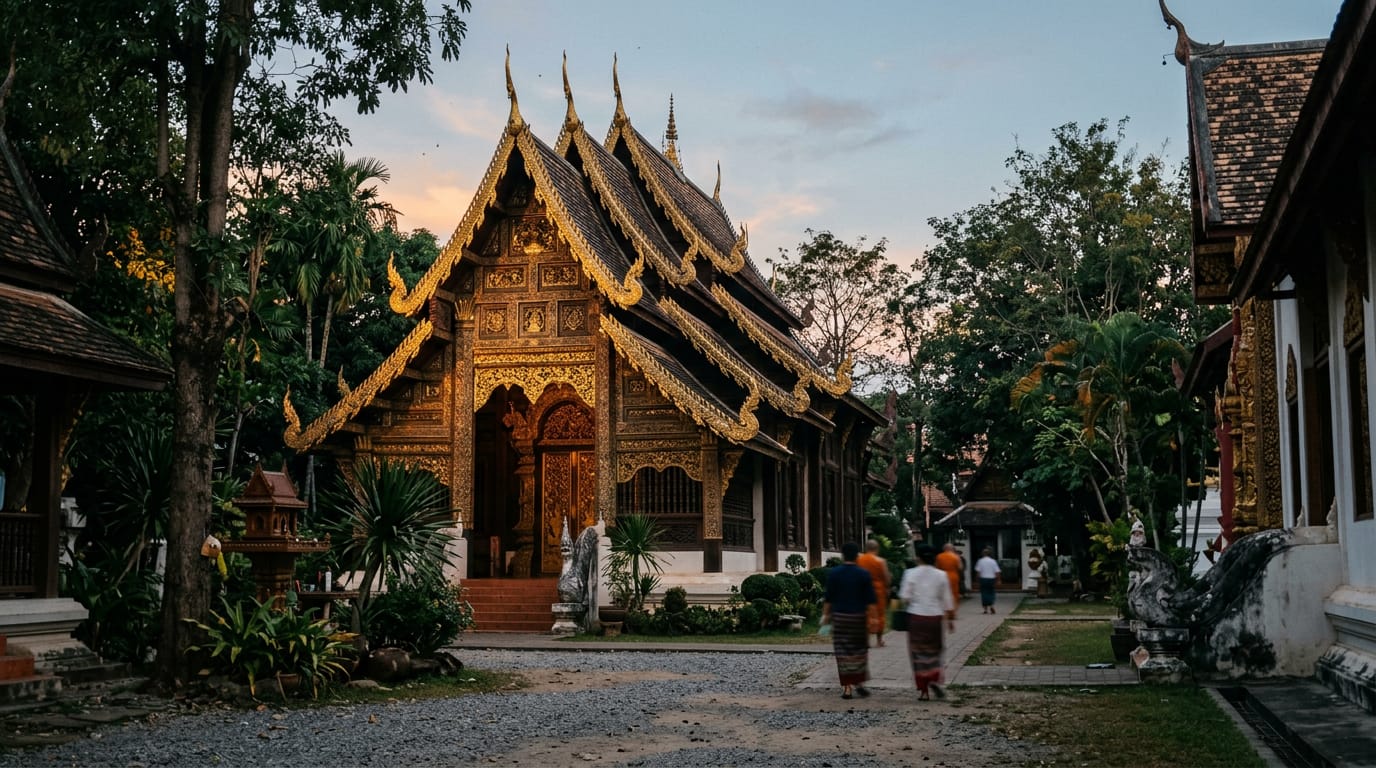
Wat Phra Singh is the most revered temple inside Chiang Mai's Old City, founded in 1345 by King Phayu of the Mangrai dynasty. Its Lai Kham viharn shelters the Phra Buddha Sihing — the Lion Buddha — which is paraded through the streets each Songkran. Together with its gilded chedi, carved teak gables and gold-leafed scripture library, the compound is the finest single example of Late Lanna architecture in northern Thailand.