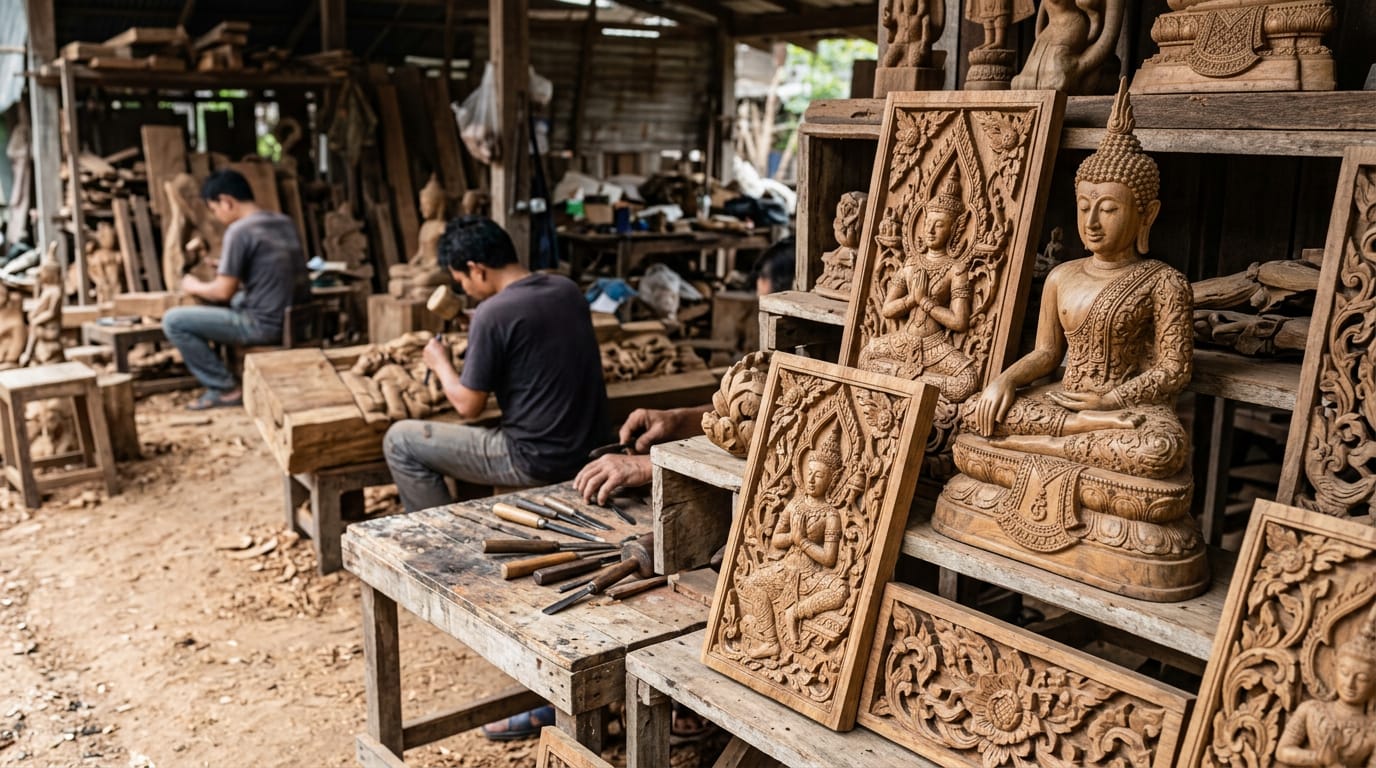
Ban Tawai is the woodcarving village 15 kilometres south of Chiang Mai's Old City in Hang Dong district. Five hundred-plus workshops and showrooms sell teak furniture, hand-carved Buddha statues, antiques, lacquerware and architectural pieces along a kilometre-long covered street. The trade dates to a 1957 royal craft initiative and remains the principal wholesale source for the city's furniture exporters.
Updated
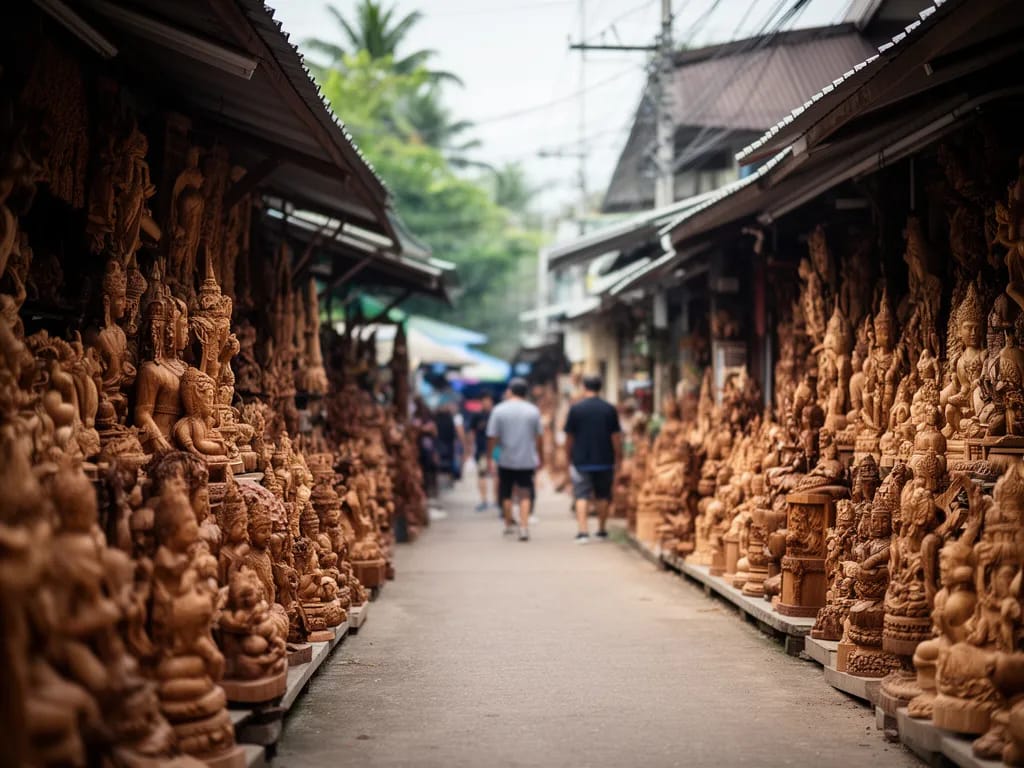
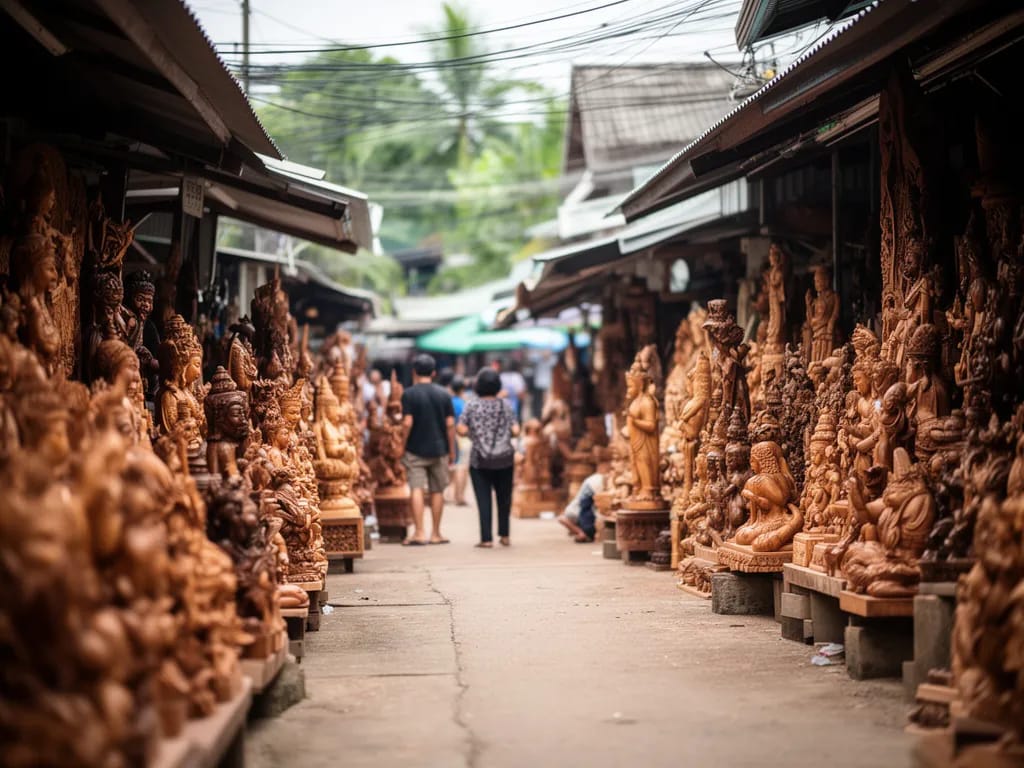
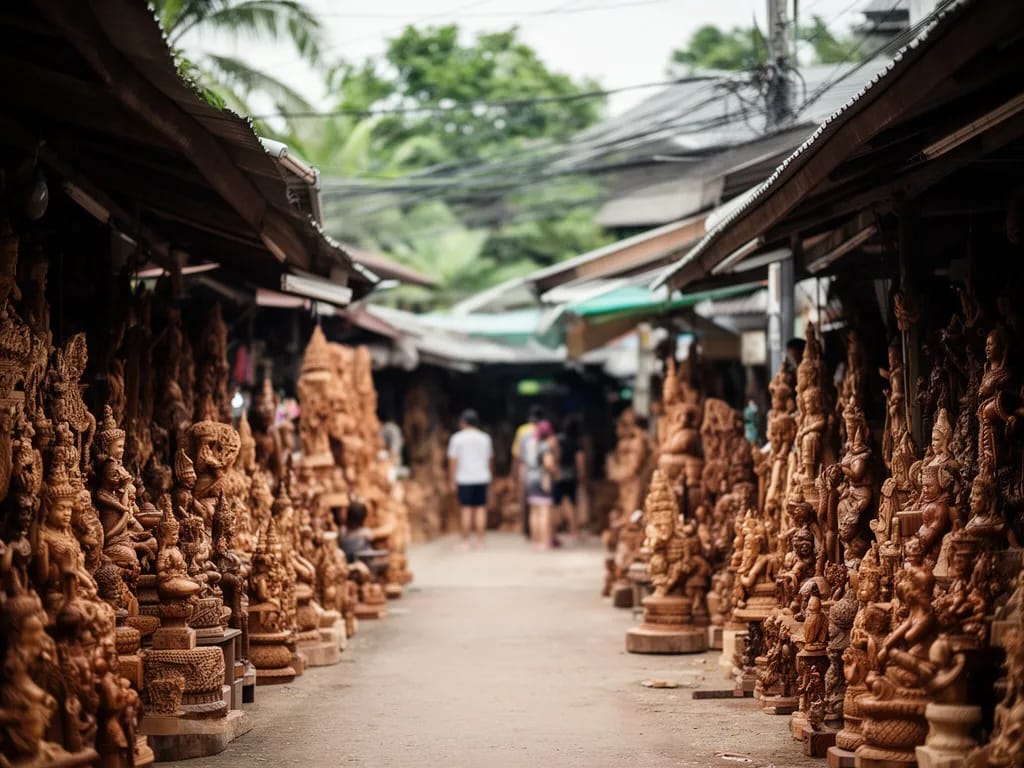
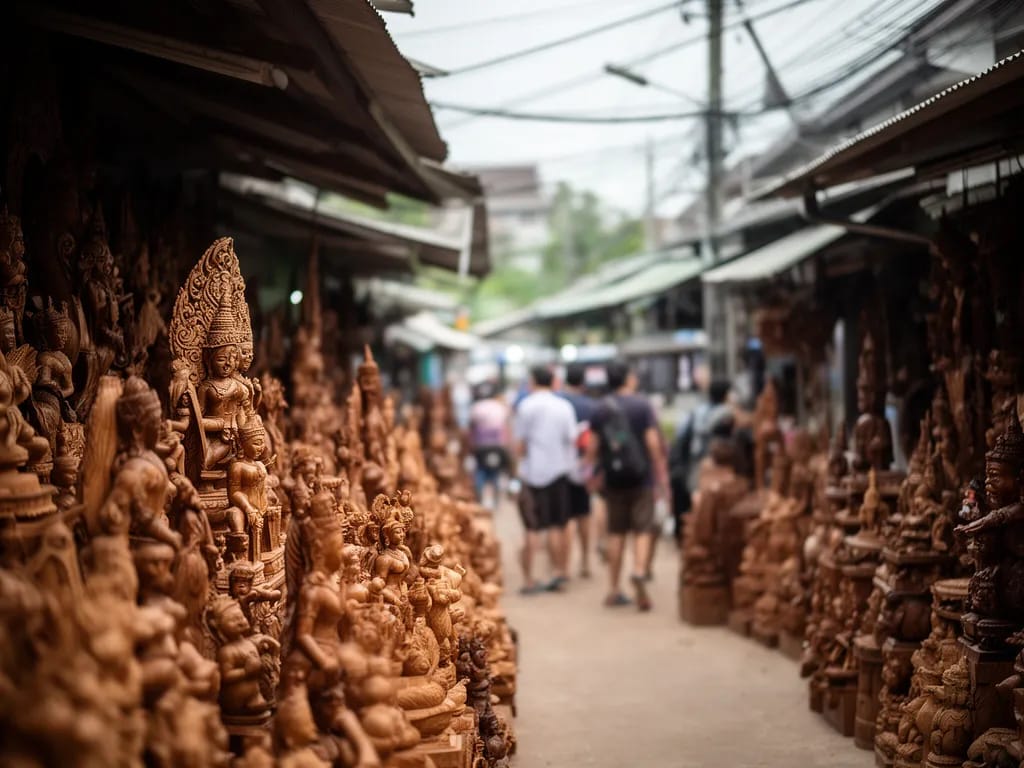
Drive 15 kilometres south from Chiang Mai’s Old City along Route 108 and the land changes character. The high-density tourism strip thins out, the rice fields begin and on the western side of the road a series of brown tourist signs point toward Ban Tawai. The village, when you reach it after a 2-kilometre side road, is unmistakable. The main covered street runs a kilometre, both sides lined with showrooms of carved teak — chairs, beds, dining tables, room dividers, Buddha statues that range from desk-sized to four-metre temple pieces, and the heavy architectural panels that were once the structural skin of houses across Lanna, the old kingdom of northern Thailand. Saws and chisels work behind every showroom. Ban Tawai is the principal woodcarving and teak-furniture village in northern Thailand, and the wholesale source for most of the furniture exported from Chiang Mai.
What it is
Ban Tawai, written บ้านถวาย in Thai, is a village in the Hang Dong district of Chiang Mai province. The name translates roughly as the offering village, a reference to the local Lanna folk story that the original 18th-century settlement provided carved teak panels and Buddha statues for the royal wats (temple-monasteries) of Chiang Mai. The woodcarving tradition is older than the village’s present commercial role, but the modern trade (the rows of showrooms, the export shipping, the international clientele) dates to a 1957 initiative under the SUPPORT Foundation of Her Majesty the late Queen Mother Sirikit, which encouraged northern villages to consolidate their craft skills and develop direct retail and export markets.
The Royal Project supplied the first wholesale buyers and the first export contacts. By the late 1970s, Ban Tawai’s own exporters had taken over, and by the 1990s the village had become the principal supplier of teak furniture to the European, North American, Japanese and Middle Eastern markets. Today around 500 workshops and showrooms trade in the village; an estimated 90 per cent of the adult population works in some part of the woodcarving or furniture industry. The village’s annual turnover is widely reported at over 2 billion baht.
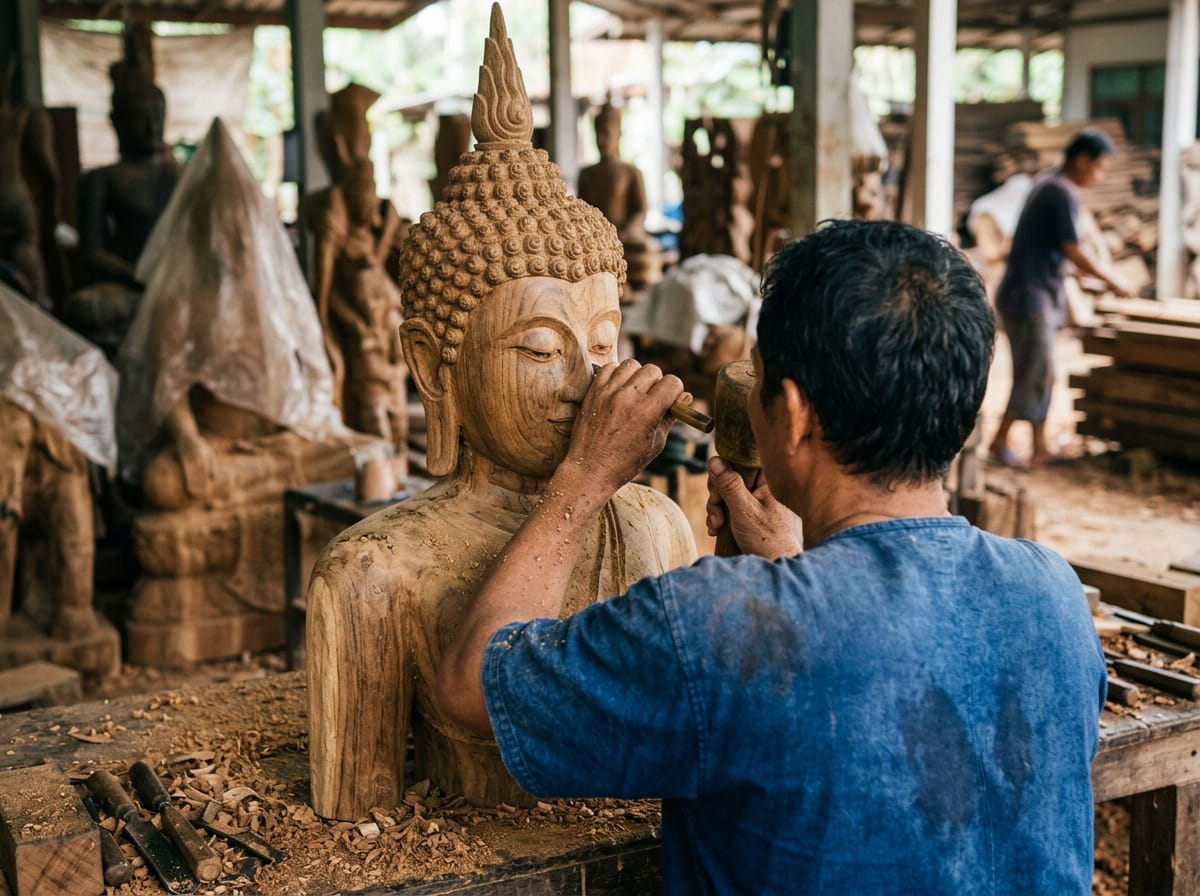
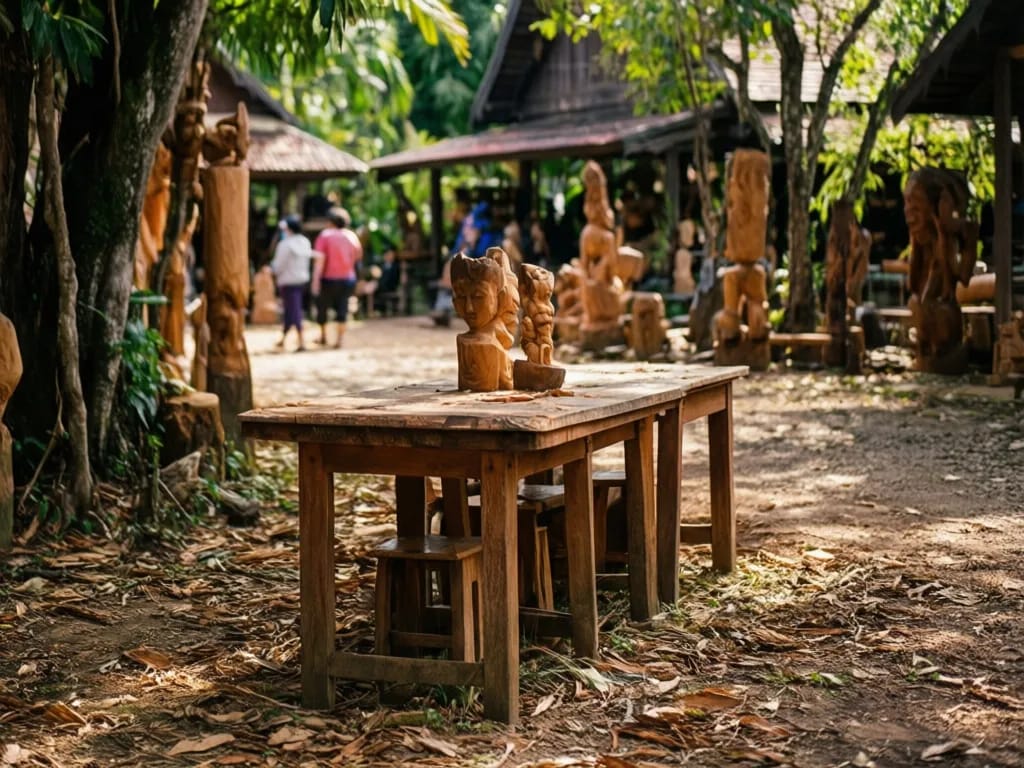
The trade is organised geographically. The main covered handicraft street, called Ban Tawai Handicraft Centre, runs from the main entrance arch on the western side and carries the highest density of retail showrooms. Behind it, in the back lanes, sit the working master carvers: single workshops where you can watch a Buddha image emerge from a raw teak block over the course of a fortnight. To the south and east of the central area, the larger furniture exporters operate from compounds with their own loading bays, container yards and crating facilities. A second smaller cluster of antique shops sits at the northern end of the main street.
What you’ll find
The village’s offer is genuinely deep. The seven main categories follow.
Teak furniture
The dominant category. Dining tables, benches, four-poster beds, opium beds, cabinets, bookcases, room dividers and the larger architectural panels. Most pieces are made from plantation-grown Thai or Burmese teak, or salvaged teak reclaimed from demolished traditional houses. A six-seat dining table runs 25,000 to 80,000 baht depending on the wood grade and the depth of carving. An opium bed costs 15,000 to 60,000. A four-poster bed 20,000 to 100,000. Reclaimed teak is increasingly common and well-marked; the salvaged pieces carry the patina and tool marks of their previous life.
Buddha statues
Hand-carved Buddha images sit at the centre of the craft. Desk-sized teak Buddhas cost 200 to 1,500 baht; larger statues at three-quarter human scale 3,000 to 15,000; temple-scale figures up to four metres tall, in the seated meditation posture or the standing alms-bowl posture, run from 50,000 to several hundred thousand baht. Stone Buddhas in sandstone or granite, carved at the southern end of the village by a small cluster of stoneworkers, range from 1,000 baht for a garden-scale piece to 80,000 for a major architectural figure.
Antiques
The antique cluster at the northern end of the main street stocks Chinese altars (mostly from southern China and Hong Kong), lacquer chests, old Burmese cabinets, teak window frames salvaged from demolished houses, English colonial-era pieces from Burma and rural northern Thai farm tools. Provenance is variable; ask for the dealer’s documentation and inspect joinery. The reputable dealers sell mid-19th to early 20th century pieces with clear histories.
Architectural and garden pieces
The southern end of the village specialises in larger architectural pieces: stone Buddhas for garden installations, sandstone reliefs, water features, carved teak gateways and the heavy ridge-pole pieces from old Lanna houses. Hotels and resorts across Thailand source from here. The garden pieces typically need road haul; the village’s logistics partners handle loading and delivery.
Lacquerware, basketry, ceramics
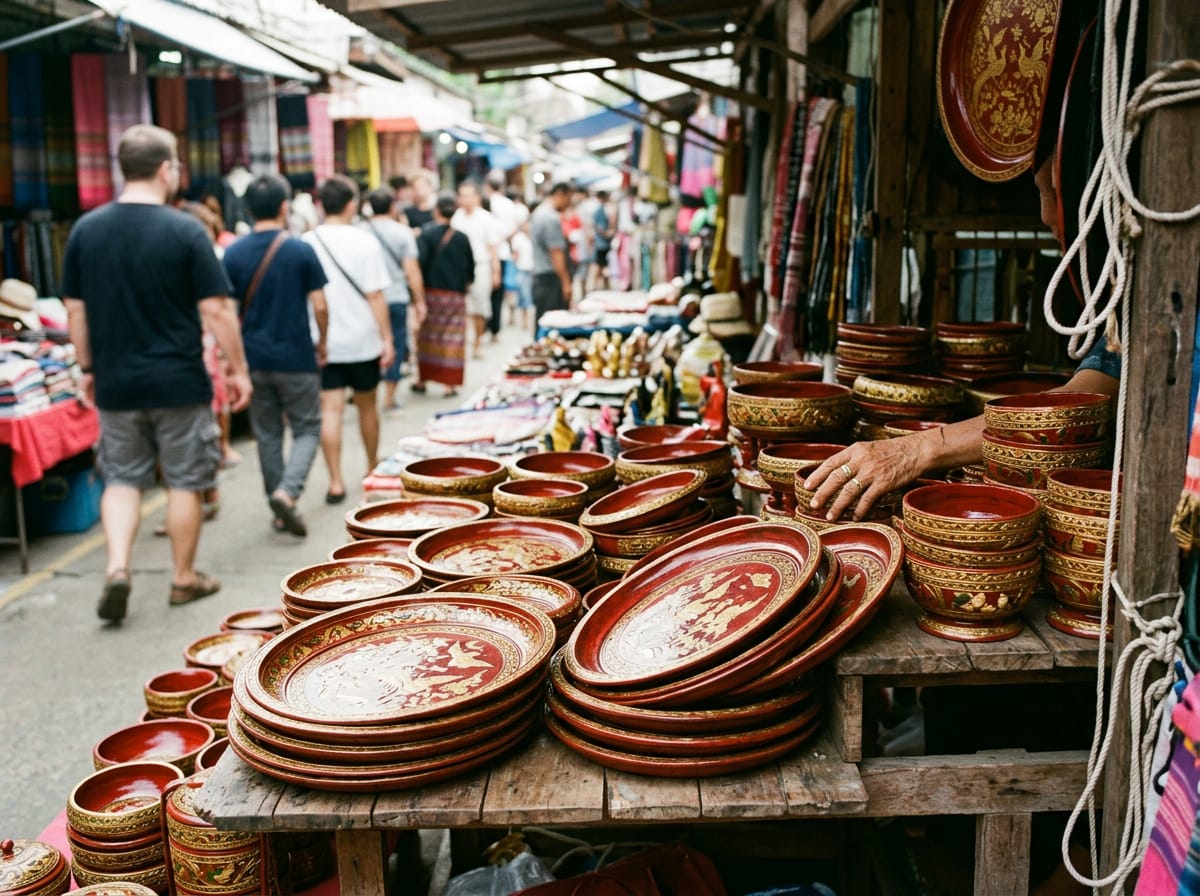
A smaller but consistent category. Lacquerware bowls and trays in the red, black and gold Burmese style cost 200 to 1,500 baht. Bamboo and rattan baskets, Akha and Karen ethnic minority pieces and the celadon ceramics from the nearby San Kamphaeng kilns fill out the smaller-format offer.
Custom commissions
Most workshops accept custom orders for furniture, doors, panels, room dividers and Buddha statues. Lead times are 4 to 8 weeks for standard furniture and 3 to 6 months for major architectural commissions. Deposits are 30 to 50 per cent on order, balance on completion. Bring measurements and reference photographs. The larger workshops have English-speaking sales managers; for the smaller carvers in the back lanes, a Thai-speaking guide is helpful.
Shipping and export
Almost every showroom arranges international shipping. The standard service handles container loading at the village, crating in the workshop’s facility, road haul to Laem Chabang port near Bangkok and onward sea freight. A 20-foot container to Europe or North America costs USD 1,800 to 2,400; a 40-foot container 2,800 to 3,500. Door-to-door takes 4 to 8 weeks. Most exporters carry their own export licence and handle customs and CITES documentation.
How to navigate and best time
Start at the main entrance arch and walk south along the covered street. The retail showrooms are densest in the first 600 metres. Cross to the eastern side at the mid-point and walk back, then divert into the back lanes for the master workshops. The southern end opens onto the architectural and garden pieces; loop back from there. A full lap takes 3 to 4 hours at a steady pace and covers every category.
The best window is weekday mornings, 10:00 to 14:00. The carvers are working, the showrooms are quiet enough for a conversation with the owner and the showroom managers have time to walk you through provenance, wood grade and shipping. Weekends are busier with domestic Thai shoppers, particularly Saturday and Sunday afternoons. The hot months from March to May are uncomfortable from late morning onward because most of the covered street is open-sided; an early start and a midday break are sensible. The cool dry season from November to February is the most pleasant.
A few practical notes. Public toilets cost 5 baht at the main entrance arch, at the centre car park and at the southern end. Three ATMs sit along the main street (Bangkok Bank, Kasikorn Bank, Siam Commercial Bank). Most showrooms take card; the smaller workshops are cash-only. The Ban Tawai tourist office at the main entrance arch carries a free map of the village and can provide an English-speaking guide for 500 baht for a half-day.
Major pieces should not be bought on the first visit. The serious approach is to spend day one walking the village and shortlisting, day two on negotiation, photograph and shipping arrangement. Most exporters quote freely and the asked price for major furniture is the starting point for a 10 to 20 per cent negotiation.
Getting there
From the Old City, the simplest options are the yellow songthaew (shared pickup-truck taxi) and Grab.
A yellow songthaew from the Chiang Mai Gate runs to Hang Dong from 06:00 to 19:00 and costs 50 to 80 baht per person. Ask for Ban Tawai; the driver will drop you at the main entrance arch. The journey takes 30 to 40 minutes outside peak traffic and 50 to 60 minutes during the morning rush. The return songthaew from the village runs until about 18:00; in the evening you may need to walk 2 kilometres back to Route 108 to flag one down.
A Grab or Bolt car costs 200 to 300 baht and takes 25 minutes outside peak traffic. The same operator can collect you for the return trip. Tuk-tuks from the Old City negotiate from 400 baht for the round trip and will wait at the village. The most flexible option for serious shopping is a hire car with driver at 1,500 to 2,000 baht for the day, available through any hotel; the driver helps with translation, stays with the vehicle while you browse and assists with loading any pieces you take with you.
If you are driving yourself, take Route 108 south from the Old City. The Ban Tawai junction is on the western side of the highway, 14 kilometres from Tha Phae Gate, and is signed in English. Free parking is available at the main entrance arch and at three car parks along the central spine. Avoid arriving between 07:30 and 09:00; the morning rush on Route 108 doubles the journey time.
Where to eat and nearby
The village has its own small food court at the main entrance, with northern Thai noodle and rice stalls open 09:00 to 16:00. A row of slower restaurants sits along the southern end of the main street; Khun Tan Restaurant is a reliable lunch stop with traditional Lanna set menus at 200 to 350 baht per person. The Hang Dong town centre, 3 kilometres south, has the main Tesco Lotus, a 7-Eleven and several Thai restaurants. For coffee, the Akha Ama Hang Dong branch (3 kilometres south on Route 108) serves the same single-origin Thai coffees as the Old City branches.
Nearby destinations within a 30-minute drive include the San Kamphaeng craft road and the Bo Sang umbrella village, although a Bo Sang–Ban Tawai combination is a 60-kilometre round trip and best done with a hired car. The Royal Park Rajapruek botanical garden, 5 kilometres east of Ban Tawai on the Mae Hia Road, is a worthwhile add-on; entry is 200 baht.
Tips and etiquette
Bargain modestly on furniture (10 to 20 per cent below the asked price), and on antiques (15 to 25 per cent). Do not bargain on the smaller pieces in the food court or the workshop tip jar. Ask for CITES and export documentation in writing on any major teak purchase. Inspect joinery on antique pieces — modern reproductions are common and not always declared as such. Photograph the piece before payment, and ask for serial numbers or workshop marks. The reputable exporters provide a written guarantee against shipping damage and a clear return policy.
Buddha statues are subject to Thai export controls. Modern reproductions of Buddha images under 10 baht weight can leave the country freely. Antique Buddha images (older than 1928), regardless of size, require a Fine Arts Department export permit; the reputable shops handle this for you, but the process takes 2 to 4 weeks. Do not attempt to export an antique Buddha without the permit; customs at Bangkok airport check carefully.
Related and combine with
The natural craft pairing is the Bo Sang umbrella village and the San Kamphaeng craft road on the northeastern side of Chiang Mai. A hired car for the day can cover both villages, although the round trip is 60 kilometres and a single-village day is more comfortable. For a retail follow-on, the Warorot Market in the Old City carries smaller lacquerware and the kind of teak desk pieces that travel as hand luggage. The Saturday Walking Street on Wua Lai Road, in the silversmith quarter, complements Ban Tawai for a craft-focused weekend.
Photos
Frequently asked questions
Where is Ban Tawai and how far is it from Chiang Mai?
Ban Tawai sits 15 kilometres south of Chiang Mai's Old City in Hang Dong district, on the western side of Route 108. By road from Tha Phae Gate the journey is 17 kilometres, taking 25 minutes outside peak traffic and 40 minutes during the morning rush. The village is reached by turning right (west) off Route 108 at the Ban Tawai junction, then driving 2 kilometres to the main covered handicraft street. The Hang Dong town centre is 3 kilometres further south. Hang Dong serves as the administrative seat of the district and includes the main Tesco Lotus and the Hang Dong fresh market.
What are Ban Tawai opening hours?
Most workshops and showrooms trade 09:00 to 17:00, every day of the year. The main covered handicraft street, known as Ban Tawai Handicraft Centre, runs 09:00 to 17:00. Some of the larger furniture exporters along the village's outer ring keep slightly longer hours, 08:30 to 17:30, and the master carvers in the back lanes start work as early as 07:30. Sundays are quieter on the showroom side but the workshops continue. The village does not close for public holidays. The single annual exception is the morning of Songkran Day One (13 April), when most workshops close until midday for the regional water-bathing ceremonies.
Is there an entry fee at Ban Tawai?
No. The Ban Tawai handicraft area is a public village street with no gate, ticket or barrier. Free parking is available along the main street and at three large car parks at the entrance, the centre and the southern end. The shops themselves are open to browse without obligation. A guided tour of one of the master workshops, where you can watch a piece carved from raw teak through to finished lacquer, can be arranged on the day for a tip of 100 to 200 *baht* per visitor; the larger workshops also accept group bookings through the Hang Dong tourist office.
What can I buy at Ban Tawai?
Carved teak furniture leads the village: dining tables, benches, four-poster beds, opium beds, cabinets, room dividers and the heavy architectural panels used in traditional Lanna and Burmese houses. Hand-carved Buddha statues range from 200 *baht* desk-sized pieces to multi-tonne temple-scale figures. Antiques include Chinese altars, lacquer chests, old Burmese cabinets and teak window frames salvaged from demolished houses. Lacquerware, ceramic, bamboo and rattan, basketry and the smaller decorative pieces fill out the offer. Architectural and garden pieces — stone Buddhas, sandstone reliefs and water features — sit at the southern end of the main street.
Why is Ban Tawai called a royal craft village?
The village's commercial woodcarving trade dates to a 1957 royal initiative under Her Majesty the late Queen Mother Sirikit's SUPPORT Foundation, which encouraged northern Thai villages to consolidate their crafts and develop direct retail and export markets. Ban Tawai's existing woodcarving skills, inherited from the teak-house building tradition of Lanna, made it the natural southern Chiang Mai site for the programme. The Royal Project supplied initial wholesale buyers, then withdrew gradually as the village's own exporters took over. Today around 90 per cent of the village's adult population works in some part of the woodcarving and furniture trade.
Can I have furniture from Ban Tawai shipped overseas?
Yes. Almost every showroom on the main covered street arranges international shipping. The standard handles container loading at the village, crating in the workshop's own facility, road haul to Laem Chabang port near Bangkok and onward sea freight. A 20-foot container to Europe or North America runs USD 1,800 to 2,400; a 40-foot container 2,800 to 3,500. Door-to-door takes 4 to 8 weeks. Most exporters carry their own export licence and handle customs documentation; CITES paperwork for protected woods is included in the quote. Ask for references; the larger exporters have decades-long relationships with European furniture importers and dealers.
Is the teak at Ban Tawai legal and sustainable?
Most of the teak sold today at Ban Tawai is plantation-grown Thai or Burmese teak, or salvaged teak reclaimed from demolished old houses. Both have legal documentation. Old-growth Burmese teak from natural forest, which used to dominate the trade, is now restricted under Thai law and under CITES Appendix II for several related species. Reputable exporters provide certificates of origin and the shipping paperwork to satisfy import inspection in the EU, US, UK and Australia. If you are buying a major piece, ask for the documentation in writing before payment and check the shop's Federation of Thai Industries membership card.
How do I get to Ban Tawai from Chiang Mai Old City?
A yellow *songthaew* from the Chiang Mai Gate runs to Hang Dong from 06:00 to 19:00 and costs 50 to 80 *baht* per person. Ask for Ban Tawai; the driver will drop you at the main entrance arch. The journey takes 30 to 40 minutes. A Grab or Bolt car costs 200 to 300 baht and takes 25 minutes outside peak traffic. Tuk-tuks negotiate from 400 baht for the round trip and will wait. The most flexible option for serious shopping is a hire car with driver at 1,500 to 2,000 baht for the day, available through any hotel; the driver helps with translation and stays with the vehicle while you browse.
How long should I spend at Ban Tawai?
Allow at least two hours for a casual browse of the covered handicraft centre. Three to four hours covers the main street and the side workshops. A full day is needed if you are commissioning furniture, buying a major piece or visiting the master carvers in the back lanes. Most serious buyers come for two consecutive days: day one to walk the village and shortlist showrooms, day two to negotiate, photograph and arrange shipping. Combine the visit with the [Bo Sang umbrella village](/umbrella-village-bo-sang-san-kamphaeng/) for a full craft-village day, though Ban Tawai is southwest and Bo Sang is northeast, so the round trip is roughly 60 kilometres.
Can I commission a custom piece at Ban Tawai?
Yes, and this is one of the village's strongest offers. Most workshops accept custom commissions for furniture, doors, panels, room dividers and Buddha statues. A standard dining table runs 4 to 8 weeks; a major architectural commission (carved wooden gateway, ten-metre panel for a hotel lobby) 3 to 6 months. Deposits are 30 to 50 per cent on order, with the balance on completion. Bring measurements, reference photographs and any technical drawings. The larger workshops have English-speaking sales managers; for the smaller carvers in the back lanes, a Thai-speaking guide is helpful for the design conversation.
Related guides
Market
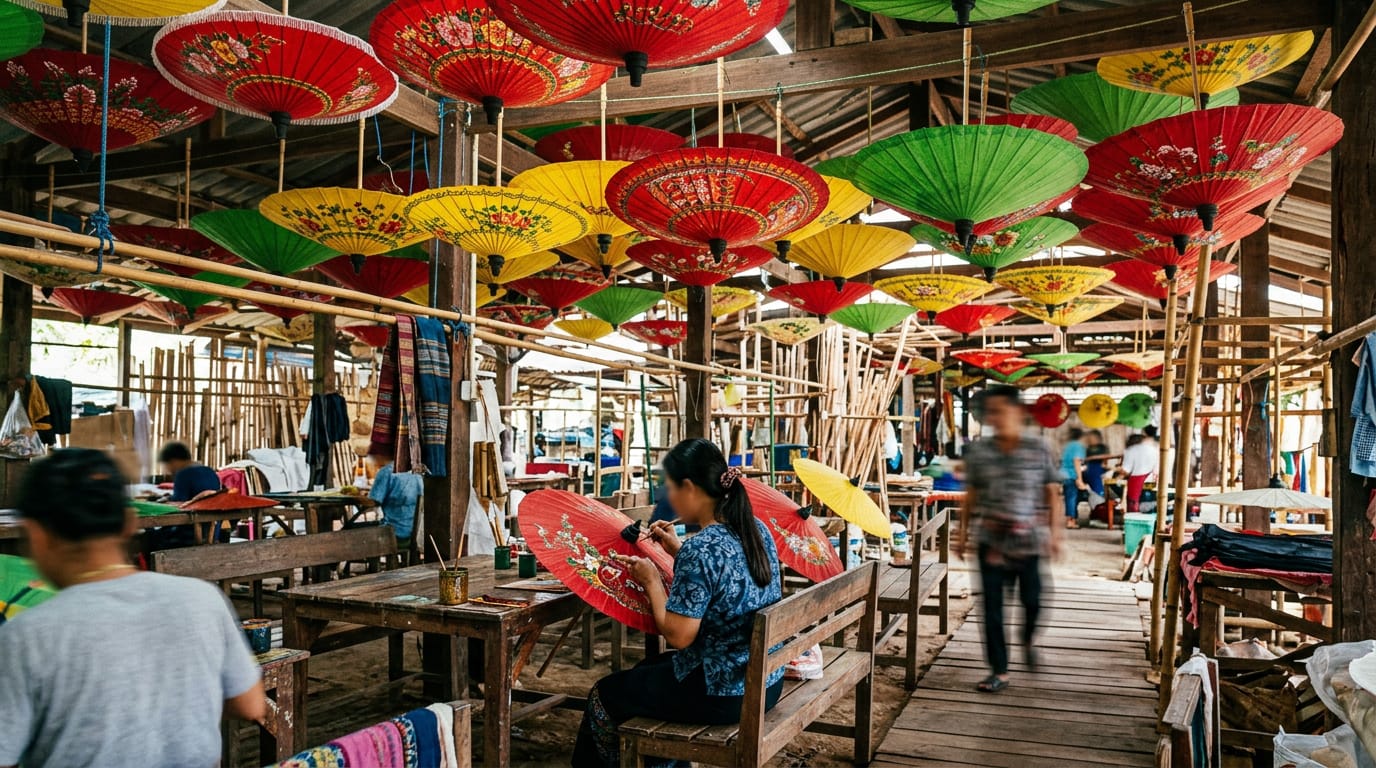
Bo Sang Umbrella Village and the San Kamphaeng Craft Road
Bo Sang Umbrella Village in San Kamphaeng district, 9 kilometres east of Chiang Mai's Old City, is the home of hand-painted rice-paper umbrellas. The Bo Sang Umbrella Festival fills the village every third weekend of January. The wider San Kamphaeng craft road along Route 1006 links workshops for saa paper, silk weaving, lacquerware, celadon ceramics and silver.
Market
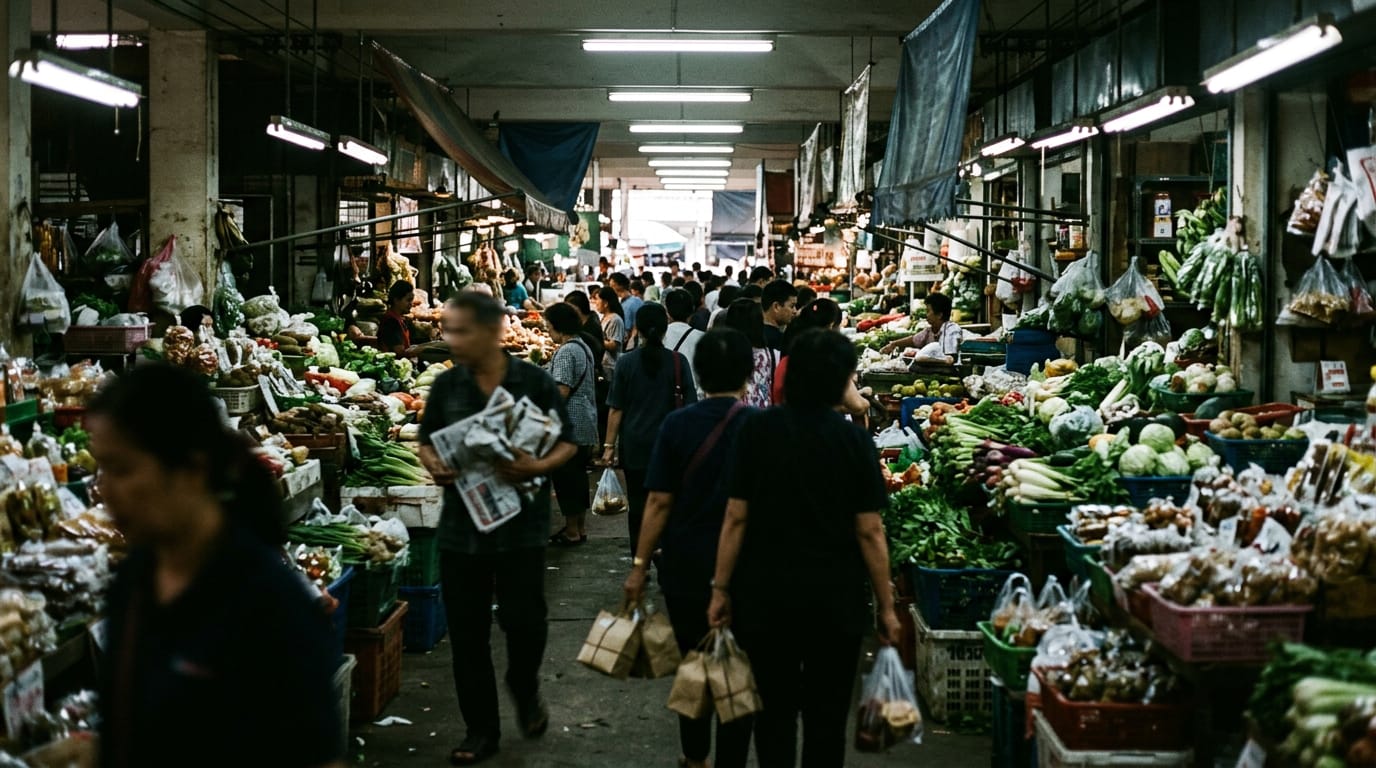
Warorot Market (Kad Luang)
Warorot Market, known locally as Kad Luang, is Chiang Mai's largest and oldest fresh market, set just east of Tha Phae Gate against the Ping River. Three trading floors plus a dense weave of surrounding lanes carry produce, fabric, kitchenware, Chinese pastry, sai oua sausage and the city's most reliable kao soi, with the Flower Market and Talat Ton Lamyai pressed against its northern wall.
Market
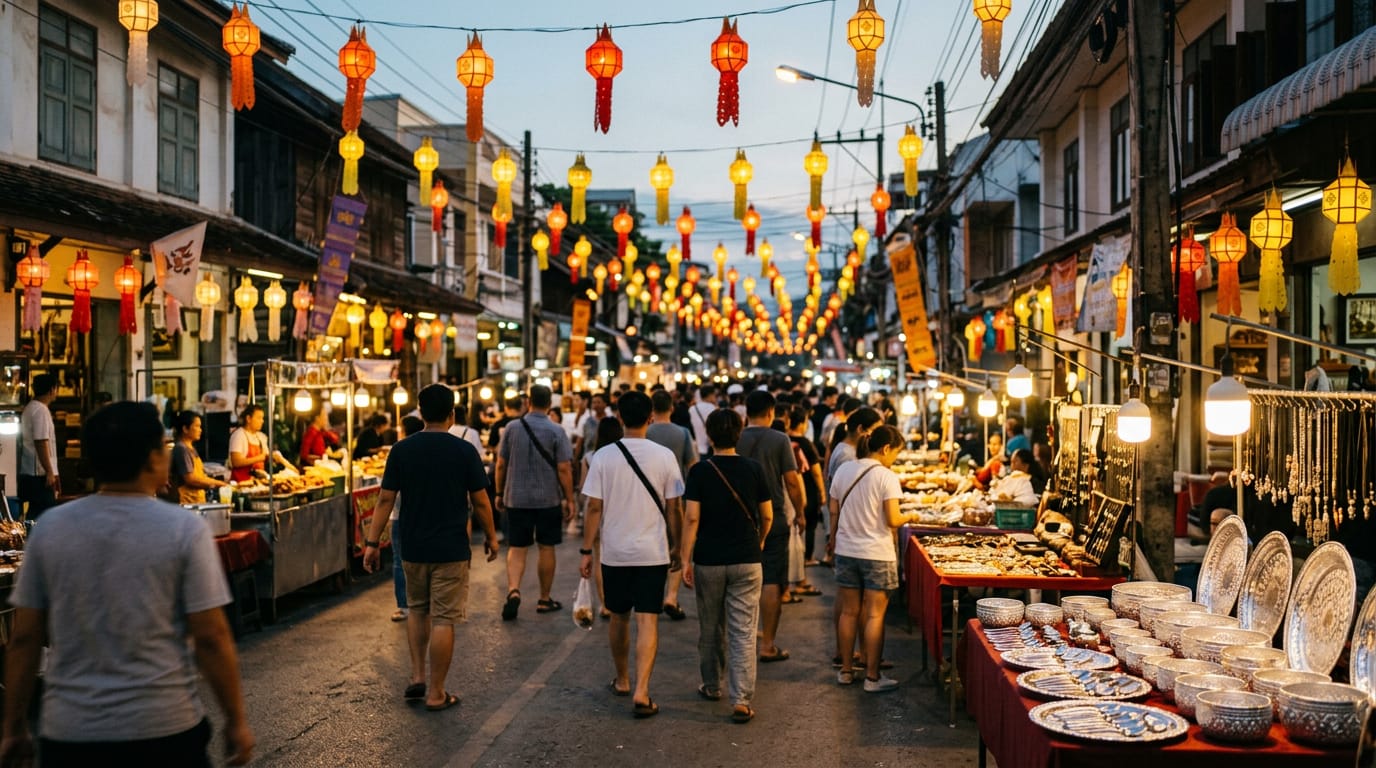
Saturday Walking Street (Wua Lai Road)
Chiang Mai's Saturday Walking Street runs the length of Wua Lai Road, the silversmith quarter immediately south of the Chiang Mai Gate. Open every Saturday from 16:00 to 22:00, it is smaller, more local and more craft-led than its Sunday counterpart, with silverware, lacquerware and Lanna handicrafts beside food stalls and the Songkran procession route on day one of the New Year festival.