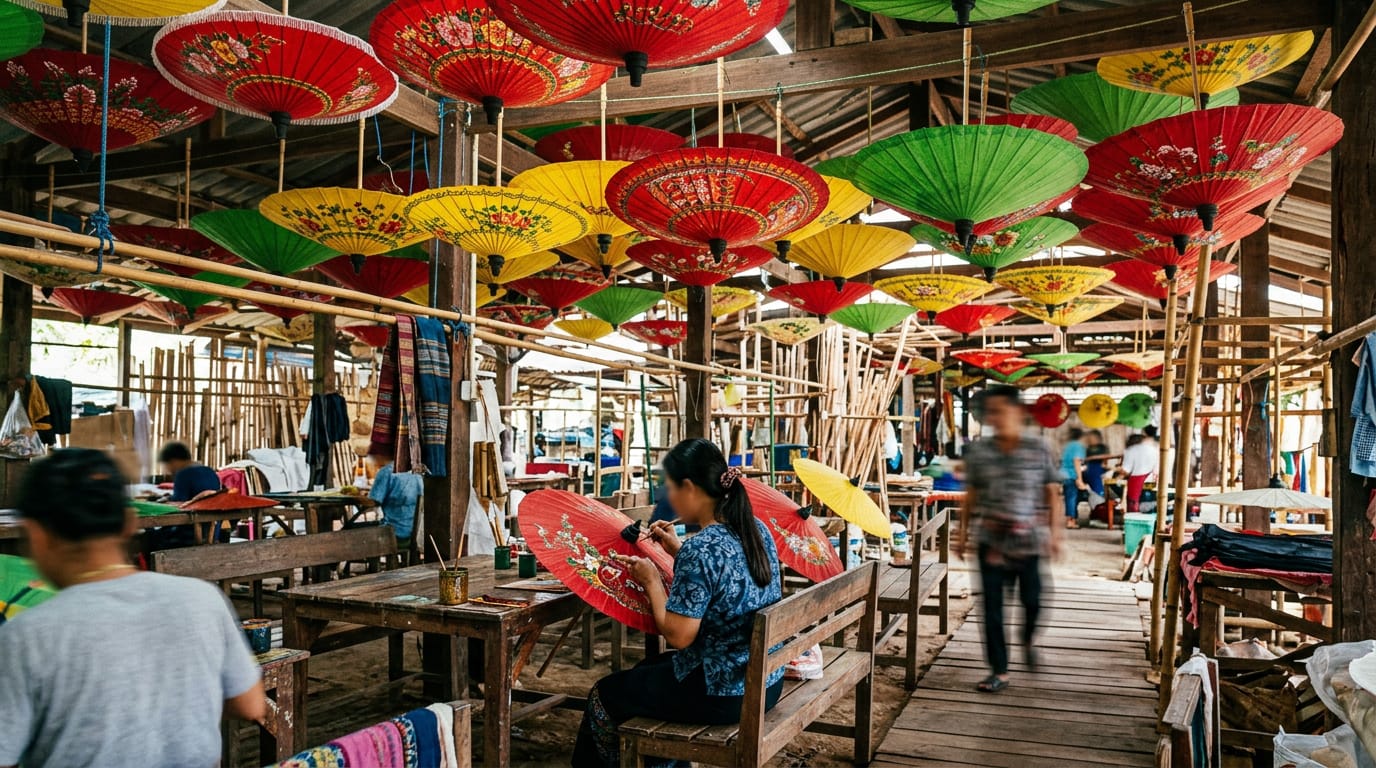
Bo Sang Umbrella Village in San Kamphaeng district, 9 kilometres east of Chiang Mai's Old City, is the home of hand-painted rice-paper umbrellas. The Bo Sang Umbrella Festival fills the village every third weekend of January. The wider San Kamphaeng craft road along Route 1006 links workshops for saa paper, silk weaving, lacquerware, celadon ceramics and silver.
Updated
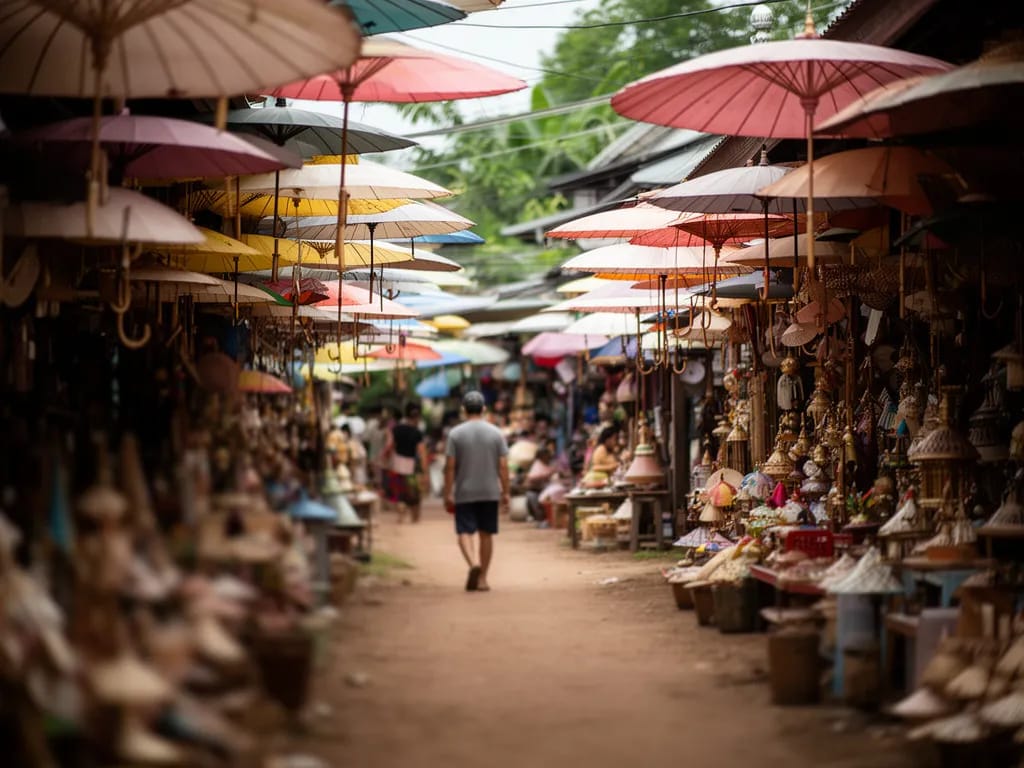
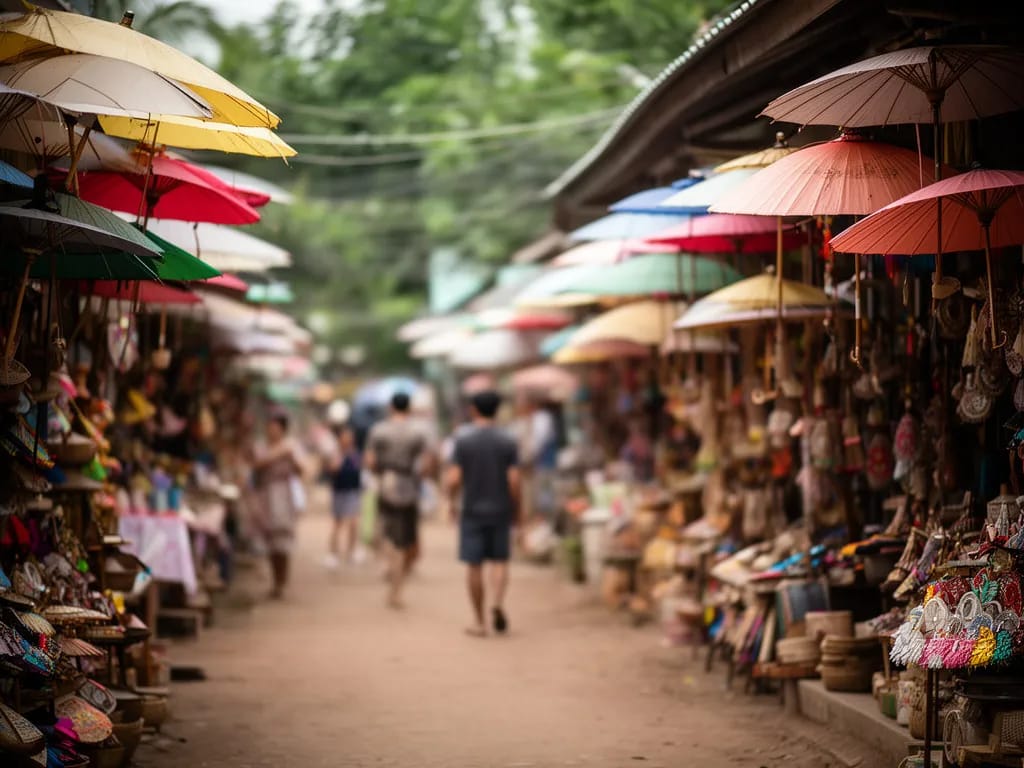
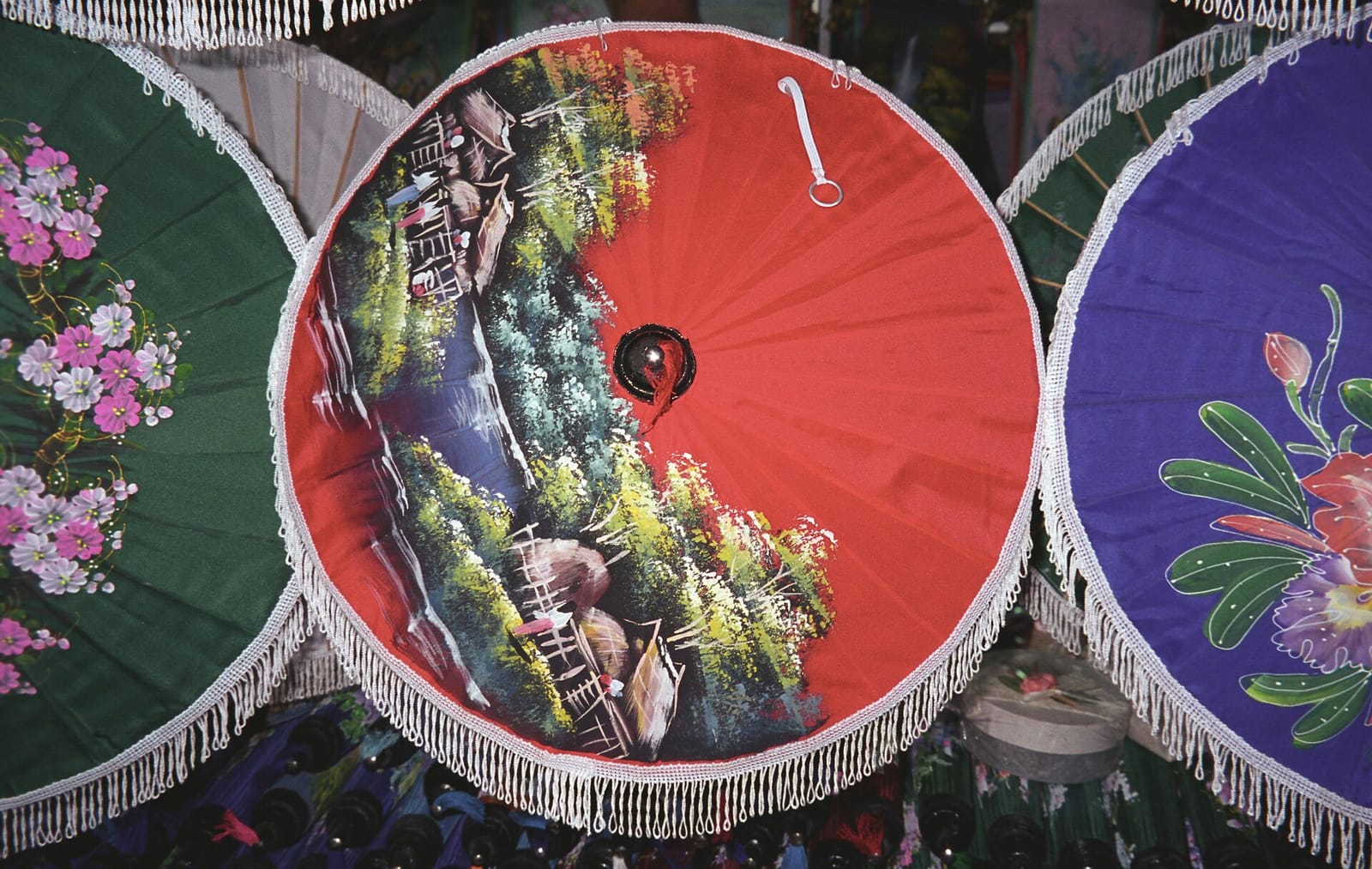
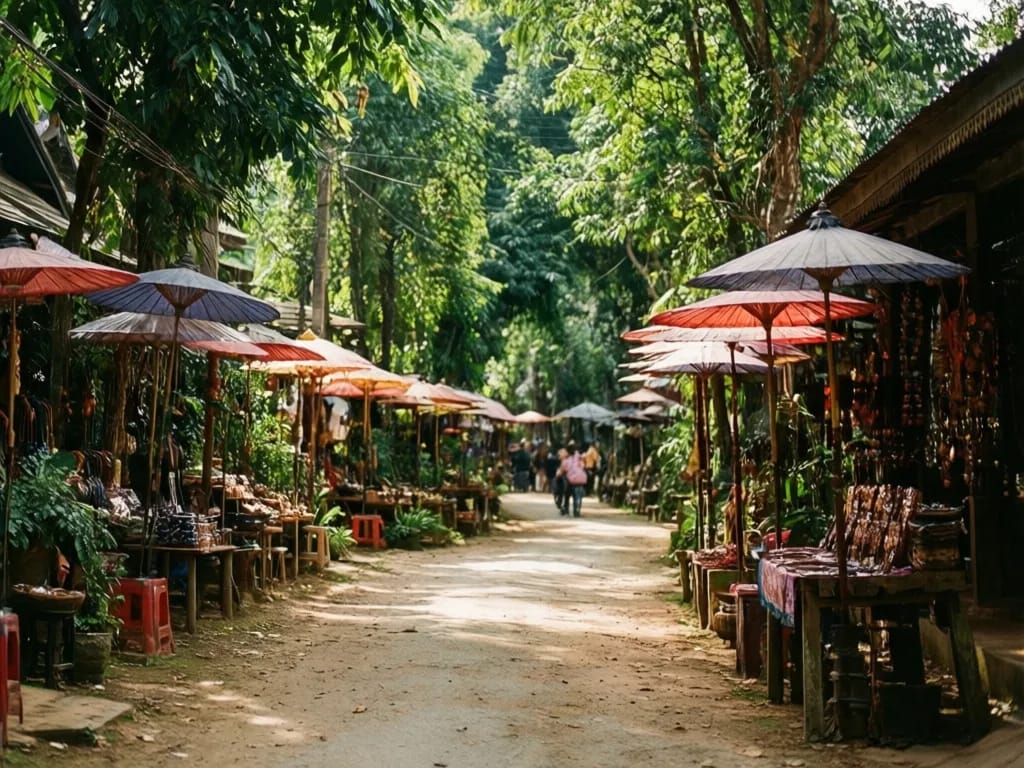
Drive east from the Old City along Route 1006, the road known locally as the San Kamphaeng craft road, and the city thins out gradually. The dense streets end at Sankampaeng Soi 1, the rice fields begin, and brown tourist signs along the verge begin pointing toward the craft villages on either side. Nine kilometres out from Tha Phae Gate, a left turn brings you into Bo Sang. The main street, 600 metres long, is lined with workshops where bamboo frames are built, saa (mulberry-bark) paper is stretched, and the canopies are hand-painted in floral, peacock and Lanna (northern Thai) geometric motifs. By any honest measure Bo Sang is the most photogenic craft village near Chiang Mai. Hold the visit for the third weekend of January and you will catch the annual Umbrella Festival, when the village’s main street fills with parasols in every size from desk to wedding scale.
What it is
Bo Sang Umbrella Village, written บ่อสร้าง in Thai, is a craft village in San Kamphaeng district, 9 kilometres east of Chiang Mai’s Old City. The umbrella-making tradition is documented here from the early 19th century. Local legend credits a Buddhist monk, returning from a pilgrimage to Yunnan, with bringing the craft back to the village; whether or not that history is exact, the technique closely resembles the south-Yunnanese and northern Burmese umbrella traditions, and the village has practised it continuously since.
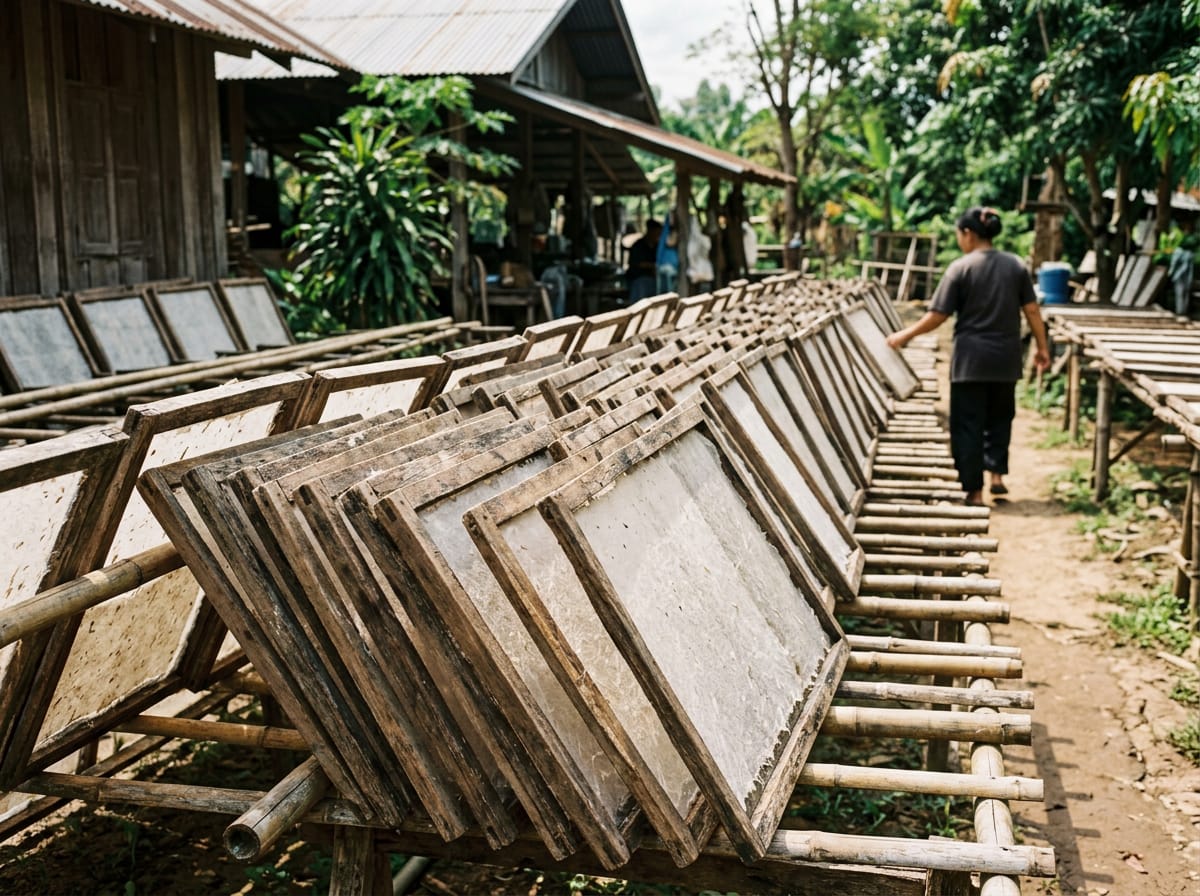
The wider San Kamphaeng craft road, Route 1006 from Chiang Mai’s eastern ring road to the San Kamphaeng town centre, links a sequence of craft villages that have specialised in different crafts since at least the 18th century. The first 5 kilometres after the ring road host saa paper workshops, where the inner bark of the mulberry tree is pulped and hand-formed into the heavy textured paper used at Bo Sang and across northern Thailand. Kilometres 5 to 9 carry the umbrella workshops, with Bo Sang at the centre. Kilometres 9 to 12 are silk-weaving villages; kilometres 12 to 16 lacquerware, celadon ceramics from the San Kamphaeng kilns and silver. The road’s craft density gives the day trip its weight: it is one of the few drives in northern Thailand where you can see five or six distinct crafts produced from raw material to finished piece within a 30-minute stretch.
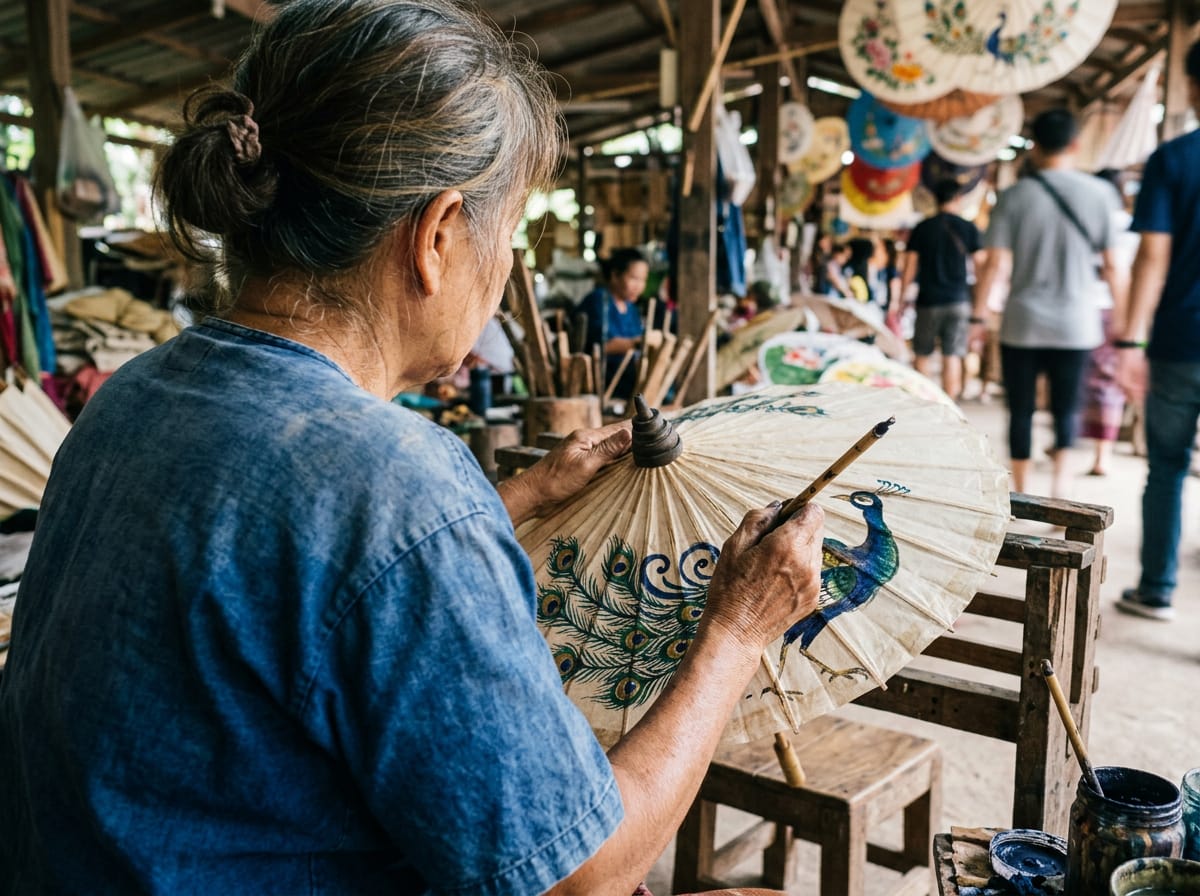
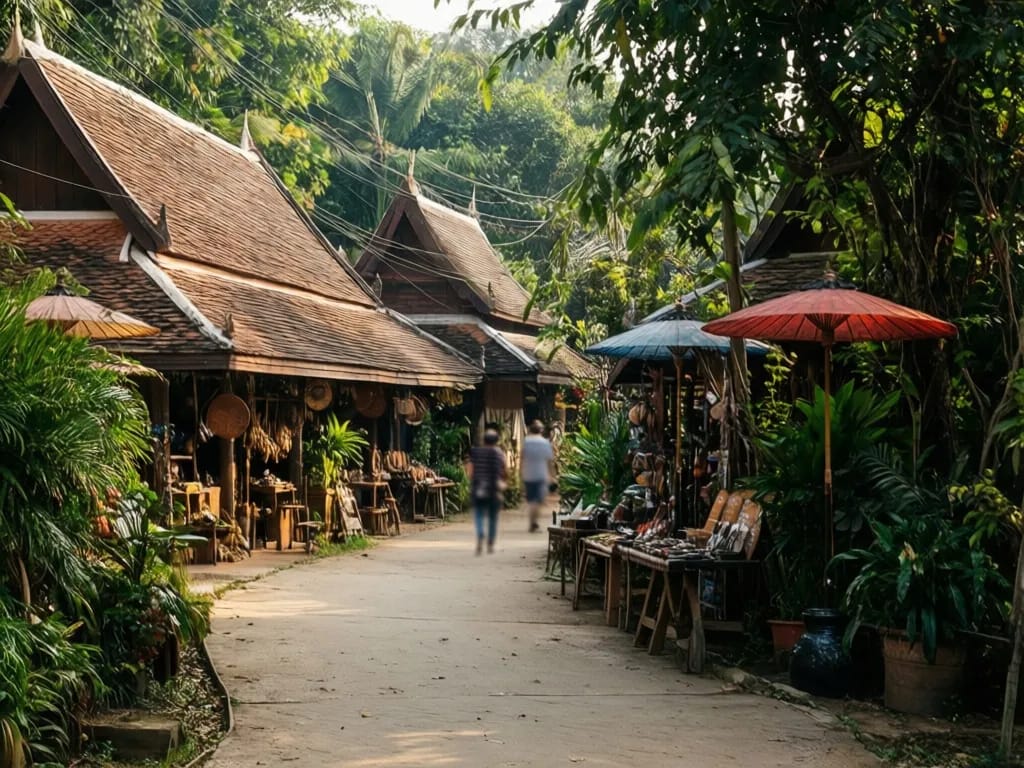
Bo Sang itself has roughly 80 working umbrella workshops, organised into family compounds along the main street and in the back lanes. The trade is dominated by women; the painting and the canopy stretching are traditionally women’s work, while the bamboo frame assembly is more often men’s. The Umbrella Making Centre, near the centre of the main street, is the largest workshop and the easiest visitor entry point.
What you’ll find
Umbrellas account for most of what is sold, in four size tiers, with the paint-your-own sessions and related saa paper crafts alongside.
Small decorative umbrellas
The smallest pieces, with canopies 20 to 40 centimetres in diameter, are made for desktop and shrine use. Prices run 80 to 300 baht. The motifs are usually simple — single flowers, calligraphy characters, geometric Lanna patterns. These are the most-bought pieces by visitors and travel easily in hand luggage. The umbrella folds flat to 5 centimetres at the canopy.
Mid-range hand-painted
The next tier, with canopies 45 to 80 centimetres, includes the most varied painting work. Peacocks, flowering branches, dragons, herons and the classic landscape with Doi Suthep in the background. Prices run 400 to 1,500 baht. Each piece is signed by the artisan in Thai script on the inner canopy.
Large parasols
Canopies 90 centimetres to 1.5 metres in diameter. These are used as parasols, as decorative pieces in hotel lobbies and as wedding props. Prices 1,500 to 4,000 baht. Heavier hand-painted detail, with multiple-coat lacquer finish for durability.
Wedding-scale parasols
Canopies 1.8 to 2.5 metres. Used in northern Thai wedding processions and as architectural pieces in temples and hotels. Prices 4,000 to 8,000 baht. Custom commissions are accepted for larger sizes and unusual motifs; lead times are 4 to 8 weeks. The largest piece ever made at Bo Sang, displayed at the festival, has a canopy of 3.5 metres.
Paint-your-own and workshops
The Umbrella Making Centre runs a paint-your-own experience from 09:00 to 16:00 daily. The smallest piece (a 30-centimetre canopy) costs 200 baht; the artisans help with the brush stroke and suggest motifs. The umbrella dries in 30 minutes and packs flat for travel. Longer paid workshops (1,200 baht for a half-day) cover the full hand-painted process from canvas preparation to finishing.
Related craft at the village
Beyond umbrellas, Bo Sang’s workshops sell saa paper notebooks, hand-bound diaries, paper lanterns in white and red, and the smaller decorative crafts that share materials with the umbrellas. The village’s tea house, at the southern end of the main street, sells northern Thai tea in saa paper-wrapped gift boxes.
How to navigate and best time
The village’s main street is short — 600 metres — and easily walked in either direction. The Umbrella Making Centre at the centre is the easiest visitor entry point; the smaller family workshops along the back lanes are more authentic but require a willingness to negotiate language. A full lap of the village takes 90 minutes; allow 2 to 3 hours with the paint-your-own experience.
The single best time to visit is the Bo Sang Umbrella Festival on the third weekend of January. The 2027 festival runs Friday 15 to Sunday 17 January. The Friday opens at 08:00 with a market and craft demonstrations. The Saturday’s principal parade leaves the village square at 10:00 with women in full Lanna dress carrying decorated parasols along Sankamphaeng Road; the parade returns by 12:30. The Saturday evening hosts the light-and-sound show at the village square from 19:30, with the main street lit by hand-made paper lanterns. Sunday closes with the Miss Bo Sang Umbrella beauty pageant in the afternoon. The festival draws crowds of 15,000 to 25,000 over the three days.
Outside the festival, the best window is weekday mornings, 09:00 to 12:00. The artisans are working, the showrooms are quiet enough for conversation and the sun has not yet reached the main street’s hot afternoon angle. Weekends are busier with domestic Thai shoppers. The hot months from March to May are uncomfortable after 11:00 because the main street is partly open; an early start is sensible. The cool dry season from November to February is the most pleasant.
The wider craft road can be made into a half-day or full-day trip from Bo Sang. A half-day adds the silk weaving villages on the eastern side, returning to the city by midafternoon. A full day starts at the saa paper workshops on the western side, takes lunch at Bo Sang and continues east through silk, lacquerware and the celadon kilns. The order matters; the morning light is better for the western paper workshops and the afternoon light for the silk weaving showrooms on the east.
A few practical notes. Public toilets are at the Umbrella Making Centre and at the village square. There are two ATMs on the main street. Most workshops take cash; the larger showrooms also accept card. Free parking is available behind the Umbrella Making Centre and along the main street; a small lot at the village square fills by 10:00 on festival weekends.
Getting there
A white songthaew (shared pickup-truck taxi) runs from Praisani Road on the eastern side of Warorot Market to Bo Sang and San Kamphaeng. The fare is 30 baht per person, the journey takes 25 to 35 minutes and departures run every 15 to 20 minutes from 06:00 to 18:00. Ask for Bo Sang. The driver will drop you at the main street entrance arch. The return runs until about 18:00; outside those hours a songthaew on the main San Kamphaeng road can usually be flagged down within 10 minutes.
A Grab or Bolt car costs 150 to 200 baht and takes 20 minutes outside peak traffic. The same operator can collect you for the return. Tuk-tuks negotiate from 300 baht for a one-way trip and from 600 baht for a round trip with waiting. For the wider craft road, the most flexible option is a hire car with driver at 1,500 to 2,000 baht for a full day; the driver helps with translation and stays with the vehicle while you browse.
If you are driving yourself, take Route 1006 east from Chiang Mai’s eastern ring road. Bo Sang is signed in English at 11 kilometres. Free parking is available at the village. Avoid arriving between 07:30 and 09:00; the morning rush on the eastern ring road doubles the journey time.
Where to eat and nearby
The village’s main street has two slow restaurants serving traditional northern Thai food: Bo Sang Kitchen, near the Umbrella Making Centre, with set menus at 200 to 350 baht per person; and the Tea House at the southern end, with simple noodle and rice dishes at 60 to 100 baht. A small food court at the village square runs noodle and stir-fry stalls 09:00 to 16:00 with main courses 40 to 80 baht. For coffee, the Akha Ama Bo Sang branch on the corner of the main street and Route 1006 serves the same single-origin Thai coffees as the Old City branches.
Beyond the village, the San Kamphaeng town centre 4 kilometres east has the larger Tesco Lotus, several Thai restaurants and the well-known Khao Soi Mae Manee, open 08:00 to 16:00 daily, with a 60-baht bowl of the city’s signature northern noodle. The San Kamphaeng hot springs, 16 kilometres further east on Route 1006, make a useful afternoon add-on; entry 100 baht.
Tips and etiquette
Bargain modestly on umbrellas (10 to 15 per cent below the asked price). Do not bargain on workshop demonstrations or on the paint-your-own experience. Carry cash in small notes for the smaller workshops; PromptPay is widespread but not universal. Ask before photographing close-up portraits — the Thai phrase tai roop dai mai (may I take a photo?) is sufficient. Tips of 20 to 50 baht to the artisan demonstrating a craft are appreciated but not expected. During the Umbrella Festival, the main street becomes a parade route; do not stand in the road once the parade has started, and follow stewards’ direction at the principal crossings.
Related and combine with
The natural wider-craft pairing is the San Kamphaeng road’s silk weaving and ceramic villages on the way back to the city. For a different craft register, Ban Tawai sits 25 kilometres south and is the woodcarving and teak-furniture village; the two are best as separate day trips. The Saturday Walking Street on Wua Lai Road in the silversmith quarter sells smaller versions of Bo Sang umbrellas and the same saa paper notebooks at a modest markup. Warorot Market carries the umbrellas in its second-floor souvenir row at a 20 to 30 per cent markup over Bo Sang prices. For festival-season visitors, the Bo Sang Umbrella Festival takes over the village’s central road on the third weekend of January; confirm exact dates against the TAT events calendar before planning a trip around it.
Photos
Frequently asked questions
Where is the Bo Sang Umbrella Village?
Bo Sang sits 9 kilometres east of Chiang Mai's Old City, in San Kamphaeng district. By road from Tha Phae Gate it is 11 kilometres along Route 1006 (the San Kamphaeng craft road), which heads east from the city's eastern ring road. The village's main street, Sankamphaeng Road, runs north of Route 1006 and is signed in English. The wider San Kamphaeng craft road continues a further 4 kilometres east through the silk weaving and lacquerware villages to the San Kamphaeng town centre.
What are Bo Sang opening hours?
Most workshops and showrooms in Bo Sang trade 08:00 to 17:00 every day of the year. The main umbrella-making workshop, the Umbrella Making Centre, runs demonstrations from 08:30 to 16:30 and accepts visitors without booking. The village's smaller family workshops keep slightly variable hours but are generally open 09:00 to 16:00. During the Bo Sang Umbrella Festival on the third weekend of January, the entire village's hours extend to 08:00 to 22:00, with the main street closed to traffic in the evening for the festival market.
When is the Bo Sang Umbrella Festival?
The Bo Sang Umbrella Festival runs every year on the third weekend of January. The 2027 festival is scheduled for Friday 15 to Sunday 17 January. The festival is a three-day craft fair, parade and cultural showcase. The Friday opens with a market and craft demonstrations. The Saturday hosts the principal parade, with women in Lanna dress carrying decorated parasols along Sankamphaeng Road from 10:00, and the evening light-and-sound show at the village square from 19:30. Sunday closes with a beauty pageant and the Miss Bo Sang Umbrella crowning.
What is special about Bo Sang umbrellas?
Bo Sang umbrellas are hand-made from *saa* paper (mulberry paper), stretched over a bamboo frame, with the canopy hand-painted in floral or animal motifs. The craft is documented in Bo Sang from the early 19th century and was originally introduced from Yunnan by a Buddhist monk. The umbrellas are sized from 30 centimetres in canopy diameter to a 2.5-metre wedding-scale parasol. The smaller decorative umbrellas cost 100 to 300 *baht*; the mid-range hand-painted pieces 400 to 1,500; the wedding-scale parasols 3,000 to 8,000. Each is signed by the artisan.
What is saa paper?
*Saa paper* is the traditional northern Thai paper made from the inner bark of the mulberry tree, hand-formed in shallow trays and dried in the sun. The paper is heavy, slightly fibrous and durable enough to use as a structural canopy on an umbrella. It is also used for notebooks, lanterns, scrolls, calligraphy and the lampshades that have become a signature export of northern Thailand. Workshops along Route 1006 between Chiang Mai and Bo Sang carry out the full production cycle from raw mulberry bark to finished paper. The bigger paper mills at the village of San Sai also welcome visitors and run free demonstrations.
What can I see along the San Kamphaeng craft road?
The 16-kilometre Route 1006 from Chiang Mai's eastern ring road to the San Kamphaeng town centre passes a working sequence of craft villages. The first 5 kilometres are *saa* paper workshops; kilometres 5 to 9 lead into Bo Sang and the umbrella workshops; kilometres 9 to 12 are silk weaving villages, with working looms at the larger showrooms; kilometres 12 to 16 carry lacquerware, celadon ceramics from the San Kamphaeng kilns and silver. The full road can be driven in 35 minutes without stops or made into a full-day craft tour with workshop visits.
Are workshop demonstrations free?
Yes. The major workshops on the Bo Sang main street and along Route 1006 run free demonstrations during their normal trading hours. The Umbrella Making Centre at Bo Sang has dedicated demonstration tables where visitors can watch each stage of production — bamboo frame assembly, *saa* paper stretching, painting and finishing. The silk weaving workshops near Sankampaeng town have working looms in the showroom and the weavers welcome questions. Buying is not required to watch. Small tips (20 to 50 *baht*) to the demonstrating artisan are appreciated but not expected.
Can I paint my own umbrella at Bo Sang?
Yes. The Umbrella Making Centre runs a paint-your-own-umbrella experience on demand, from 09:00 to 16:00. The smallest size (a 30-centimetre canopy) costs 200 *baht* including paint and brushes; the artisans help with the brush stroke and can suggest motifs. A 45-centimetre canopy costs 350 baht. Larger sizes are available by booking ahead. The painted umbrella can be packed flat for travel and dries in 30 minutes. The Centre also runs longer paid workshops (1,200 baht for a half-day) where you can complete a full hand-painted piece under instruction.
How do I get to Bo Sang from the Old City?
A white *songthaew* runs from the eastern side of the Warorot Market on Praisani Road to Bo Sang and San Kamphaeng. The fare is 30 *baht* per person and the journey takes 25 to 35 minutes. The *songthaew* runs from 06:00 to 18:00 with departures every 15 to 20 minutes. Ask for Bo Sang or San Kamphaeng. A Grab or Bolt car costs 150 to 200 baht and takes 20 minutes outside peak traffic. Tuk-tuks negotiate from 300 baht for a one-way trip. Hire a car with driver for 1,500 to 2,000 baht for a full day on the craft road; this is the best option if you plan to stop at multiple villages.
How long should I spend at Bo Sang and the craft road?
Allow 2 to 3 hours for Bo Sang itself, which covers the Umbrella Making Centre, the main street workshops and a stop to paint a small umbrella. A full day, 6 to 8 hours, is needed to do the wider San Kamphaeng craft road properly: *saa* paper workshops on the way out, Bo Sang at the centre, silk weaving and lacquerware on the way home. During the Bo Sang Umbrella Festival on the third weekend of January, plan for a full afternoon and evening to cover the parade, the workshops and the evening light-and-sound show at the village square.
Related guides
Market
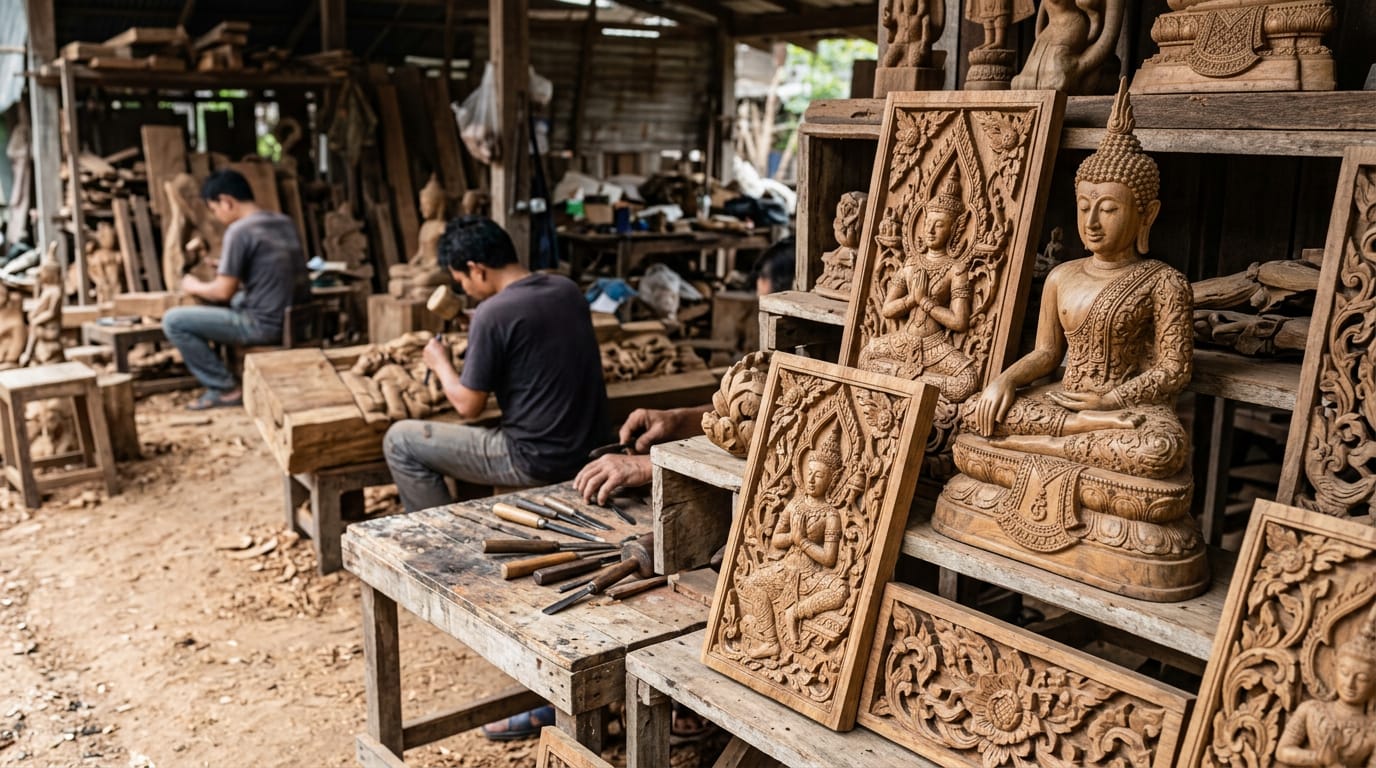
Ban Tawai Woodcarving Village
Ban Tawai is the woodcarving village 15 kilometres south of Chiang Mai's Old City in Hang Dong district. Five hundred-plus workshops and showrooms sell teak furniture, hand-carved Buddha statues, antiques, lacquerware and architectural pieces along a kilometre-long covered street. The trade dates to a 1957 royal craft initiative and remains the principal wholesale source for the city's furniture exporters.
Market
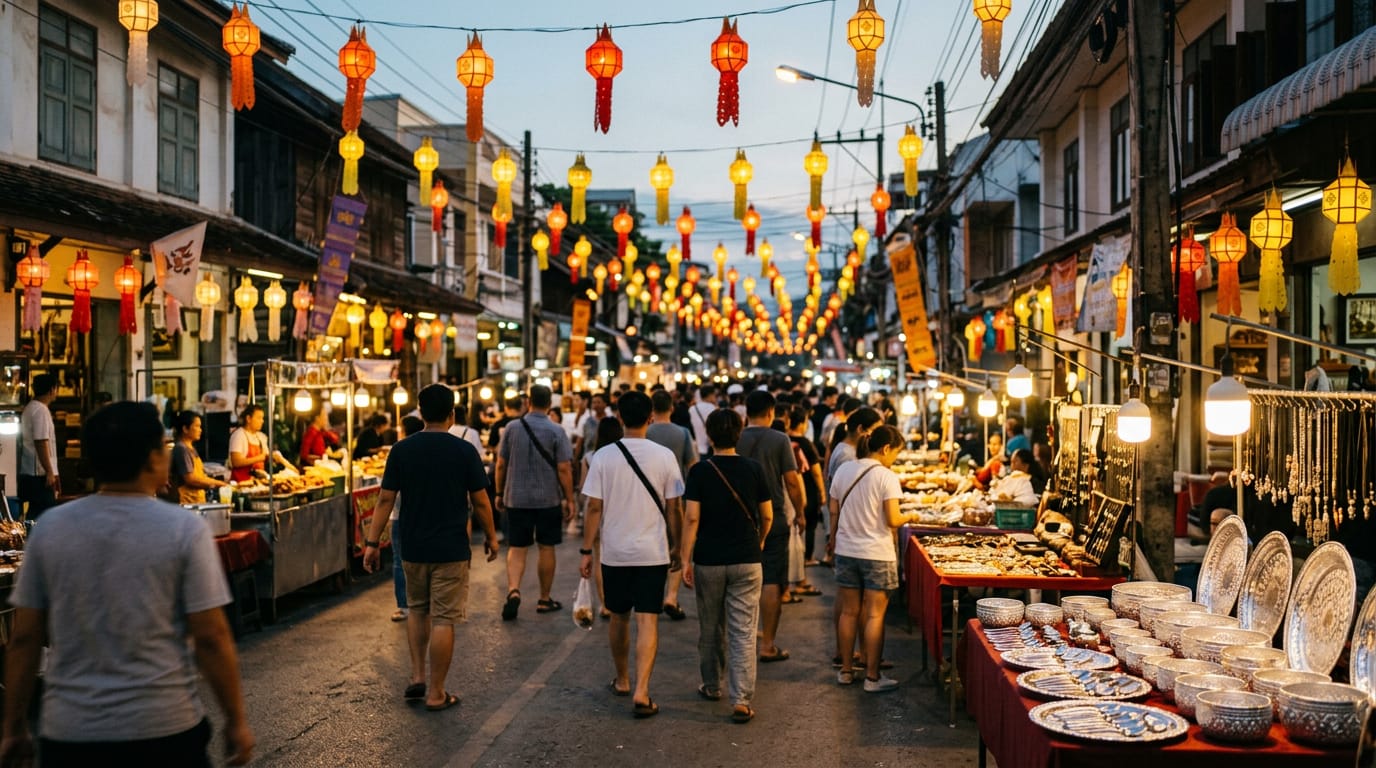
Saturday Walking Street (Wua Lai Road)
Chiang Mai's Saturday Walking Street runs the length of Wua Lai Road, the silversmith quarter immediately south of the Chiang Mai Gate. Open every Saturday from 16:00 to 22:00, it is smaller, more local and more craft-led than its Sunday counterpart, with silverware, lacquerware and Lanna handicrafts beside food stalls and the Songkran procession route on day one of the New Year festival.
Market
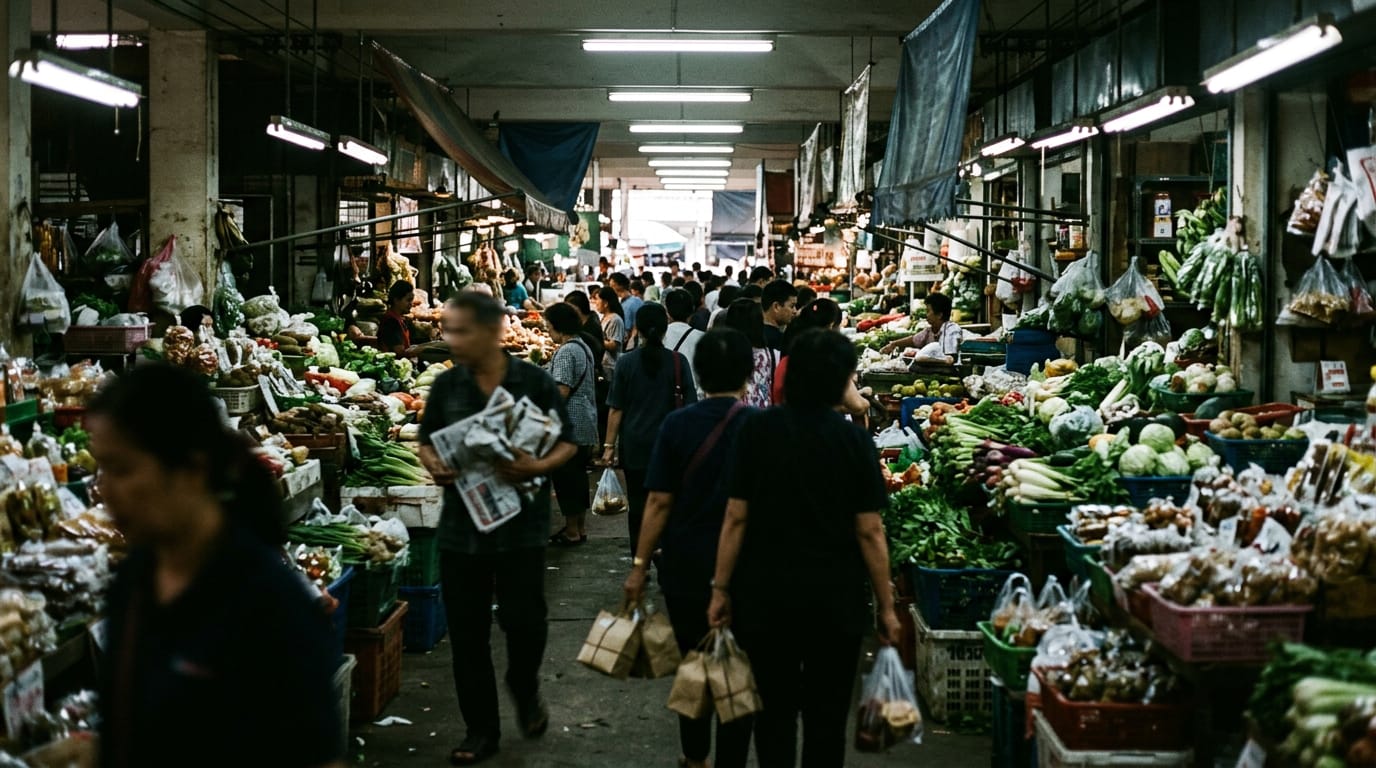
Warorot Market (Kad Luang)
Warorot Market, known locally as Kad Luang, is Chiang Mai's largest and oldest fresh market, set just east of Tha Phae Gate against the Ping River. Three trading floors plus a dense weave of surrounding lanes carry produce, fabric, kitchenware, Chinese pastry, sai oua sausage and the city's most reliable kao soi, with the Flower Market and Talat Ton Lamyai pressed against its northern wall.