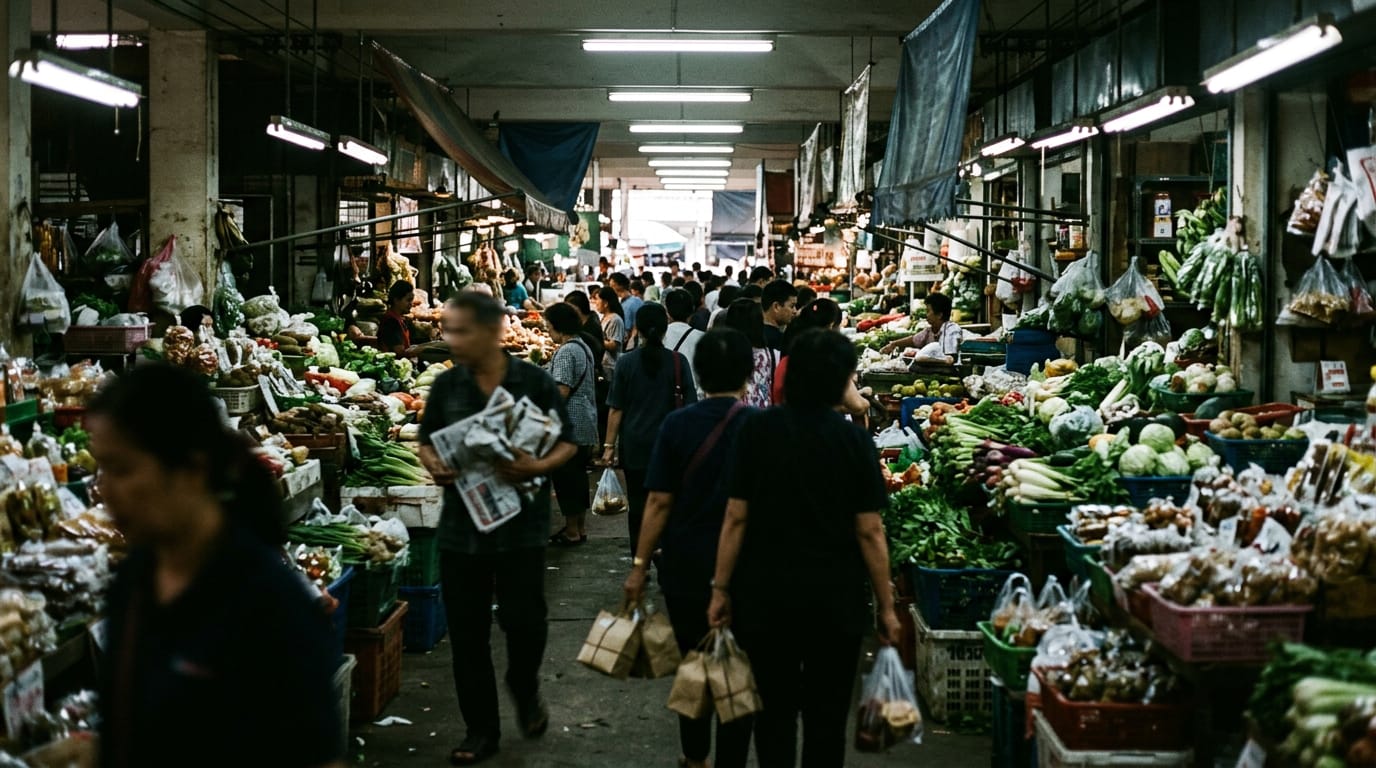
Warorot Market, known locally as Kad Luang, is Chiang Mai's largest and oldest fresh market, set just east of Tha Phae Gate against the Ping River. Three trading floors plus a dense weave of surrounding lanes carry produce, fabric, kitchenware, Chinese pastry, sai oua sausage and the city's most reliable kao soi, with the Flower Market and Talat Ton Lamyai pressed against its northern wall.
Updated
Warorot Market is the working heart of old Chiang Mai. Most visitors meet it for the first time at street level, threading between motorbike sidecars on Wichayanon Road, and then stepping through one of the side doors into a three-storey hall that smells, at any hour of the day, of dried chilli, fermented soy bean and lemongrass. To the people who shop here daily it is simply Kad Luang. The word kad is northern Thai for market; luang carries the sense of great, principal or royal. The name has stuck since the original wooden hall was put up under Princess Dara Rasmi’s household in 1910 to formalise the trade that had grown along the Ping River bank, and it has held that title through fire, flood and rebuild.
What it is
Warorot is the city’s main fresh market, the principal cloth and uniform wholesaler, and the largest single hub for northern Thai food in Chiang Mai. The current concrete hall, completed in 1959 and partly rebuilt after a 2005 fire, contains roughly six hundred indoor stalls across three floors. A further dense ring of outdoor trade fills the lanes on every side, blurring the line between the market proper and the surrounding Chang Moi quarter. The complex shares its northern wall with Talat Ton Lamyai, the dried-fruit and provisions hall named after a long-vanished roadside longan tree, and its eastern wall with the Chiang Mai Flower Market on Praisani Road. Most locals treat all three as a single market, and they trade as one.
The market sits in Chang Moi sub-district, a short walk east of Tha Phae Gate and a block back from the Ping River. The Iron Bridge (Saphan Lek) crosses the river immediately to the east, putting the riverside cafés of Charoenrat Road within five minutes’ walking distance. The post office, which lent its name (Praisani means post in Thai) to the adjoining road, sits one block south.
What you’ll find
Warorot rewards a slow lap. The trading is dense, the boundaries between floors and lanes are loose, and the same stallholder often deals in three or four lines of stock at once. The summary that follows is the rough map most regular shoppers carry in their heads.
Ground floor — fresh
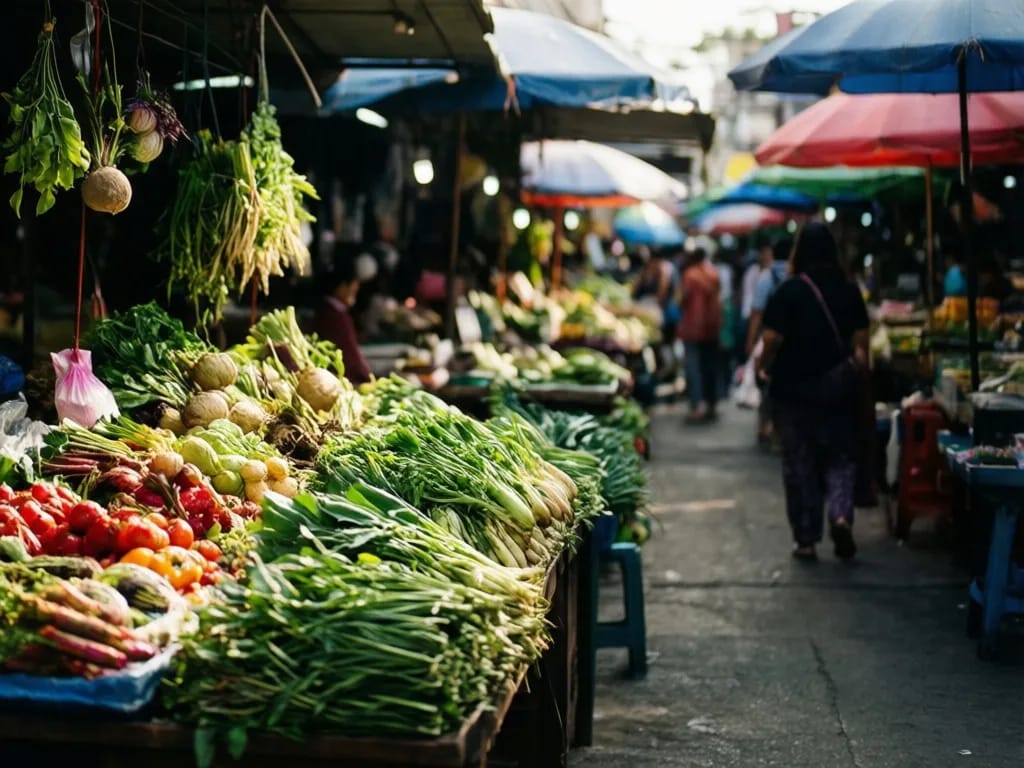
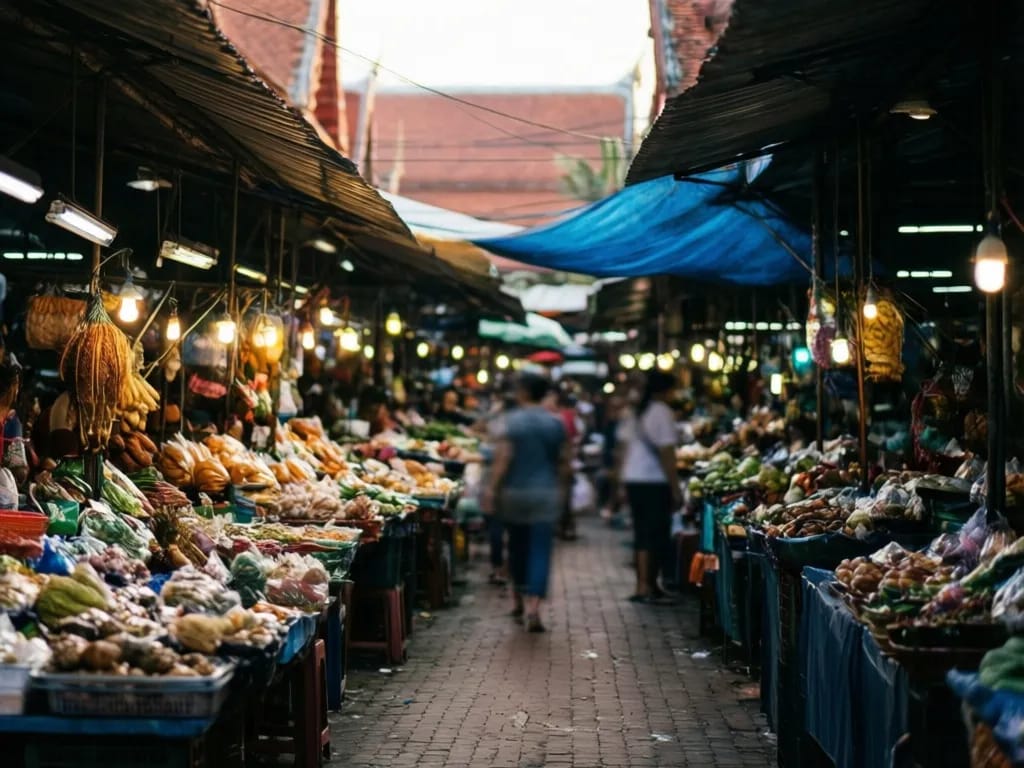
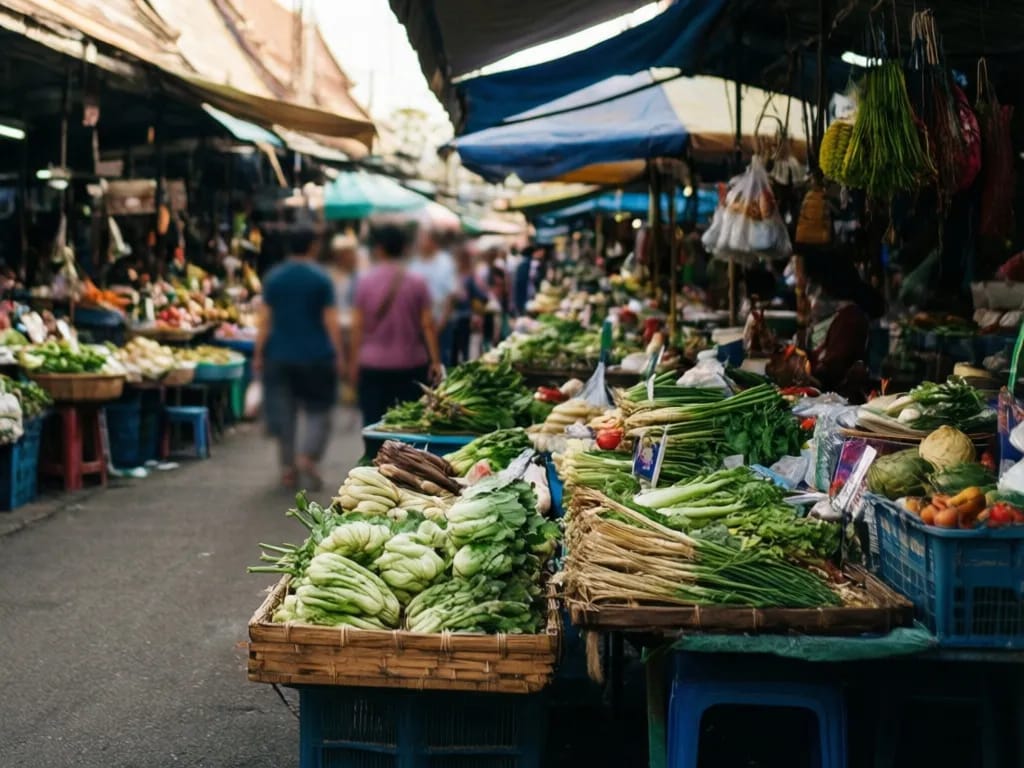
The ground floor is the fresh market. Produce dominates the southern half — bunches of holy basil, kaffir lime leaf, lemongrass, galangal, banana flowers, mangoes piled in graded heaps, green papaya, jackfruit and the seasonal northern specials of Siamese tulip flower and bamboo shoots. The northern half handles meat and fish: pork, chicken, river fish from the Ping and Mekong, freshwater prawns and the small pan-fried trays of mackerel. The eastern wall is a row of dried-goods stalls — sun-dried chillies, fish sauce by the litre, fermented soy bean (tua nao) pressed into discs and the dark, almost-black shrimp paste (kapi) sold by the spoon.
Along the southern edge, a row of Chinese-Thai bakery counters carries the city’s best concentration of Teochew pastry: kanom pia (mung-bean cakes), salapao (steamed buns), Chinese mooncakes around the autumn festival, and the soft yellow custard tarts sold from 06:00. Two of the counters, Yim Yim and the unnamed one beside the southern stairs, have been there since the 1960s.
First floor — fabric
The first floor is fabric and ready-to-wear. Northern Thai cotton in checked and indigo patterns, Burmese longyis brought across from Mae Sai, school uniforms in their distinctive shades, sportswear, ready-made monk’s robes in safflower orange, lengths of synthetic silk for the city’s tailors, and the long aisles of factory-made trousers and shirts that supply most of the working population of greater Chiang Mai. This floor is where the city does its serious clothes shopping. Tourists are welcome but not catered to; prices are written, fixed, and roughly 30 to 50 per cent below the Sunday Walking Street markup on equivalent goods.
Second floor — kitchenware, dry goods, herbal medicine
The second floor is the broadest in scope. Kitchenware fills the western half — woks, terracotta sticky-rice steamers, mortars carved from granite, charcoal grills, papaya-salad pestles. The northern half holds dried goods in volumes a household can use: rice in sacks, dried mushrooms, sweet preserved tangerine, dried-shrimp powder. The eastern strip is herbal medicine, a remnant of the older Chinese pharmacy trade that once defined this district: small wooden drawers of dried roots, jars of pickled deer antler, packets of pre-mixed cold remedies and the old Hokkien apothecaries still on hand to advise. The southern strip carries religious supplies for temple offerings: saffron candles, incense, the small folded gold leaf used at every Buddha image, ceremonial candles, monks’ alms bowls.
Outside — street food, surrounding lanes
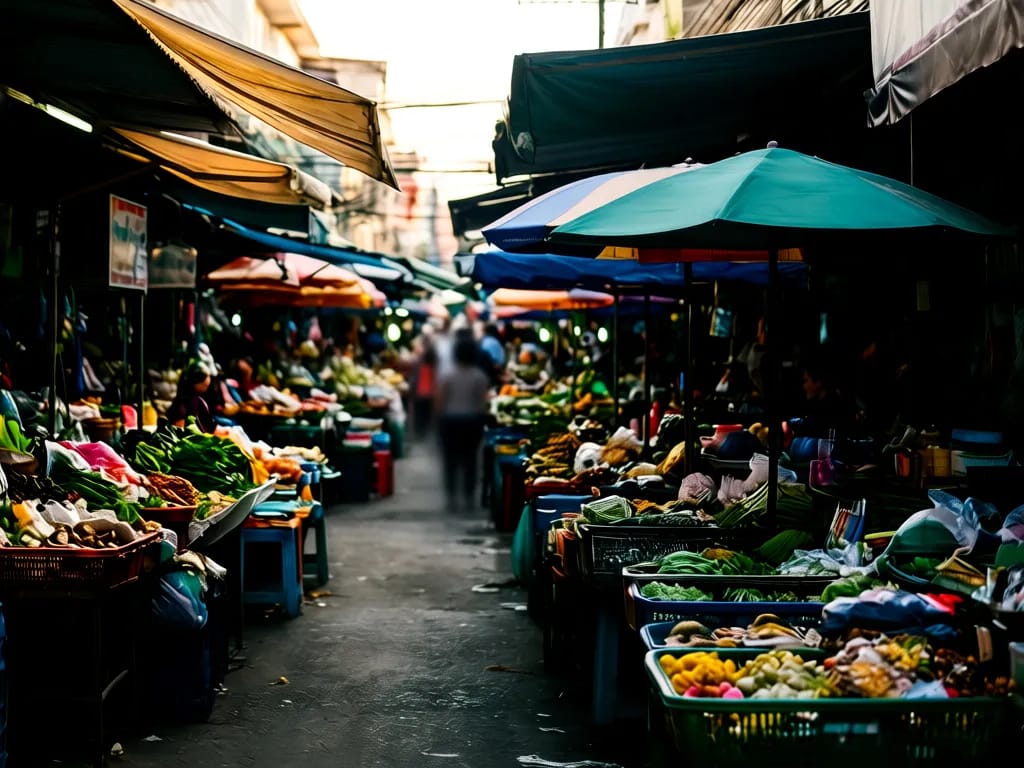
The lanes outside are where most visitors end up spending the longest. The eastern wall, facing Praisani Road, is a row of charcoal stalls grilling sai oua (herb-and-pork northern sausage) coils, dry-fried pork rinds and the sticky-rice baskets to go with them. The southern lane between Warorot and Chang Moi Road carries the three reliable kao soi (curry noodle soup) stalls, Khao Soi Lung Prakit the most consistent, along with kanom jeen noodle stalls, a stall for the sour bamboo-shoot soup (kang som mai phai) and two old-school iced-coffee carts. The northern lane opens directly onto the Flower Market and the Praisani Road wholesale strip, with the riverside cafés of Charoenrat Road a single bridge crossing away.
How to navigate and best time
The market has four entrances, one on each side. Most visitors come in from the south, off Chang Moi Road, because that is where the songthaew (shared pickup-truck) taxis and tuk-tuks naturally drop. From there the cleanest route is up the southern stairs to the first-floor fabric hall, across to the eastern stairs down to the ground-floor fresh market, out the eastern door to the sai oua row on Praisani Road, then north along Praisani into the Flower Market and Talat Ton Lamyai. That single loop covers the market in 90 minutes without doubling back.
If you have only 30 minutes, walk the ground floor west to east, exit on Praisani, eat a sai oua coil, and leave through the Flower Market end. If you have a full half-day, add the second floor, the surrounding lanes and a slow breakfast at one of the kao soi stalls.
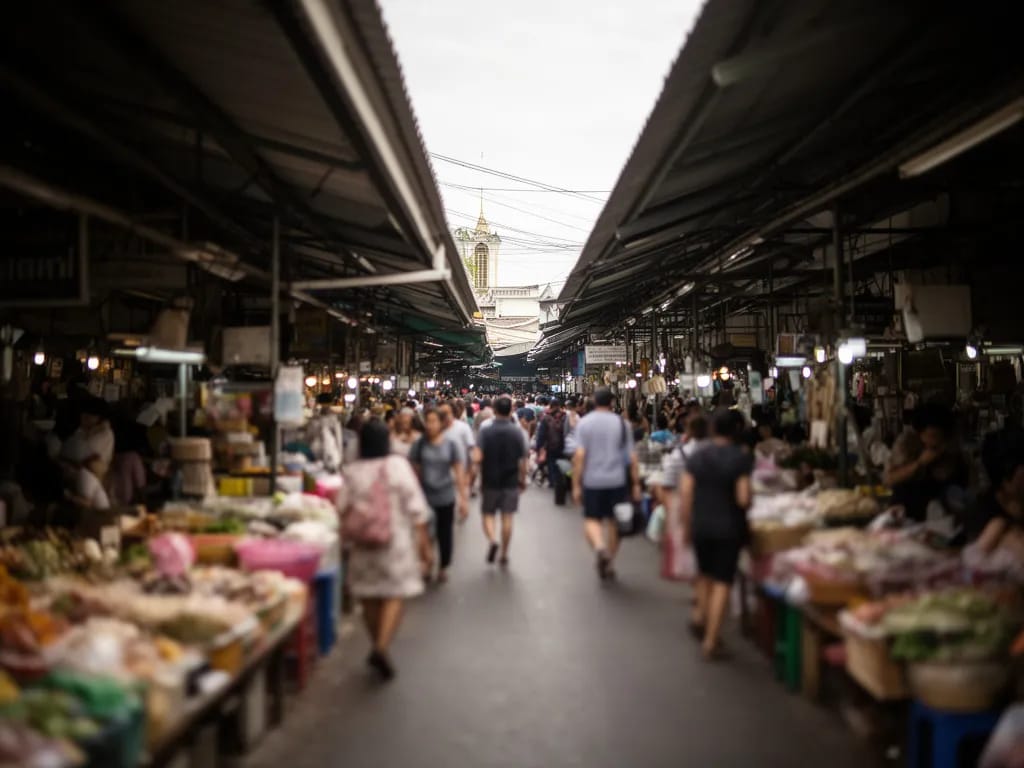
The market’s rhythm changes through the day. The wholesale produce flurry runs 04:00 to 07:00; this is the moment to come if you want to see the city’s restaurant buyers at work, but you will be in the way if you are only browsing. From 07:00 to 10:00 the ground floor is at its most photogenic — full stock, working garland makers next door at the Flower Market, and the bakery counters at peak output. The middle of the day, between 11:00 and 14:00, is the slowest stretch and a good window for a quiet visit to the fabric and kitchenware floors. From 15:00 onward the outdoor lanes pick up again as the afternoon street-food vendors set out, peaking 16:00 to 18:00 with the after-work commuter trade.
Tuesday to Thursday are the calmest weekdays. Sunday morning is the busiest non-festival day; the Sunday Walking Street vendors stock here from 04:00 to 06:00. The single busiest week is the run-up to Chinese New Year (late January or early February), when the bakery counters double their output and the Teochew families along Wichayanon Road decorate the lane with red lanterns. The other peak is the three days before the Chiang Mai Flower Festival in mid-February, when the wholesale strip on Praisani Road runs almost without interruption.
A few practical notes. Public toilets are on the ground floor near the southern entrance and cost 5 baht. There are two ATMs and a Bangkok Bank currency-exchange booth on the Wichayanon Road frontage. The market has no air conditioning beyond the bakery counters; in the hot months between March and May the interior holds heat into the late afternoon, so morning visits are kinder.
Getting there
From Tha Phae Gate, the simplest approach is on foot. Walk east along Tha Pae Road for about 850 metres, past Wat Saen Fang and Wat Bupparam, to the post office. Turn left onto Praisani Road and you are immediately at the Flower Market end of Warorot. The walk takes 10 to 12 minutes and is flat the whole way.
A red songthaew shared taxi from anywhere inside the Old City costs 30 baht per person. Ask for Kad Luang or Talat Warorot; both names are universally understood. The driver will drop you on Chang Moi Road, at the southern entrance. Tuk-tuks negotiate from 100 baht for the same route, more after dark or in rain. Grab and Bolt cars charge 50 to 80 baht and pick up at the kerb on Wichayanon Road.
By bicycle the ride from the Old City is six minutes and flat. The market has a free outdoor bicycle rack on Wichayanon Road, opposite the western entrance. Avoid driving a private car; parking is limited to a small lot at the northern end of Praisani Road that charges 40 baht per hour and fills by 08:00.
The closest river crossings are the Iron Bridge (Saphan Lek), one block east, and Nawarat Bridge, three blocks south. Both put you on Charoenrat Road and the riverside hotel strip within five minutes’ walk. Chiang Mai International Airport is 6 kilometres south-west; a metered taxi to Warorot costs around 150 baht and takes 20 minutes outside peak traffic.
Where to eat and nearby
The kao soi lane on the southern wall is the single best place in central Chiang Mai for a 60-baht bowl of the city’s signature noodle. Khao Soi Lung Prakit and Khao Soi Mae Sai are the two consistently good options. For sai oua, the Damrong Sai Ua stall on the eastern wall has been there for forty years and grills coils fresh from 09:00. For breakfast pastry, the southern bakery counters open at 06:00 with steamed buns, custard tarts and the warm soy milk that locals drink with them.
Beyond the market, the riverside strip across the Iron Bridge holds Woo Cafe and Brown Sugar for slower coffee. Wat Saen Fang’s Burmese-style chedi is a five-minute walk west on Tha Pae Road. Wat Ket Karam, on the eastern bank of the Ping River, sits ten minutes’ walk east and houses one of the city’s smaller community museums.
Tips and etiquette
A few small courtesies make the visit better. Step aside when you hear a motorbike-sidecar horn behind you — these are working delivery vehicles, not tourist obstacles. Bargaining is not standard practice on the produce or food floors; the asked price is the price. Fabric and kitchenware allow modest negotiation, typically 10 to 15 per cent below the sticker. Carry cash in small notes; many older stalls do not take card or PromptPay, and the change for a 1,000-baht note can take five minutes to assemble. Ask before photographing close-up portraits — the Thai phrase tai roop dai mai (may I take a photo?) is sufficient and almost always answered with a smile. Do not photograph inside the bakery preparation areas; this is the one place the older families consistently mind. Drones are not flown over the market.
Related and combine with
The natural pairing is the Flower Market, which shares a wall with Warorot and is best visited on the same trip. From Warorot, a 15-minute walk west along Tha Pae Road brings you to Tha Phae Gate and the start of the Sunday Walking Street on Ratchadamnoen Road, in season from 16:00. For handicraft, the Saturday Street Market on Wua Lai Road is the smaller, more local-feeling counterpart south of the Old City; the silver temple sits on the same road. For carved wood and teak furniture, Ban Tawai is 15 kilometres south and reached by songthaew. For umbrellas and rice-paper craft, the Bo Sang Umbrella Village lies 9 kilometres east along the San Kamphaeng craft road.
Photos
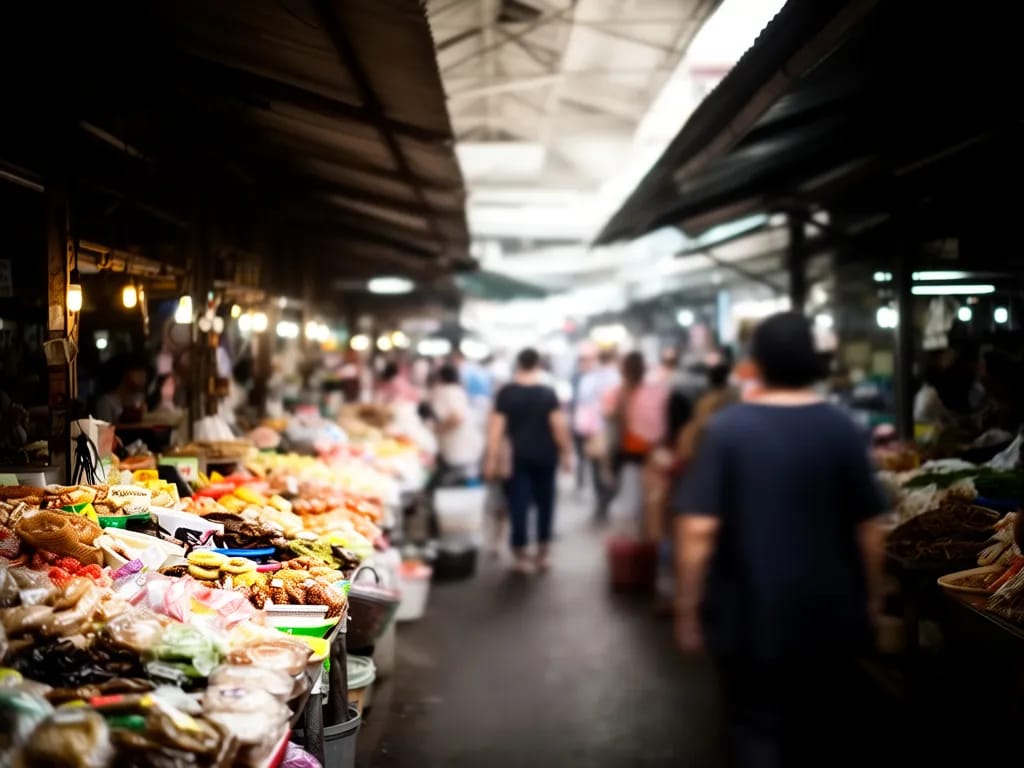
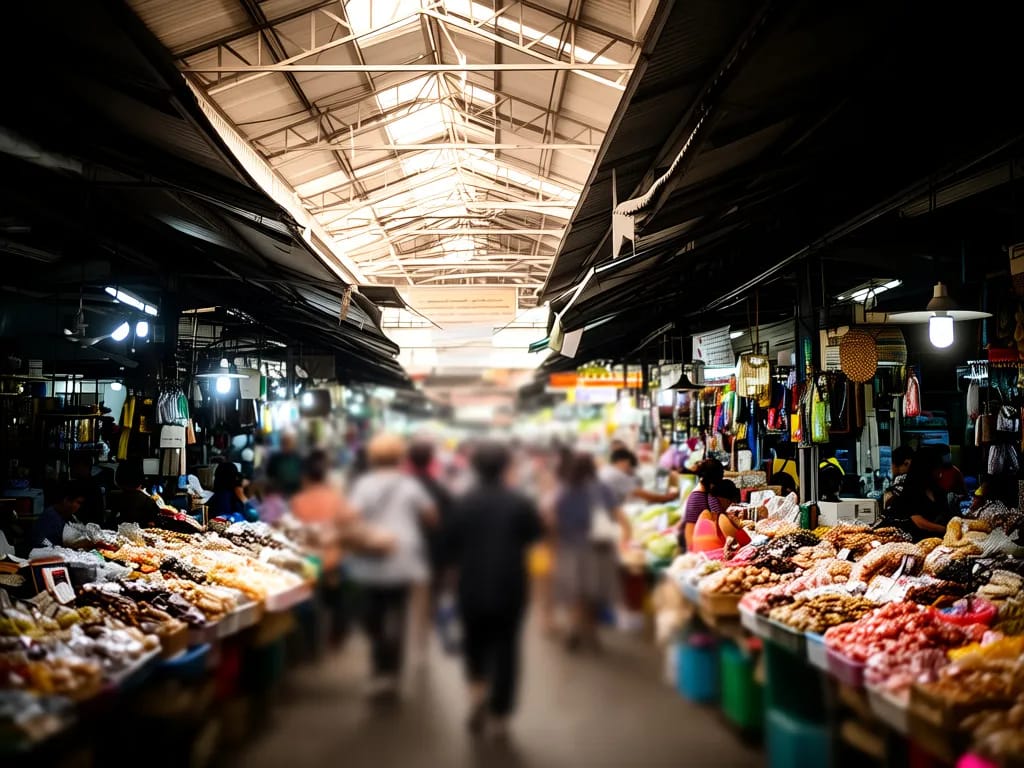
Frequently asked questions
What is Warorot Market and why is it called Kad Luang?
Warorot Market is the largest indoor fresh market in Chiang Mai, occupying a three-storey concrete hall on Wichayanon Road and spilling into the lanes around it. Locals almost always call it Kad Luang — *kad* is the northern Thai word for market and luang means great or principal, so the name reads as Great Market. It has held that title since the original wooden structure was put up by Princess Dara Rasmi's household in 1910 to formalise the trade that had already grown along the Ping River bank. The current concrete building dates to 1959 and was rebuilt after a partial 2005 fire.
What are Warorot Market opening hours?
Outdoor stalls along Wichayanon Road, Praisani Road and the Chinese-Thai bakery lane trade from roughly 04:00. The wholesale produce flurry runs to about 07:00. Interior shops on the ground, first and second floors open from 06:00 and most close by 17:00. The surrounding street-food strip on Chang Moi Road runs until about 18:00, with a smaller cluster of sai oua and rice-cake vendors trading later. The market does not close for public holidays; only a thin Chinese New Year slowdown affects the older Teochew bakeries for a day or two.
Is there an entry fee at Warorot?
No. Warorot Market is a public market with no gate, ticket or barrier. You walk in from any of the four sides — Wichayanon Road on the west, Chang Moi Road on the south, Praisani Road on the east and the small lane shared with the Flower Market on the north. Public toilets on the ground floor cost 5 *baht*. There is no parking inside; motorbike sidecars use the kerb on Wichayanon and tuk-tuks queue on Chang Moi.
What can I buy on each floor of Warorot Market?
The ground floor is the fresh market: produce, fish, pork, chicken, dried chillies, fermented bean pastes and the Chinese-Thai bakery counters along the southern edge. The first floor is fabric and ready-to-wear — Lanna cotton, Burmese longyis, school uniforms, sportswear and bolts of synthetic silk for tailors. The second floor is kitchenware, dried goods, tea, herbal medicine and a small section of religious supplies for temple offerings. Souvenirs and lower-tier handicraft sit in a thin retail ring along Wichayanon Road outside the building.
Where do I get the best kao soi near Warorot?
The lane between Warorot's southern wall and Chang Moi Road has three reliable *kao soi* stalls; Khao Soi Lung Prakit, on the corner with Praisani Road, is the most consistent and runs 09:00 to 14:00 for 60 baht a bowl. A short walk west on Tha Pae Road brings you to Khao Soi Mae Sai, also good. For an after-market dinner version, the Khao Soi Khun Yai stall opens at 17:00 on Chang Moi Kao, two blocks south. All three serve the northern Thai coconut-curry noodle with chicken or beef, crispy noodle topping, pickled cabbage, lime and shallots.
Where can I buy sai oua sausage at Warorot?
*Sai oua*, the herb-and-pork northern Thai sausage, is sold at a row of charcoal stalls along the eastern wall of Warorot, facing Praisani Road. Damrong Sai Ua and the unnamed stall directly opposite have been there for decades. A 200-gram coil costs around 80 to 100 baht; sticky rice and chilli paste are sold next to it. The sausage is grilled fresh from 09:00 and best eaten warm within an hour. Vacuum-sealed packs for travel are available at the Chiang Mai Sai Ua counter inside Talat Ton Lamyai.
What is Talat Ton Lamyai and how does it relate to Warorot?
Talat Ton Lamyai is the dried-fruit and Chinese provisions hall that sits inside the northern half of the Warorot complex, sharing a roof and an entrance. The name means under the longan tree and refers to the original 19th-century trading spot beside a roadside longan. Inside you will find dried longan, sun-dried mango, candied pomelo, mulberry, Chinese sausage, dried squid, pickled plums and shelves of loose tea. Locals treat Ton Lamyai and Warorot as one market; visitors should walk through both.
How do I get to Warorot Market from the Old City?
From Tha Phae Gate, walk east along Tha Pae Road for about 850 metres until you reach the post office, then turn left at Praisani Road. Walking takes 10 to 12 minutes. A red *songthaew* shared taxi costs 30 *baht* per person from anywhere in the Old City — ask for Kad Luang or Talat Warorot, both names are universally understood. A bicycle ride is flat and takes 6 minutes. Grab cars charge 50 to 80 baht. Tuk-tuks negotiate from 100 baht. Avoid driving a car; parking is limited and the surrounding lanes are slow.
Is Warorot Market a good place to buy souvenirs?
Yes, with the qualification that it is built primarily for locals, not tourists. The fabric floor sells northern Thai cotton, indigo-dyed Akha shoulder bags and Lanna patterned skirts at honest prices — typically 30 to 50 per cent below the Sunday Walking Street markup. The ground-floor bakery counters carry the easiest take-home gifts: Chinese pastries, kao soi paste, *sai oua* in vacuum packs, dried longan and northern Thai tea. For carved teak and lacquerware, [Ban Tawai](/ban-tawai/) is the better trip. For umbrellas, head to the [Bo Sang umbrella village](/umbrella-village-bo-sang-san-kamphaeng/).
Is Warorot Market connected to the Flower Market?
Yes. The [Flower Market](/flower-market/) sits immediately along Warorot's northern wall, on Praisani Road, and the two markets share a single five-step staircase between them. Locals treat the pair as one trip. Most visitors come for the flower market predawn, eat breakfast in Warorot at 07:00, then walk the produce and fabric floors before leaving by midmorning. The combined visit takes two to three hours and covers everything from cut orchids to school uniforms.
Related guides
Market
Chiang Mai Flower Market
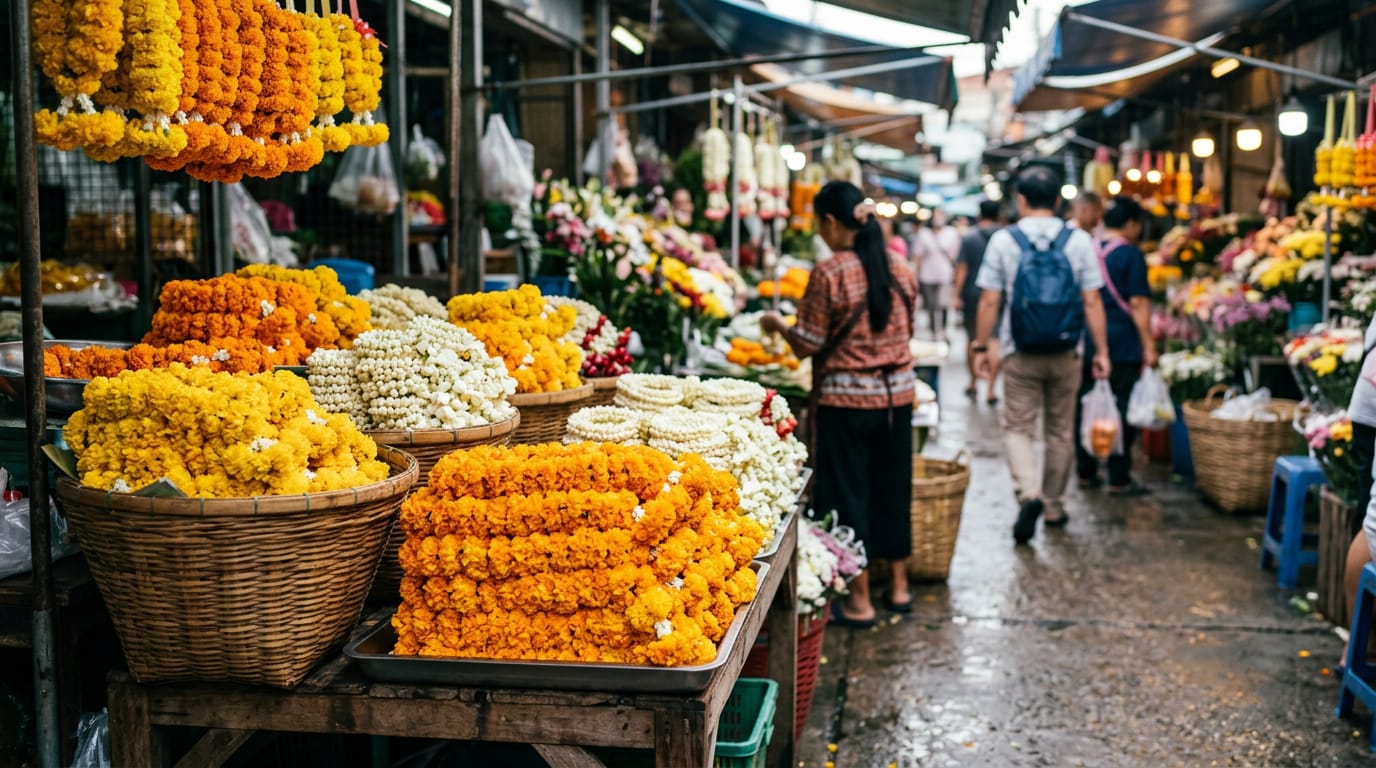
The Chiang Mai Flower Market (Talat Dok Mai) is the city's main wholesale and retail bazaar for cut flowers and ceremonial garlands, on a 400-metre stretch of Praisani Road beside the Ping River, behind Warorot Market in Chang Moi. Trading is continuous, with wholesale lorries arriving 03:00–06:00; in February 2026 it supplies the 49th Chiang Mai Flower Festival floats.
Market
Sunday Walking Street (Ratchadamnoen Road)
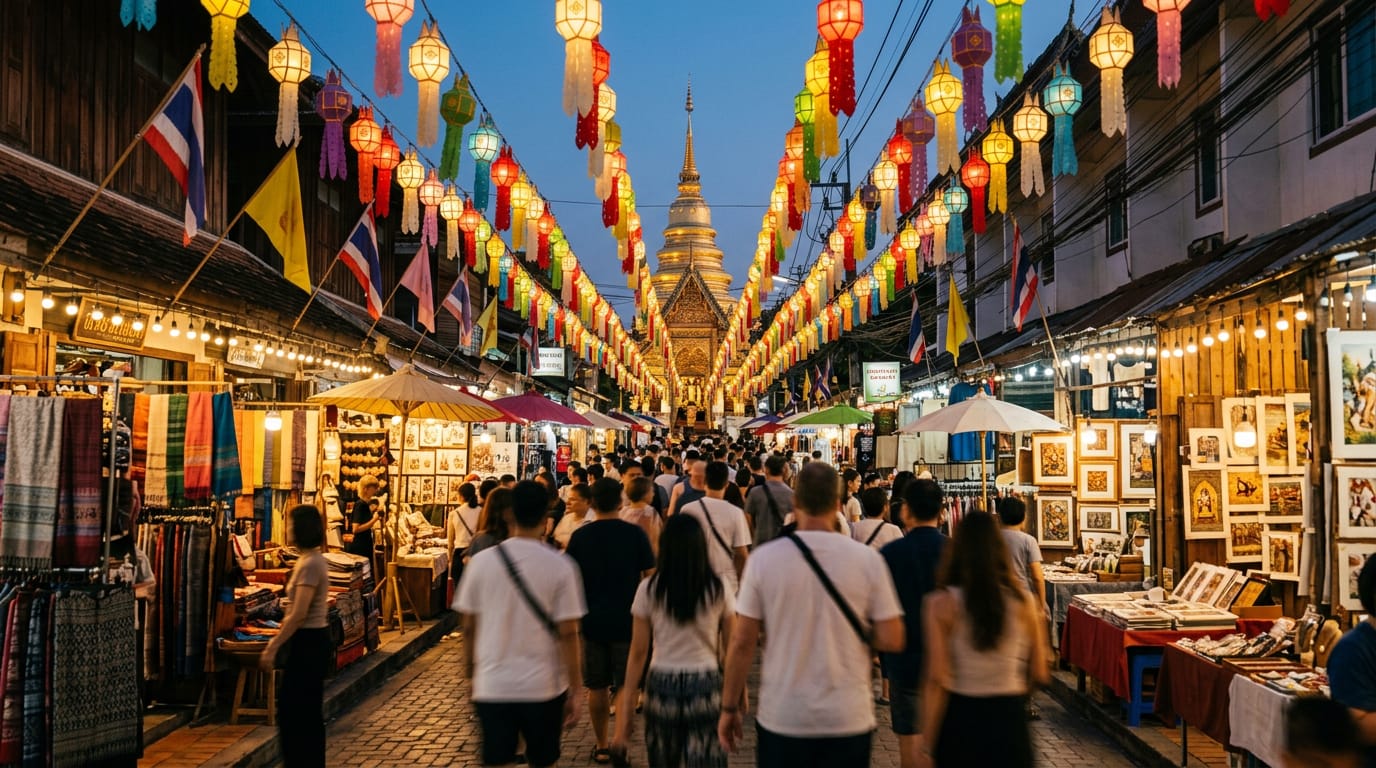
The Sunday Walking Street fills Ratchadamnoen Road through the heart of the Old City from Tha Phae Gate west to Wat Phra Singh. Around 700 vendors set up every Sunday from 16:00 to 22:00, with handicraft, paper umbrellas, silk, lanterns and three temple courtyards turned into food clusters along the route. It is the biggest weekly walking street in Chiang Mai.
Market
Saturday Walking Street (Wua Lai Road)
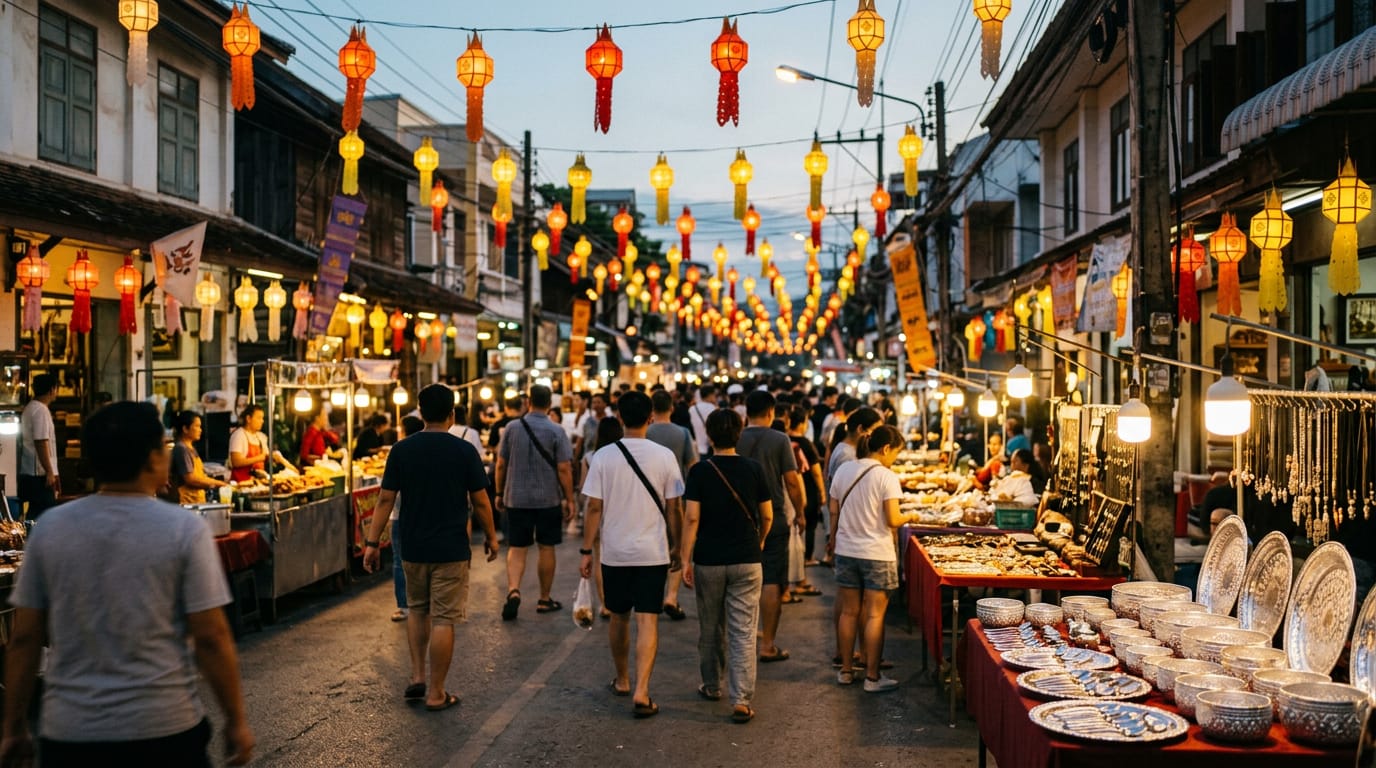
Chiang Mai's Saturday Walking Street runs the length of Wua Lai Road, the silversmith quarter immediately south of the Chiang Mai Gate. Open every Saturday from 16:00 to 22:00, it is smaller, more local and more craft-led than its Sunday counterpart, with silverware, lacquerware and Lanna handicrafts beside food stalls and the Songkran procession route on day one of the New Year festival.
Festival
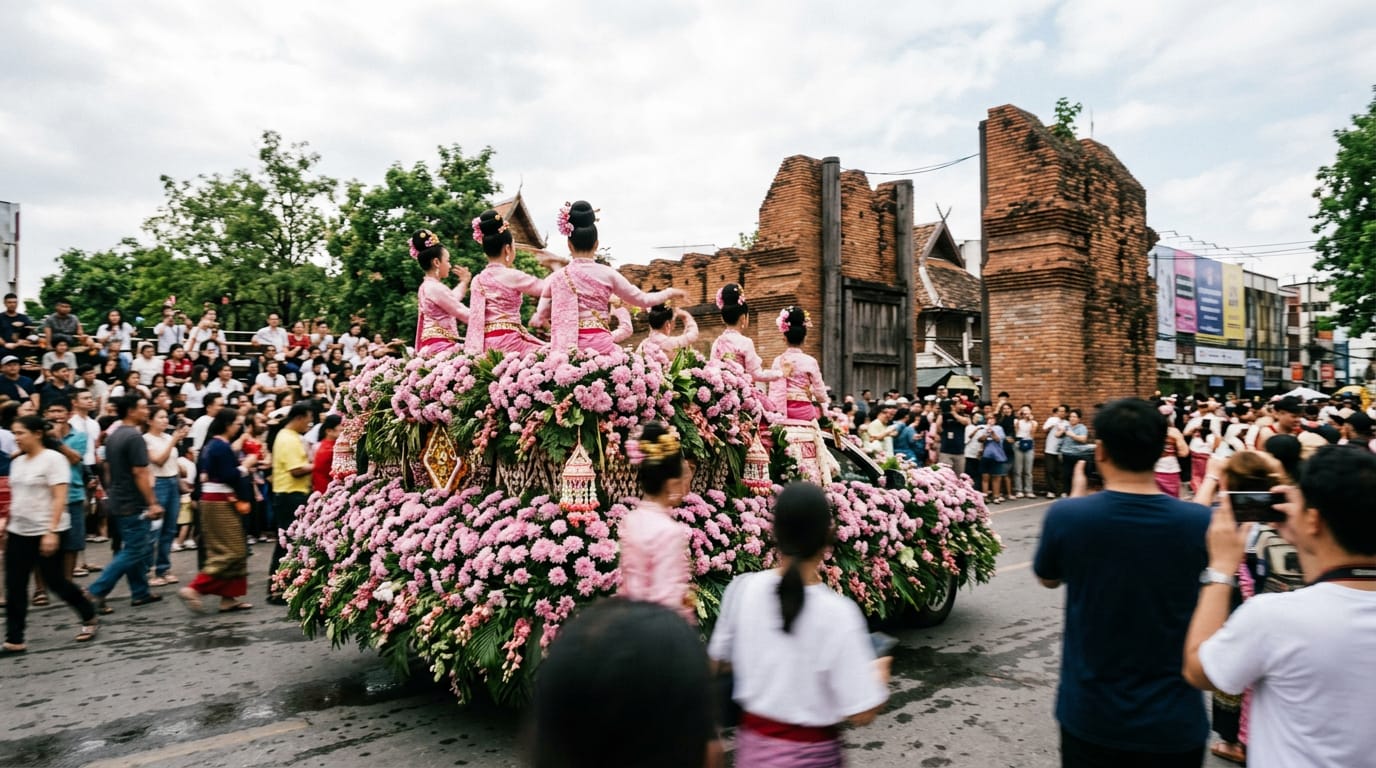
Chiang Mai Flower Festival
The Chiang Mai Flower Festival is the city's annual three-day celebration of cool-season blooms, held the first full weekend of February at Suan Buak Hat Park. The 49th edition runs 13–15 February 2026, with the headline parade of flower-covered floats setting off at 08:00 on Saturday 14 February from Nawarat Bridge along Tha Pae Road to Suan Buak Hat. Free entry, beauty pageant on Friday night, and northern Thailand's largest cool-flower trade fair across the weekend.