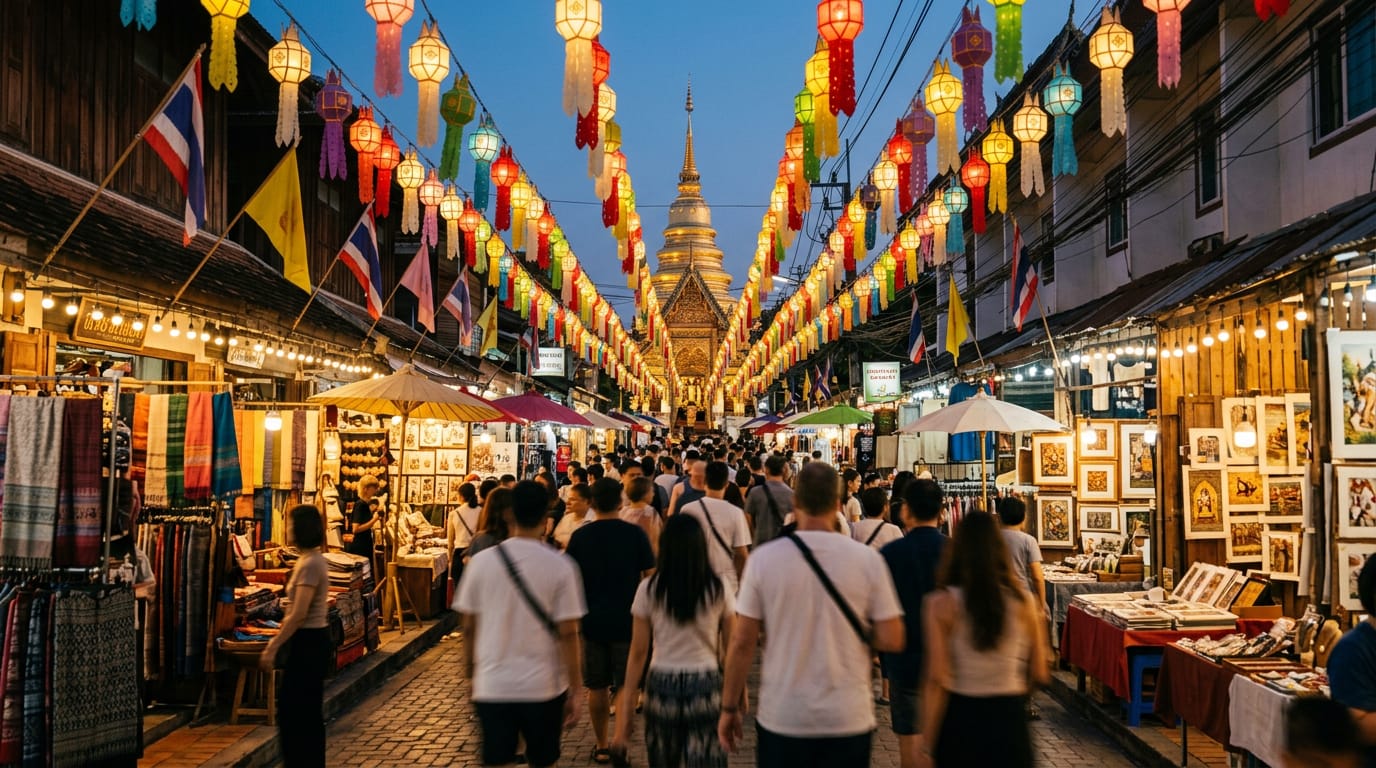
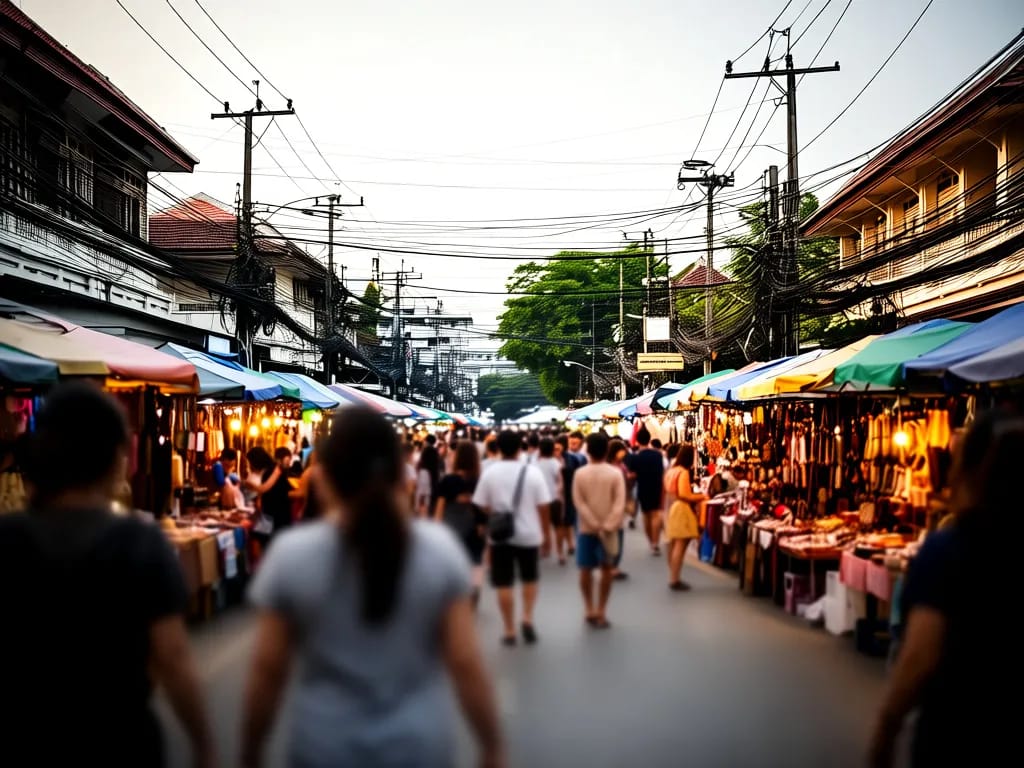
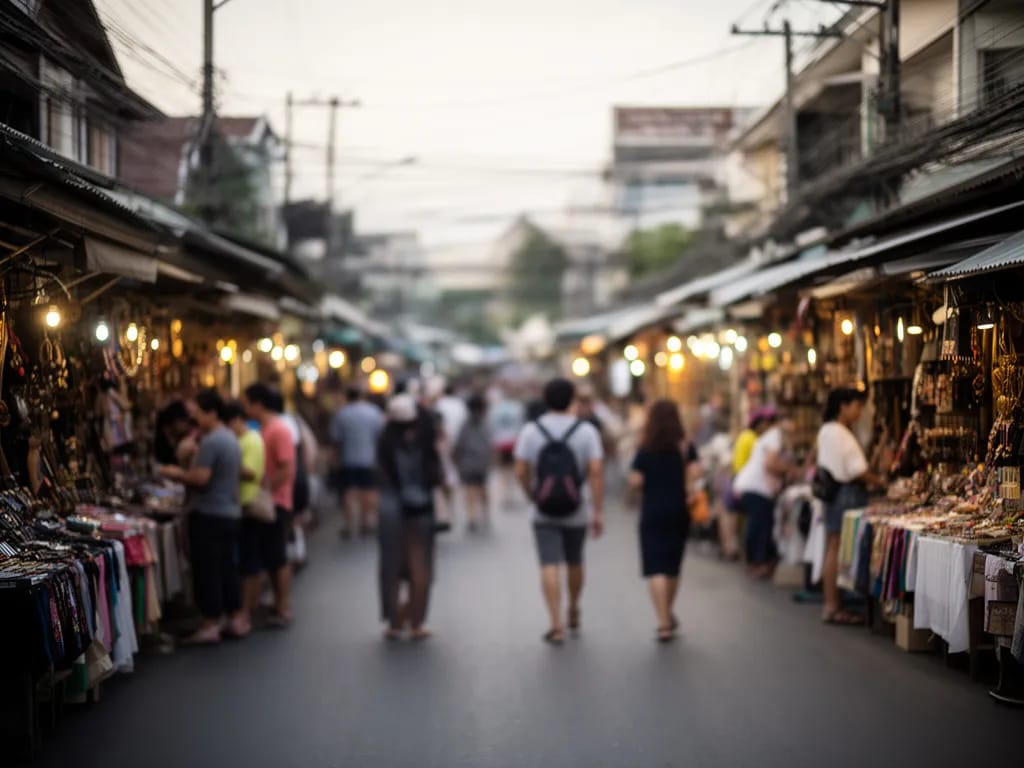
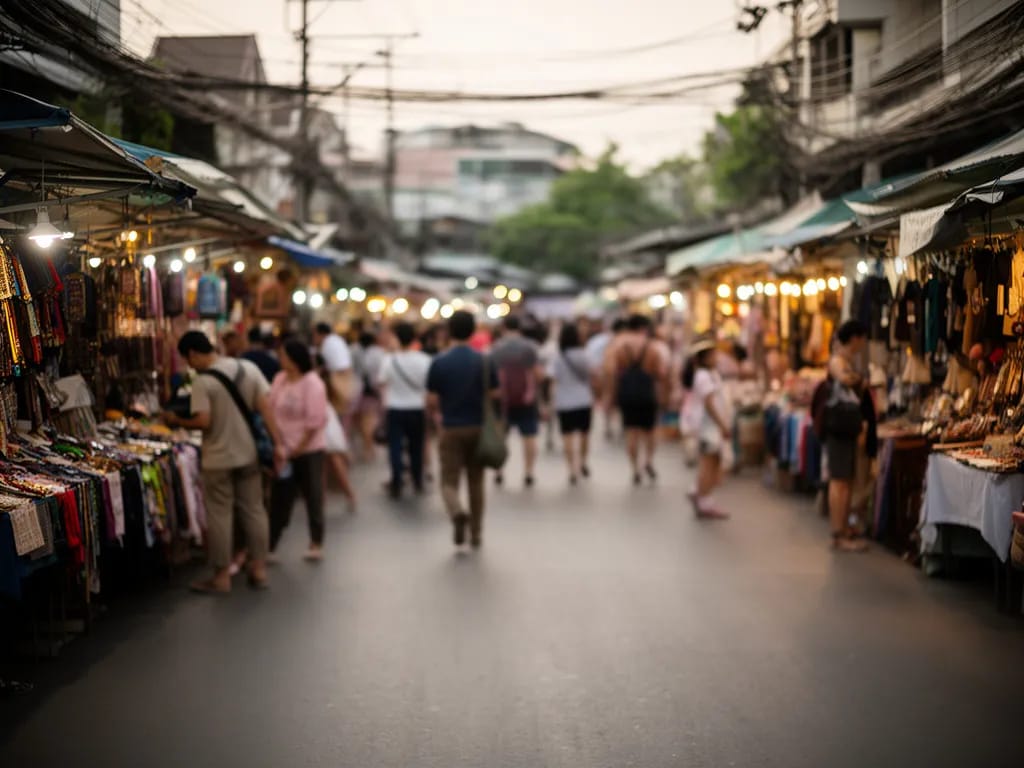
The Sunday Walking Street fills Ratchadamnoen Road through the heart of the Old City from Tha Phae Gate west to Wat Phra Singh. Around 700 vendors set up every Sunday from 16:00 to 22:00, with handicraft, paper umbrellas, silk, lanterns and three temple courtyards turned into food clusters along the route. It is the biggest weekly walking street in Chiang Mai.
Updated
The Sunday Walking Street is the single most photographed evening in Chiang Mai. By 17:00 every Sunday, Ratchadamnoen Road, the central east-west axis of the Old City, has closed to traffic from Tha Phae Gate west to Wat Phra Singh, and roughly 700 vendors have unrolled their mats, propped their poles and lit their lanterns along the kilometre of road and the three temple courtyards that anchor it. It is the biggest weekly walking street in northern Thailand. Locals call it Thanon Khon Doen Wan Athit, the Sunday walking street, or just Walking Street.
What it is
The market began in 2002 as a Tourism Authority of Thailand initiative to extend the city’s evening footfall west of Tha Phae Gate and to give Chiang Mai’s craftspeople a weekly retail outlet inside the walls. The first year ran with about 200 vendors; numbers reached 500 by 2008, 700 by 2015, and have held there since. Today the market draws crowds estimated at 30,000 to 40,000 on a typical high-season Sunday and as many as 60,000 on the Sundays closest to Loy Krathong and Western New Year. It runs every Sunday of the year, including national holidays, with one regular exception: the Sunday of Loy Krathong itself, when the eastern third near Tha Phae Gate is suspended in favour of the khom loi sky-lantern processions.
Ratchadamnoen Road is the historic central axis of the Old City, laid out in the late 13th century when King Mengrai founded Chiang Mai. The road runs in a straight line from Tha Phae Gate on the east, where the king’s processions traditionally entered the city, past the Three Kings Monument in the centre and on to Wat Phra Singh on the west. Three royal temples sit directly on the road or in lanes off it: Wat Phra Singh at the western end, Wat Chedi Luang a block south of the centre, and Wat Phan Tao directly on the road. The walking street is a craft market, a food court and a Sunday evening visit to the city’s principal wats (temple-monasteries) in one.
What you’ll find
The market’s offer falls loosely into seven categories, distributed along the route from Tha Phae Gate west.
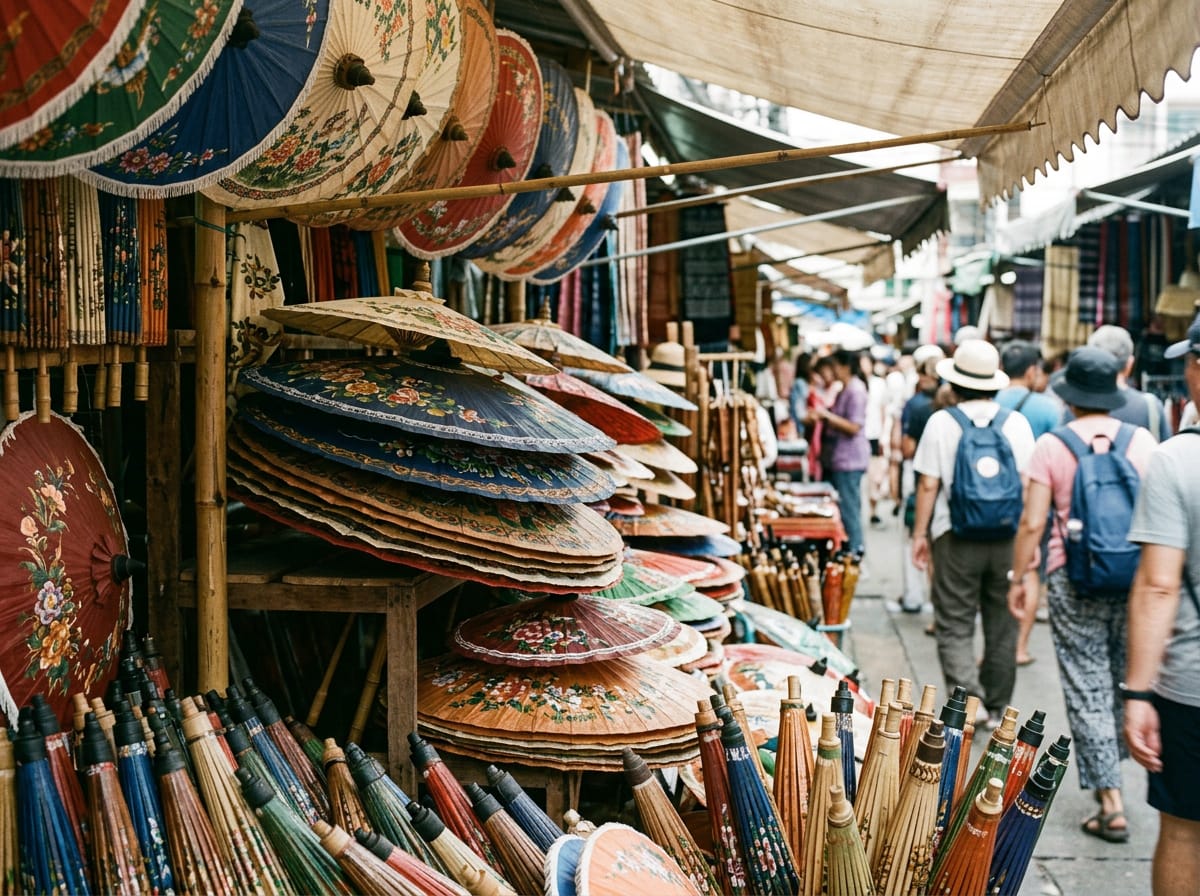
Paper umbrellas, lanterns and saa paper
The eastern third of the road, from Tha Phae Gate to the Three Kings Monument, has the heaviest concentration of saa (mulberry-bark) paper crafts. Hand-painted umbrellas from the Bo Sang village sell at 200 to 600 baht for a small parasol and 1,500 to 4,000 for a wedding-scale piece. Lanterns in white and red cost 150 to 400. Notebooks bound in saa paper, postcards, calligraphy scrolls and folded paper flowers fill out the offer.
Silk, cotton, Lanna textiles
The central third of the road, around the Three Kings Monument, is where the textile vendors cluster. Silk scarves from Sankampaeng weavers cost 250 to 800 baht; hand-woven cotton from the Mae Hong Son villages 300 to 1,000; ready-made Lanna (northern Thai) dresses, fisherman’s trousers and the loose monk-cloth shirts that have become a local uniform run 250 to 600. Akha and Hmong vendors sell embroidered shoulder bags and beadwork from a quieter row in front of Wat Phan Tao.
Lacquerware, woodcarving, ceramics
A smaller but consistent set of stalls between the centre and Wat Phra Singh sells lacquerware in red, black and gold, small carved teak pieces and the celadon ceramics that are a Sankampaeng craft. Higher-quality work is at the source (Ban Tawai for wood, Bo Sang and San Kamphaeng for ceramics and lacquer), but the walking street offers a serviceable browse.
Independent fashion, soaps, small-batch coffee
A newer category, dating to roughly 2015, fills the western quarter of the road. Local fashion designers, independent leather workers, candle and soap makers, hand-roasted coffee and small-batch chocolate from the Doi Chang growers. Prices are higher than the craft average but the work is original.
Food
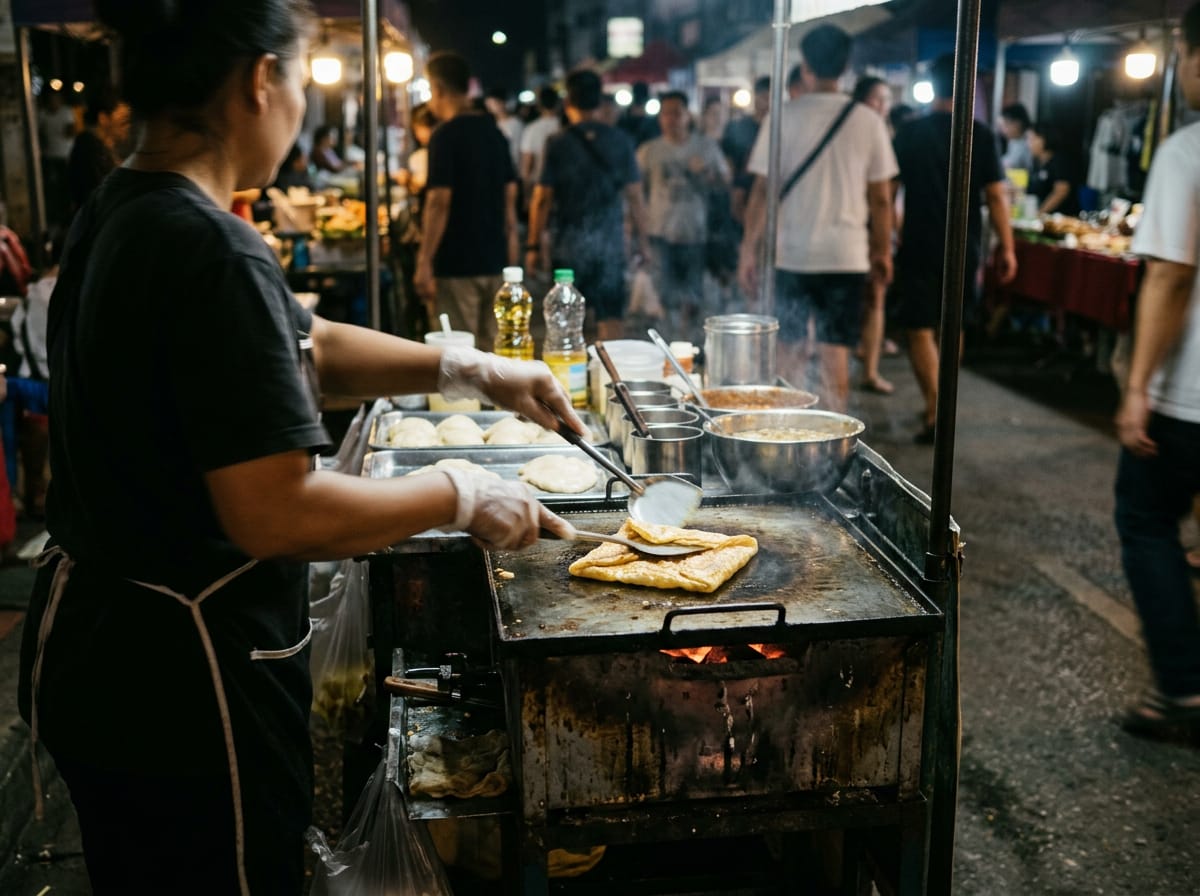
Three temple courtyards along the route are the food anchors. Wat Mahawan, near the eastern end, hosts noodle and stir-fry stalls with bench seating. Wat Phan Tao, in the centre, has the largest single food court: northern Thai kao soi (curry noodle soup), kanom jeen nam ngiao (rice noodles in tomato-pork broth), sai oua herb sausage, southern Thai fried chicken with sticky rice, sour curries and a long sweets row of mango sticky rice, coconut pancakes, roti and bua loy (rice-flour dumplings in coconut milk). Wat Phra Singh, at the western end, hosts a smaller and quieter cluster with bench seating in the rear pavilion. Beyond the temples, food carts thread the central spine: pad thai, grilled corn, fresh fruit, fresh-squeezed orange juice and the city’s best concentration of roti vendors. Most portions run 30 to 80 baht; a full dinner costs around 150 baht.
Buddha amulets, devotional objects
A row of stalls in front of Wat Phan Tao and at the Tha Phae Gate end sells Buddha amulets, yantra (sacred geometric drawings), prayer beads and small bronze figures of the Buddha. The honest vendors mark provenance and the temple of issue; the cheaper stalls sell mass-produced pieces. Devotional objects are not bargained on; the asked price reflects merit transfer.
Music and street performance
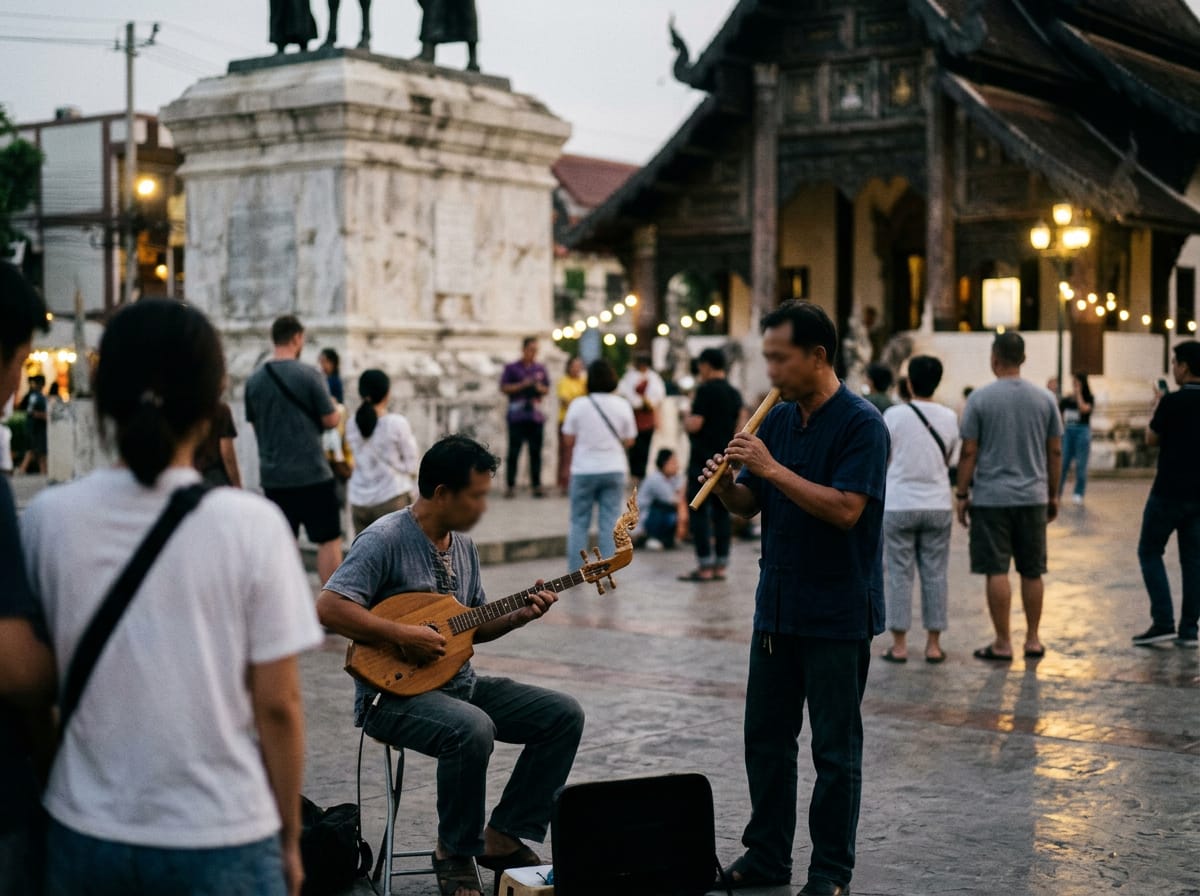
A small ensemble of buskers, with sueng (northern lute), khlui (bamboo flute) and hand drum, sets up at the Three Kings Monument square most Sundays. Charity musicians from the blind musicians’ association play at intervals along the western half. Occasional larger ensembles use the open square between Wat Phan Tao and Wat Chedi Luang for full Lanna folk concerts.
How to navigate and best time
Walk in from Tha Phae Gate and head west. The road is wider at the east, narrower in the centre near the Three Kings Monument, and opens out again at Wat Phra Singh. A full lap — west along the south side, east along the north — takes about two hours at a steady pace and covers every stall and every food court without doubling back. Allow three hours if you stop to eat or sit through music at one of the temples.
The single best window is 17:00 to 18:30. The road is fully open and stocked, the air has cooled from the late-afternoon heat, the light is still good for browsing craft detail and the crowd is steady but not yet shoulder-to-shoulder. From 18:30 to 21:00 the central stretch between Wat Phan Tao and the Three Kings Monument becomes the densest crowd of any pedestrian space in Chiang Mai; expect to move slowly. After 21:00 trading thins, food stalls begin to mark stock down and the western end empties first.
A few practical notes. Public toilets cost 5 baht at Tha Phae Gate, in the Three Kings Monument square and inside Wat Phra Singh. ATMs sit at Bangkok Bank on Ratchadamnoen, Kasikorn Bank near the Three Kings Monument and Siam Commercial Bank at the western end. There is no parking inside the closed road; the nearest open car parks are at Wat Phantao (200 metres south) and the municipal car park behind the Three Kings Monument. Most vendors take cash; PromptPay is widespread but not universal.
Getting there
The Sunday Walking Street is reached most easily on foot. From any guesthouse or hotel inside the Old City, you are within 10 minutes’ walk of one of the entrances. From the Nimman district, walk east along Huay Kaew Road and Suan Dok Road to enter at Wat Phra Singh, about 25 minutes; or take a red songthaew (shared pickup-truck taxi) for 30 baht and ask for Pratu Tha Phae (Tha Phae Gate).
From outside the Old City — the riverside hotels along Charoenrat Road, the Maya district at Nimman or the airport area — a songthaew costs 30 to 60 baht. Grab and Bolt cars charge 50 to 80 baht and cannot enter the closed road; you will be dropped at Tha Phae Gate, at the Three Kings Monument square or at Wat Phra Singh, depending on which side of the road you give as your destination. Tuk-tuks negotiate from 80 baht for the same trip.
Avoid driving a private car. The entire central Old City — Ratchadamnoen, Phra Pokklao, Ratchamanka and the cross-streets — closes to vehicles from 15:30. Police set up barricades at every entrance. If you are arriving by bus from outside the province, the Arcade bus terminal is 4 kilometres east and a songthaew from there costs 50 baht.
Where to eat and nearby
The temple food courts at Wat Mahawan, Wat Phan Tao and Wat Phra Singh are the easiest sit-down options; bench seating, fluorescent light and a fast turnover make them the most local feel on the market. For something slower, the SP Chicken northern Thai grill (10 minutes’ walk south on Soi Wat Chai Mongkol) serves the city’s best grilled chicken with sticky rice. The Akha Ama coffee branch near Wat Phra Singh stays open during the market and is a good slower stop.
After the market, the riverside cafés on Charoenrat Road (Woo Cafe, Brown Sugar, Anantara’s River Café) stay open until 22:00 and offer a quieter end to the evening. Wat Chedi Luang, two minutes south of the centre, lights its main chedi (bell-shaped stupa) at night and is worth a slow walk through the courtyard. Wat Phra Singh is open during the market hours but the inner ordination hall typically closes by 20:00.
Tips and etiquette
Bargain modestly on craft (10 to 15 per cent below the asked price). Do not bargain on food. Carry cash in small notes; PromptPay is widespread but older vendors stick to cash. Watch your bag in the densest stretch between Wat Phan Tao and the Three Kings Monument; pickpocketing is rare but not absent. Ask before photographing close-up portraits — the Thai phrase tai roop dai mai (may I take a photo?) is sufficient. Remove your shoes before stepping into any temple ordination hall and dress modestly: shoulders covered, knees covered. If you hear the national anthem played at 18:00 from the loudspeakers in the Three Kings Monument square, stand still until it finishes. Drones are not permitted over the market.
Related and combine with
The natural companion is the Saturday Walking Street on Wua Lai Road, which runs the night before and is smaller, more local and more silver-led. Pair the market with Warorot Market for a daytime-and-evening sequence: the Sunday Walking Street vendors stock much of their craft at Warorot from 04:00 the same morning. The walking street is anchored at one end by Wat Phra Singh and passes within a block of Wat Chedi Luang. During the November Loy Krathong festival the Tha Phae Gate end of the road becomes the main khom loi sky-lantern launch site; see the Yi Peng and Loy Krathong page for the full schedule. For source-quality versions of the craft sold here, the Bo Sang umbrella village and Ban Tawai are the day trips.
Photos
Frequently asked questions
Where is the Sunday Walking Street in Chiang Mai?
The Sunday Walking Street runs along Ratchadamnoen Road, the central east-west axis of the Old City. The market begins at Tha Phae Gate on the eastern moat and runs roughly 1 kilometre west to Wat Phra Singh at the foot of Doi Suthep. The full length closes to vehicles from 16:00 on Sundays. Stalls also fill the temple courtyards of Wat Mahawan, Wat Phan Tao and Wat Phra Singh along the route, and overflow into the short side lanes off Ratchadamnoen. The principal entrance is at Tha Phae Gate; the western end at Wat Phra Singh is the quieter alternative.
What time does the Sunday Walking Street open and close?
Vendors begin setting up from 15:00. The road is closed to vehicles from 16:00 and trading is light until 17:00. The market reaches full activity from 18:00 to 21:00, which is the peak. After 21:00 trading thins; the last stalls pack down by 22:30. The market runs every Sunday of the year, including national holidays, with one known exception: the Sunday of Loy Krathong (mid-November) when the entire Tha Phae Gate area is given over to the *khom loi* lantern releases and processions, and the eastern third of the market is suspended.
Is the Sunday Walking Street free to enter?
Yes. The Sunday Walking Street is a public street market with no gate, ticket or barrier. The full kilometre of Ratchadamnoen Road, plus the courtyards of three temples along the route, is open to anyone. Public toilets cost 5 *baht* and are located at Tha Phae Gate, at the Three Kings Monument and inside Wat Phra Singh. The market is wheelchair-accessible along the central stretch; the side lanes off Ratchadamnoen have uneven paving in places. There is no entry fee at the temples during the market either, though the inner shrine of Wat Phra Singh sometimes closes by 20:00.
How many vendors are at the Sunday Walking Street?
Roughly 700 vendors trade along Ratchadamnoen Road and inside the three temple courtyards on a typical Sunday. The number rises to around 850 in the high season from November to February, when overflow stalls open in the side lanes off the main road, and falls to about 550 in the wet months from June to September. The Tourism Authority of Thailand's permit office issues vendor numbers annually; a published map of the official pitches is kept at the municipal office on Wang Sing Kham Road.
What can I buy at the Sunday Walking Street?
The market's offer is broad. Handicraft dominates: hand-painted *saa* paper umbrellas from the [Bo Sang umbrella village](/umbrella-village-bo-sang-san-kamphaeng/), silk scarves from the Sankampaeng weavers, hill-tribe embroidery, hand-block printed cards, *saa* paper notebooks and lanterns, Lanna cotton clothing, wood-carving, lacquerware and Buddha amulets. Newer additions include independent fashion brands, handmade soaps and small-batch coffee. Three temple courtyards anchor the food along the route — northern Thai specialities, central Thai street food and a deep selection of sweets. Buskers and small ensembles play at the Three Kings Monument square.
What is the difference between the Sunday and Saturday walking streets?
The Sunday Walking Street on Ratchadamnoen Road is the larger and better-known of the two. It runs through the Old City, includes three temples along the route and attracts a roughly 75 per cent tourist crowd. The [Saturday Walking Street on Wua Lai Road](/saturday-street-market-wua-lai-road/) is smaller (about 400 vendors), runs through the historic silversmith quarter south of the moat, and skews more local. Saturday is the better night for craft buyers; Sunday is the bigger general experience. If you have only one Sunday in town, take the Sunday market; if you have a full weekend, do both.
Where are the food courts on the Sunday Walking Street?
Three temple courtyards along Ratchadamnoen Road become food-only clusters from 16:00. Wat Mahawan, near the eastern end, runs noodle and stir-fry stalls with bench seating. Wat Phan Tao, in the centre near the Three Kings Monument, has the largest food court, with northern Thai *kao soi*, kanom jeen nam ngiao, *sai oua* sausage, fried chicken with sticky rice, vegetable curries and a long sweets row. Wat Phra Singh, at the western end, hosts the smaller and quieter cluster, with bench seating in the rear pavilion. All three accept cash only. Prices run 30 to 80 *baht* a portion.
Is the Sunday Walking Street any good for souvenirs?
Yes, with caveats. The market is the most diverse single shopping evening in northern Thailand and almost every craft from the surrounding provinces is represented in some form. The honest range — hand-painted umbrellas, *saa* paper, silk, lacquerware, hill-tribe embroidery — is genuinely good and priced fairly given the convenience. The mass-produced range — printed T-shirts, machine-stamped jewellery, low-grade Buddha amulets — is widely available and overpriced. Bargain modestly (10 to 15 per cent) on craft; pay the asked price on food. For the highest-quality versions of each craft, the source villages — [Bo Sang](/umbrella-village-bo-sang-san-kamphaeng/), [Ban Tawai](/ban-tawai/), San Kamphaeng — are better day trips.
How do I get to the Sunday Walking Street?
From anywhere inside the Old City, walk. The market fills the central east-west axis and is reachable on foot from any point within 10 minutes. From Tha Phae Gate, you are at the eastern entrance. From the Three Kings Monument, you are in the centre. From Wat Phra Singh, you are at the western entrance. A red *songthaew* costs 30 *baht* from anywhere in the city; ask for Tha Phae Gate or Pratu Tha Phae. Grab and Bolt cars charge 50 to 80 baht and cannot enter the closed road; you will be dropped at Tha Phae Gate or at the Three Kings Monument square. Avoid driving; the entire central Old City closes to vehicles from 15:30.
Is the Sunday Walking Street open in the rainy season?
Yes. The market runs every Sunday of the year. In the wet months from June to October, sudden late-afternoon downpours can briefly clear the central stretch; vendors carry plastic sheets and the market typically resumes within 30 minutes. The covered temple courtyards become the main shelters during heavy rain, and the food stalls inside continue trading without interruption. A small folding umbrella from June to October is sensible. From November to February the air is dry and cool and this is the peak season. In March to May, the early window from 17:00 to 18:00 is the most comfortable; later in the evening the residual heat from the closed road can be tiring.
Related guides
Market
Warorot Market (Kad Luang)
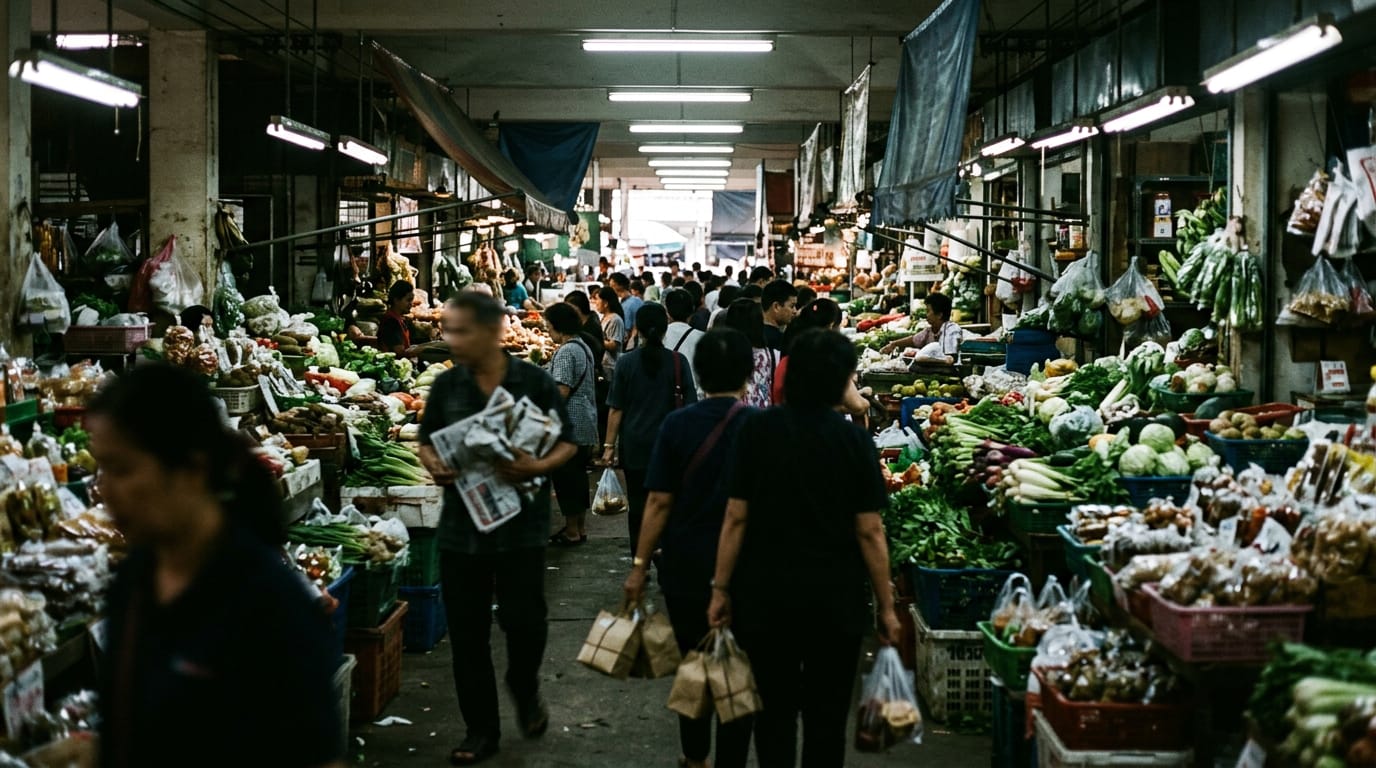
Warorot Market, known locally as Kad Luang, is Chiang Mai's largest and oldest fresh market, set just east of Tha Phae Gate against the Ping River. Three trading floors plus a dense weave of surrounding lanes carry produce, fabric, kitchenware, Chinese pastry, sai oua sausage and the city's most reliable kao soi, with the Flower Market and Talat Ton Lamyai pressed against its northern wall.
Market
Saturday Walking Street (Wua Lai Road)
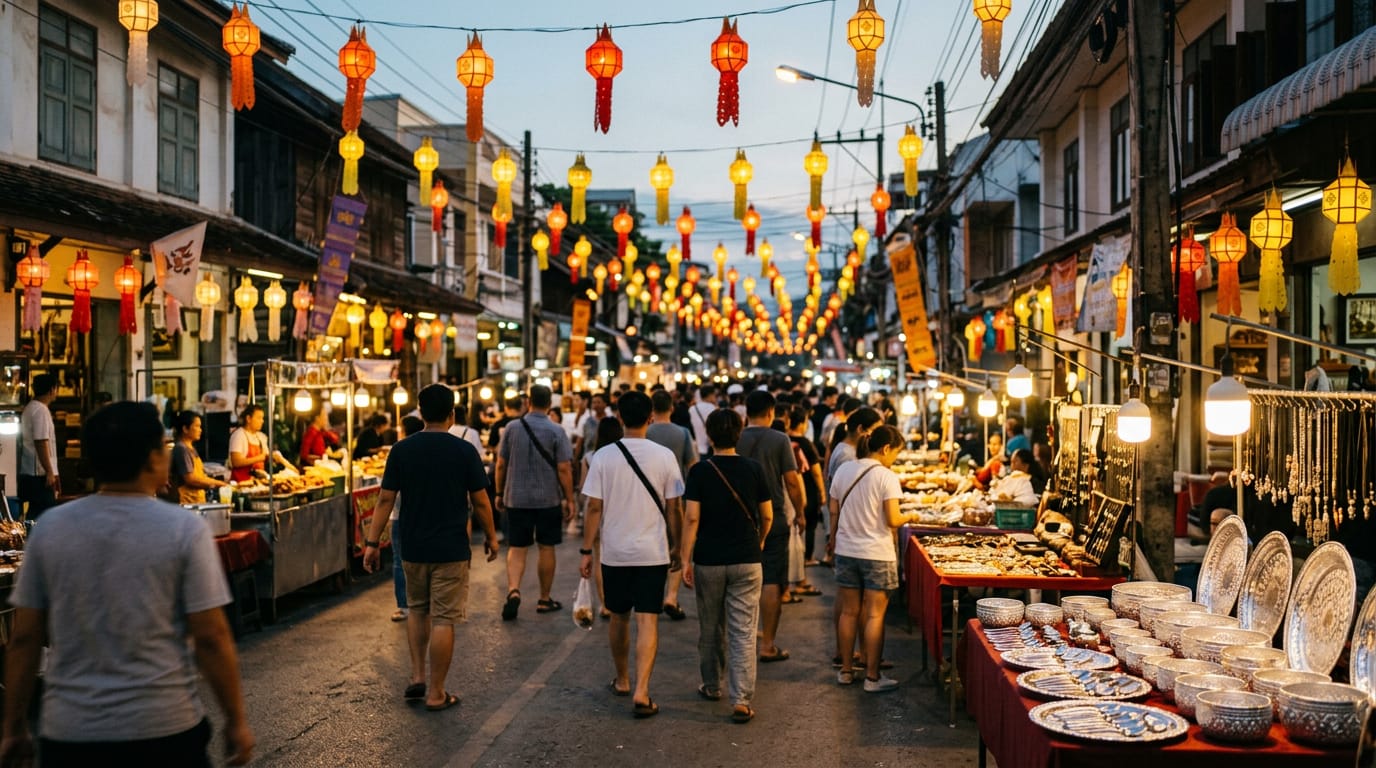
Chiang Mai's Saturday Walking Street runs the length of Wua Lai Road, the silversmith quarter immediately south of the Chiang Mai Gate. Open every Saturday from 16:00 to 22:00, it is smaller, more local and more craft-led than its Sunday counterpart, with silverware, lacquerware and Lanna handicrafts beside food stalls and the Songkran procession route on day one of the New Year festival.
Temple
Wat Phra Singh
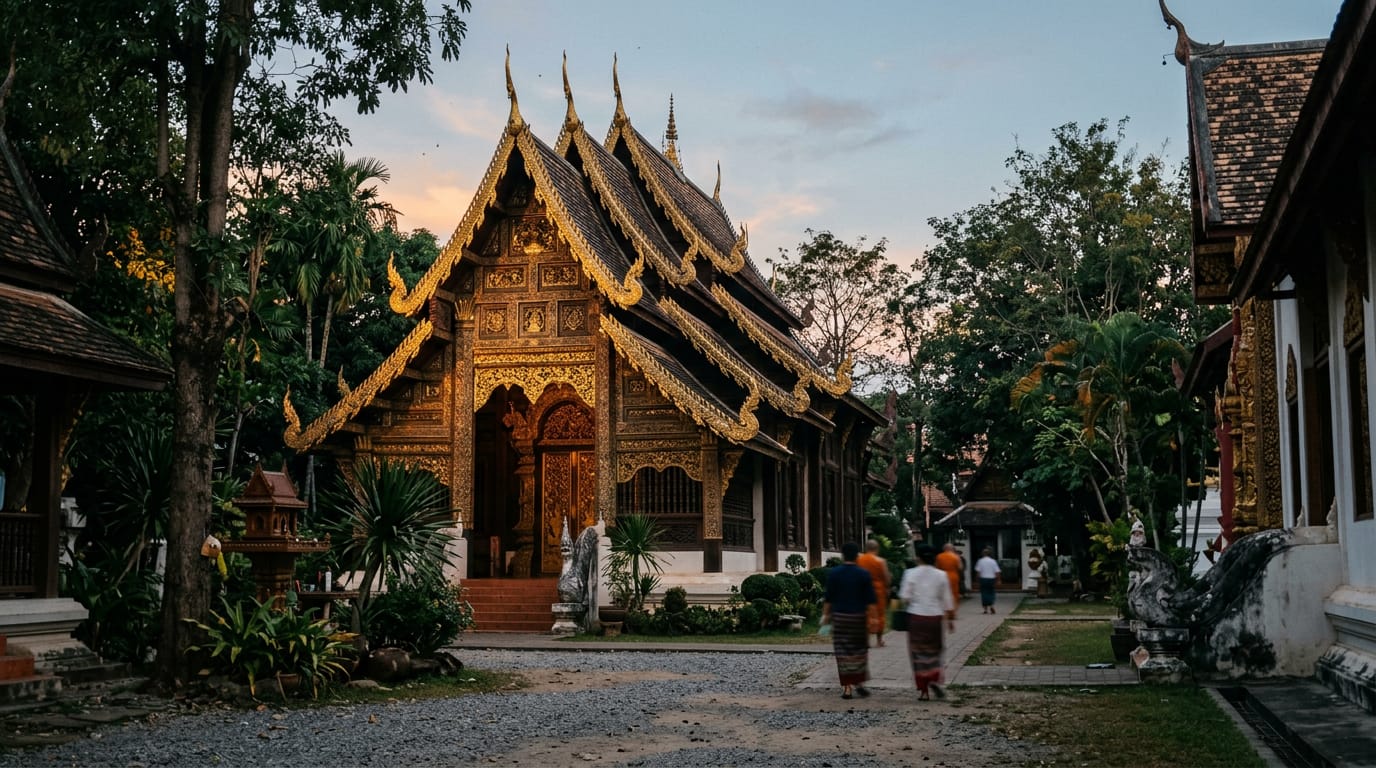
Wat Phra Singh is the most revered temple inside Chiang Mai's Old City, founded in 1345 by King Phayu of the Mangrai dynasty. Its Lai Kham viharn shelters the Phra Buddha Sihing — the Lion Buddha — which is paraded through the streets each Songkran. Together with its gilded chedi, carved teak gables and gold-leafed scripture library, the compound is the finest single example of Late Lanna architecture in northern Thailand.
Temple
Wat Chedi Luang
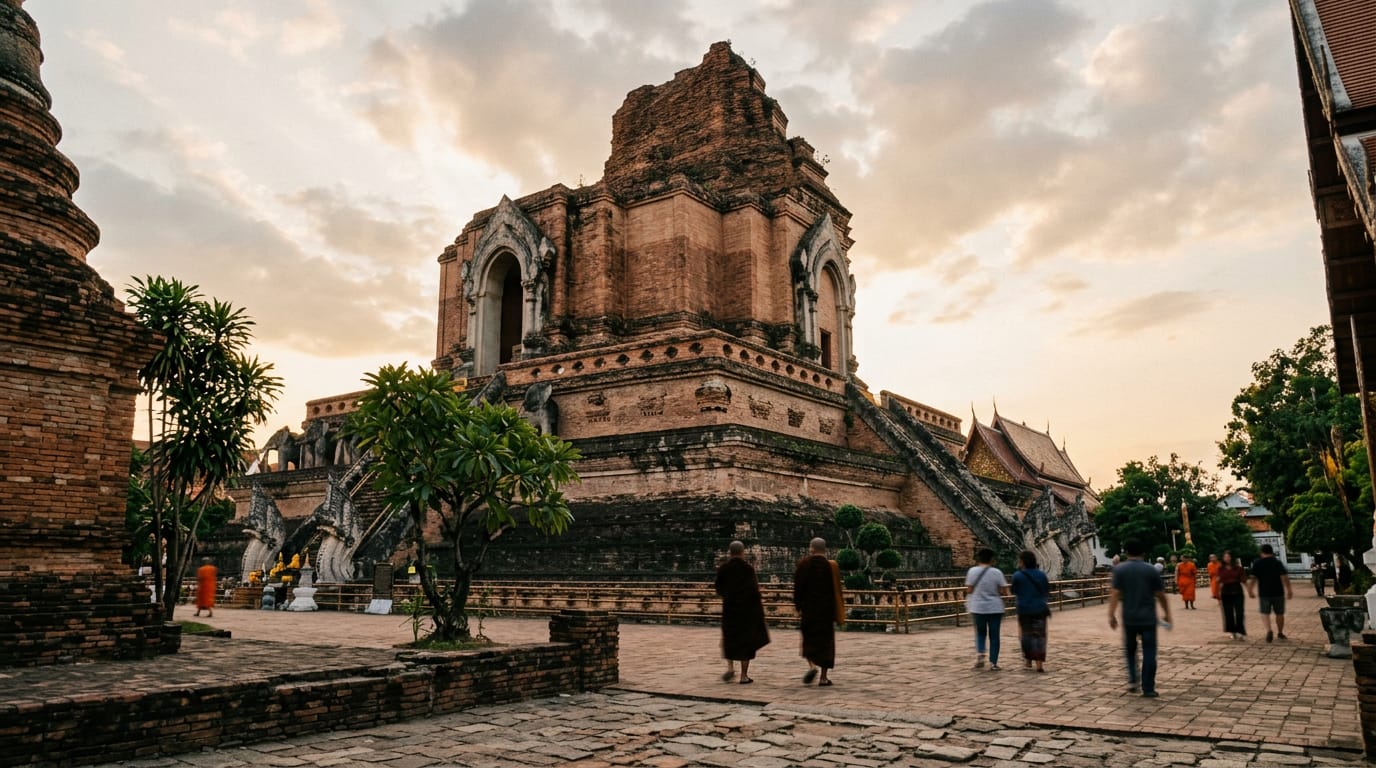
Wat Chedi Luang holds the ruined 60-metre chedi that was once the tallest building in Lanna and still dominates the centre of Chiang Mai's Old City. Founded in 1391 by King Saen Muang Ma and completed in 1481 under Tilokaraj, it was partly toppled by the 1545 earthquake. The compound also houses the city pillar and Chiang Mai's active monk-chat programme.
Festival
Yi Peng and Loy Krathong
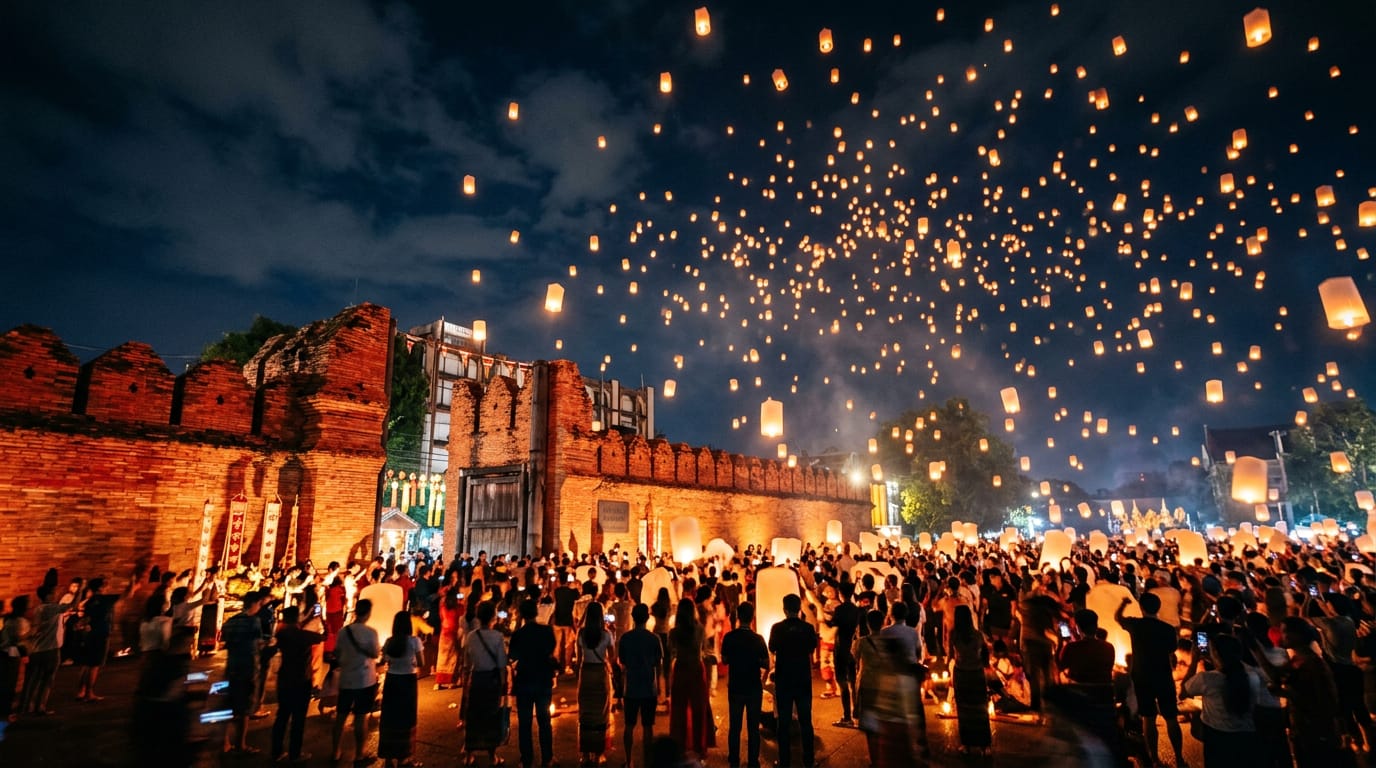
Yi Peng and Loy Krathong are Chiang Mai's twin festivals of light, held together over three nights on the full moon of the twelfth lunar month. Yi Peng is the Lanna sky-lantern release; Loy Krathong is the all-Thai floating of candle-rafts on rivers and ponds. In 2026 the festival runs 23–25 November, with free public lantern releases at Tha Phae Gate, krathong floating along the Ping River and Wat Phra Singh, and large ticketed mass releases at Doi Saket and Mae Jo.