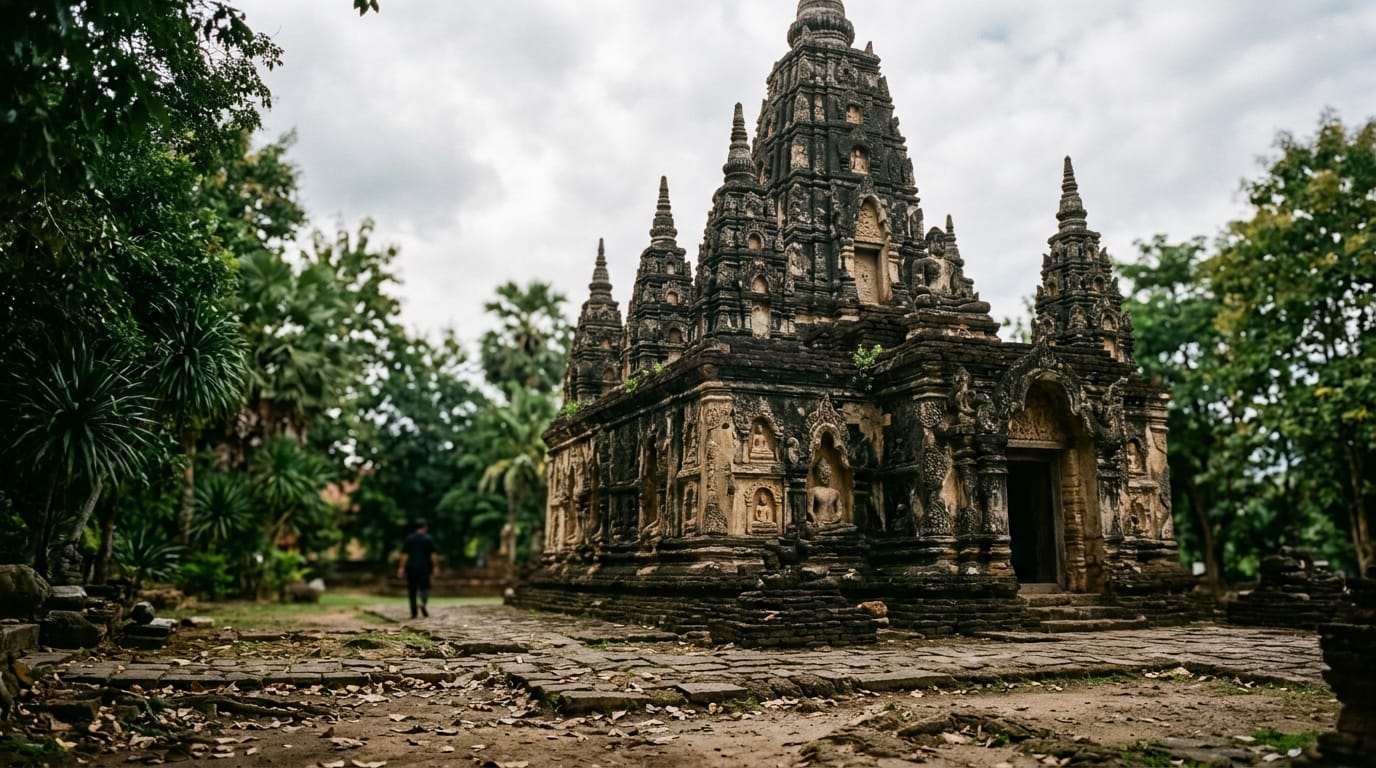
Wat Jed Yod, the Seven-Spired Temple, was founded in 1455 by King Tilokaraj and is the only temple in northern Thailand modelled on the Mahabodhi at Bodh Gaya. Its seven spires commemorate the seven weeks the Buddha spent in meditation after his enlightenment. In 1477 the temple hosted the Eighth World Buddhist Council, which revised the Pali canon.
Updated
Wat Jed Yod is the temple of the seven spires and the 1477 council. It sits 2 km north of the Old City moat, near the Chiang Mai National Museum, off the Super Highway that loops around the northern edge of the city. Founded in 1455 by King Tilokaraj, its chedi is modelled directly on the Mahabodhi Temple in Bodh Gaya (the only such building in northern Thailand), and the compound itself is one of the most historically important Buddhist sites in Southeast Asia. Most visitors arrive without knowing any of this. The temple is much the quieter for it.
History and significance
The temple was founded in 1455 by King Tilokaraj, the ninth and arguably the most powerful king of the Mangrai dynasty. Tilokaraj ruled Lanna for forty years, expanded the kingdom to its greatest territorial extent, defeated the Ayutthayan armies of King Trailok in three campaigns, and made Chiang Mai the most important centre of Theravada Buddhist scholarship north of Sri Lanka. The foundation of Wat Jed Yod was the culminating religious act of his reign.
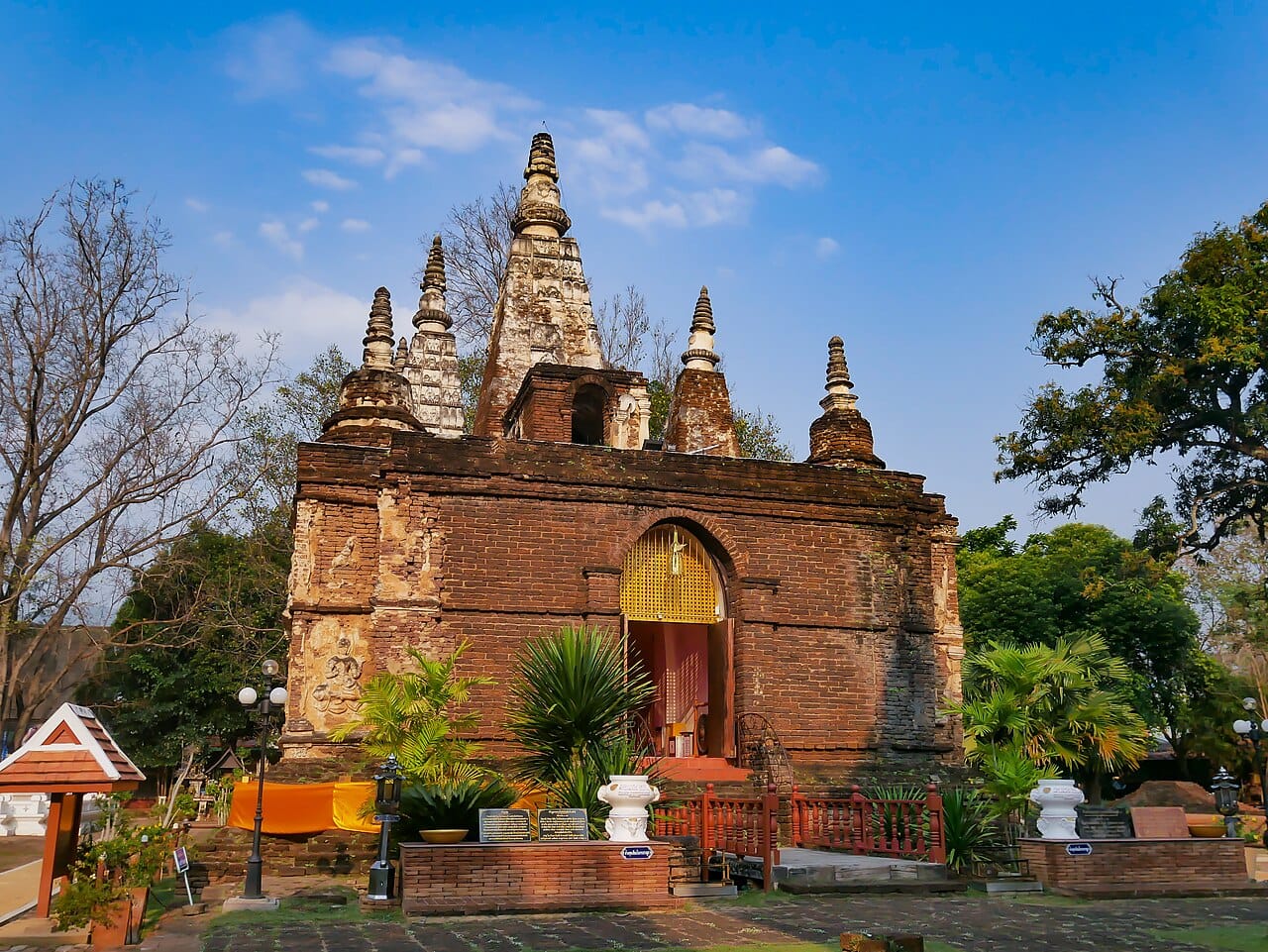
The plan was unusual. Tilokaraj dispatched a delegation of monks and craftsmen to Bodh Gaya in India, the site of the Buddha’s enlightenment, to record the proportions of the Mahabodhi Temple itself. The Mahabodhi was already old by then, dating in its current form to the seventh century. The delegation measured, drew and returned. The chedi at Wat Jed Yod was then built to those proportions: a tall central tower flanked by four smaller corner towers and two further small spires on the front platform, seven in total. The number commemorates the seven weeks the Buddha spent in meditation immediately after his enlightenment at Bodh Gaya, each week in a different posture and place; the design represents the entire post-enlightenment cycle in architectural form.
The chedi was only part of the scheme. The compound was conceived as a representation of the sattamahasathan, the seven sites around Bodh Gaya where the Buddha passed those seven weeks, and tradition holds that a bodhi tree of the sacred Bodh Gaya lineage was planted at the consecration. The temple’s formal name, Wat Photharam Maha Viharn, refers to that tree: a ‘photharam’ is a bodhi-tree monastery.
This is the only Mahabodhi-derived chedi in northern Thailand. There are a handful of related forms further south (Wat Chet Yot in Bangkok is a Bangkok-era copy of this one), and a few in Pagan and Lan Xang, but Wat Jed Yod is the principal Southeast Asian example, and the closest architectural copy of the Indian original ever built in Thailand.
The chedi was completed by 1476, just in time to host the most important event ever held at the temple: the Eighth World Buddhist Council in 1477. The council was convened by Tilokaraj himself and brought together senior monks from Lanna, Sukhothai, Burma, Lan Xang (Laos) and southern Siam. The purpose was to revise the Pali canon (the body of texts that records the Buddha’s teachings), which by the 15th century had developed regional variations that needed reconciling. The council met at Wat Jed Yod for several months and produced a revised canon that informed Theravada scholarship for the next four centuries.
That puts the temple in rare company: the 1477 gathering is one of only three Theravada councils held outside Sri Lanka in the entire post-classical period, and the only one ever held in Thailand. The Eighth Council is the reason that fifteenth-century Chiang Mai is sometimes called the second Sri Lanka of Buddhist scholarship.
The council’s effects outlasted the kingdom. The textual work begun here fed a golden age of Pali scholarship in Chiang Mai that ran for two generations, producing commentaries such as the Mangalatthadipani, composed in the city in the early sixteenth century and still part of Thai monastic education today. When monks across Thailand sit their Pali examinations, part of the syllabus traces back to the scholarly culture this compound anchored.
Tilokaraj died in 1487 and was cremated at the temple. His ashes are held in a smaller white chedi at the back of the compound, behind the principal Mahabodhi-style stupa. The compound declined after the Burmese conquest of 1558, but the chedi survived because it was solid brick and stucco. The current main viharn dates from a major restoration in the 1960s under royal patronage. The Chiang Mai National Museum, opened in 1973 on the adjacent plot, was deliberately sited next to Wat Jed Yod to anchor the temple in its proper historical context.
What to see
A full visit covers four features. The compound is large and gardenlike, so plan a slow walk rather than a checkpoint sweep.
The seven-spired chedi
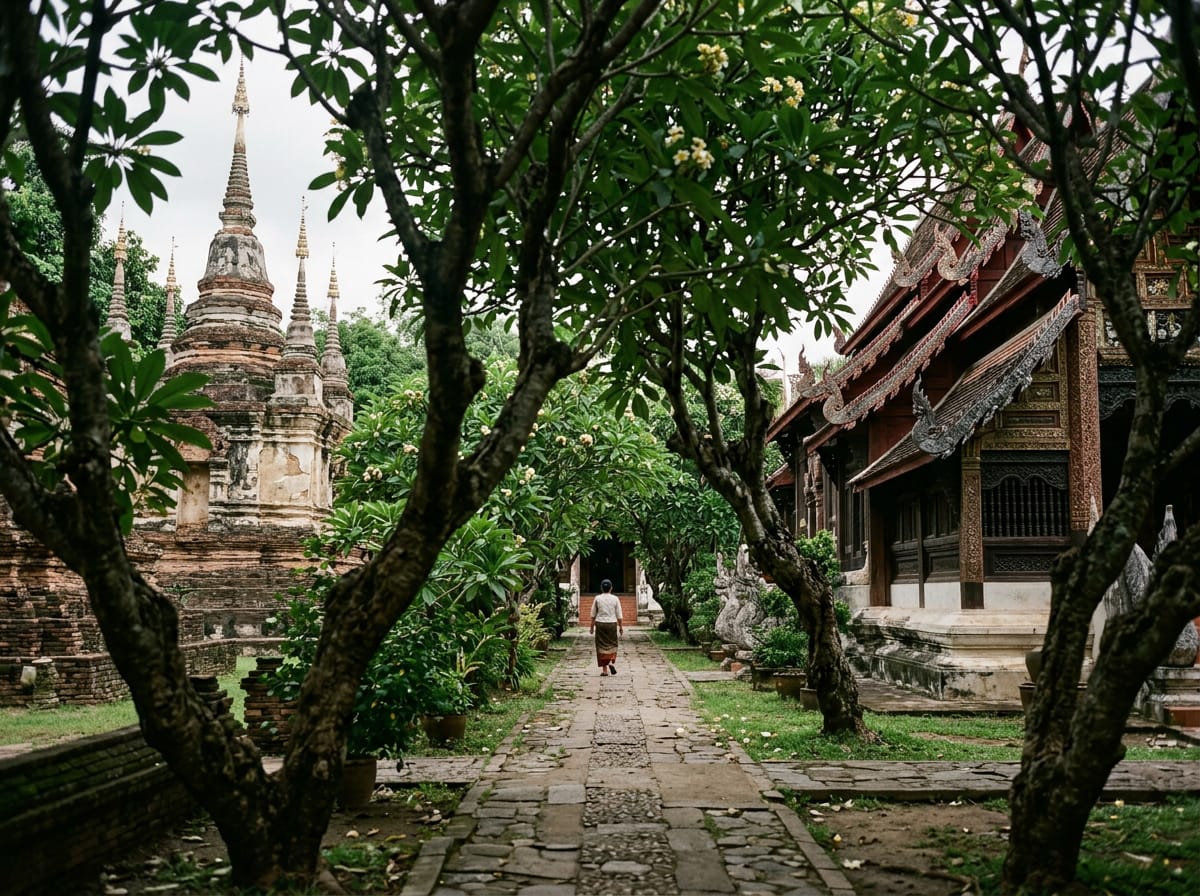
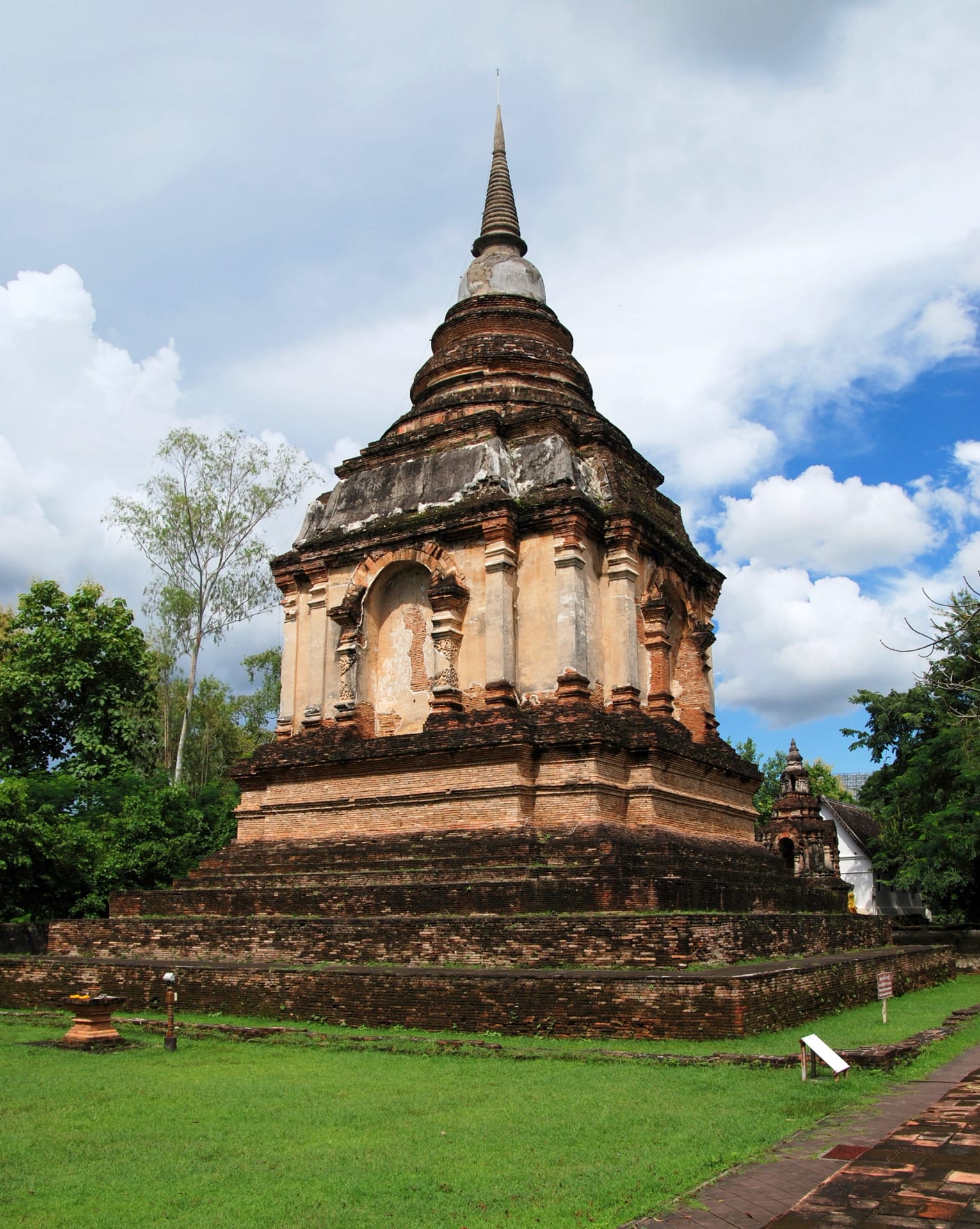
The principal chedi sits at the centre of the compound, raised on a square terrace and surrounded by frangipani trees. The form is tower-on-tower: a central spire about 18 metres tall, with four smaller corner spires at the four corners of the upper platform, and two further small spires set forward on the front platform. The total is seven. Each spire is solid brick faced in white-finished stucco, with horizontal banding that mirrors the proportions of the Indian original.
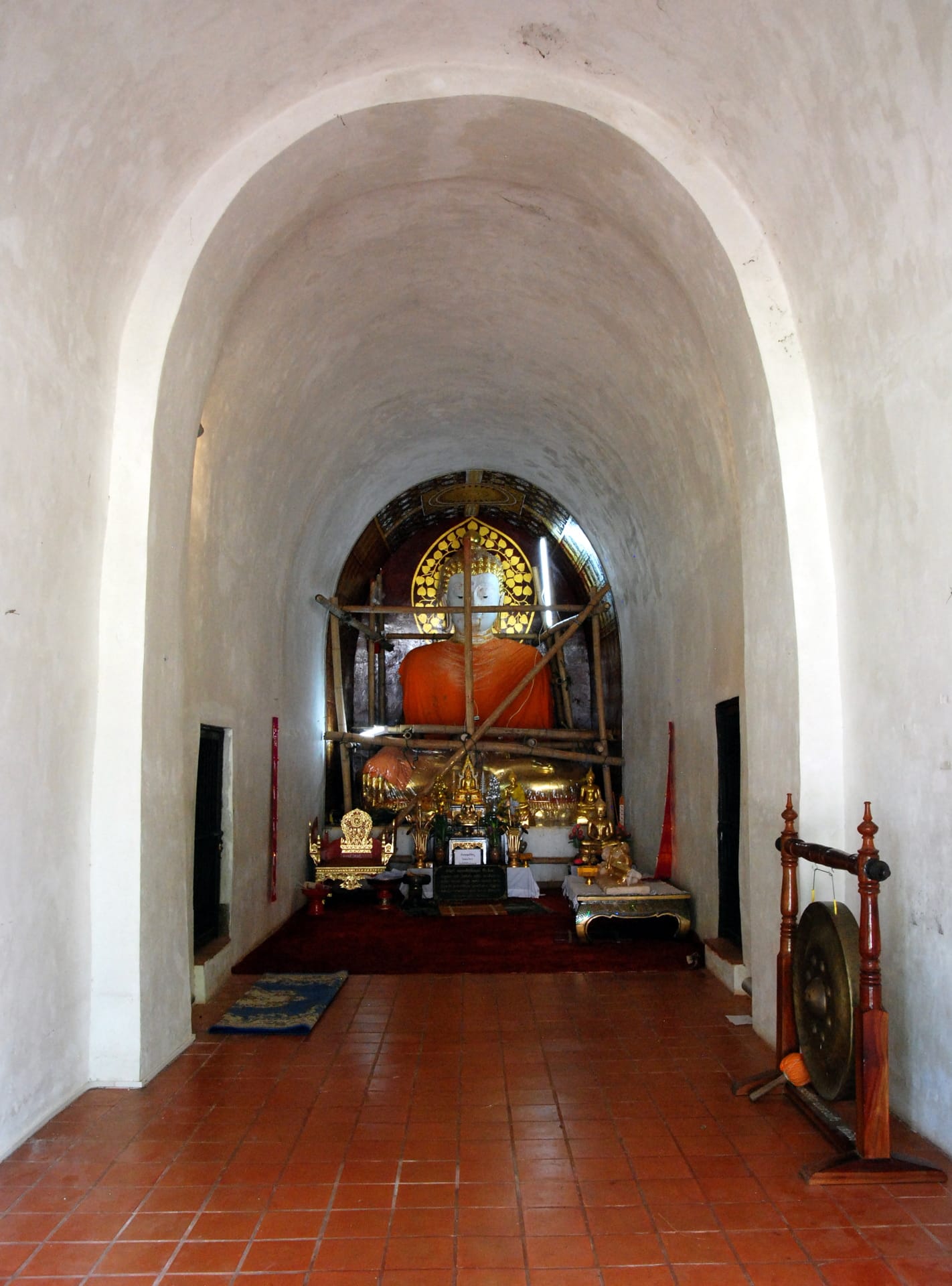
A small chamber at the eastern base of the chedi is open to visitors. Step inside; it holds a seated Buddha image in the maravijaya posture, offerings of flowers and incense, and a few worn stone inscriptions. The chamber is dim and narrow; bring a small torch if you want to study the inscriptions. The upper levels of the chedi are not accessible.
The stucco devata reliefs
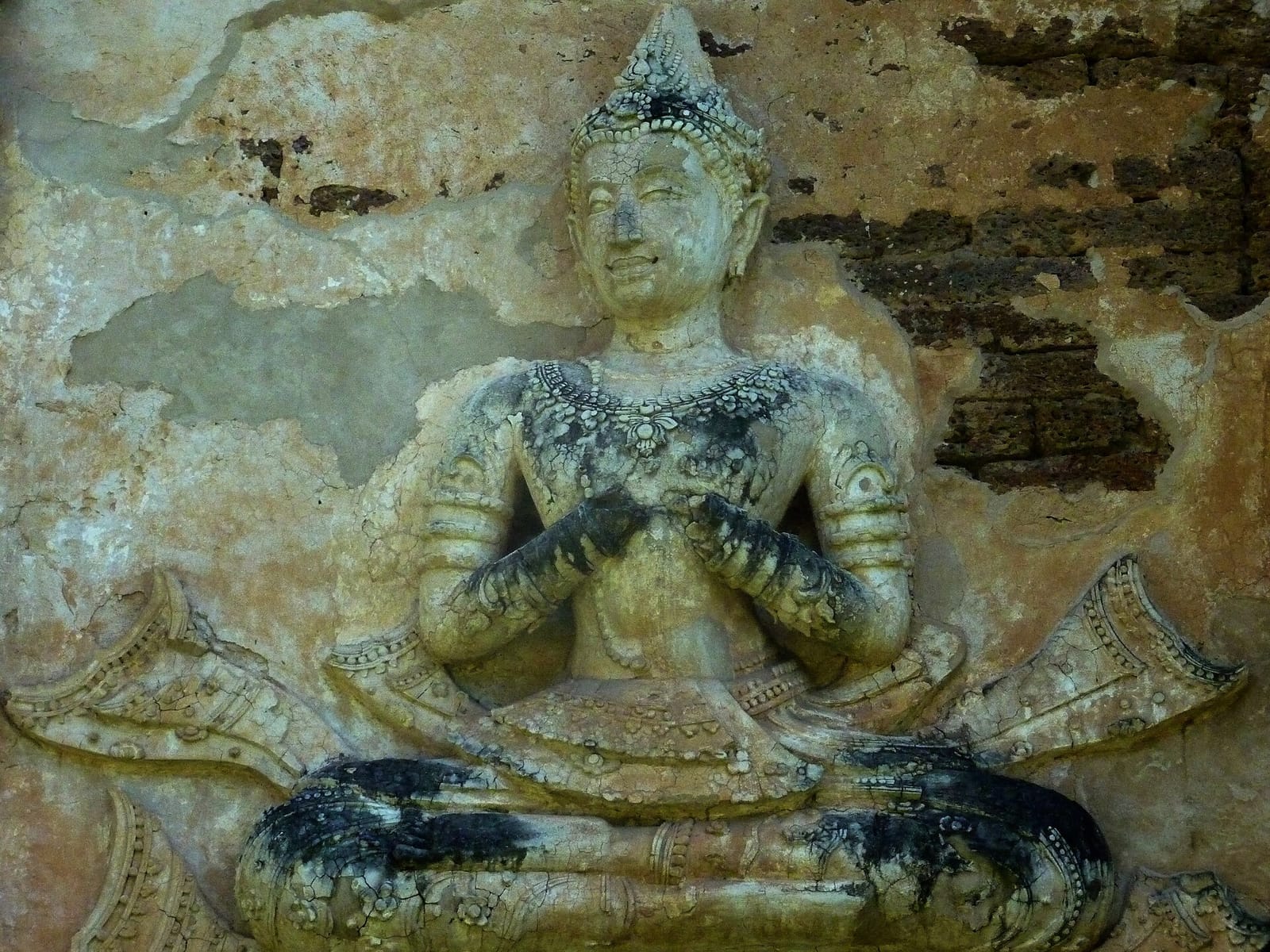
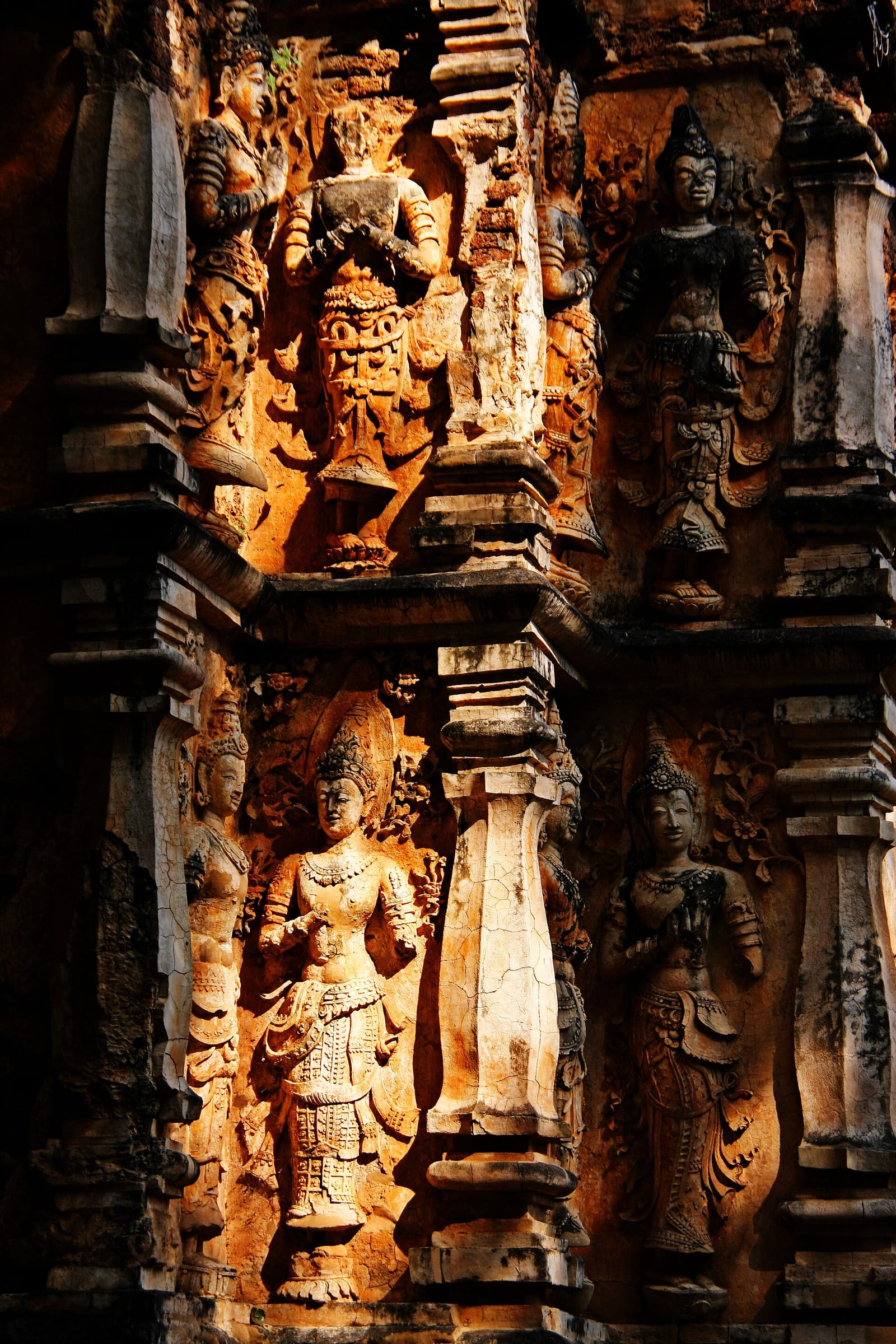
The exterior walls of the chedi carry the temple’s most significant artistic feature: a continuous frieze of stucco devata reliefs depicting members of Tilokaraj’s family. The chronicle records that the king commissioned the reliefs as a memorial to his queen, his sons and his closest courtiers, all of whom are shown as celestial beings standing in low relief in robes and jewellery of the period. The figures are roughly a metre tall, finely modelled, with detailed crowns, earrings, necklaces and finger ornaments. There are about thirty of them in total, running around the chedi at waist height.
The reliefs are the finest surviving 15th-century Lanna stucco anywhere in northern Thailand. Many are weathered and a few are missing, but the best-preserved figures (particularly on the south-east side) are extraordinary. Late afternoon side light from the west, between 16:00 and 16:45 in the cool season, catches the relief at its most readable. The work rewards a slow walk around the entire base.
Whether the figures are true portraits is its own question. The faces are individualised enough to make the family story believable, and several wear the heavy ear ornaments and layered necklaces of the fifteenth-century court rather than standardised celestial regalia. Pick one figure and follow its details for a minute or two: the stucco was worked while soft, and you can still find tool marks in the deeper folds of the robes.
The main viharn
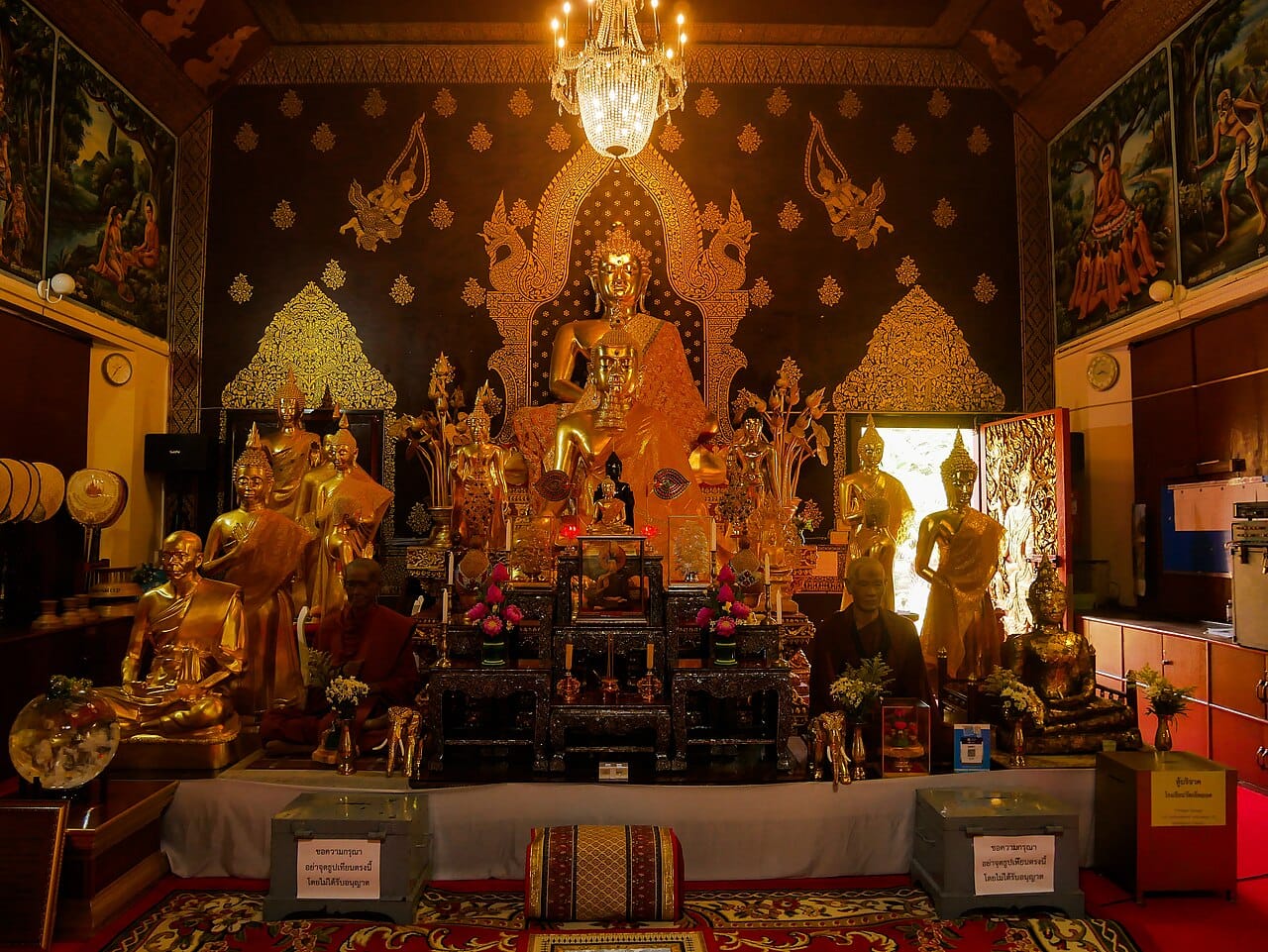
The viharn luang sits to the east of the chedi and is a 1960s rebuilding in restrained Lanna style: a wide open-sided hall under a steep pitched roof, with the principal Buddha image on a raised altar at the western end. The hall is open and airy, with no historic murals. Its function today is as the main assembly hall for daily chanting at 06:30 and 16:30. Visitors are welcome to sit at the back during these services.
The Tilokaraj chedi
At the back of the compound, behind the main chedi, stands a smaller whitewashed bell-shaped chedi on a square terrace. This is the memorial chedi of King Tilokaraj himself, built in 1487 to hold his cremated ashes. It is plain compared to the principal Mahabodhi-style stupa and is easy to walk past, but the historical association is significant: this is the resting place of the founder of the entire compound and the convener of the 1477 council.
The gardens around all four features are extensive and well kept, with lotus ponds, frangipani trees, and shaded paths leading to small subsidiary chedis and offering shrines. The whole compound functions as much as a memorial garden as a working temple, and the slowness of the walk through it is part of the experience.
Look also for the compound’s bodhi trees, their trunks wrapped in coloured cloth and shored up with mai kham (carved wooden props offered by worshippers to support the tree and, by extension, the faith). The props accumulate by the dozen under the oldest trees, and the forest of them leaning into a single trunk is one of the quieter devotional sights in the city.
How to visit
Wat Jed Yod sits about 2 km north of the Old City, just south of the Super Highway (Highway 11) at the junction with Suthep Road. The temple is on the same plot as the Chiang Mai National Museum.
From Tha Phae Gate, a Grab is the easiest option, at 10 minutes and around 100 baht outside rush hour. A red songthaew from Chang Phueak market or anywhere along Huay Kaew Road is 50 baht per person on a shared ride or 200 baht to charter. From Wat Phra Singh, a Grab is around 80 baht.
From Chiang Mai International Airport, a metered taxi is 200 baht and takes 20 minutes; the temple is on the airport-to-Old-City route via the Super Highway.
Parking is straightforward. A large free car park sits inside the compound gates on the north side, with overflow space along the eastern boundary. Motorbikes park free along the inner verges. The car park is rarely full.
The temple has no formal coach park, and few coach groups stop here. The location off the standard temple-crawl circuit is one of the reasons the compound stays quieter than the Old City temples despite its historical importance.
If you are walking or cycling, approach from the south through the lanes off Huay Kaew Road rather than along the Super Highway frontage, which has fast traffic and intermittent pavement. The crossing at the museum junction has lights. Inside the gates the noise of the road drops away almost immediately; the compound’s trees do most of the work.
The Chiang Mai National Museum sits on the adjacent plot to the south. The museum holds the most important Lanna archaeological collection in the city, including stone inscriptions and stucco fragments excavated from Wat Jed Yod itself. Most visitors combine the two, the temple first and the museum second, for a half-day that covers most of what is worth knowing about fifteenth-century Lanna.
Etiquette and dress code
The standard rules apply. Cover shoulders and knees; vests, short shorts, sheer tops and miniskirts are not permitted inside the viharn or the chedi chamber. Sarongs are lent free of charge by the main viharn entrance. Shoes come off before entering the viharn, the ubosot and the small chamber at the base of the principal chedi. The gardens and the chedi exterior can be walked in normal footwear. Hats and sunglasses should be removed inside. Sit with your legs tucked to the side rather than crossed when seated in front of any Buddha image. Do not point your feet at an image or at a monk. Women should not hand objects directly to monks; use the cloth provided. Photography is welcome throughout the compound. Drones are not permitted within the Old City moat or near the museum.
Best time to visit
The temple is at its best either in the first hour after sunrise (06:00 to 07:30) or in the late afternoon between 15:30 and 16:45. The morning gives cool air, birdsong in the gardens and almost no other visitors. The late afternoon gives side light on the stucco reliefs, which is when the devata figures on the south-east face of the chedi read at their best.
Avoid midday, particularly between November and February, when the open chedi platform reflects heat from every direction and the light on the reliefs is flat. The gardens at the back of the compound stay shaded throughout the day, but the main chedi is fully exposed.
The gardens reward unhurried visitors in another way. The frangipani and fig trees draw a steady traffic of bulbuls and sunbirds through the early morning, and the compound is open enough that you can actually watch them. The birds of Thailand page covers the common species around Chiang Mai.
The full-moon days of the Buddhist calendar (Wisakha Bucha in May, Asanha Bucha in July, Makha Bucha in February) bring small candlelight wian thian processions around the chedi at dusk, with lay supporters in white robes carrying candles, incense and lotus flowers. The processions are quieter than the equivalents at Wat Phra Singh and are particularly atmospheric. Visitors are welcome to join, walking three times around the chedi clockwise with a lit candle.
Nearby and related
Wat Jed Yod sits a little outside the standard temple circuit but pairs naturally with the National Museum next door and with the older temples inside the Old City.
- Chiang Mai National Museum — directly adjacent to the south, holding the principal Lanna archaeological collection, including pieces from Wat Jed Yod itself. Open Wednesday to Sunday, 09:00 to 16:00, 100 baht for foreigners.
- Wat Chiang Man — the oldest temple in the city, 15 minutes south by Grab inside the Old City. The natural pair for a Mangrai-dynasty history day.
- Wat Phra Singh — the principal royal Lanna temple inside the Old City, 15 minutes south by Grab. Together with Wat Chiang Man and Wat Jed Yod it forms the standard royal-temple itinerary.
- Huay Kaew Road, running west from outside the temple, leads to Chiang Mai University and on to Wat Umong and the foot of Doi Suthep — a useful onward direction if you have a full day.
Photos
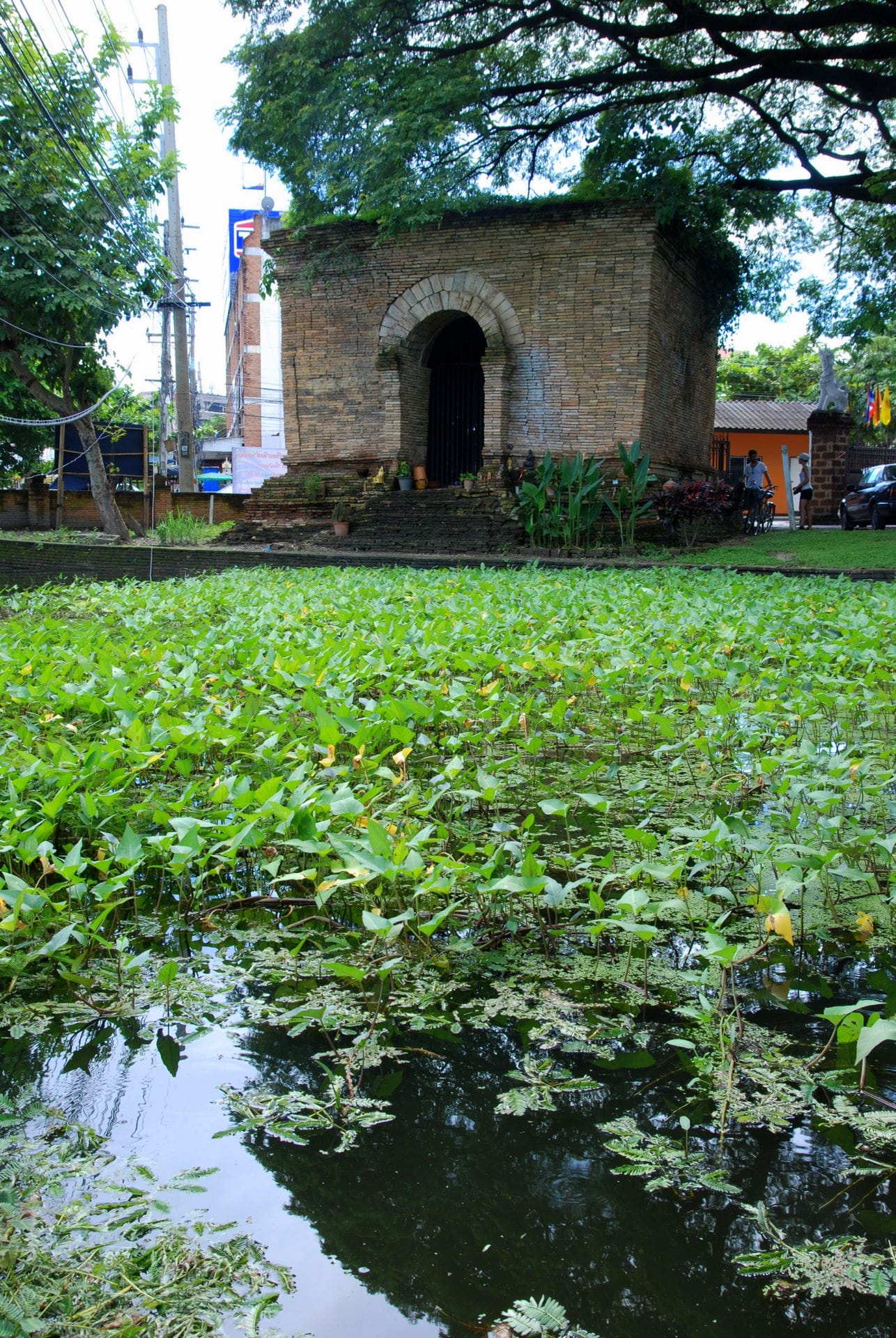
Frequently asked questions
What time does Wat Jed Yod open?
Wat Jed Yod opens daily at 06:00 and closes at 17:00. The chedi and the gardens are accessible during all open hours; the main viharn is open from 07:00 to 17:00. Morning chanting takes place at 06:30 and evening chanting at 16:30. The temple stays open later for the major Buddhist holy days — Wisakha Bucha, Asanha Bucha and Makha Bucha — when candlelight wian thian processions are held around the chedi at dusk.
Is there an entry fee at Wat Jed Yod?
No. Entry to the temple is free for everyone, foreigner or Thai. A donation box stands inside the main viharn and at the base of the chedi — 20 baht is customary. The Chiang Mai National Museum next door charges 100 baht for foreigners separately. Many visitors combine the two.
Where is Wat Jed Yod?
Wat Jed Yod sits about 2 km north of the Old City, just off the Super Highway (Highway 11) near the Chiang Mai National Museum. The street address is Super Highway Road, Chang Phueak subdistrict. From Tha Phae Gate it is a 10-minute Grab ride (around 100 baht) or a 25-minute red songthaew journey for 50 baht. The temple is not in obvious walking range of the Old City and most visitors take motorised transport.
Why is the chedi seven-spired?
The seven spires represent the seven weeks the Buddha spent in meditation immediately after his enlightenment at Bodh Gaya. The design is modelled directly on the Mahabodhi Temple in Bihar, India — the site of the enlightenment itself — which is unique in northern Thailand. King Tilokaraj commissioned a delegation to Bodh Gaya in the 1450s to record the proportions of the original, and the Wat Jed Yod chedi was built to those measurements when the delegation returned. It is therefore not only seven-spired but also the closest architectural copy of the Mahabodhi anywhere in Southeast Asia.
What happened here in 1477?
Wat Jed Yod was the host site for the Eighth World Buddhist Council, convened in 1477 by King Tilokaraj. The council brought together senior monks from across the Theravada world — Lanna, Sukhothai, Burma, Lan Xang (Laos) and the south — and produced a revised text of the Pali canon. It was the third major canonical council since the Buddha's lifetime and the only one ever held in Thailand. The revised canon produced here informed Theravada Buddhist scholarship for the next four centuries. The site is therefore one of the most historically important Buddhist locations in Southeast Asia, even though most visitors arrive without knowing it.
What is the dress code for Wat Jed Yod?
Shoulders and knees must be covered for both men and women. Sarongs are lent at a small stand by the main viharn entrance. Shoes come off before entering the viharn, the ubosot and the inner chamber at the base of the chedi. The gardens and the chedi exterior can be walked in normal footwear. Hats and sunglasses should be removed inside the buildings.
What are the stucco reliefs on the chedi?
The exterior walls of the chedi carry stucco devata reliefs — figures of celestial beings — modelled on members of King Tilokaraj's own family. According to the temple chronicle, Tilokaraj commissioned the reliefs to honour his queen, his sons and his closest courtiers, who are depicted as devata standing in low relief along the outer walls. The figures are about a metre tall, finely modelled with detailed jewellery, hair ornaments and robes. They are the best surviving 15th-century Lanna stucco anywhere in the city. Late afternoon side light from the west catches the relief best.
How long does a visit to Wat Jed Yod take?
Allow 45 to 60 minutes for the main chedi, the viharn, the gardens and the smaller chedi at the back of the compound holding Tilokaraj's ashes. Photographers should add another 20 minutes for the stucco reliefs from different angles. If you combine the visit with the Chiang Mai National Museum next door, plan for 2 to 3 hours total. The gardens themselves are large enough for a slow walk and the temple is one of the quietest major compounds in the city.
Is Wat Jed Yod busy with tourists?
No — it is one of the quieter major temples in Chiang Mai despite its historical importance. The location north of the Old City puts it outside the standard temple-crawl circuit and few coach groups stop here. Morning and late afternoon visits are often almost solitary. Saturday afternoons can be slightly busier because local families come to make merit. Outside coach windows the compound stays peaceful in a way that Wat Phra Singh and Wat Chedi Luang no longer manage.
Can I see inside the chedi?
Yes. A small chamber at the base of the chedi, on the eastern side, is open during compound hours. It holds a seated Buddha image and offerings. The chamber is narrow and dim — bring a small torch if you want to study the inscriptions. Step inside, sit briefly in front of the image, and step out again; the visit takes only a minute or two but is part of the proper circuit. The upper levels of the chedi are not accessible to visitors.
When was Wat Jed Yod built?
Wat Jed Yod was founded in 1455 by King Tilokaraj, the ninth ruler of the Mangrai dynasty and one of the most powerful Lanna kings. The chedi itself was completed by 1476, in time to host the Eighth World Buddhist Council the following year. The compound declined after the Burmese conquest of 1558 but the chedi survived because it was solid masonry. The current main viharn dates from the 1960s, when the temple was restored under royal patronage. The smaller chedi holding Tilokaraj's own ashes stands at the back of the compound and dates from his death in 1487.
Can I visit Wat Jed Yod and the National Museum together?
Yes — they sit on adjacent plots and are designed to be visited together. The Chiang Mai National Museum, on the south side, holds the most important Lanna archaeological collection in the city, including pieces excavated from Wat Jed Yod itself. The museum opens at 09:00 and closes at 16:00, Wednesday to Sunday (closed Monday and Tuesday). Visit the temple first, walk to the museum next, and plan 90 minutes for each. The combination is one of the best history-focused half-days in the city.
Related guides
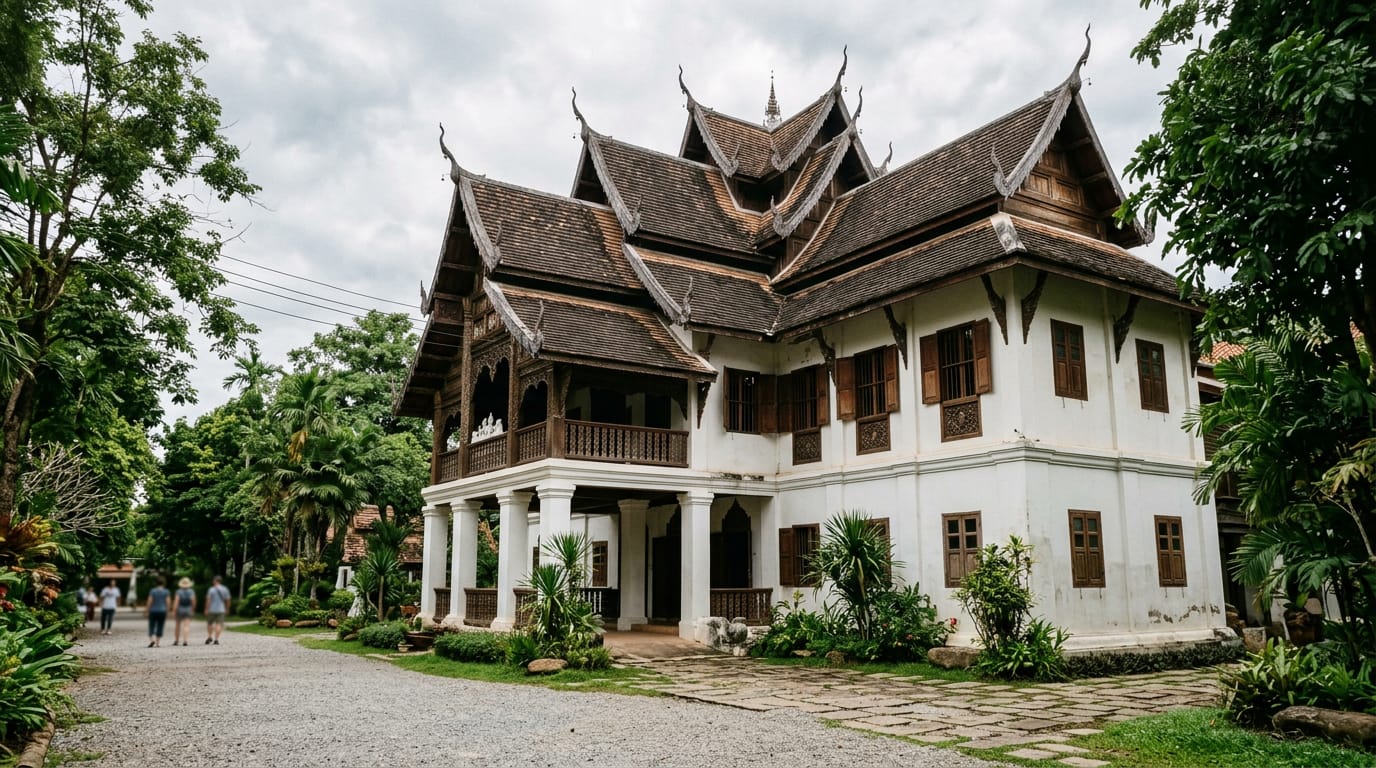
Museum
Chiang Mai National Museum
The Chiang Mai National Museum is the principal state collection for northern Thailand, housed in a purpose-built Lanna-influenced hall opened in 1973 under the Fine Arts Department. Its galleries run from Ban Chiang prehistoric pottery through Hariphunchai bronzes and the full sweep of the Mangrai dynasty to the modern royal regalia of the Chiang Mai ruling house. The building sits on the Superhighway north of the Old City, next door to Wat Jed Yod.
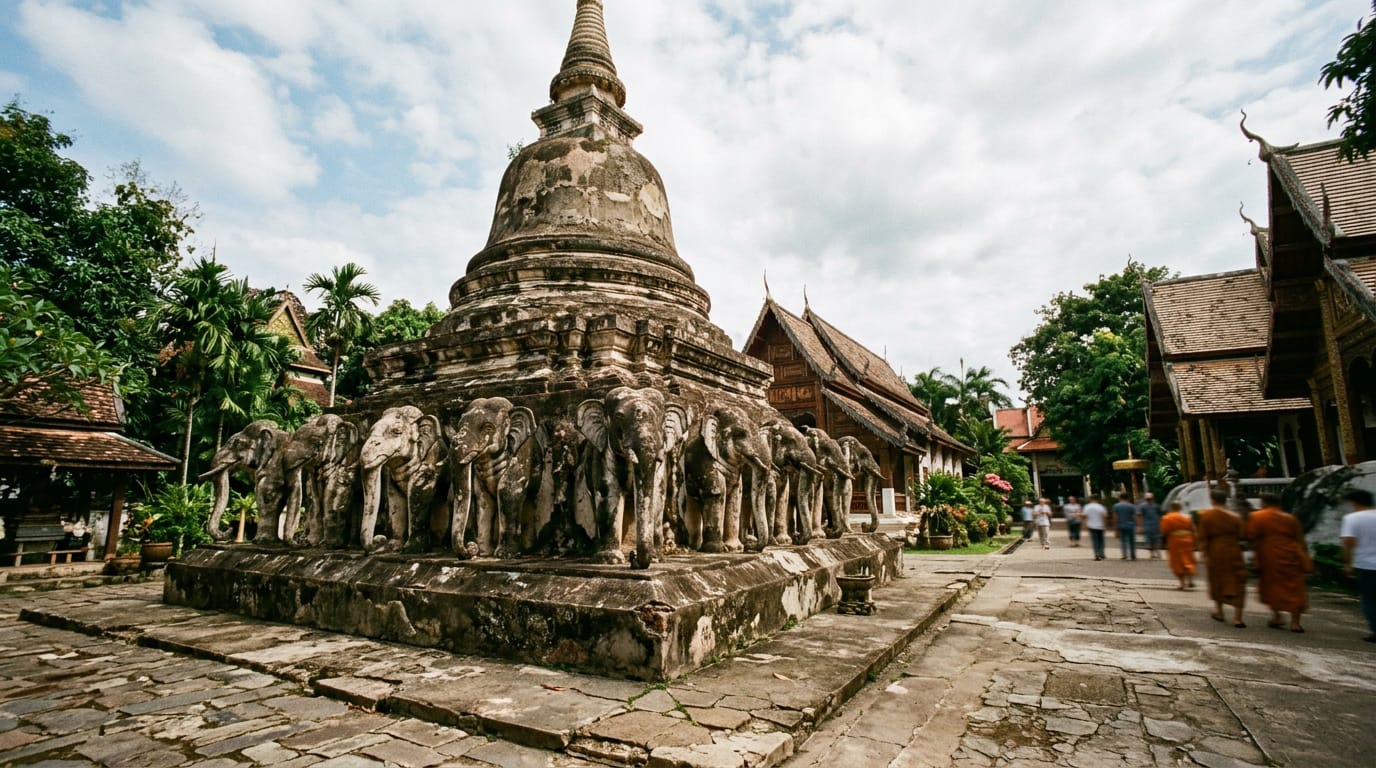
Temple
Wat Chiang Man
Wat Chiang Man is the oldest temple in Chiang Mai, founded in 1297 by King Mangrai as the first building inside his new walled city. Its Chedi Chang Lom, ringed at the base by fifteen elephant statues in stucco, set the template for Lanna stupa design. The Phra Sila marble Buddha and the crystal Phra Setangkhamani are kept inside a locked viharn.
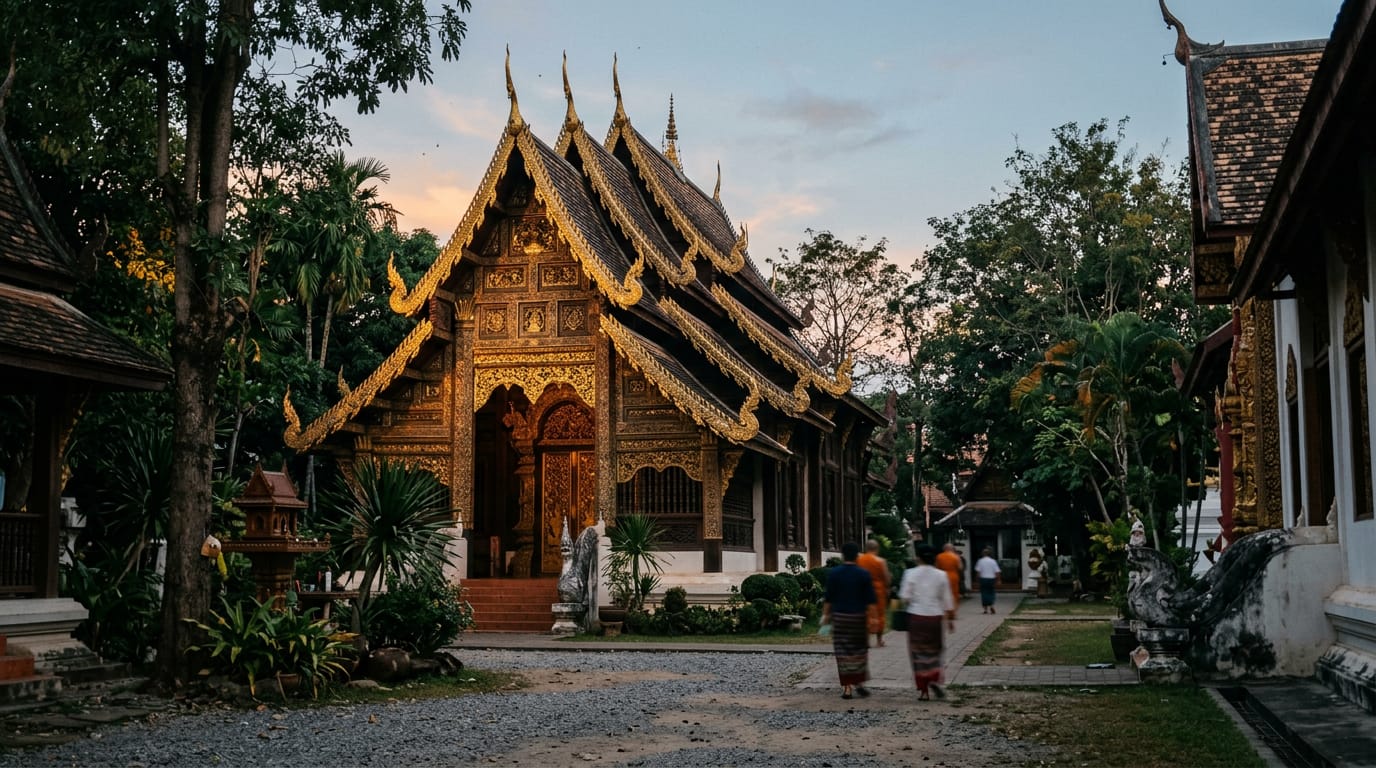
Temple
Wat Phra Singh
Wat Phra Singh is the most revered temple inside Chiang Mai's Old City, founded in 1345 by King Phayu of the Mangrai dynasty. Its Lai Kham viharn shelters the Phra Buddha Sihing — the Lion Buddha — which is paraded through the streets each Songkran. Together with its gilded chedi, carved teak gables and gold-leafed scripture library, the compound is the finest single example of Late Lanna architecture in northern Thailand.