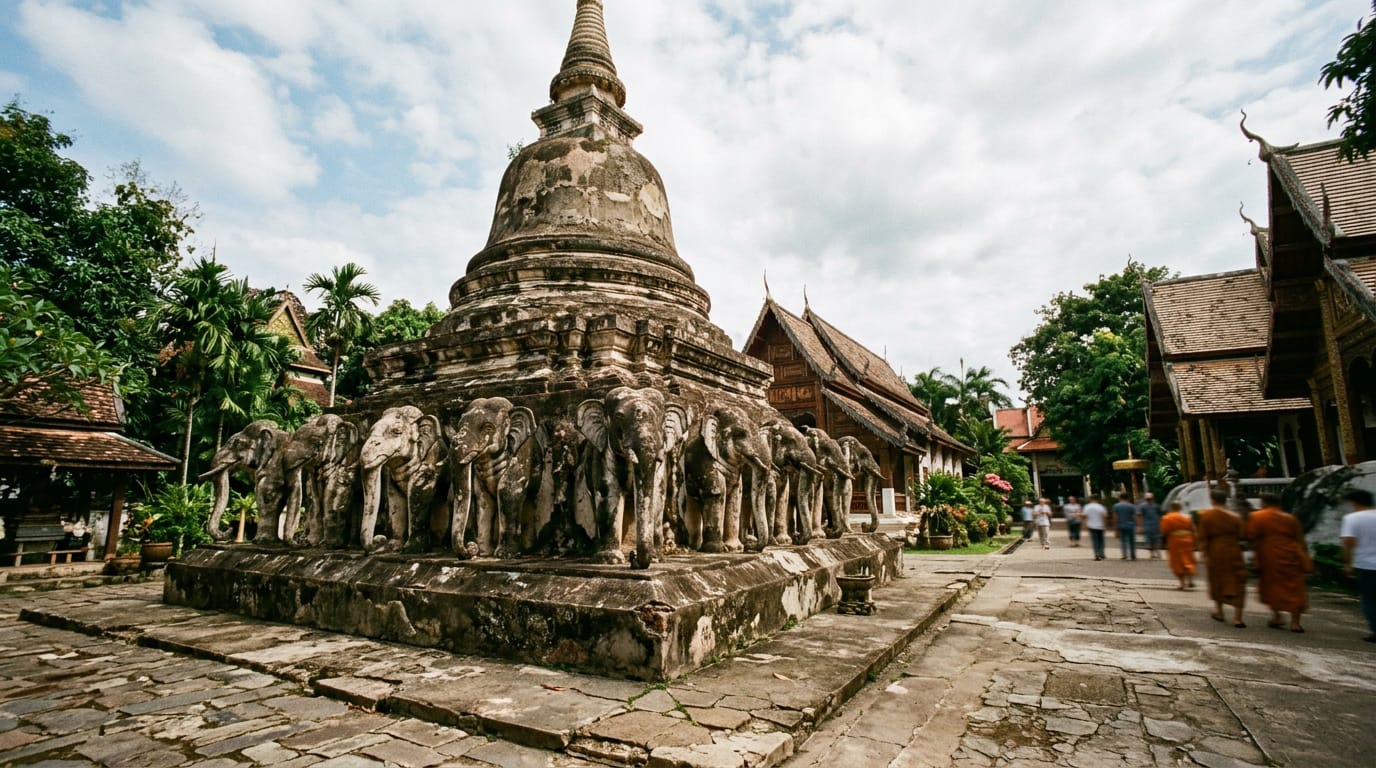
Wat Chiang Man is the oldest temple in Chiang Mai, founded in 1297 by King Mangrai as the first building inside his new walled city. Its Chedi Chang Lom, ringed at the base by fifteen elephant statues in stucco, set the template for Lanna stupa design. The Phra Sila marble Buddha and the crystal Phra Setangkhamani are kept inside a locked viharn.
Updated
Wat Chiang Man is the oldest temple in Chiang Mai. King Mangrai founded the city in April 1296 and ordered this wat built the following year on the patch of ground where he had camped while planning the walls. Seven centuries later it is still an active monastery, and it holds two of the most revered Buddha images in northern Thailand. Most visitors miss it. That is a mistake.
History and significance
The temple sits in the north-east quarter of the walled Old City, on Ratchaphakhinai Road, about halfway between the Three Kings monument and Chang Phueak Gate. It was the first permanent building inside Chiang Mai. Tradition holds that Mangrai chose this exact ground because the site felt auspicious during the planning meetings of 1294–1296, when he and his allies (King Ngam Muang of Phayao and King Ramkhamhaeng of Sukhothai) selected the location for the new Lanna capital. The three rulers later became known as the Three Kings, commemorated by the bronze monument 600 metres south. Wat Chiang Man is, in effect, the foundation stone of the entire city.
The name records the moment. ‘Chiang Man’ is usually read as ‘the steadfast city’, a deliberate statement about a capital that was, at the time, a building site surrounded by rivals. Mangrai is said to have lived on this spot while the walls went up, so the temple marks the city’s first religious foundation and its first royal address at once.
A long stone inscription set into the compound wall behind the ordination hall records all of this. The text was carved in 1581, during a period of Burmese occupation, and gathers earlier traditions that had been transmitted orally. It dates the temple’s founding to the equivalent of 1297, names Mangrai as the founder, and lists the abbots who served through the fourteenth century. It is one of the earliest dated documents in Lanna history and is still studied by scholars in Chiang Mai University’s Lanna Studies department.
The compound suffered repeatedly during the long Burmese occupations of the sixteenth, seventeenth and eighteenth centuries. The viharns were burnt at least twice, the bronze fittings melted down, and the monastic community scattered. After King Kawila recovered Chiang Mai in 1796 the wat was rebuilt as one of his earliest restoration projects, with the current main viharn dating from around 1820. The elephant chedi behind it is older; the lower terrace and the elephant figures themselves are essentially original, though the bell and finial were re-gilded in the 1920s and again in 2014.
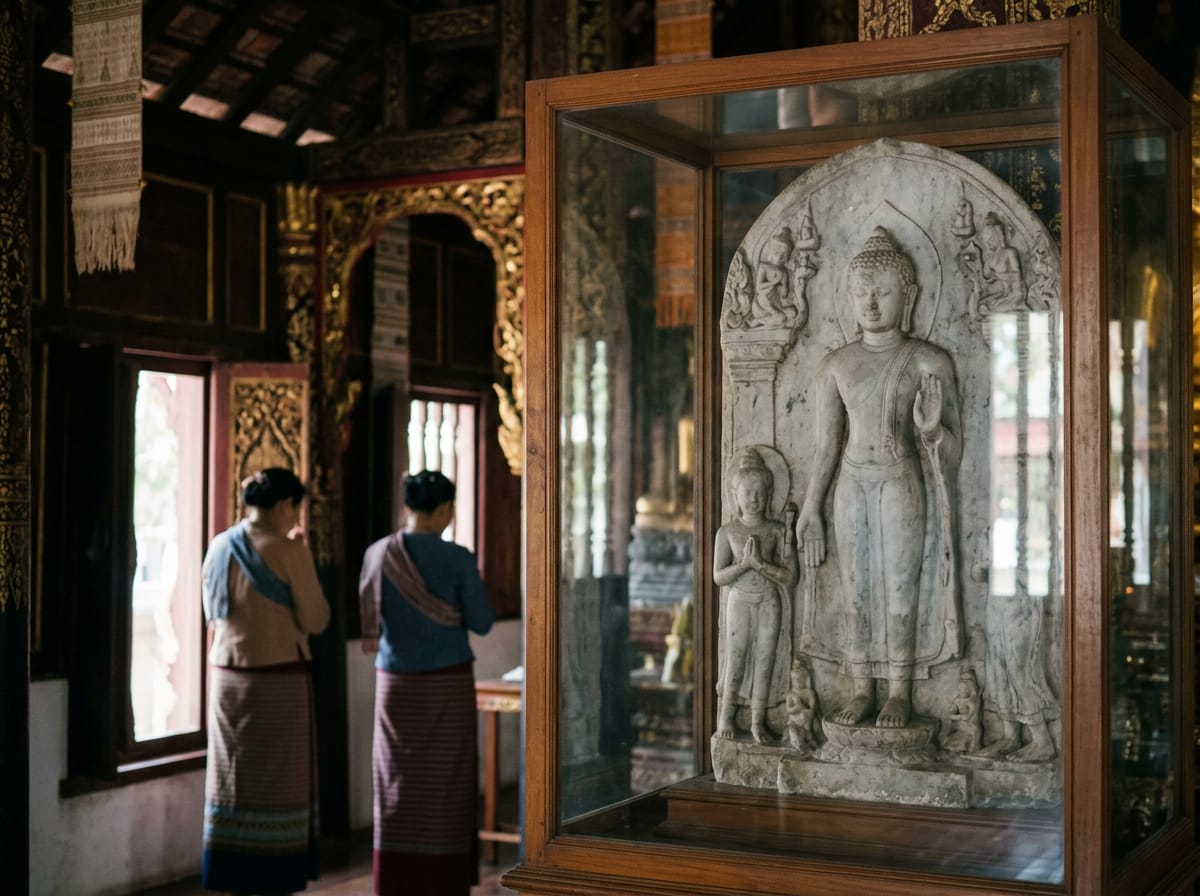
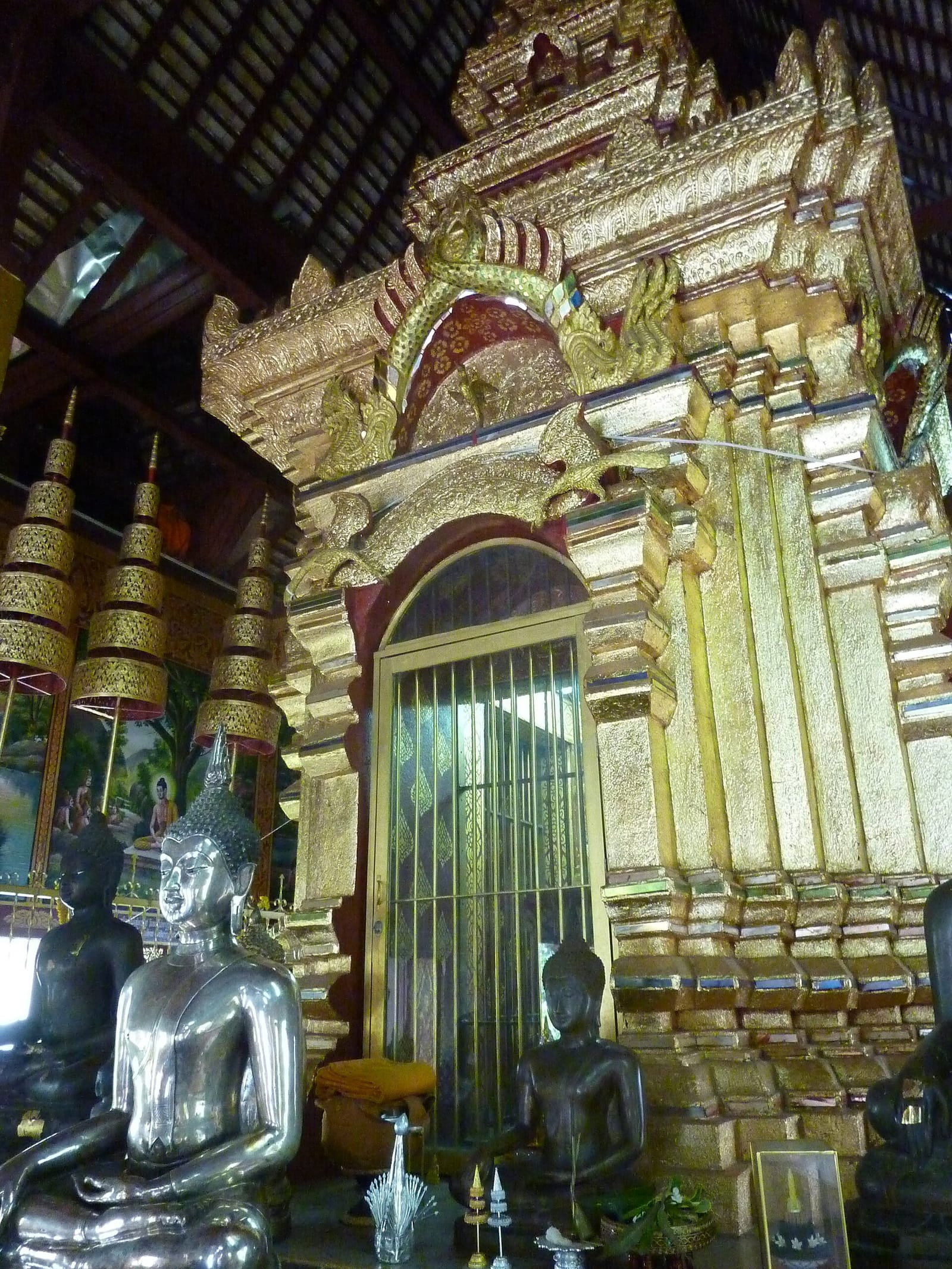
The temple’s other treasure is its pair of ancient images, the Phra Sila and Phra Setangkhamani. Both are believed to be around 1,800 years old and to have been brought to Lanna from Sri Lanka and northern India by way of Lopburi. The Phra Sila is a marble relief of the Buddha taming the elephant Nalagiri; the Phra Setangkhamani is a tiny crystal image, less than ten centimetres tall, said to have rain-making properties. Both are kept inside a locked grille in the smaller viharn and brought out for processions on Songkran and the major Buddhist full-moon days. Their actual age and origin are debated, but their religious importance is not; northern Thai pilgrims travel here specifically to see them.
What to see
The compound is small and the route around it is short. Five buildings cluster inside a single walled enclosure roughly 150 metres on each side.
The Chedi Chang Lom
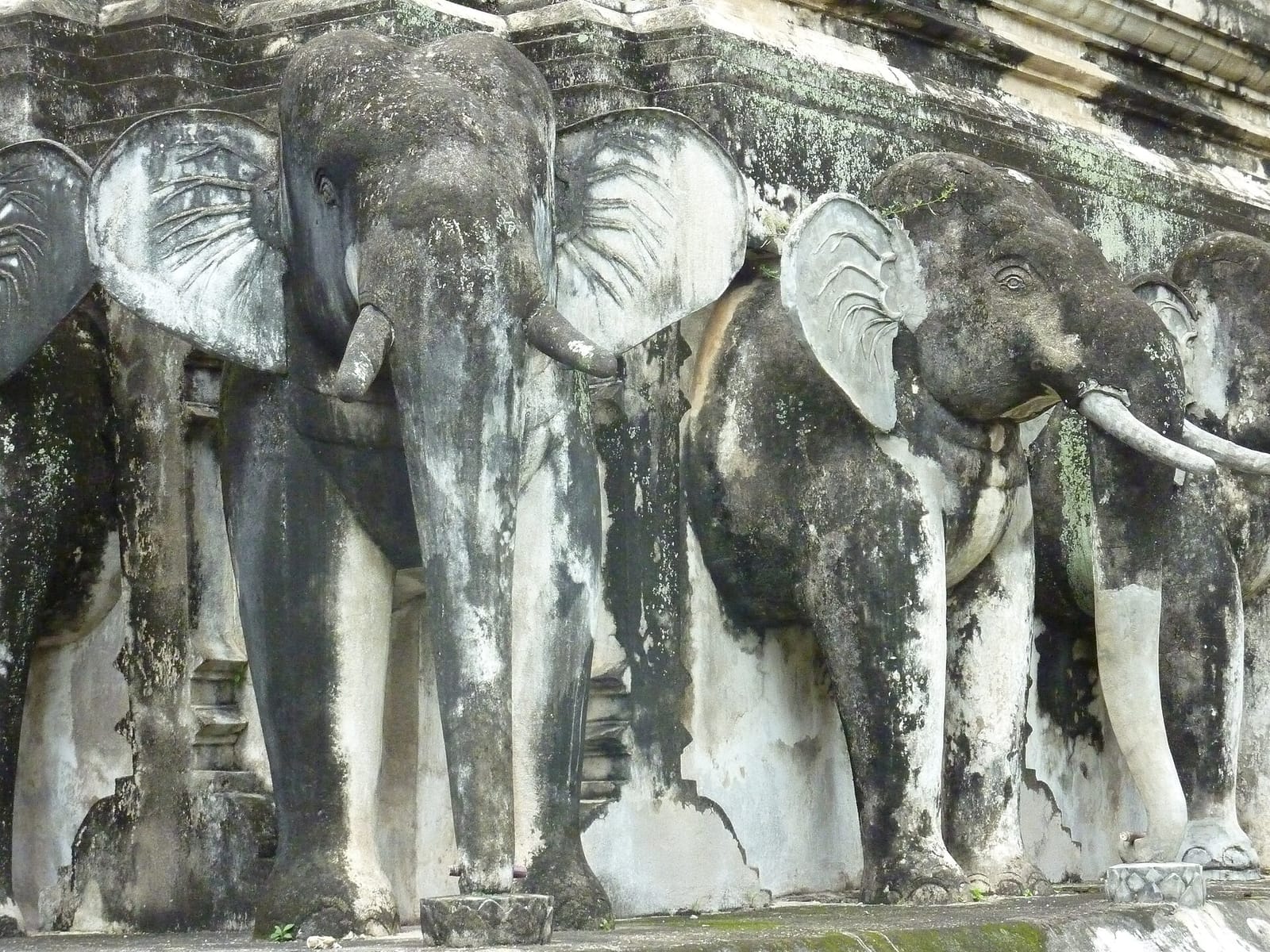
The elephant chedi is the highlight and the reason most photographers come. It stands behind the main viharn on a square terrace, with fifteen half-bodied elephants in painted stucco emerging from the lower wall as if carrying the structure on their backs. Five elephants face each of the three visible sides (the fourth side abuts the viharn). The bell above sits on a stepped octagonal base and rises to a pointed gold spire about 18 metres high.
This was the first Lanna chedi to use the elephant-buttress motif, borrowed from earlier Sukhothai stupas such as Wat Chang Lom at Si Satchanalai. From here the motif spread to Wat Phra Singh, Wat Suan Dok, and dozens of smaller royal temples. The Wat Chiang Man elephants are the prototype. They were last restored in 2008 by craftsmen from the Fine Arts Department, who replaced the cement-render skin while leaving the original stucco cores intact. The afternoon light from the south-west catches them best between 15:30 and 16:30.
Stand at the south-east corner and read the structure from bottom to top: the square elephant terrace is Sukhothai thinking, the octagonal courses above it are Lanna, and the gilded bell is the crown on both. The early history of Lanna architecture, borrowing from the south and building its own grammar on top, is stacked up in one 18-metre monument. It is also worth crouching. Photographed from knee height at the terrace edge, the elephants appear to be walking out of the wall.
The main viharn
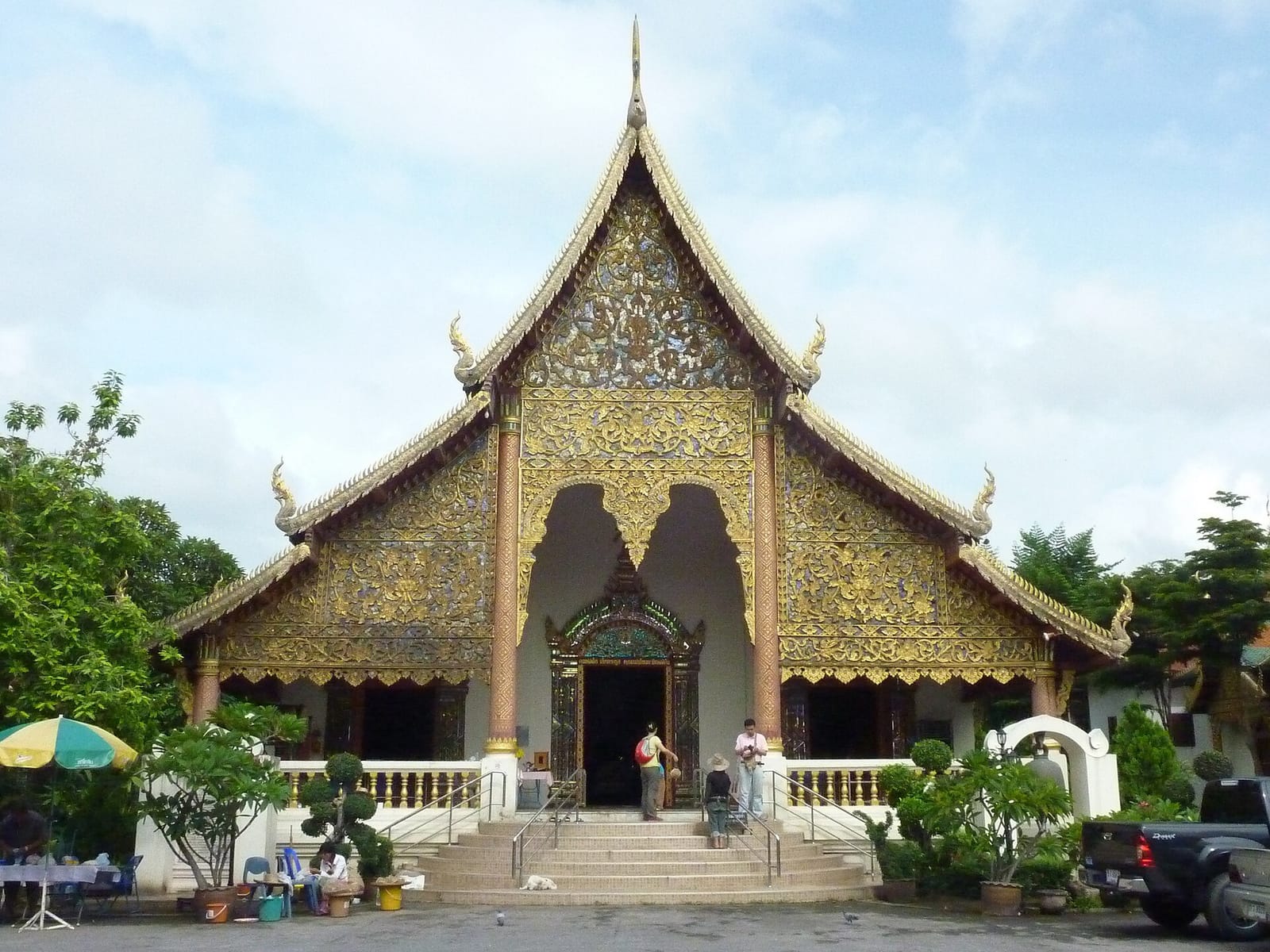
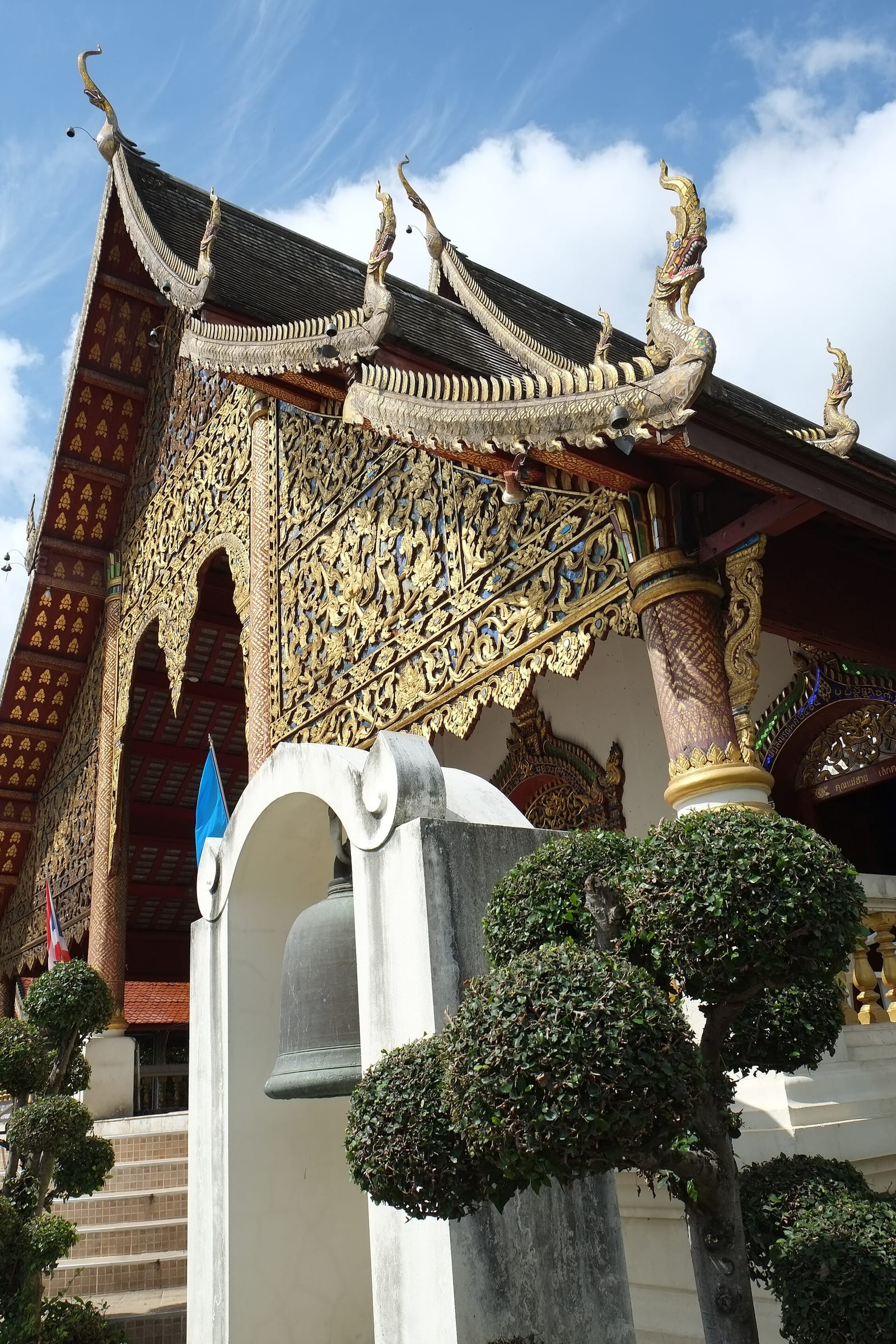
The viharn luang stands on the east-west central axis just inside the principal gate. It is a Kawila-era building from around 1820, with a three-tiered Lanna roof, gilded gable carving, and a wide raised teak floor inside. The principal image is a large copper-alloy Buddha in the maravijaya posture, seated on a tall altar at the western end. The walls are plain; there are no historic murals here, the original paintings having been lost in the eighteenth-century fires.
The viharn is used for daily chanting at 06:30 and 16:30 and for the regular Sunday alms-blessing ceremonies. Visitors are welcome at any of these provided they sit at the back, do not photograph during the service, and stay until it ends.
The smaller viharn: Phra Sila and Phra Setangkhamani
To the south of the main viharn stands a smaller assembly hall built specifically to house the two ancient images. The interior is dim, dominated by a gilt mondop on the central altar in which the Phra Setangkhamani sits inside a small reliquary, and a side niche behind glass holding the Phra Sila marble. Both images are usually behind locked grilles, but you can see them clearly through the bars at any time. On Songkran, on the major Buddhist holy days, and during the temple’s own January fair, the grilles are opened and the images are carried in slow procession around the elephant chedi while worshippers pour lustral water over them.
The ubosot
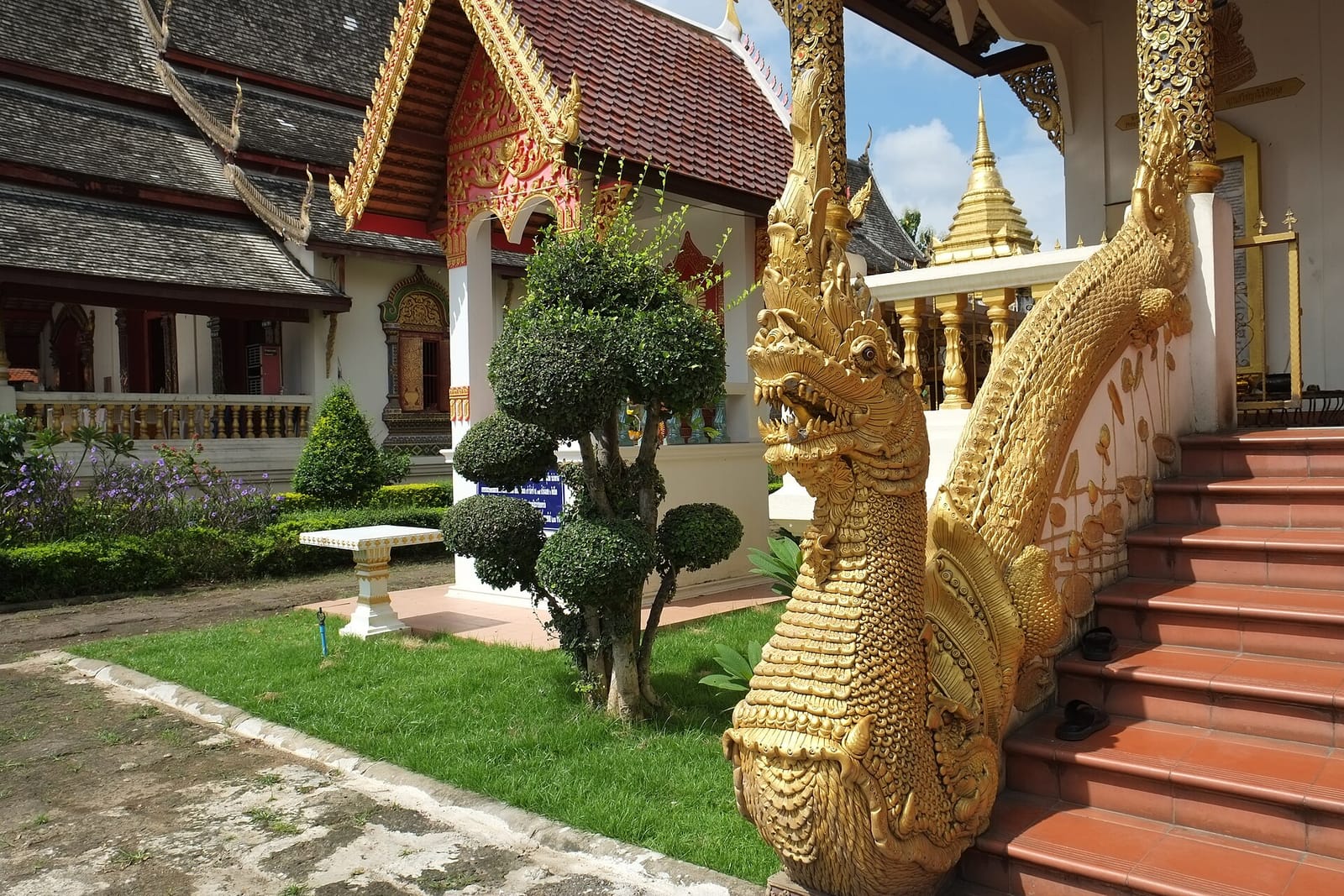
The ordination hall sits in its own walled inner enclosure to the north, marked by sema boundary stones in the form of seated stone lions. The exterior carving, particularly the nak sadung serpent finials on the gable ends, is fine work. The hall itself is opened only for ordinations and major ceremonies. The 1581 stone inscription that records the temple’s founding is mounted in the wall just behind the ubosot, with a Thai-and-English translation panel beside it.
The ho trai
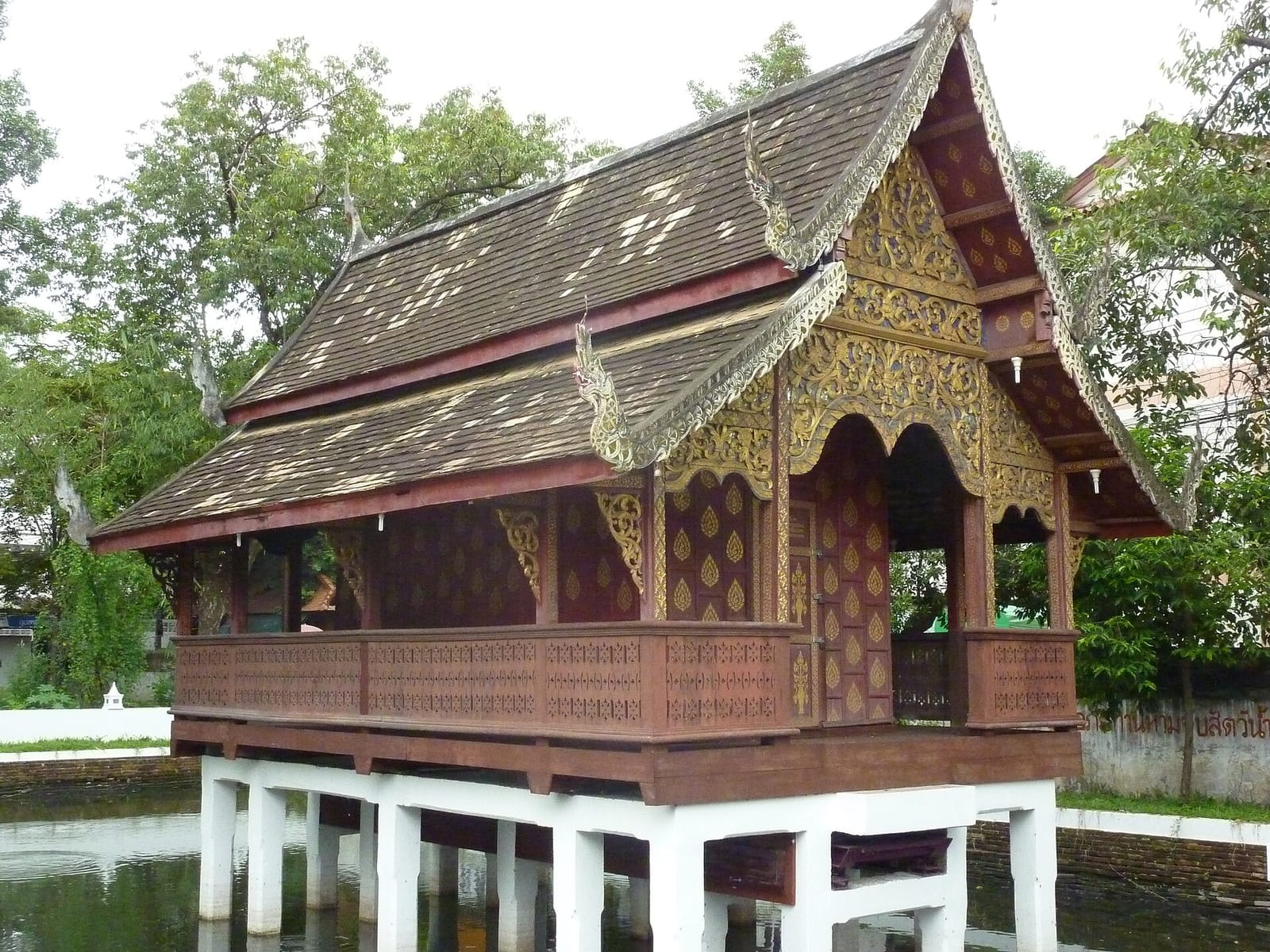
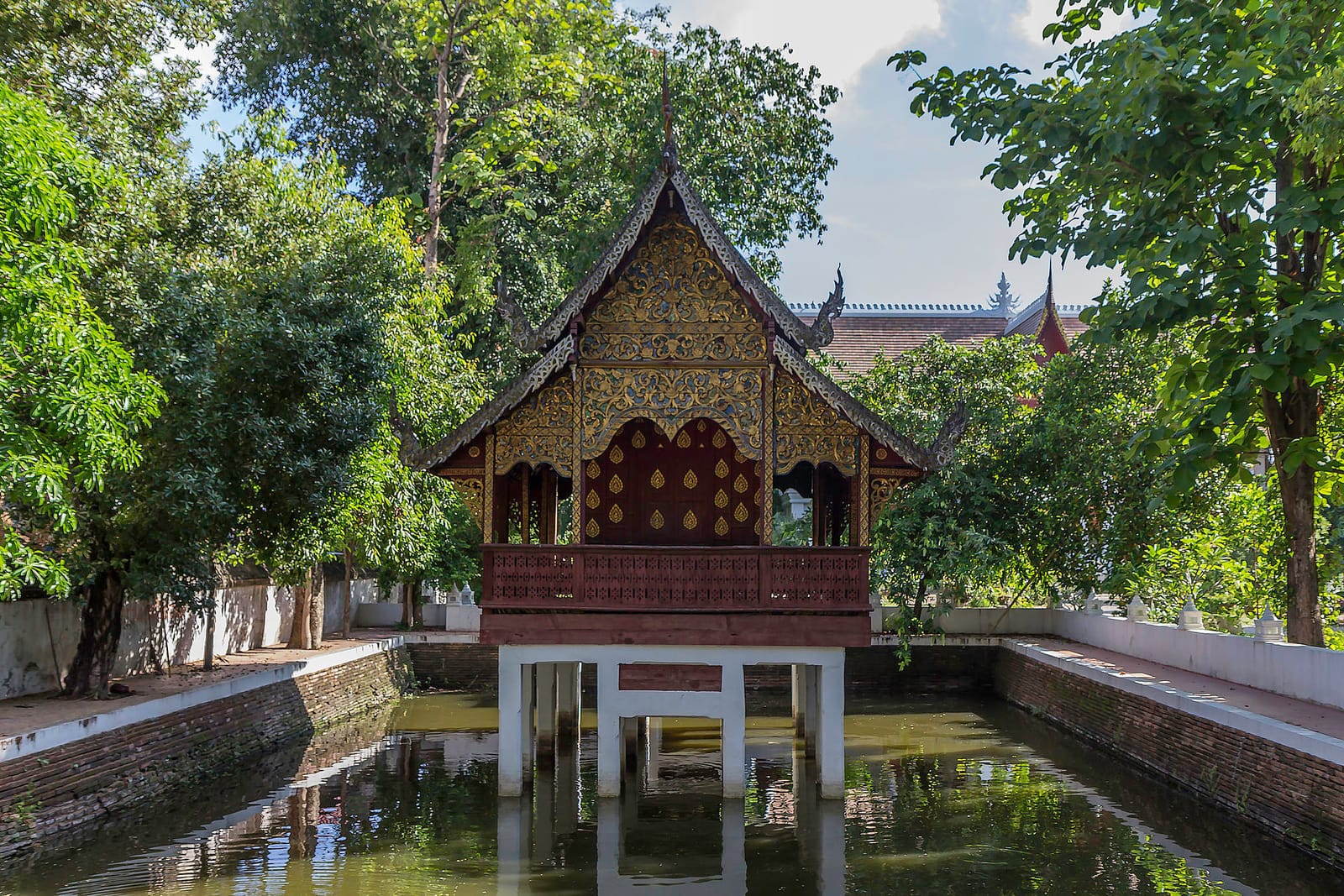
The ho trai scripture library stands on a high masonry plinth at the southern edge of the compound. The raised platform protected palm-leaf manuscripts from termites, flooding and rodents, a recurring problem in the rainy season. The upper storey is teak, with carved wooden shutters and small stucco deva figures in shallow relief along the eaves. The building is locked, but the exterior reads well from every side. It is one of the most complete surviving ho trai in northern Thailand and worth circling once.
How to visit
Wat Chiang Man sits in the quieter north-east quarter of the Old City, well away from the main tourist trail. From Tha Phae Gate at the eastern moat, walk west along Ratchadamnoen Road for about 400 metres, then turn right onto Ratchaphakhinai Road and continue north for 600 metres. The temple gate is on the left, marked by a pair of small white naga pillars. The total walk takes 15 minutes.
From the Three Kings monument, walk north on Phra Pokklao Road for 200 metres, turn right onto Wiang Kaeo Road and follow it east for 400 metres, then turn left onto Ratchaphakhinai. The walk takes 10 minutes through residential lanes that are themselves part of the experience: old teak houses, small noodle stalls, the smell of jasmine in the late afternoon.
From outside the moat, a red songthaew from Chang Phueak market or Warorot market costs 30 baht per person on a shared ride, or 100 baht to charter. Grab fares from the Nimmanhaemin area run 100 to 130 baht.
Parking is easy by Old City standards. A free public car park sits on Ratchaphakhinai Road 100 metres north of the temple and another on Wiang Kaeo Road just to the south. Motorbikes can park on the verge directly outside the gate. The temple has no formal coach park, which is one of the reasons it stays quieter than its better-known neighbours.
The surrounding lanes are pleasant for walking. Wat Lam Chang sits 3 minutes west, Wat Dok Eung 5 minutes south, and the small but striking Burmese-style Wat Pa Pao 8 minutes north. A morning that takes in all four of these plus Wat Chiang Man will give you a much richer feel for the religious geography of the Old City than the standard Wat Phra Singh-Wat Chedi Luang circuit.
On Sundays it is worth organising the day backwards: temple in the late afternoon, then a slow walk south to Ratchadamnoen Road as the Sunday Walking Street sets up from 16:00. The quiet northern reaches of the market are ten minutes from the temple gate, and arriving with the stallholders, before the crowds thicken, is the best way to see it.
Etiquette and dress code
The rules are the same as at every major Thai temple. Cover shoulders and knees; vests, short shorts, sheer tops and miniskirts are turned away. Loaner sarongs sit in a basket by the main viharn door, free of charge, with a 20 baht donation appreciated. Shoes come off before entering any of the viharns or the ubosot; leave them on the racks. Remove hats and sunglasses inside. Sit with your legs tucked to the side rather than crossed in front of any Buddha image. Do not point your feet at an image. Women should not hand objects directly to monks; place items on a cloth or tray. Photography is fine throughout the compound and inside the viharns; flash near the ancient images is discouraged. Drones are not permitted anywhere inside the Old City moat.
Festivals and ceremonies
The ceremonial year peaks at Songkran, the Thai new year in mid-April, when the Phra Sila and Phra Setangkhamani leave their grilles and are carried out so the public can pour scented water over them. The belief that the crystal image brings rain gives the ritual real weight: the procession falls at the very end of the dry season, when the request is not theoretical. If you are in the city for Songkran, the image-bathing ceremonies here are a quiet counterpoint to the water fights on the moat road.
The temple’s own fair in January runs for several evenings, with food stalls along Ratchaphakhinai Road, sermons in the main viharn and the compound strung with lights. It is a neighbourhood event rather than a tourist one, which is precisely its appeal: you will eat well for 100 baht and watch the elephant chedi by lamplight.
On the major Buddhist full-moon days an evening wian tian, a candlelit walk three times around the chedi, begins after dark. Visitors may join; candle-and-flower sets cost about 20 baht at the table by the viharn door.
Best time to visit
The temple is at its best in the first hour after sunrise, when the elephant chedi catches direct east light and the lanes around the compound are empty. From 06:00 to 08:00 you will often have the place almost to yourself. The 06:30 morning chanting begins shortly after the gate opens; sit at the back of the main viharn and listen for fifteen minutes if you have the time.
The afternoon also rewards a visit. The light on the elephants is best from 15:30 to 16:30, when the south-west sun grazes the stucco at a low angle and the figures cast long shadows along the terrace. The 16:30 evening chanting follows. Avoid 10:30 to 12:30 in the cool season, when coach groups occasionally stop here on a longer city circuit. Saturday afternoons are busier than other days because local families come to make merit. The full-moon days of the Buddhist calendar bring quiet processions around the chedi at dusk and are particularly worth a visit if your dates coincide.
Nearby and related
Wat Chiang Man sits in the densest cluster of historic temples in the city. A morning’s walk can reasonably cover four or five compounds without ever stepping outside the moat.
- Wat Phra Singh — the principal royal temple of the Old City, 12 minutes’ walk south-west, holding the Phra Buddha Sihing and the textbook example of Late Lanna architecture.
- Wat Chedi Luang — the ruined 60-metre chedi of the old royal temple, 10 minutes’ walk south on Phra Pokklao Road, with the Three Kings monument and the Lanna Folk Museum on the way.
- Wat Jed Yod — the seven-spired temple north of the Old City, modelled on the Mahabodhi in India and the site of the 1477 Eighth World Buddhist Council, a 15-minute drive or 30-minute walk north.
- Chiang Mai Arts and Cultural Centre — the city history museum behind the Three Kings monument, 10 minutes’ walk south. Its founding-of-the-city galleries make the best possible preface to the oldest temple in it.
- Wat Lam Chang — a smaller compound 3 minutes’ walk west, founded in the same period and notable for its elephant-stable enclosure where Mangrai’s royal elephants were once kept.
- Wat Pa Pao — Burmese-style Shan temple 8 minutes’ walk north, completely different in feel and one of the more striking lesser-visited compounds inside the moat.
Photos
Frequently asked questions
What time does Wat Chiang Man open?
Wat Chiang Man opens daily at 06:00 and closes at 17:00. The compound stays accessible during the morning chanting around 06:30 and the evening chanting from 16:30. Visitors are welcome to sit quietly at the back of the viharn during these services. There is no late opening on full-moon days, although the temple does host evening candlelight processions for Wisakha Bucha and Makha Bucha when the gates stay open until about 21:00.
Is there an entry fee at Wat Chiang Man?
No. Entry to Wat Chiang Man is free for everyone, foreigner or Thai. A donation box stands inside each viharn — 20 baht is customary if you light incense or candles. The small bookshop near the ho trai sells laminated guides for 60 baht and bottles of holy water for 20 baht; both are voluntary purchases and the proceeds go to temple upkeep.
Where is Wat Chiang Man located?
Wat Chiang Man sits in the north-east quarter of the Old City on Ratchaphakhinai Road, about 500 metres south of Chang Phueak Gate and 600 metres north of the Three Kings monument. The street address is 171 Ratchaphakhinai Road. From Tha Phae Gate it is a flat 15-minute walk; from Wat Phra Singh it is 12 minutes north-east through quiet residential lanes.
Why is Wat Chiang Man important?
It is the oldest temple in Chiang Mai. King Mangrai founded the city in 1296 and the following year, in 1297, he ordered Wat Chiang Man built on the spot where he had camped during the planning of the walled town. The compound is therefore the original foundation of the Lanna kingdom's capital, and the stone inscription set into the wall behind the ubosot is one of the earliest dated documents in northern Thai history.
What is the Chedi Chang Lom?
Chedi Chang Lom means 'chedi surrounded by elephants'. It is the bell-shaped stupa behind the main viharn, rising from a square terrace whose base is ringed by fifteen half-bodied elephants in painted stucco. The elephants emerge from the wall as if supporting the structure on their backs. This was the first Lanna chedi to use the motif, copied from Sukhothai precedent, and it became the template for royal stupas at Wat Phra Singh, Wat Suan Dok and many smaller compounds.
Can I see the Phra Sila and Phra Setangkhamani?
Both images are kept in the smaller viharn on the south side of the compound, behind locked grilles. They are usually visible through the bars during opening hours and are brought out into the open hall on Songkran (13 April), Wisakha Bucha (May full moon), Asanha Bucha (July full moon), and during the temple's own annual fair in January. On those days the images are processed around the chedi and worshippers pour scented water over them. At other times you can see them clearly enough through the grille and pay respects without entering the inner sanctum.
What is the dress code for Wat Chiang Man?
Shoulders and knees must be covered for both men and women. Vests, short shorts, sheer tops and miniskirts are not permitted inside the viharns. A small basket of loaner sarongs sits by the main viharn doorway and is free of charge — a donation of 20 baht is appreciated. Shoes come off before entering any of the buildings. Hats and sunglasses should be removed inside.
How long does a visit to Wat Chiang Man take?
Allow 30 to 45 minutes for a full visit covering the main viharn, the elephant chedi, the smaller viharn holding the two ancient images, the ubosot and the ho trai. Photographers should add another 20 minutes for the chedi from different angles, particularly the south-east side where the elephants catch afternoon light. Combine the temple with neighbouring Wat Lam Chang (3 minutes' walk west) and Wat Pa Pao (8 minutes north) for a half-morning Old City temple loop.
Is Wat Chiang Man busy with tourists?
Less so than Wat Phra Singh or Wat Chedi Luang. Coach groups occasionally stop here in the morning between 10:00 and 11:30 but the compound is large enough to absorb them, and outside those windows the temple feels genuinely quiet. Sunrise visits between 06:00 and 08:00 are often almost solitary. Avoid Saturday afternoons, when local families come to make merit after the morning rains-retreat alms round.
How do I get to Wat Chiang Man from Tha Phae Gate?
Walk west along Ratchadamnoen Road for about 400 metres, then turn right (north) onto Ratchaphakhinai Road and continue for 600 metres. The temple gate sits on the left. The total walk is around 15 minutes and passes Wat Saen Muang Ma Luang and Wat Dok Eung on the way. A red songthaew costs 30 baht per person if you flag a shared one; charter is 100 baht.
Can I attend chanting at Wat Chiang Man?
Yes. Morning chanting begins at about 06:30 and evening chanting at 16:30, both lasting around 40 minutes. Sit at the back of the main viharn with your feet tucked to the side, do not photograph during the service, and remain seated until the chanting ends. There is no fee. Lay supporters arrive with rice and curry for the monks immediately after morning chanting — a quiet and unstaged glimpse of daily monastic routine.
Was Wat Chiang Man really built in 1297?
Yes. The temple's foundation date is recorded on the stone inscription mounted behind the ubosot, set into the compound wall in 1581 to commemorate earlier history. The text identifies King Mangrai as the founder and gives the year of construction as the equivalent of 1297 in the Western calendar — the year after Chiang Mai's foundation in April 1296. Some of the current buildings have been rebuilt several times since, but the chedi core and the inscription itself remain from the earliest Lanna period.
Related guides
Temple
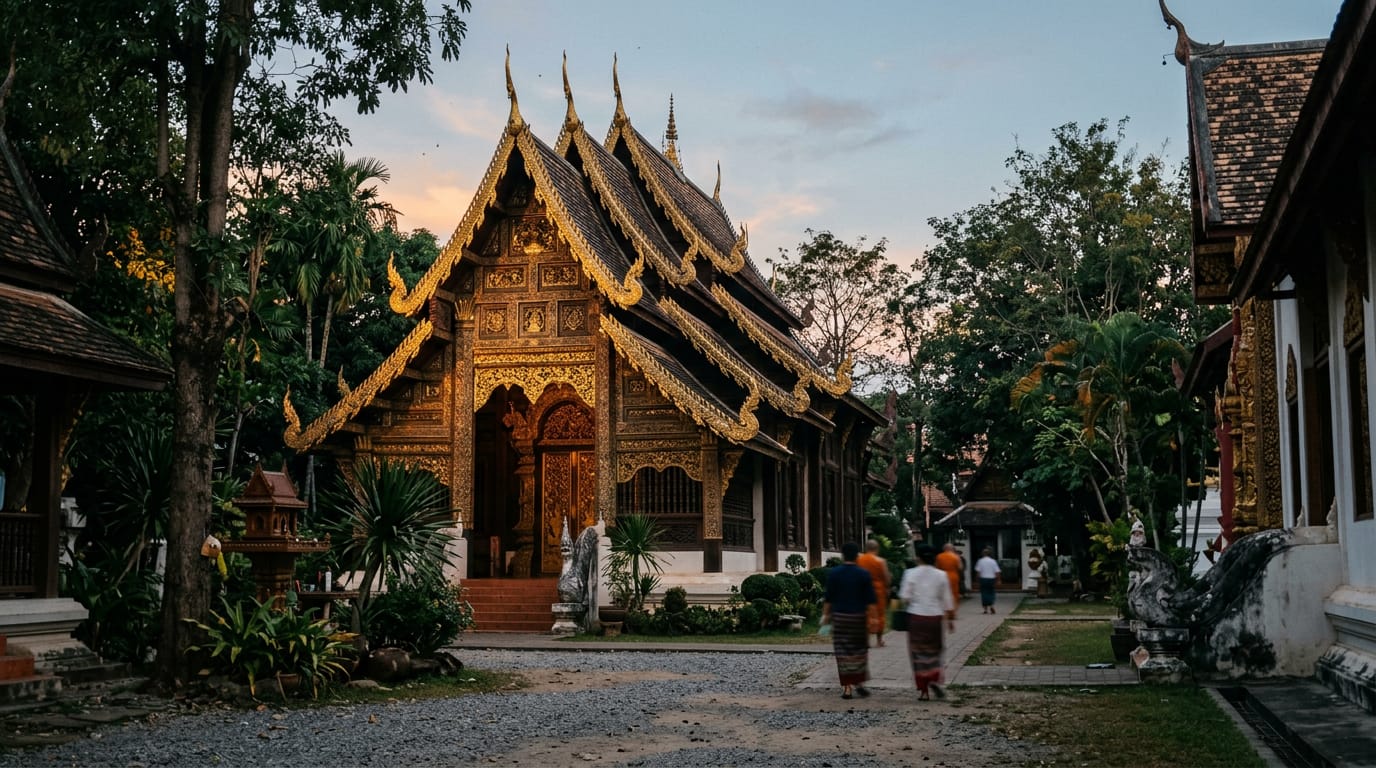
Wat Phra Singh
Wat Phra Singh is the most revered temple inside Chiang Mai's Old City, founded in 1345 by King Phayu of the Mangrai dynasty. Its Lai Kham viharn shelters the Phra Buddha Sihing — the Lion Buddha — which is paraded through the streets each Songkran. Together with its gilded chedi, carved teak gables and gold-leafed scripture library, the compound is the finest single example of Late Lanna architecture in northern Thailand.
Temple
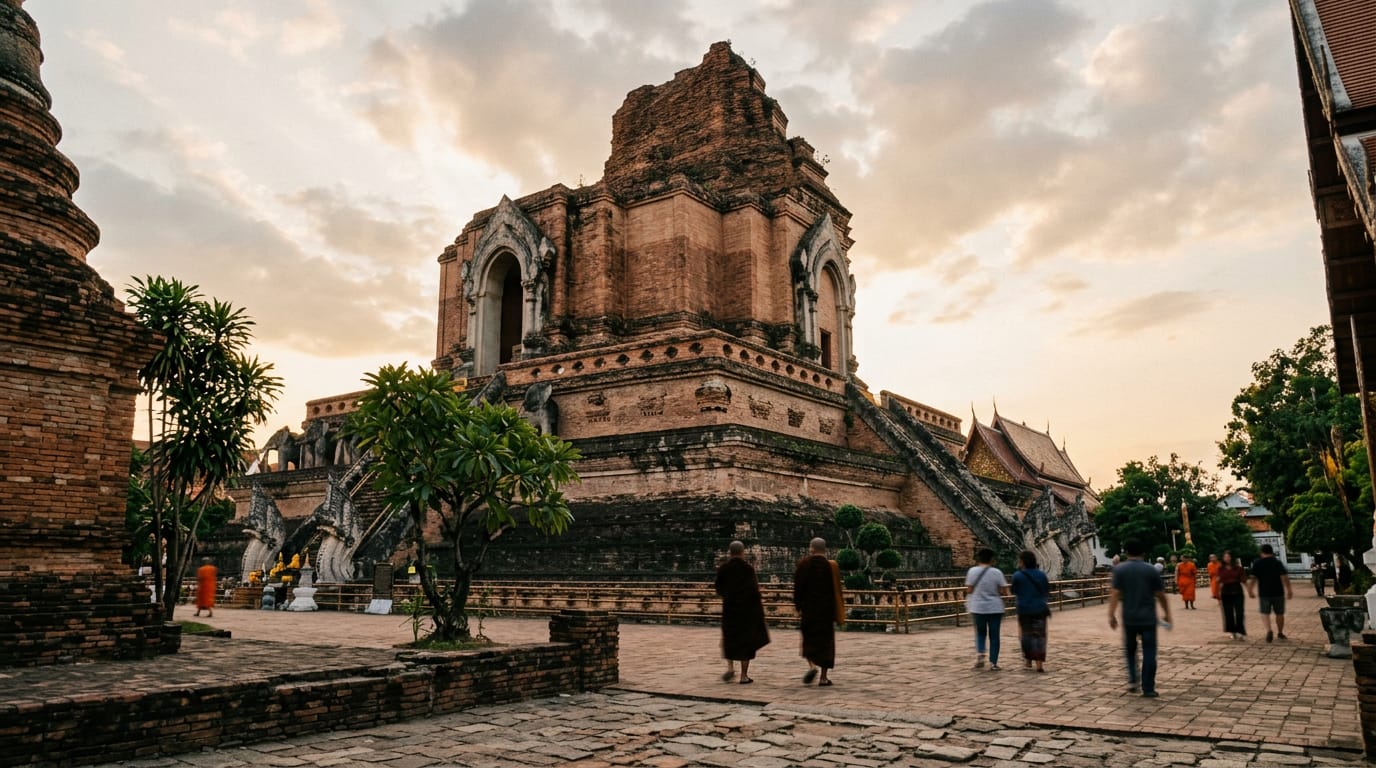
Wat Chedi Luang
Wat Chedi Luang holds the ruined 60-metre chedi that was once the tallest building in Lanna and still dominates the centre of Chiang Mai's Old City. Founded in 1391 by King Saen Muang Ma and completed in 1481 under Tilokaraj, it was partly toppled by the 1545 earthquake. The compound also houses the city pillar and Chiang Mai's active monk-chat programme.
Temple
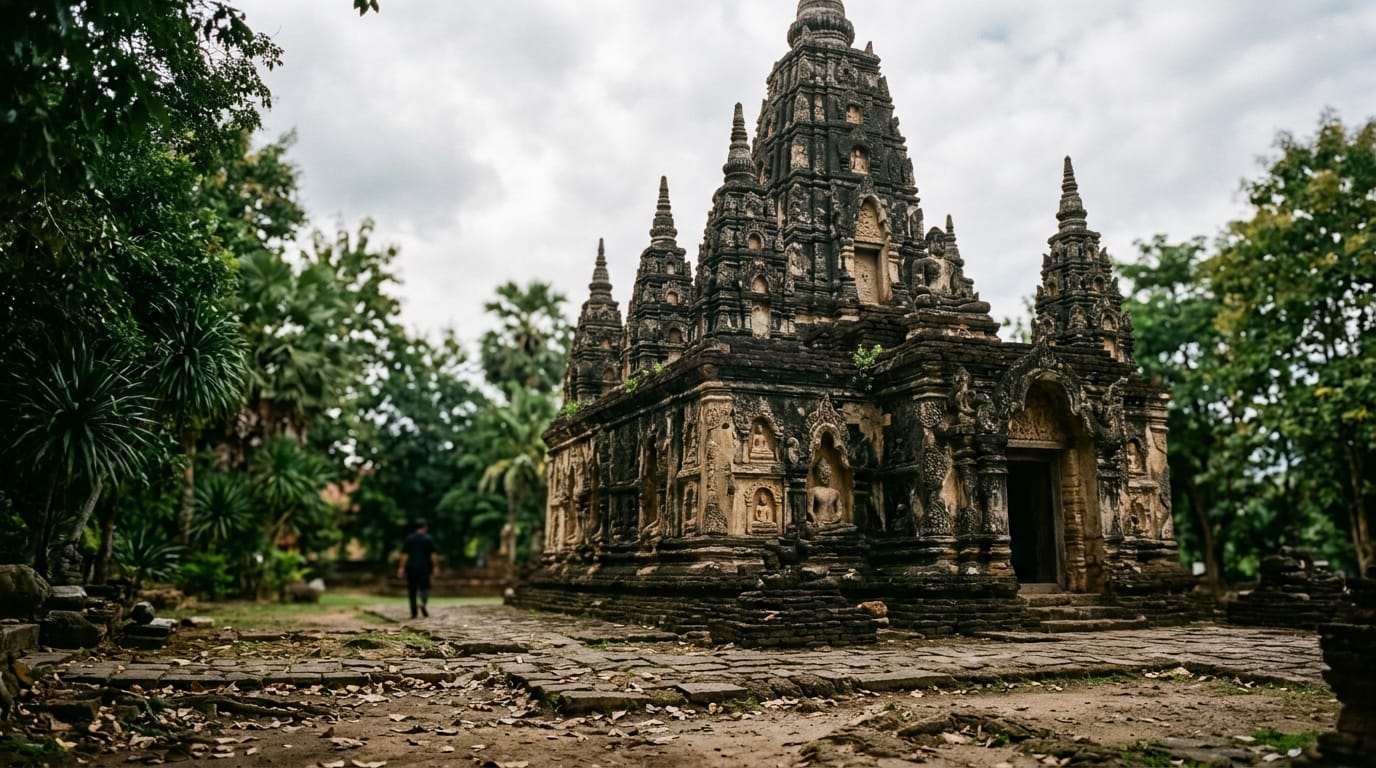
Wat Jed Yod
Wat Jed Yod, the Seven-Spired Temple, was founded in 1455 by King Tilokaraj and is the only temple in northern Thailand modelled on the Mahabodhi at Bodh Gaya. Its seven spires commemorate the seven weeks the Buddha spent in meditation after his enlightenment. In 1477 the temple hosted the Eighth World Buddhist Council, which revised the Pali canon.